Showing posts with label Josef Sommer. Show all posts

December 31, 2025

Strange Days.

Review #2494: Strange Days.

Cast: 
Ralph Fiennes (Lenny Nero), Angela Bassett (Lornette "Mace" Mason), Juliette Lewis (Faith Justin), Tom Sizemore (Max Peltier), Michael Wincott (Philo Gant), Vincent D'Onofrio (Burton Steckler), Glenn Plummer (Jeriko One), Brigitte Bako (Iris), Richard Edson (Tick), William Fichtner (Dwayne Engelman), and Josef Sommer (Palmer Strickland) Directed by Kathryn Bigelow (#1258 - K-19: The Widowmaker, #1548 - The Hurt Locker, #1820 - The Loveless#2188 - Near Dark#2361 - Blue Steel)

Review: 

Inadvertently, I stumbled onto this movie when looking around for further movies involving Kathryn Bigelow. This was her fifth film as a director that just happened to be in between Point Break (1991) and The Weight of Water (2000). It came around after years of script development from James Cameron, who first envisioned it in 1985 and apparently wrote it mind for Bigelow (incidentally, they were once married) to direct it. They then collaborated on working the elements that interested them into the film, with Bigelow striving for grit while Cameron strove for the romance that resulted in a treatment. The treatment was then worked by Jay Cocks into a script that happened to get developed around the time of the Rodney King beating and the L.A. riots (incidentally, Bigelow was involved with the city cleanup). Cameron was more involved with the effects than being on set as a producer (he noted he visited the set just twice as a co-producer), particularly with wondering how the opening scene would look like in showing someone being part of a robbery that sees them swarmed by cops to see one run up a staircase and then have a jump from a ledge that had special cameras and rigs for it. This film and True Lies (1994) were part of a deal between 20th Century Fox. Set in the then future year of 1999 on December 30 and December 31, the movie was released in October of 1995 and somehow flopped with audiences, making less than half of its $42 million budget*, but there is a slight cult audience for the film.
  
Okay, so here's one: an electronic device (SQUID: Superconducting QUantum Interference Device) that lets you experience recorded memories and physical sensations of other people that happens to have little discs for storage (older film lovers might remember that interfacing oneself to record their sensations on tape for others to experience came a bit earlier with Brainstorm [1983], although that dealt with the military trying to get their hands on it). Memories were meant to fade, particularly when doomsday or redemption is on the line. This is a fascinating film that is hard to really piece down as belonging to any one genre, mainly because it makes the mark for sci-fi thriller just as much as it does belong to the noir genre, complete with plenty to astound the audience with beyond its violence. Sure, maybe we aren't all looking upon the world with VR headsets, but our fascination with technology is a strange one when you consider where "parasocial" has evolved to in the last couple of years with how now we can see any type of "living" to stream on a phone you can hold in your hand. People probably are isolated now more than ever, particularly in what we "see" and "feel", and there is something amusing in parts for what the film shows in how people use and don't use SQUID, specifically with the lead two characters. Fiennes (cast in the wake of being nominated for an Academy Award for Schindler's List instead of Andy Garcia) makes for a fascinating conman, one who is particularly vulnerable and fascinating because of how he eventually lands up in the quest to do the hardest thing one might think of: learning to let the past go and actually move forward. There's more to life than being a two-bit pathetic person, and he makes it a curious one to actually emphasize with. Of course, it is Bassett who provides the key moral center of the film, one who is just as handy in asserting herself (such as with a fist) as she is someone clearly desiring to see someone actually make a leap forward with her (as one does with arguably the biggest hero of the film). Sizemore and Lewis might seem outmatched within the confines of basically being in a noir (right down to the latter singing like a femme fatale might do), but I liked both of them in what they provide in their odd duck qualities that think people can be used up just like a beverage to eventually see go by the wayside. The 145-minute runtime leads to plenty of buildup for what type of world would have such a device go around even if someone might use it on a person dying of sexual assault, for example (also disturbing is a scene showing someone going brain dead from amplified signals). Sure, it might hit a ray of hope for its climax that may only work best as if one was watching a fable close itself down, but there is something to be had about a movie that seems to want to remind us to actually get real beyond being looped in playback. As a whole, Strange Days is a curious film in its desire to show the weird world of voyeurism within the confines of a dystopian future that may very well seem a bit familiar to those viewing the world with their eyes and ears nowadays. It deserved better than where it landed in 1995 and should be looked at by all the curious ones out there for its dazzling execution.

Overall, I give it 9 out of 10 stars.

See you in 2026.

*In comparison, in its first full week (it was limited on the first week) of release, the movie was beaten out by newcomers such as Jade and the Scarlet Letter to go along with the popular movie of the week again with Seven. And yeah, Get Shorty was the week after that.

November 18, 2022

Redux: Close Encounters of the Third Kind.

Review #126: Close Encounters of the Third Kind.

Cast
Richard Dreyfuss (Roy Neary), Teri Garr (Ronnie Neary), Melinda Dillon (Jillian Guiler), François Truffaut (Claude Lacombe), Bob Balaban (David Laughlin), J. Patrick McNamara (Project Leader), Warren Kemmerling (Major “Wild Bill” Walsh), Roberts Blossom (Farmer), Philip Dodds (Jean Claude), and Cary Guffey (Barry Guiler) Directed by Steven Spielberg.

Review
“People are always looking for – I don’t know what you’d call it – I guess, the cosmic entertainment. More than the meteorological explanation. From the behavioral science point of view, I was just as interested in finding out why people looked to the skies, and want to believe, as I was in looking to the skies myself, to try to understand what’s happening up there, that the Air Force and the Government don’t want to tell us about.”

The 1970s were a hell of a time to make movies. Steven Spielberg became a major director during this time because of numerous features that he made, whether that involved television films such as Duel (1971) or his film debut with The Sugarland Express (1974), or more specifically, the big blockbuster Jaws (1975). Close Encounters of the Third Kind went from a development deal first done in 1973 to release in 1977, one with a script entirely written by himself that was inspired by a variety of factors, at least when it arose from script hell. The original idea was to have a script done by Paul Schrader, but troubles with the script led to re-writes by John Hill (each of which involved a cop as the lead) before Spielberg took over himself. David Giler, Jerry Belson, Hal Barwood, and Matthew Robbins all made suggestions or script doctoring, although only Spielberg is credited on the final script. One inspiration was Spielberg and his father seeing meteor showers, but one also has to consider Spielberg's previous 1964 film Firelight, which he wrote and directed as a 17-year-old living in Phoenix, Arizona. That film (not available to the public) dealt with an investigation of a series of colored lights in the sky that saw people disappear. Lastly, the song "When You Wish Upon a Star" also proved inspiration in the writing. His next film would come out two years later with 1941, the war ensemble comedy flop. There are numerous versions of the film, owing to how post-production was handled between Spielberg and Columbia Pictures. The film was rushed into finishing by the studio for a release on November 16, 1977, while Spielberg would've liked to release it the summer of next year. They made a deal together after its success that would see him re-edit the film how he wanted, provided that he include a sequence that showed the interior of the mothership. Spielberg regretted the sequence, which was first seen in 1980 as a "Special Edition" that apparently added a few sequences involving Dreyfuss and his character in the family time before his close encounter. A third edition labeled the "Collector's Edition" is basically the same re-edit but without the mothership sequence. Incidentally, Devils Tower, which had a couple of scenes filmed on location (minus the airstrip that was filmed on a disused airbase in Alabama), has a showing of the film on a nightly basis. Incidentally, Columbia Pictures tried to force a sequel, and Spielberg did conceive an idea called Night Skies on the off-hand chance they tried to make a film without him, which even saw John Sayles serve as a consultant for what would have been done after Raiders of the Lost Ark (1981) that would've been about aliens terrorizing a family. The script did not go too far, save for one thing: an alien being depicted as befriending one of the terrorized people as a benevolent creature to someone living in a broken home eventually spiraled into E.T. the Extra-Terrestrial (1982).

I wonder what was in my thought process when watching this movie all those years ago, since the only time I remember watching the film was in April of 2012, although being the first film that I wrote a review (brief as it was) after the passing of my dad. Maybe I dug the special effects, for which Douglas Trumbull was the visual effects supervisor while Carlo Rambaldi designed the extraterrestrials. Or maybe it was John Williams and his music score that got to me more than anything. Looking back, the movie is good, but it was not nearly as good as I imagined it was, although one can certainly see the appealing qualities in the 45 years that have passed since its release beyond the visually arresting imagination seen in plenty of Spielberg movies. It is the visual images that come from the movie that create the lasting impression of the film in awe, whether that involves a kid being distraught after seeing a fatherly meltdown involving mashed potatoes or the abduction of a little kid or the very first time that we see the alien lights. The scope of the film is quite involving, with effects that mostly back this vision up (I can see where Spielberg would think that digital effects of now might supercede what is seen here, but hey, effects made by human hands and tenacity work fine when it is executed well).

These are the actors that were presented the chance to play the main role before Dreyfuss and his lobbying paid off: Steve McQueen (said no because he couldn't cry on cue), Dustin Hoffman, and Gene Hackman, and Jack Nicholson. Truffaut, as you probably know, was a famous French director. Spielberg wanted him for this role from the first moment of casting, although he apparently put it off until the last minute (incidentally, he appeared in four feature films as an actor, but this was the only one where he was not the director). Dreyfuss is technically the best part of the film when it comes to the acting, although I would argue that Dillon holds just as much weight despite less than half of the screentime. As much I despise the character in the long run, he does play it with conviction to where one does have the semblance of sympathy of seeing an obsession drive a family man into a curious place where imagination is only half the story. Garr isn't given too much to really do besides being the skeptic (i.e., a level-headed person that has to be shown as a foil because the movie doesn't have an answer) with worry and fears. Dillon is the one to appreciate in panic, one that we are always on the side on in the pained parental fear held most: a missing child. I almost think that the film might have worked better with her on the mount rather than Dreyfuss, but you have to remember that the character is distinctly one that reflects the director in his curiosity more than anything.

It is the ending that doesn't quite bring things together to a great finish. Not to beat a dead horse, but the fact that a character like Roy decides to just galivant across the galaxy is a bit weird when you remember that most of the film saw him try to raise two kids with his wife. Regardless of how the film presents the family, it just comes off as a bit too selfish to really work as an ending in the way that I'm sure Spielberg wanted. In fact, Spielberg has been quoted as saying that he wouldn't have made the film the way it was after he started his own family, as he had a "privilege of youth" when making the original film (Dreyfuss has stated in recent years that any idea of the ending being different if Spielberg was a family man to be "nonsense"). I felt that the story between Dillon's character and the desperation and obsession she has over the alien encounter is far more interesting to consider than deadbeat Roy tearing down his whole life on Earth, unless one is meant to take it as the tragedy that it sounds like. But this is a movie where the way to deal with a massive spaceship is to trade musical notes. As a whole, the movie kind of just ends with parts that seem more like possibilities for further curiosity rather than a complete story such as missing men from long ago brought back to Earth, or the idea of just how one reacts to seeing their son get snatched and get returned to them. As a whole, the movie has endured for the imagination it inspires within the unknown with mostly skillful execution, one that is at least a contender for the first tier of interesting sci-fi movies of the past 50 years and a worthy effort from a soon legendary director. It inspires a curiosity in the exploration of what lies beneath knowing that one is not alone in this world beyond the people inhabiting the Earth, which is crisply presented in a solid enough manner by Spielberg and company.

Overall, I give it 9 out of 10 stars.

On Sunday: Turkey Week III, a collection of "turkey" movies from November 20th until November 26th.

November 16, 2019

Silkwood.


Review #1299: Silkwood.

Cast: 
Meryl Streep (Karen Silkwood), Kurt Russell (Drew Stephens), Cher (Dolly Pelliker), Craig T. Nelson (Winston), Fred Ward (Morgan), Diana Scarwid (Angela), Ron Silver (Paul Stone), Josef Sommer (Max Richter), Charles Hallahan (Earl Lapin), Tess Harper (Linda Dawson), Sudie Bond (Thelma Rice), Henderson Forsythe (Quincy Bissell), and Bruce McGill (Mace Hurley) Directed by Mike Nichols (#175 - Who's Afraid of Virginia Woolf?, #550 - The Graduate, and #637 - The Birdcage, and #1157 - Wolf)

Review: 
On November 13, 1974, a chemical technician was killed in a car collision in Crescent, Oklahoma is what is believed to be an accident. Karen Silkwood, of course was more than just a blurb on the newspages, since she was an activist who was investigating wrongdoing into the plutonium plant that she worked in, for which she had been contaminated. Her death inspired a lawsuit against the plant she worked for, which had two trials before a final settlement in 1986, with the closure of the nuclear fuels plant having occurred the year after Silkwood's death. In any case, it does seem interesting to make a biopic drama based on her short life that attempts to stick to a group of the basic facts alongside movie-magic that conjure some ambiguity that goes off mostly without a hitch. Perhaps it proves a bit too long at 131 minutes, but one that can't really be denied is that the movie has a well-picked cast to ready its ship along when it is required to. The cast really does seem to seep right into these ordinary folks without trouble, really, where even knowing the fate of its focus doesn't make for much predictability, one who has a bit of tunnel vision for what she believes is the imperative thing to do. This is key with Streep, who pulls in a tremendous performance, filled with spark of persistence and warmth that make her story flow for its audience that makes her interesting enough to follow with. Russell, in a departure from the usual action genre roles, pulls off a rugged turn that seems just as down-to-earth as the lady he acts opposite with, and they do share some casual chemistry together whenever he is on screen. It shouldn't prove too surprising that Cher was suited for an understated yet fine performance here. In her second film since venturing back into acting (after starring in Come Back to the Five and Dime, Jimmy Dean, Jimmy Dean on stage and screen the previous year), she seeps right into an unassuming role and does just fine with making the right impression with just being oneself. The rest of the cast does alright with filling out this world with no big troubles, where one doesn't need a clear villain or hero to really drive the facts along (McGill does play his role pretty adversarily, but not at the expense of realism). Is our focus a martyr or someone who got caught up in their own moral imperative? However one feels about the muddled circumstances of her ultimate fate, one cannot say that the film isn't still compelling through and through its real-life surroundings that will provoke at least some discussion when it comes to whistle-blowing and what proves to be the right thing to do, no matter what the risks could prove. In that sense, this proves to be a decent piece of entertainment headlined by Streep and her cast to go along with a well-run story from the headlines.

Overall, I give it 8 out of 10 stars.

January 28, 2019

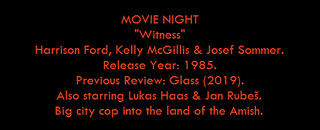
Witness (1985).


Review #1185: Witness.

Cast: 
Harrison Ford (Det. John Book), Kelly McGillis (Rachel Lapp), Josef Sommer (Chief Paul Schaeffer), Lukas Haas (Samuel Lapp), Jan Rubeš (Eli Lapp), Alexander Godunov (Daniel Hochleitner), Danny Glover (Lt. James McFee), Brent Jennings (Sgt. Elton Carter), Patti LuPone (Elaine), Angus MacInnes (Fergie), Frederick Rolf (Stoltzfus), Viggo Mortensen (Moses Hochleitner), and Timothy Carhart (Zenovich) Directed by Peter Weir (#960 - The Year of Living Dangerously)

Review: 
Witness is an interesting crime thriller, standing out for its well-done structure and story (which won an Academy Award for Best Original Screenplay) with plenty of entertainment value and a game cast. The story was written by Pamela Wallace, Earl W. Wallace and William Kelley, with the latter two doing the screenplay. Kelley had contributed to scripts for Gunsmoke in the 1970s while Wallace served as executive story consultant, and it was the development of an outline for the show that resulted in a film script, originally named Called Home. The script (consisting of 182 pages originally) languished for years, with 20th Century Fox rejecting it due to the fact that they didn't make rural movies. A re-write of the screenplay resulted in Ford expressing interest in doing the movie, and eventually the film found its studio in Paramount Pictures. Weir was hired to do the film after funding for The Mosquito Coast (which was made the following year with Ford) fell through, and this was his first film made in America after several features made in his native Australia.

In any case, it is interesting to see a movie set within the community of the Amish, particularly with the differences shown between the kind of life lived by Ford's character as opposed to the Amish characters and how he adapts to spending some time there. It comes off as more than a crime thriller at times, having moments of passion and romance between Ford and McGillis that helps give the film plenty of energy to go around. Ford is superb, playing his role as if he was in a modern Western drama (and not in a usual action kind of film), resourceful in his pursuit for justice while also taking note of the people around him and how he stands out quite clearly from them. This is particularly notable in one scene near the climax, where he stands up for one of his fellow Amish when they are harassed by town-folk who seem to view them as a curiosity or something to pick at, particularly when mocking their committal to nonviolence in war. McGillis shines as well, being a warm graceful presence with a degree of curiosity, whether when interacting with Ford or with Haas, who does fine for his scenes. The other members of the cast have their moments to shine, such as Sommer and his quiet but lurking presence or Rubeš and his wise and thoughtful presence. It is interesting to see Glover playing against type, although he doesn't have too much on screen. The film never feels flat at 112 minutes, having a fine balance between drama and action that never feels overwrought or disrespectful. You never get the sense of boredom at any real point, with each scene having a real sense of purpose and a well-made look from cinematographer John Seale. The movie has its fun moments, such as the barn-raising sequence or when Ford is trying to get the kid to identify the suspect through a ride-along. The climax is certainly effective enough with a quiet ending that wraps things up just fine. On the whole, this is a gripping tale that has its elements of thriller and romance wrapped within a community story that makes it stick out from other films in an captivating and entertaining way that is a solid pick worth recommending.

Overall, I give it 9 out of 10 stars.

January 3, 2017

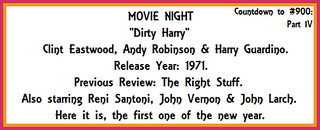
Dirty Harry.


Review #893: Dirty Harry.

Cast: 
Clint Eastwood (Inspector Harry Callahan), Andy Robinson (Scorpio), Harry Guardino (Lt. Al Bressler), Reni Santoni (Inspector Chico Gonzalez), John Vernon (The Mayor of San Francisco), John Larch (Chief of Police), John Mitchum (Frank "Fatso" DiGiorgio), Woodrow Parfrey (Jaffe), and Josef Sommer (District Attorney William T. Rothko) Directed by Don Siegel.

Review: 
I decided to use this film as the beginning point in part because the 45th anniversary (in late December) had passed on without notice, and it also seemed right to do this film, a hallmark of police films. This is certainly an excellently crafted film, right down from the style and action but also the way it presents its main character. Eastwood is excellent at conveying this loose cannon type of cop with the sort of cynicism and blunt edge without any kind of insincerity nor too overblown. The movie is at its best when showcasing the action (or in some cases, the sets used, such as Kezar Stadium), with a particularly excellent climax in a rock quarry. Besides the grit (and catchphrases) is a movie that does not try to hide its loyalties or thoughts on certain manners, especially with scenes regarding Vernon. Guardino and Santoni are serviceable, doing their roles without any kind of distraction. Robinson does a good job as the villain in part because of his mannerisms and how unassuming he seems. There is a perfect kind of imbalance that he conveys that work within the manners of the film. The movie seems to slow itself a bit around the middle, but it manages to have a good enough beginning and end that it doesn't really account for too much slog. It's obvious to say this isn't the kind of movie for anyone (especially for ones that aren't fans of violence), but it's also obvious to say this is a film that uses everything given to it (fine directing and a fine enough cast along with well conveyed action) and makes it a worth while time at 102 minutes. It isn't a standard kind of procedural and that's just the way it likes it to be.

Welcome to Season 7 (2017), folks: Countdown to #900: 10, 9, 8, 7...

Overall, I give it 9 out of 10 stars.

November 14, 2016

The Mighty Ducks.


Review #868: The Mighty Ducks.

Cast:
Emilio Estevez (Gordon Bombay), Joss Ackland (Hans), Lane Smith (Coach Jack Reilly), Heidi Kling (Casey Conway), Josef Sommer (Mr. Gerald Ducksworth), Joshua Jackson (Charlie Conway, #96), Elden Henson (Fulton Reed, #44), Shaun Weiss (Greg Goldberg, #33), M. C. Gainey (Lewis), Matt Doherty (Lester Averman, #4), and Brandon Adams (Jesse Hall, #9) Directed by Stephen Herek (#021 - Bill and Ted's Excellent Adventure and #502 - Man of the House)

Review:
What is it about this movie that inspires joy? It's not as cynically honest as The Bad News Bears (though it does have a similar premise), but there is a sort of charm to this film in its silliness. The characters are about as interesting as the movie allows them, with Estevez being good at being a grouch, with some sort of believably as a coach. There is at least a semblance of atmosphere, with some nice shots of Minnesota. It has its interesting moments (mostly involving hockey, with the flying V standing out), and though it ends like the way you would expect there is at least some sort of closure to the plot. Sure, the movie waddles between ridiculousness (especially when it starts quacking) and legitimacy, but it is serviceable. The villain (of sorts, played by Smith) is also serviceable in his ridiculous competitiveness. The movie is funny when it is being itself and not going for something inherently ridiculous. The child actors are fairly decent as well, with the varying kinds of of personalities that are in some way charming. I wouldn't say the movie breaks any real ground, but it is at least a good way to spend 100 minutes. Obviously there are other sports films to watch and obviously there are other kids films to watch, but I suppose that if you really need a fix of both Disney flicks and hockey this is the one for you.

Overall, I give it 7 out of 10 stars.