Showing posts with label Akihiko Hirata. Show all posts

December 31, 2025

Samurai II: Duel at Ichijoji Temple.

Review #2493: Samurai II: Duel at Ichijoji Temple.

Cast: 
Toshiro Mifune (Miyamoto Musashi), Kōji Tsuruta (Sasaki Kojirō), Mariko Okada (Akemi), Kaoru Yachigusa (Otsu), Michiyo Kogure (Dayū Yoshino), Mitsuko Mito (Okō, Akemi's mother), Akihiko Hirata (Seijūrō Yoshioka), Daisuke Katō (Tōji Gion), Kurōemon Onoe (priest Takuan (Takuan Sōhō), Sachio Sakai (Matahachi Honiden), Yū Fujiki (Denshichirō Yoshioka), Machiko Kitagawa (Kogure), Eiko Miyoshi (Osugi, Matahachi's mother), and Eijirō Tōno (Shishido Baiken) Directed by Hiroshi Inagaki (#2173 - Samurai I: Musashi Miyamoto)

Review: 
Sure, let's do another samurai movie. You might remember Samurai I: Musashi Miyamoto (1954) utilized the epic novel Musashi by Eiji Yoshikawa (about the life and deeds of swordsman Miyamoto Musashi) for a worthwhile film that obviously had to keep going. A variety of people returned to do this film ranging from its director in Hiroshi Inagaki and its writer Tokuhei Wakao (who co-wrote the last one with Inagaki as based on a play by Hideji Hojo), its assistant director in Jun Fukuda and select members of its cast. You get some action pretty quickly in the film with the opening that sees the kusarigama (a chain-sickle) get used up before one sees the lead engage himself in self-development while also trying to take on a school of swordsmanship. One year later saw the release of Samurai III: Duel at Ganryu Island, which I take it will surely have an involving duel between Musashi and Sasaki Kojirō, who apparently was described as the toughest opponent he ever faced (of course all of this happens before Musashi even turned 30, because the actual man ended up dying in 1645 in his sixties, in a cave, from what might have been lung cancer).

Sure, you might wonder where the path of enlightenment comes from for a movie that involves a good deal of slashing. Well, there is meant to be a path for the pilgrims who wish to learn the ways of what a samurai are besides thinking it means to turn people into dead slabs (it doesn't involve blood, but in fairness, it was the 1950s). Mifune is now going through the road of stoicism that basically reveals that the road of honor and respect can be a very tenuous one when nobody plays exactly to the rules. There are no easy solutions to growing up as a person beyond actually doing it. Everyone has their own murky intentions because no one is defined by just being someone in somewhere. It just so happens that committing to fight one man ends up being a confrontation with a school because of other people's waylaid views. Mifune is about as good in stoic conviction, mainly because you get the idea pretty quickly that his destiny is going to go down to his choices of seeing himself beyond who he thinks he is and to actually realize it. One respects things in nature and life without becoming reliant on them, I suppose. Tsuruta makes for a solidly addition to the proceedings, curious in his maneuvering at least when compared to the drama played out by returners such as Yachigusa (okay there's also another going after him and a whole thing about other returners, but I think you get the idea). The opening battle sequence is there to show that the journey isn't getting better at swordplay, because anybody can go with swords when they are young. The ambushes that are shown in the film are pretty interesting for the time period, and in general you get a movie that allows its final sequences to breathe on their own in what is past and what is to come. As a whole, Samurai II continues the journey of its one curious samurai with plenty of energy and interest in making a journey of fulfillment come around with enough fun beyond looking at things as just moving through the next blade movement. It sets the stage for what is to come in the next film in setting how the journey has gone in learning and seeing beyond the trappings of period and action dramas for a pretty good time.

Overall, I give it 8 out of 10 stars.

November 9, 2024

Redux: Godzilla (1954).

Redux #167: Godzilla (1954)

Cast: 
Akira Takarada (Hideto Ogata), Momoko Kōchi (Emiko Yamane), Akihiko Hirata (Dr. Daisuke Serizawa), Takashi Shimura (Dr. Kyohei Yamane), Fuyuki Murakami (Dr. Tanabe), Sachio Sakai (Hagiwara), with Ren Yamamoto (Masaji Yamada) and Haruo Nakajima & Katsumi Tezuka (Godzilla) Directed by Ishirō Honda.

Review:
"Having seen the terror of the atomic bomb in real life, it is most important to weave this element into the film well, so that everyone will understand."

From my review on June 16, 2012:
This is the first world cinema film to come from Japan [on Movie Night]. Gojira (also known as Godzilla) is a film franchise over 50 years old with 28 films in exactly 50 years (1954-2004). This film is chilling, with good atmosphere, with some night scenes that are genuinely frightening. The effects look good to this day, giving you a scare and two. The setting in Japan with the black and white color of the film make it even more threatening as the effects could be hide any mistakes visible in color. Setting it in Japan after the devastation from World War II only adds to it more. The scene that is chilling is at the near end is with the choir girls singing as the city is in peril. This film may be a bit slow at times, but it is still an achievement in filmmaking to this day after 58 years.
I had been waiting to look back at the original Godzilla (known in the Hepburn romanization as Gojira and occasionally released on home media as such) for a long time. After all of these years, I looked forward most to covering it again probably more than seeing the follow-up films that came in its wake. But to know it is to understand how it came together so curiously: Tomoyuki Tanaka had first come up with a idea to do a giant monster film after the failure to make a film in Indonesia (set during the Japanese occupation the previous decade, incidentally). He was flying back on a plane, and it came to him to basically take inspiration from The Beast from 20,000 Fathoms (1953) and the Daigo Fukuryū Maru incident, in which a boat had suffered from contamination after the Bikini Atoll was going through nuclear testing in March of 1954 (one crew member died from radiation sickness, the others survived). Shigeru Kayama was hired to do the initial treatment (which had ideas such as featuring footage of the Maru that went by the wayside) before Takeo Murata and Ishirō Honda wrote the screenplay; Honda had been hired to direct after people such as Senkichi Taniguchi declined. Teizō Toshimitsu and Akira Watanabe designed the creature under the supervision of Eiji Tsuburaya while two performers would be in the suit. Toho actually had a radio drama air during the summer in order to try and build interest for audiences before eventually showing photos of the monster in newspapers prior to release. The movie was first released in one city (Nagoya) on October 27, 1954 before getting a nationwide showing on November 3, 1954, to profound success in its native country. As people already know, an Americanized version of the film was released in 1956 that was trimmed and re-edited, although Toho would later use the "King of the Monsters" label to refer to the character to go along with even showing the edit as "Monster King Godzilla (Kaiju o Gojira)" in theaters. While he didn't direct the 1955 sequel, Honda would direct various other productions for Toho, such as the color monster movie Rodan (1956) and seven of the follow-up Godzilla films from King Kong vs. Godzilla (1962) to Terror of Mechagodzilla (1975).
 
Admittedly, it is a movie that is more historical for what it spawned in its wake more than just being a perfect movie. It is easy to see where the American edit found the 96-minute runtime something to try and edit down for some sort of idea of standards in getting to the point, and one might wonder what the fuss is in that buildup to destruction. But admirers (such as the one I grew up with) see those composite shots mixed with miniatures and can enjoy the craftsmanship anyway for a movie that is sobering in its spectacle and depiction of sacrifice that is moody and capably made in a manner that set a blueprint worth cribbing from in the years to pass. In the seven decades since its release, technology has improved in making a movie monster look more "real" and for some there have been some quality follow-up Godzilla films (perhaps in story or otherwise), but the power of the original still manages to strike a nerve in terms of the sheer curiosity it generated in how it all came to be. Even trying to make an American rendition (1998, 2014) only shows that big money isn't everything (I say this as someone who likes some of those films in selective ways). The acting works with the bleak atmosphere in sheer confidence for what its director wanted to do in humanism, working its main triangle (Takarada-Kochi-Hirata) to worthwhile drama, particularly with Hirata in terms of conflict for what is most important when it comes to technology and the face of danger. Shimura just provides the established presence of worried curiosity that makes the mark handily. Sure, you would see some of these actors again in other Godzilla films, but they really did just hit out of the park in tension on the first try in ways that is easier to celebrate rather than replicate. The movie has carefully dedicated angles, as worked on by Masao Tamai with the cameras of the time (namely old ones) to go alongside a dazzling musical score by Akira Ifukube to accentuate the terror. It just manages to balance the fine line of showing terror (mostly in the reactions rather than directly interacting with the creature) without testing one's patience for the matters at hand. The prayer-for-peace sequence is especially startling in its sincerity. The climax itself is carefully curated in a way that you don't always see in impactful decision-making without needing bombast to drive it all home, particularly in those last moments musing about the nature of where nuclear testing or war may go if left to certain hands. Far from exploitive, there is real passion at hand from Honda and company in what we end up celebrating as a whole rather than simply going right in on just the effects. Metaphor or monster, the power of Godzilla is in just how enduring it all is as the years go on in humanistic filmmaking that made for worthwhile entertainment in ways that we still marvel at to this day.

Overall, I give it 10 out of 10 stars.

January 26, 2024

Samurai I: Musashi Miyamoto.

Review #2173: Samurai I: Musashi Miyamoto. 

Cast: 
Toshiro Mifune (Miyamoto Musashi a.k.a. Takezo), Rentarō Mikuni (Honiden Matahachi), Kuroemon Onoe (priest Takuan Sōhō), Kaoru Yachigusa (Otsu), Mariko Okada (Akemi), Mitsuko Mito (Oko), Eiko Miyoshi (Osugi), Akihiko Hirata (Seijuro Yoshioka), Kusuo Abe (Temma Tsujikaze), and Eitaro Ozawa (Terumasa Ikeda) Directed by Hiroshi Inagaki.

Review: 
The career director is a respectable one, identifiable pattern of direction or not. Hiroshi Inagaki directed over eighty films from a span of 1928 to 1972. He was the son of a shinpa actor (i.e. a modern form of Japanese theater) that became an actor himself with the Nikkatsu studio. He had aspirations of directing and did so with Chiezō Productions and then Kikkatsu. In 1935, the first part of a serial, as written by Eiji Yoshikawa, was released in the newspaper Asahi Shimbun. Musashi: An Epic Novel of the Samurai Era eventually finished in 1939 with a novel release and translation following decades later. It detailed the exploits (fictionized) of swordsman Miyamoto Musashi, a legend who lived from 1584 to 1645 in Japan. It made ideal sense to make a film about Musashi, because, well, there have been dozens of them, with Inagaki having done a serial in 1941 about him to go with directors such as Kenji Mizoguchi and Daisuke Ito doing their own films during the same era. Inagaki made Conclusion of Kojiro Sasaki: Duel at Ganryu Island [Kanketsu Sasaki Kojirô: Ganryû-jima ketto] (1951), which had Mifune play Musashi. At any rate, this is a film belonging to a genre labelled the "jidaigeki", or more specifically, a period drama, with this being set around the Battle of Sekigahara in 1600. This was released by Toho in September of 1954, which was behind countless films that would be considered classics that included Seven Samurai (released in April, which also had Mifune) and Godzilla (October). It was this one that was awarded an Honorary Academy Award among the international films, the last "Honorary" award before a formal category was created. Inagaki did further jidaigeki films such as the epic Chūshingura: Hana no Maki, Yuki no Maki (1962) prior to his death in 1980 at the age of 74.

Two further films followed with Inagaki as director among a cast led by Mifune (who appeared in twenty (!) films directed by Inagaki): Samurai II: Duel at Ichijoji Temple (1955) and Samurai III: Duel at Ganryu Island (1956). The pursuit of spiritual wisdom makes for an interesting start with this film, which makes for a worthy folk tale where fact and fiction do not entirely matter when it comes to an entrancing presence and the promise for more. One loves those period dramas that give time to build on the desire to see people use swords in graceful execution. The 93 minutes is handled in two ways: building the legend that must rise from low beginnings (a battle that sees a quest for glory turn to being a fugitive) to the realization of the ways that come in a samurai. In short: it isn't all talk or all about finding where to put the sword in someone's gut. Mifune is at the heart of it all in ways that come in appreciating how he puts his energy into the role that encompasses all of the impulse and rawness that comes in a person wracked in having to figure out who they really are. Sure, Seven Samurai may have been the big Mifune spotlight film of that year (where he played a would-be samurai), but this is just as interesting to watch him in raptured roughness, whether that involves women (such as trying to not cling on Yachigusa) or hanging from a rope. One can only be on the road so much before either stumbling onto enlightenment of some kind of crashing into the end of a sword (literal or not), you might say. Filmed in Eastman Color, you can't beat a film that looks the way it does in showing the landscape of a time long ago with a workman spirit that likes a good legend for the public to see play out for more than just one time, where one really will return without hesitation.

Overall, I give it 8 out of 10 stars.
Next: Robert Bresson's Angels of Sin.

August 8, 2023

Son of Godzilla.

Review #2070: Son of Godzilla.

Cast: 
Akira Kubo (Maki Goro), Tadao Takashima (Professor Kusumi), Bibari Maeda (Saeko Matsumiya), Akihiko Hirata (Fujisaki), Yoshio Tsuchiya (Furukawa), Kenji Sahara (Morio), Kenichiro Maruyama (Ozawa), Seishiro Kuno (Tashiro), with Hiroshi Sekita, Seiji Onaka, and Haruo Nakajima (Godzilla), and Marchan the Dwarf (Minilla) Directed by Jun Fukuda (#1668 - Ebirah, Horror of the Deep)
 
Review: 
Obviously, you don't have to go in order to enjoy the history of Godzilla films, but I do find it curious at times to see just what is different from time to time in these creature features, particularly as it is soon to reach its 70th anniversary. It also just so happens that Son of Godzilla is the eighth feature film of the series, released in the first lengthy streak of the series in which there was a Godzilla film in all but two of the years between 1962 and 1975. It happens to be the second straight Godzilla film directed by Jun Fukuda, which yet again involves Godzilla found lurking on an island, but this time with a twist that would shift some of the next few films. Fukuda and his crew were thought to be suited for a lower budget than, say, Ishirō Honda; Honda and company (such as Eiji Tsuburaya) were busy with King Kong Escapes, which was released in the summer of 1967. Honda would return to direct the next two films in the series with Destroy All Monsters (1968) and All Monsters Attack (1969), which each happened to feature Godzilla...and his son, which is referred to as Minilla (minus the English dub, which went with Minya). Fukuda would not return to the director's chair of a Godzilla film until Godzilla vs. Gigan (1972).

The enjoyment of the film may very well depend on just how much you care about Godzilla, well, entering fatherhood (as suggested by producer Tomoyuki Tanaka, although obviously the screenplay was fleshed out by Shinichi Sekizawa...and a newcomer with Kazue Shiba). Of course, since this is an island feature, this comes out after some usual exposition about why one is there to begin with (weather expedition) and how one manages to create a baby Godzilla. 86 minutes sometimes can go pretty quickly when it is something you like or feel like a chore, and I think this one is just fine. I think it is a marked improvement on the aforementioned Ebirah film if only because it seems to actually hit the target is wants to set with rubber-suited folks that is at least seems to generate a worthy smile rather than mild feeling. Look, we've already gotten ourselves past the point where the films involved some sort of solemn attempt at monster-ravaging society and into "setting of the week" territory, so taking the feature on with the merits of "did it do something for me?" is what applies here. That said, the actors at least seem game to not just snooze the time away, which at least this time doesn't involve special island powders. If one thinks the actors seem like they are wishing to be anywhere else but on this film, well, that sums up how much you will find pretty much of a decent chunk of monster movies,  some being better than others (obviously). The folks seem on their element here in that semi-serious way where plot goes the way they go without bumbling loudness. I find the giant mantis and spiders an adequate enemy here, if only because I figure, well, they can't always be great giant monsters, so aiming a bit smaller is fine. Besides, when it comes to establishing a bully that would pick on an egg, sure, the mantis seems about right to build up Godzilla turning the tables on. Minilla as a whole is about on par with, well, other sons of monsters (how many can you name off the top of your head that don't involve Son of Kong?), which basically means you either go with the eccentricities (a braying noise-sorry, baby noises) or don't, and I fall on the side of engaging with it as if it means something beyond being used as a promo tool. The series turning a leaf isn't going to hurt unless they make a bad habit out of it, what can I say? The last sequence shows Godzilla and son now involved in snowy hibernation, complete with them huddling together after it looks like one will fall by the wayside in the snow. It is a nice little sequence for a film that as a whole is light without turning lightweight and useful without being unneeded. 

Overall, I give it 7 out of 10 stars.
Next up: Soviets, but a comedy this time.

April 16, 2021

Ebirah, Horror of the Deep.

Review #1668: Ebirah, Horror of the Deep.

Cast: 
Akira Takarada (Yoshimura), Toru Watanabe (Ryota Kane), Toru Ibuki (Yata Kane), Chotaro Togin (Ichino), Hideo Sunazuka (Nita), Kumi Mizuno (Daiyo), Pair Bambi (the Shobijin), Jun Tazaki (Red Bamboo Commander), Akihiko Hirata (Red Bamboo Captain Ryuui), Hideyo Amamoto (Red Bamboo Captain Naval Officer), with Haruo Nakajima (Godzilla) and Hiroshi Sekita (Ebirah) Directed by Jun Fukuda.

Review: 
"All I can remember is that making GODZILLA VS. THE SEA MONSTER was like pouring two cups of water into one. I had to cut one sequence after another."

The funny thing to remember about Godzilla is that most of the movies end up with him fighting a big monster for perilous enjoyment, and they all build up to it in their own respective ways (i.e. cliché) that can lend for distinct movies. So far, Ghidorah, the Three-Headed Monster and Invasion of Astro-Monster have proven better in the first few of the Godzilla sequels, although obviously Godzilla vs. Mothra is also up there. Most of those films took place within military settings or within a city to build the set-up, which got considerably lighter after the first film. All is not quite what it seems with the island setting for this film. For one thing, the original working title was "Operation Robinson Crusoe: King Kong vs. Ebirah"; Rankin-Bass Productions, who was working on The King Kong Show (1966-1969) with Toei, rejected the idea, but Toho liked what they saw while replacing Kong with Godzilla. At any rate, Toho and Rankin-Bass would team up for King Kong Escapes (1967), which combined elements from the show alongside the spy genre as the second and last film that Toho made with the license on the character. Unlike other movies of the series, this movie was distributed in the States only on television, for which it was known as "Godzilla versus the Sea Monster". At helm for director is Jun Fukuda. Born in Japanese-occupied China, Fukuda studied in Japan with Japan Art University before serving in World War II. He was hired to work with Toho in 1951, where he would start as an assistant director. For the next ten years, he worked under directors on films such as So Young, So Bright (1955, directed by Toshio Sugie) and Rodan (1956, directed by Ishirō Honda) before getting his chance to direct in 1959 with Osorubeki hiasobi. He would do a variety of genres until his retirement in 1977 that ranged from action to comedy to science fiction. He was the third person to direct a Godzilla film and the first one to replace Ishiro Honda since Motoyoshi Oda helmed Godzilla Raids Again (1955). Over the next eight years, he would be tasked to direct four more Godzilla features from Son of Godzilla (1967) to Godzilla vs. Mechagodzilla (1974). Over the course of his career with Godzilla, he would approach the films as action dramas, albeit ones that would be tightly filmed in budget and shooting. A modest man, Fukuda enjoyed working with the cast of this film (singling out Hirata and Mizuno), but he did not find any of the Godzilla be his favorites in his career. In one interview, he even was asked if there should have been any sequels to Godzilla in the first place, and he actually answered no (he also noted that he enjoyed making his comedy films more so than the monster movies), where even being sent a copy of the film he made by Toho was "like opening up an old wound."

For the first time in the series, Eiji Tsuburaya was not the director of special effects, since he shifted to supervisor; instead, it was Sadamasa Arikawa that served as special effects director, although he did not take kindly to the cheap demands by Toho, which Arikawa felt was because he could pushed around by them more so than with Tsuburaya (who had his own company and reputation by then). This was the fifth writing effort out of ten Godzilla features done by Shinichi Sekizawa. So instead of Godzilla rampaging the countryside of Japan, he is instead dormant for most of the movie on an island that also has Mothra in the distance in slumber while the focus is on a quartet of humans that are there after being shipwrecked by the title character (Ebirah; ebi incidentally is a shrimp prominent in Japanese cuisine) after looking for a missing brother...after losing a dance marathon contest that would've won a sailboat. Oh, and the island has a group of militants exploiting the land for a formula that keeps the crabby monster at bay. So...yeah, we are talking about a movie where Godzilla eventually fights a shrimp/crab that only seems to fight in the water and can be repelled by militants with a special island powder. I guess Mothra (making her fifth of six appearances in the original series, albeit with a somewhat deteriorating costume) fights Godzilla, in that it involves dust. Godzilla isn't exactly at the "Earth's defender" stage yet, merely placed in the "Well, I destroyed cities, but now I have shifted my interests to being my monster self, so muck off Mothra/Ebirah". Of the cast, Takarada, Hirata, Mizuno, Tazaki, and Nakajima are the most seasoned actors present in this film, and they are fine here, with Takarada and Hirata generally being the most interesting (although Mizuno makes impressions here and there, although the scene spent with Godzilla looking at her like Kong is a bit...weird). The others aren't boring, but the light pace mixed with its tone doesn't exactly make them quite interesting. I admire the scene where they think about their escape and about Godzilla "helping" them before they yell at him to jump off the soon-to-be exploding island; one could find it cynically amusing and ponder the fact that Godzilla lives on again to potentially "visit" another place in time only because someone told him to ump.

So yeah, one is really here to see what stuff will happen with Godzilla, for better or worse. Did I mention there is a condor fight? It actually is the worst fight scene of these films so far, mostly because one can't even see the fight clearly, and it seems appropriate that Godzilla fires it out of existence. Godzilla awakens in a sequence clearly meant to evoke other monsters: a lightning strike. I suppose it goes along with all the non-Godzilla aspects that make for a really cheesy pastiche of clichés, all of which start with comic bumbling and lead right into playing rock volleyball with Ebirah (the icing on the cake is a tribute shot to another movie with a character rubbing their nose...Godzilla, having just done a dance in the film before that). The pace is lighter, but it doesn't mean the movie moves any faster for enjoyment, particularly if one desires to see some interesting Godzilla action, and I suppose it could only set the stage for weirder entries in the series that will range from the offspring of Godzilla to a monster mash to children getting involved with the monsters - there were eight of these films made in the 1960s, and this was the fifth of those released.  If the music by Masaru Sato (a favorite of the director) is memorable for any reason, it is probably because the electric guitar manages to reverb like the James Bond theme, which can either be thought of as distinctive or distracting. In general, the movie acts as yet another cut into the burrowing decisions by Toho and others to shift Godzilla for children with a goal of doing it as fast and cheaply as possible. That isn't to say that Fukuda failed in brining in a new perspective with the film, because he does do a fine job here, but as a Godzilla movie it certainly does fall a bit flat in the lasting enjoyment department. If one can get through some filler to get to parts involving rubber suit monsters, you might have a time here, although the 87 minutes will either feel really short or tolerable enough to finish yet another Godzilla adventure. I can't give it a positive notice, because it doesn't exactly prove a triumph, but I can acknowledge it as a curiosity that may suit others in mind, five decades after the fact. 

Overall, I give it 6 out of 10 stars.

May 31, 2019

Ghidorah, the Three-Headed Monster.


Review #1226: Ghidorah, the Three-Headed Monster.

Cast: 
Yosuke Natsuki (Detective Shindo), Yuriko Hoshi (Naoko Shindo), Hiroshi Koizumi (Assistant Professor Murai), Akiko Wakabayashi (Princess Selina Salno of Selgina), Emi and Yumi Ito (Shobijin), Takashi Shimura (Dr. Tsukamoto), Hisaya Ito (Malmess, Chief Assassin), Akihiko Hirata (Chief Detective Okita), Kenji Sahara (Kanamaki), Susumu Kurobe (Assassin), Ikio Sawamura (Fisherman), Haruo Nakajima (Godzilla), Masanori Shinohara (Rodan), and Shoichi Hirose (King Ghidorah) Directed by Ishirō Honda (#167 - Godzilla [1954/1956], #711 - Mothra, #1092 - Gorath, #1224 - King Kong vs. Godzilla, and #1225 - Mothra vs. Godzilla)

Review: 
Well, here we are. Essentially this has become like a Godzilla Week (with one obvious next step to come), although I do intend to cover a different sort of monster movie for June. Hope you folks enjoy film, for which all four monsters showcased here are also happening to be featured in the new Godzilla film.

As one might say, once you find gold (in case, box office dollars), you go off to search for more gold mines (in other words, bigger spectacle pieces) to scrounge around for. For the fifth film in the Godzilla franchise, there would not be just two monsters this time around; four monsters would be featured (Rodan had its own feature film in 1956 by Toho, right in the middle between Godzilla and Mothra's debut), while the big highlight is the introduction of the three-headed King Ghidorah. The monster was based off of Japanese mythology, such as the tale of Yamata no Orochi, which had featured an eight-headed (and eight-tailed) dragon. Eiji Tsuburaya's design for Ghidorah was modified to have just three heads. If operating the Godzilla costume seems grueling, the costume for King Ghidorah was not much better, owing to the fact that Hirose spent hours being hunched over in a costume with only a crossbar for support, while numerous men in rafters helped worked plastic wires for the neck, tails and wings - which would get stuck together on occasion.

The cast handle their responsibilities with enough conviction to go around; they aren't necessarily aiming to win awards as much as they are playing with familiar kinds of roles (after all, half of these actors have been in other Toho sci-fi films). Highlights in the cast include Natsuki and Hoshi, giving off light charm and rolling with the plot just as normally. Wakabayashi, cast as someone believing themselves to be from Venus (like that famous book, only 30 years early) shines just as well, reserved yet capable at letting this role seem more than a offbeat standout. As per the course, there's plenty of oddball sci-fi/fantasy meshes to go along with the monster mashing, and the human story doesn't tread too much water. I do appreciate the effort to push a bit of an message regarding the Earth and trying to help the planet one lives on, even if it's regarding a giant monster. In general, the series was soon shifting towards having Godzilla be more of a defender of the Earth than a simple towering beast over all, which reflects the lighter tone undergone. The fight between Godzilla and Rodan (turning up just before the hour mark) is a bit amusing, what with a giant flying reptile facing off against Godzilla with one move involving him dropping Godzilla into an electrical tower while they also flail their arms about and bash rocks against each other like volleyball (resolved of course by Mothra spraying the two of them with some pollen). Highlight two involves the monsters speaking...through the translation of the fairy guardians. If one has accepted tiny twin guardians of a giant moth creature by this point, one could probably accept (or expect) anything, so having someone claiming to be from Venus show up is quite a curve-ball. The designs for the creatures are fairly well done, with King Ghidorah looking like a suitable beastly threat with a nice golden polish (changed from suggested ideas of green or red) to go along with it.

Despite the rush to make sure that this film was released on the heels of a film released only eight months prior, it does seem that Honda and his crew (which was the same from the previous film with regards to direction, writing, music, effects, producer) have managed to do good craftsmanship once again with making a workable monster movie. It is a neat grand mess of ideas that I find to be quite wonderfully amusing to go along with. It works as a fine-tuning of the monster mash formula for the series while also having plenty of charm to go alongside a capably consistent feature well worth checking out.

Next Review: Godzilla: King of the Monsters (2019).

Overall, I give it 8 out of 10 stars.

May 29, 2019

King Kong vs. Godzilla (1962).

Review #1224: King Kong vs. Godzilla. 

Cast:  
Tadao Takashima (Osamu Sakurai), Kenji Sahara (Kazuo Fujita), Yū Fujiki (Kinsaburo Furue), Ichirō Arishima (Mr. Tako), Mie Hama (Fumiko Sakurai), Jun Tazaki (General Masami Shinzo), Akiko Wakabayashi (Tamie), Akihiko Hirata (Shigesawa, Doctor), Somesho Matsumoto (Onuki, Doctor), Akemi Negishi (Chikiro's Mother, Faro Island Native), with Shoichi Hirose (King Kong) and Haruo Nakajima (Godzilla) Directed by Ishirō Honda (#167 - Godzilla [1954/1956], #711 - Mothra, #1092 - Gorath)

Review: 
I suppose if there is any Godzilla film that gets mentioned quite a bit by monster moviegoers, it would be this one - after all, it remains the highest attended film of the franchise in Japan, having sold 11.2 million tickets on original release, with release in other countries (such as America) to follow. It is the third film of the franchise, released seven years after Godzilla Raids Again. The genesis for the film took place over a span of two years, evolving from the original proposition from effects animator Willis O'Brien (known from his work on King Kong) that he dubbed King Kong meets Frankenstein, for which a big fight between Kong and a giant Frankenstein would occur in San Francisco, with a script eventually being fleshed out by a writer named George Worthing Yates. Attempts to ship the idea to other studios did not pan out well in part because of the intent to do the film effects in stop-motion (deemed too costly), but Toho eventually acquired interest in the idea of making a film with King Kong, albeit through replacing Frankenstein with Godzilla to be released in 1962, Toho's 30th anniversary as a company. Honda returned as director alongside Eiji Tsuburaya directing the special effects, with a new writer in Shinichi Sekizawa; this is contrast to the first two films - the first film had a screenplay from Takeo Murata and Honda with a story from Shigeru Kayama, while the second film had Murata and Shigeaki Hidaka do the screenplay with Kayama as story writer. With this new writer came a light shift in tone. This shift also applied to the action with the monsters, such as when the two monsters volley a boulder back and forth. Nearly half the budget (roughly $200,000) dealt with paying RKO Pictures for the rights to King Kong. The film takes its time in setting the stage for its two monsters with its plot of the humans, for which Honda intended to be a satire on the Japanese TV industry. After all, there is quite a bit of humor on the attempts to drive up ratings (for a pharmaceutical company sponsoring TV programs). In that sense, it comes off as a bit silly, but at least it gives you a glimpse at what is to come without having a complete tonal shift when the monsters show up, with it being half an hour before either Kong or Godzilla show up, and the former monster has more to do with the plot for the opening hour before the latter monster makes more of an appearance. In that regard, the acting is just fine, playing itself a bit tongue-in-cheek with a bit of energy to try and make sure things aren't being wobbily held before its key players come in to show their hand. Arishima is the key highlight in giving off a bit of amusement amongst a minimal but passable story.

It does have some of the beats from the original King Kong, such as a trip to a mysterious island with natives that holds Kong defending them against other monsters (in this case, octopuses) along with bringing him back for publicity sake, and he even takes a girl with him while climbing up a giant building. I do applaud the look given to Godzilla, which certainly looks wonderful for his first foray in color. King Kong doesn't come off as well, mostly because the face looks a bit closed in, and the fur does seem a bit too distracting when wondering what kind of fur carpet they cut it from. Admittedly, it proves pretty amusing when it actually builds up to the two monsters meeting for their big final battle in the 85 minute mark, what with Kong being transported there by a stack of big balloons while asleep (the less said, the better). I applaud the idea to try and freshen up the films by going for a bit lighter fare, even if it does come at the cost of the characters; it certainly sticks out in the evolution of these films from films about a radioactive monster that attacks Japan to one involving a monster that encounters other particular monsters in a mashup, which is quite enjoyable to look at. The American edit that followed included removal and re-cutting of certain scenes, making the action seem like it was from a newscast, while utilizing music from older movies (a good deal of them from monster movies) that was shot for three days and $15,500 that was eventually distributed by Universal-International in American theaters in 1963. The versions differed only slightly in the climatic battle, with the edit including footage from The Mysterians (1957) to make a earthquake sequence seem more destructive, slight differences in dialogue regarding speculation over Godzilla surviving or not, and hearing only Kong's roar in the end. The success of this film prompted Toho to propose a sequel (which would've been called Continuation: King Kong vs. Godzilla), but the project did not come to fruition (they did however help co-produce King Kong Escapes in 1967, based off an animated series that Rankin/Bass had done earlier in the decade). They also had ideas about pitting Godzilla versus Frankenstein's monster, but this was scrapped instead in favor of pitting the monster against a familiar creature in Mothra, which was released two years later. Over a half century later, there will finally be a matchup of Godzilla and Kong, this time by Legendary Pictures. One would expect they will come up with a servicable story that isn't just repeating the same beats like other certain studios - at least monster movies inspire plenty of imagination. In any case, this is a fairly entertaining spectacle piece, having light fun with its big mashup between people in rubber suits that appeals well to both adults and kids alike, whether having popcorn at hand or not.

Overall, I give it 7 out of 10 stars.

Godzilla, King of the Monsters! (1956)


Review #1223: Godzilla, King of the Monsters!

Cast: 
Raymond Burr (Steve Martin), Takashi Shimura (Dr. Yamane; dubbed by Sammee Tong), Momoko Kōchi (Emiko), Akira Takarada (Ogata; dubbed by James Hong), Akihiko Hirata (Dr. Serizawa; dubbed by James Hong), Sachio Sakai (Hagiwara), Fuyuki Murakami (Dr. Tabata), Ren Yamamoto (Seiji), Toyoaki Suzuki (Shinkichi), Tadashi Okabe (Dr. Tabata's Assistant), Toranosuke Ogawa (President of Company), and Frank Iwanaga (Security Officer Tomo), with Haruo Nakajima and Katsumi Tezuka (Godzilla) Directed by Terry Morse, as originally directed by Ishirō Honda (#167 - Godzilla, #711 - Mothra, and #1092 - Gorath)

Review: 
The original Godzilla was a success upon release in 1954. Over nine million tickets were sold in Japan upon initial run in Japan (which remain the second most attendance for a Godzilla film in Japan) - it soon found its way to being distributed to the United States - in Japanese-American neighborhoods. In 1955 (the same year that Toho would release Godzilla Raids Again), the international rights for the film would be sold to an American group interested in adapting it for further audiences in America, led by Joseph E. Levine, who was involved in over 400 films in his life-tiem as either producer, distributor, or financier (ranging from Santa Claus Conquers the Martians to The Producers). 20 minutes of footage with Burr, alongside stand-ins were edited into the feature, trying (for 1956 standards) to make it seem that he is part of the action, with a bit of dubbing involved when not having Burr just ask someone that he knows to help translate what is going on. The run-time is obviously different from before, with Gojira running at 96 minutes and this lasting 80 minutes. It feels strange to see this one after nearly seven years since I viewed the original - so it is interesting to see what I viewed once again (for the most part), if only to remember how serious it had taken itself (such as shots involving people trapped under rubble), with the black-and-white cinematography helping to make the sequences with Godzilla really stand out in terror. A good deal of the subtext involving the horrors of nuclear testing (along with character elements) is cut out, which admittedly does make for a more stream-lined movie, which I suppose is preferable to dubbing the whole dialogue - even if it does undercut the ultimate decision made in the climax a bit. Burr gives a fairly wooden performance with such a strange role of being in the background of impactful events in the film and occasional dialogue to other characters (one sequence amusingly having him talk to the back of someone's head) that would probably work better for an audio play than anything. He doesn't really get in the way of enjoying the actual film, which in its own right still holds up well. If given the choice between watching the original film with subtitles, a dub, or this, the easy choice for me is still the film in its original 1954 film, but this manages to be a fair second choice. After all, this is the version that audiences outside of Japan were introduced to, lingering as a drive-in favorite and in TV syndication for years on end. It treats the original (and its cast members) with respect, letting them be in the forefront (beside sequences with Godzilla, naturally) just as before.

Believe it or not, this isn't the last time the film would receive edits for release in another country. Italian filmmaker Luigi Cozzi made further edits in 1977 to this film, colorizing the film (hence why it the credits list it as presented as in Spectorama 70) along with adding new scenes (such as Godzilla destroying a train and various stock footage) that made it last 105 minutes; it is referred to as "Cozzilla" in most circles, with limited availability besides the Internet Archive. In 1985, New World Pictures released Godzilla 1985, a re-edit of Toho's The Return of Godzilla (1984) that served as a follow-up to the original film, including additional footage with Burr reprising his role of Martin from this feature. It shouldn't be forgotten that Godzilla, King of the Monsters! soon found its way to Japan, being released in 1957 under the title Kaiju Ō Gojira (translating to "Monster King Godzilla"). In any case, while this film loses some of the underlying structure that made the original Gojira a riveting monster movie, it holds itself well enough with its foundation to make for an interesting piece of entertainment nonetheless.

Overall, I give it 7 out of 10 stars.

June 8, 2018

Gorath.


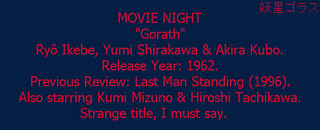
Review #1092: Gorath.

Cast: 
Ryô Ikebe (Dr. Tazawa - Astrophysicist), Yumi Shirakawa (Tomoko Sonoda), Akira Kubo (Tatsuma Kanai - Cadet Astronaut), Kumi Mizuno (Takiko Nomura), Hiroshi Tachikawa (Wakabayashi - Pilot of Ôtori), Akihiko Hirata (Endô - Captain of Ôtori), Kenji Sahara (Saiki - Vice Captain of Ôtori), Jun Tazaki (Raizô Sonoda - Tomoko's Father), Ken Uehara (Dr. Kôno - Astrophysicist), and Takashi Shimura (Kensuke Sonoda - Paleontologist) Directed by Ishirō Honda (#167 - Godzilla and #711 - Mothra)

Review: 
Note: I watched the English dubbed version of this film, which I happened to encounter on television last night. However, I have found a source or two that have compared the original version and the English dubbed version (which features Paul Frees for some of the voices), which are slightly noticeable in its editing, and I hope that seeing the English dub doesn't affect the quality of this review, since I generally try to watch a world cinema film with its original language and subtitles. In any case, I hope you enjoy this review.

With this science fiction film (also known as Yôsei Gorasu), you get the best of both worlds (of sorts): You get your share of shots in space involving either rockets or a planet and you also get your share of scenes involving exposition and occasional story bits with characters. Whether that makes for a serviceable time is up to you, but I found it be okay if not too particularly exceptional. The actors are fairly okay, but because of how the film likes to jump around between numerous people (generally ones in some sort authority), there isn't anyone who sticks out too particularly well, although Tazaki commands a bit of attention for the brief time he is on screen. The strangest moment of the movie isn't even involving the deadly planet, it's actually a part where one of the characters (played by Kubo) takes a framed photo of someone who died and throws it out the window. A close second involves the planet apparently having the power to give someone who gets close to it some sort of amnesia - which is cured by looking at it again apparently. There isn't really too much to the story other than just the incoming planet (which you get to hear is 6,000 times the mass of Earth a few times) and some exposition on the solution to said planet: move the Earth. In a worse movie, it'd probably be easy to pick at that and probably get mad for being insulting to the mind, but in a movie as okay as this, it doesn't feel too terrible to go through, perhaps since it doesn't feel too deceptive in being entertainment - success or not.

The effects are pretty nice to look at for the time that they were created in, having some model shots that seem pretty convincing at moments, particularly during the climax with a flood, which is quite striking. At the head of the department behind the visual effects for the film along with Toho as a studio was Eiji Tsuburaya (who you may know as one of the creators for Godzilla). One interesting thing about the film is a giant walrus named Maguma that appears near the end of the movie, which was added in at the last minute due to influence from one of the producers. Most of the sequence was actually cut out of the English-dubbed version, believe it or not, with the result being a bit disjointed and probably more amusing to giggle at than the original. There exists numerous run-times for the film, with the original being 88 minutes long, the German version being 84 minutes, the American version being 83 minutes, and the American VHS release being 77 minutes. The movie doesn't try to be just one of those sci-fi movies that throw random situations at an audience, having an aim for presenting a message involving cooperation between humans and achievement against all odds, which at the very least is something worth presenting. It isn't a complete success, but it isn't a complete failure either. It won't be known as a great classic, but it is something that you could encounter late at night and probably have some enjoyment with in you're in the right mood.

Overall, I give it 6 out of 10 stars.