Showing posts with label Lois Weber. Show all posts

March 29, 2023

Where Are My Children?

Review #1993: Where Are My Children?

Cast: 
Tyrone Power Sr (District Attorney Richard Walton), Helen Riaume (Mrs. Richard Walton), Marie Walcamp (Mrs. William Carlo), Cora Drew (Walton's Housekeeper), Rena Rogers (Lillian - Housekeeper's Daughter), A.D. Blake (Roger - Mrs. Walton's Brother), Juan de la Cruz (Dr. Herman Malfit), and C. Norman Hammond (Dr. William Homer) Directed by Lois Weber (#644 - The Blot and #1809 - A Chapter in Her Life) and Phillips Smalley.

Review: 
In 1914, Margaret Sanger found herself indicted for violating obscenity laws because she sent a pro-contraception newsletter in the mail. She fled the country for a time and then returned. In 1916, she opened a family planning and birth control clinic in Brooklyn. She was arrested not long after the clinic opened and later tried as both running a public nuisance and distributing prohibited contraceptives. A staunch opposer of abortion, she founded the American Birth Control League in 1921, which later became known as Planned Parenthood (there were other people involved in the push for birth control as a movement, such as Emma Goldman and Mary Dennett, incidentally). Perhaps it isn't a surprise that the Universal Film Manufacturing Company made a film loosely inspired by the proceedings. The film was directed by Lois Weber and Phillips Smalley, who were married at the time and worked on a variety of films together (in 1908 for example, he worked in the Gaumont Film Company). Of course, they were not listed as directors in the original credit (so yes, the rare no-director credit for a film), and they also served as producers and writers that was based on a story by Lucy Payton and Franklin Hall. Weber and Smalley returned to the subject of birth control with The Hand That Rocks the Cradle (1917), which they each directed and starred in as a film about a birth control advocate imprisoned for her work. Sanger wrote and produced her own film about birth control that same year. Each film is lost, however (the latter was found by the Supreme Court to not fall under the protection of the First Amendment in free speech). The print I watched was a reconstruction (as funded by the Women's Film Preservation Fund of New York Women in Film and Television) that had been done in 2000 from several incomplete prints from America and Europe that saw a surviving post-production script used to help with ordering shots and give text to incomplete intertitles. 

You know, it is not every day that you see a movie that has a lead character that believes in eugenics (incidentally, Sanger was a believer in negative eugenics, but I can think of worse things to be a part of, such as talking about eugenics in any kind of good light in the current day). That, or a 62-minute movie that doesn't even bother to give a name to one of the lead characters besides "Ms." Of course, this is also a movie that starts by talking about unborn children residing in "Heaven's gates" until they are either born on Earth (wanted or not) or they are sent back, complete with a shot used a couple of times over involving the gates. Honestly, I wish the 1917 film was the one we could see instead. Maybe there was something more compelling about a film that actually talked about birth control rather than the distinct anti-abortion film present here. It shows mostly affluent women going with abortions while an attorney discovers just why his wife has more parties than children around the house. The only time it really talks about birth control is when the doctor (early in the film) is asked about the pamphlets he is giving out (which say stuff such as: "when only those children who are wanted are born, the race will conquer the evils that weigh it down" or positing the question about if unwanted children born to ignorant people could suffer disease and asking for people to save the lives of mothers not willing to give birth to unwanted children), since his work usually takes him to the slums. Really it just invites the question as to why the rich are getting abortions in the first place rather than birth control, or why we are not focusing on a movie about the less fortunate dealing with unwanted children, but who knows. Power was a noted actor of his time, but be doesn't really help the role seem anything more than just an off-putting focus to have (i.e., who the hell wants a lead that likes eugenics?). The rest of actors are okay, but nothing inspiring (it's weird that Riaume was actually credited as "Mrs. Tyrone Power", since she was married to him at the time). It isn't particularly interesting as a look upon child care because it is more about the dangers of abortion (either as something the rich use or when someone dies from it) that is not nearly as compelling as the filmmakers think it is. The shots with the gates for unwanted children is just a weird way to convey the proceedings, but nothing tops an ending where a couple is just shown stewing alone with the children they could've had being ghosts. As a whole, it is a social drama that seems a bit too hollow to make the impact it thinks it wants beyond mild exploitation that probably could've been done better years later rather than this.
 
Overall, I give it 6 out of 10 stars.
Next: Women's month ends with Jeanne Dielman, 23 quai du Commerce, 1080 Bruxelles


March 3, 2022

A Chapter in Her Life.

Review #1809: A Chapter in Her Life.

Cast: 
Claude Gillingwater (Mr. Everingham), Jane Mercer (Jewel), Jacqueline Gadsden (Eloise Everingham), Frances Raymond (Madge Everingham), Robert Frazer (Dr. Ballard), Eva Thatcher (Mrs. Forbes), Ralph Yearsley (Zeke Forbes), Fred Thomson (Nat Bonnell), and Beth Rayon (Susan) Directed by Lois Weber (#644 - The Blot)

Review: 
"As I was convinced the theatrical profession needed a missionary, he suggested that the best way to reach them was to become one of them so I went on the stage filled with a great desire to convert my fellowman."

The story of the silent era has many names and many faces, but one that is not to be forgotten in the era when it comes to multi-faceted talent is Lois Weber. Actress, screenwriter, producer, and director, Weber cultivated an eventful career that lasted roughly two decades in motion pictures. Born in Allegheny City, Pennsylvania, she excelled in music, doing so in both piano and soprano singing to go with her evangelical interests (which she served on street corners alongside social activism). It was at the age of 25 (in 1904) that she decided to take up acting, convinced that the profession needed a missionary (in her words). She would work in the theater for a number of years before becoming involved with the film industry through the American Gaumont Chronophones; in 1911, she would become a director, serving as a co-director for several short films. In 1914, alongside her husband Phillips Smalley (a familiar pairing as they directed a handful of films together), she directed her first feature-length film in The Merchant of Venice (1914), although it is now lost. She would work for numerous studios such as the Rex Motion Picture Company and Universal before she would form her own studio in 1917, which had its own shooting stage while employing her husband as studio manager and her as the key brain behind filmmaking (although their relationship would soon deteriorate). Her most noted works generally touched social problems of the time (in the tradition that directors like D.W. Griffith had done), such as Where Are My Children? (1916), which touched on the subject of abortion alongside The Blot (1921), which touched on the issue of poverty. Of course, 1921 would end up being her peak. She would direct just five further works until 1934. This film was the third-to-last film that Weber would direct, in part because of the collapse of her film studio in 1921 but also because of the shift of audience curiosity with the advent of the Jazz Age (well, one could also cite a push within Hollywood to weed out certain folks, but whatever). 

By this point in her life, she returned to Universal to remake her previous effort in Jewel (1915), which like this film is an adaptation of the 1903 novel Jewel: A Chapter in Her Life, which had been written by Clara Louise Burnham. By the time the 1920s ended, she spent her time within house operations (such as her own Garden Village and ranch), before a mild comeback attempt in 1932-33 formally ended her career; Weber died in 1939 at the age of sixty, but her legacy has only now come into focus when discussing driven directors of the early age, complete with a recent biography (Lois Weber in Early Hollywood by Shelley Stamp). Weber adapted the book with Doris Schroeder (she would help write a handful of Westerns in the next few decades). Older moviegoers might find familiarity with works such as Pollyanna when it comes to main characters being idealistic children (after all, its lead actor in Gillingwater would appear in a handful of films opposite Shirley Temple from 1936 until his death in 1939). The movie is more of a vehicle for Weber to express her belief in the power of divine love through faith to help guide others back from their old ways (i.e. weird socialite people). So yes, the power of innocence overwhelming hypocrisy is exactly the kind of thing that springs just an hour for one's attention. In that sense, one will be just fine here, since this is a mild effort that works out in its attempts at good-hearted optimism without choking the viewer in too much sentimentality. Gillingwater was already forty years old when he entered the film industry, so he naturally makes a worthy foil for kind folks to play off (or play historical characters); this was the debut star role for Mercer, who was featured in a handful of roles before falling out the industry. Her wide-eyed expressions do okay for what is needed in terms of passing the time between trying to not just say "swell". The others fit the formula required in doing expressions that don't turn into vacant stares (for a film that utilizes little sets, anyway). The film maneuvers towards the inevitable with few surprises, but at least it does not ooze in tedium or with an overbearing sense of importance (take one or two steps and it might fit within the religious film craze, really). While this isn't exactly one of Weber's best films, it is a mild curiosity that could still fill an hour for any curious cinema enjoyer, and I suppose that will be more than enough when it comes to exploring women directors of the early 20th century.

Overall, I give it 7 out of 10 stars.

Welcome to Women's History Month for March once again. We will feature films from numerous decades while featuring familiar and new feminine faces. Next Time is Working Girls (1931).

October 6, 2014

Movie Night: The Blot.


Review #644: The Blot.

Cast
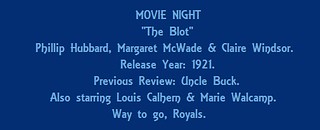
Philip Hubbard (Professor Andrew Griggs), Margaret McWade (Mrs. Griggs), Claire Windsor (Amelia Griggs), Louis Calhern (Phil West), and Marie Walcamp (Juanita Claredon) Directed by Lois Weber.

Review
Lois Weber is probably one of the most important legends of the silent era, she directed over 100 films (short and feature length) in her lifetime, and that number isn't even accurate as she may have done at least 200, though only a small portion survive. This movie comes from the 1920's, a decade in which I admit I've barely covered (This is only the 13th film I've covered on this era), and the movie is still relevant in today's society, especially for teachers, which is a strong point, when a movie manages to not be dated even after 90 years. The actors do a fine job, they convey their feelings very well without managing to overact too much. The atmosphere is pretty decent, it helps that Weber filmed in real locations and not just sets, trying to make a film as realistic as possible, and she succeeds. The movie is a pretty good drama, it manages to convey a slight dark tone that has a glimmer of hope at the end of the tunnel.

Overall, I give it 8 out of 10 stars.