Showing posts with label Ralph Ineson. Show all posts

August 3, 2025

The Fantastic Four: First Steps.

Review #2405: The Fantastic Four: First Steps.

Cast: 
Pedro Pascal (Reed Richards / Mister Fantastic), Vanessa Kirby (Sue Storm / Invisible Woman), Ebon Moss-Bachrach (Ben Grimm / The Thing), Joseph Quinn (Johnny Storm / Human Torch), Julia Garner (Shalla-Bal / Silver Surfer), Sarah Niles (Lynne Nichols), Mark Gatiss (Ted Gilbert), Natasha Lyonne (Rachel Rozman), Paul Walter Hauser (Harvey Elder / Mole Man), Ralph Ineson (Galactus), and Matthew Wood (H.E.R.B.I.E.) Directed by Matt Shakman.

Review: 
Sure, you might know that 20th Century Fox was behind those ridiculous attempts at making Fantastic Four movies based on the team that on each occasion (2005, 2007, 2015) somehow managed to flounder more than if the unreleased 1994 movie had been given the shot it deserved.* It took six years from the acquisition of that studio (and subsequent pausing of any plans to do a Marvel-based movie) and one cameo from a different Reed Richards (hey, remember when they let Sam Raimi do a movie with Doctor Strange in the Multiverse of Madness [2022]?) but here we are again. The director for this film in Matt Shakman (remember that Jon Watts was once tapped for the film before dropping out) had previously directed one film with Cut Bank (2014) that was in the midst of plenty of television from It's Always Sunny in Philadelphia to whatever "WandaVision" is (his family-centric pitch, for already established heroes is what you get here, and you can infer further here). For whatever reason, there are five writers listed for this film: Eric Pearson, Jeff Kaplan, Ian Springer, and Kat Wood for the story and Josh Friedman, Pearson, Kaplan, Springer for the screenplay.

I wanted to wait a while to see the movie because what the hell is this movie doing being released so close to the other superhero movie of the summer? Was this movie rushed in the belief that it just had to meet a late July slate? It can't even last for over two hours (114 minutes might sound like I'm only technically correct, but still), what exactly happened here? Sure, it does have a few interesting moments to go with a resourceful style (speaking of which, how idiotic must one be to not have included H.E.R.B.I.E. in one of these previous movies?) and so on, but there is something that you either will believe should've been done years ago or is not nearly as grand as it should be. Maybe it is the over-saturation that had been present in the past few years (if I have to spend time streaming a show in the attempts at going with an alleged film universe, I would rather learn how to knit instead), maybe the general feeling that setting it in a different Earth when an "Avengers movie" is already imminent seems a bit silly, maybe it just is an okay film. Do you ever watch something and in your mind, you think it is making all the "right moves" and yet somehow just doesn't click every box you want for a really good time rather than just "fine time for a rental"? Was the bar so low for a Fantastic Four movie that didn't suck (in a way, the best family-led group of superheroes for a film...is still The Incredibles [2004])? But let's at least start with positives: it does have a neat quartet of characters, mainly thriving on the qualities of Quinn and Moss-Bachrach in interactions that protrude worthwhile confidence (as one does for a hothead and a guy that happens to be a rock-man) to make the Pascal and Kirby seem just as interesting to contrast in "staid" nature. I like the look of the movie quite a bit, right down to the hero costumes that protrude confidence in actually wanting to stick out for a period piece. Garner makes a quality Surfer in  The showing of powers (mostly with the Invisible Woman) do look pretty good and actually give credence to the idea of this family being a formidable, nay, fantastic group to possibly see further (not exactly in "Avengers", I mean a good ol' Fantastic Four sequel). 

My quibbles may probably ironic: in its attempts to feature a different main adversary (i.e. no Doom) and different "hook" (i.e. a baby Franklin), there is a mish-mash of ideas that are begging to taken to bigger levels that somehow feel short of greatness. I don't care what folks say about comic book logic, "Earth-insert number here" does undercut things a tiny bit ("oh, the Earth is in trouble! Not our Earth, some other Earth that happens to have different names and people that look like us, but an Earth!") in tension, but my real complaint is that I don't find the idea of tying the movie around Franklin to be particularly refreshing. It just seems like something cribbed from the second or third movie of a rejected pitch more than what is meant to be high tension because it (to me, anyway) undercuts the fact that I want to see the core four that one saw in the opening that dealt with, well, villains. I like seeing Hauser as a Mole Man, what was wrong with that as a main villain? Don't tell me that the Fantastic Four only has two villains (look, we can talk about the next Doom antoher time) man, sometimes you want a small plate before you get to the main course (Spider-Man: Homecoming (2017), a better example of the "let's not do the whole origin thing", didn't choose friggin Doctor Octopus or the Goblin in the first movie, they went with the Vulture). Galactus (you might remember in the 2007 film resembled a cloud where here he towers a bit over the Statue of Liberty) only has, what, three whole scenes? I like Ineson fine, but this is ridiculous. Hell, maybe the movie would've been better if he actually won in consuming the Earth, what else is the point of having a "Earth-whatever" if you're just going to swing the Four onto a different place anyway? Multiverses and different timelines should be for animated material or maybe, just maybe, we just have a group of heroes that just go with the flow of being a tight-knit group. The movie looks and sounds nice and has some entertainment (i.e. pacing out its effects sequences for patience that I'm fine with, albeit with quibbles for the climax*) that may just be neat for you. As a whole, it may not hit as many of the marks you would want in for a truly spectacular movie (or even a cosmic soap opera), but it has enough to ultimately carry it to the finish line of general entertainment to inquire further with these folks.

Overall, I give it 7 out of 10 stars.
You might wonder what exactly the theme is for August: What better way to whip up another month of Season 15 than to also celebrate five years of trying to have an interesting theme for August than to just throw any theme imaginable for the month. Yes, for All-In-One August, you'll see a few movies reviewed for their "Anniversary in August", or as "Action in August" or "Around the World in August or "Acknowledged in August", or, well "2025". 

*Incidentally, the main four of that movie actually have cameo appearances in this movie, which just raises questions over why they hadn't been given their due years ago.

*SPOILER (in lighter text): it feels ridiculous to have a character die and make their sacrifice...only to be resurrected. By a baby. Blah blah blah Franklin is this in comics, again, I feel like they really wanted to do a family angle just so they had the trick of killing someone off only to see them revived right in hand. I assumed, with the Thunderbolts* "credits scene", that the Fantastic Four were going to escape their world after either Galactus won or something happened to make them go into our Earth. Instead, you get a bullshit revival of Invisible Woman, who you know wasn't going to die anyway! Really, only guys with barely a name or ones picked out of a hat (i.e. not Hawkeye, who was never cool) die in these movies! Or am I just insane?

December 27, 2024

Nosferatu (2024).

Review #2327: Nosferatu.

Cast: 
Bill Skarsgård (Count Orlok / Nosferatu), Nicholas Hoult (Thomas Hutter), Lily-Rose Depp (Ellen Hutter), Aaron Taylor-Johnson (Friedrich Harding), Emma Corrin (Anna Harding), Willem Dafoe (Prof. Albin Eberhart Von Franz), Ralph Ineson (Dr. Wilhelm Sievers), and Simon McBurney (Herr Knock) Directed by Robert Eggers (#780 - The Witch, #1833 - The Northman)

Review: 
"A lot of people talk about my films as stylized. But aside from the fairy tale composition, it’s not intended to be stylized. I over-rehearse with the intention of it being in the actors’ muscle memory, so that it doesn’t feel like hitting a mark. If you’re doing expressionist cinema, you are aware of the artifice so much, because it’s stylizing the world in a way that is completely unrealistic. Here, obviously — you know, I’m sick of talking about my research, too, but obviously the verisimilitude of the material world is very important to me."

In 1922, a movie from a cheap studio came out with unusual circumstances. Prana Film was behind one and only one film: this one, which had been founded by Enrico Dieckmann and Albin Grau, with the latter being an occultist artist (supposedly, he was inspired to do the film based on an experience in World War I, where he met a Serbian farmer that apparently had a father rise from the grave to feed on blood); Grau designed the sets and costumes, complete with making up a letter with "Enochian" symbols that shows up in the film. The duo brought Henrik Galeen in to write a screenplay that would be inspired by the 1897 novel Dracula (as written by Bram Stoker) and F.W. Murnau as a director. Of course, Florence Balcombe, the widow of Stoker, did not like hearing that someone made a movie freely adapted from Dracula and issued a lawsuit, with the result being the negative and all prints of the film ordered to be destroyed (incidentally: years after the lawsuit, she did grant the rights of the book to a guy who made it into a play for the theater which, well, she didn't get the entitlements for it). But the movie, unlike Balcombe, would endure in the public sphere. Over a half-century later, Werner Herzog was eager to make his own "homage" of Nosferatu and waited until the copyright for Dracula to enter the public domain to make what became Nosferatu the Vampyre (1979). which had the names of the book characters incorporated for a curious outcome of artful terror (it set itself in 1850, whereas both the 1922 and 2024 film are set in 1838). As a youth, Eggers found an image of its star in Max Schreck that had him obsessed enough to later direct a stage version of Nosferatu. Eggers had first been tapped to direct a Nosferatu remake since the first announcement being in 2015. Each version has their own distinct edge in terms of the climax (the 1922 movie details a "pure-hearted woman" offering blood of her own will, the 1979 movie features an awakened sick man, and, well, "the purity of dawn" is something you have to see here).

I'm not quite sure where I would rank it among movies involving vampires, but it probably will rest pretty high, managing to outrank directors who tried to make their own Dracula movies such as Bram Stoker's Dracula (1992), for example. But with this "folk vampire" story, one will have plenty to highlight in a movie that focuses on a psychic and erotic connection with a creature of pure evil that emanates haunting atmosphere most films would dream to have. It is the perils of being blinded by perceived enlightened times at the cost of folk tales. With a film like this, we get to participate in the ritual of folk terror that clearly had plenty of investment from Eggers in history and curiosity (for one, Eggers had already read Montague Summers in terms of his work on vampires but obviously one would wonder about the imitation of Vlad the Impaler and the works of Jean-Martin Charcot in terms of hysteria). In short, Eggers has crafted his own legend of unsettling nature that earns every moment it crafts in terror with craftsmanship made from love that is deliberate in its pacing (132 minutes) for all of the senses possible. Interestingly, Skarsgard had read for the role later played by Hoult (of course, I can't imagine what the film would've ended up with Harry Styles or Anya Taylor-Joy as leads). Skarsgard (as aided by opera singer Ásgerður Júníusdóttir in lowering his vocal range) is exquisite in his unsettling nature as a rotting Transylvanian nobleman corpse. He ends up wrapped in darkness and makeup that makes him pretty distinct in an obsession and rotting core that one can certainly see as both repulsive and seductive. Wrapped in agency as a victim of choices (most significantly the ones to start and close the movie) is a wonderful Rose-Depp that seems to understand the darkness that lies beneath the surface of the time one is wrapped up into with a grace that works well in selling this gothic tragedy. Hoult is the most normal of the folks in the main group, which namely means a man having his 19th century preconceptions shattered (consider that in this version, he is even warned to not go to the Carpathian Mountains by his wife), which he handles with worthy timing. Rounding out the cast is a mix of strange seasoned dignity, whether that involves the conventional in Ineson, the shaken Taylor-Johnson (who gets to have a disturbing last highlight), or, well, the occult magic of Dafoe, who plays the role with gusto in terms of shattering belief that dominates the screen in a way that is distinct from the usual "vampire hunter" role because of how committed he is mystical devotion. Of course, Corrin and McBurney also do well in the cast (the latter proves quite suitable in raving madness). Above all, this is a tremendously gorgeous movie to view in Gothic despair (as captured by Jarin Blaschke), one in which there are plenty of moments to simply gaze in curiosity, whether that involves a nighttime ritual (consider what they do there when compared to how things go in the last scene involving vampire confrontation) or the leadup to meeting Orlok on his realm. As a whole, it is a charmer of the grotesque that builds its dread for righteous furor for a damn good time that likely will improve with further viewings. It is a tossup to figure out what lurks best in the totally-not Dracula adaptations, but you will not go wrong here.

Overall, I give it 9 out of 10 stars.

April 13, 2024

The First Omen.

Review #2198: The First Omen.

Cast: 
Nell Tiger Free (Margaret Daino), Sônia Braga (Sister Silvia), Ralph Ineson (Father Brennan), Bill Nighy (Cardinal Lawrence), Tawfeek Barhom (Father Gabriel), Maria Caballero (Luz Valez), Nicole Sorace (Carlita Scianna), Ishtar Currie-Wilson (Sister Anjelica), Andrea Arcangeli (Paolo), and Charles Dance (Father Harris) Directed by Arkasha Stevenson.

Review: 
You may recall that the idea for The Omen (1976) came about because producer Harvey Bernhard had a conversation with a friend involving the Bible and religion, which is where writer David Seltzer came in to eventually craft it into a screenplay (amusingly, Seltzer was first reluctant to do the screenplay because he did not have a belief in the devil). Richard Donner was picked to direct and, well, you know the rest. If you've seen a film with a possibly evil child and a worried mother such as, say, Rosemary’s Baby (1968) or The Exorcist (1973), well, of course it is the kind of thing to inspire a few follow-ups. This "First Omen" was first planned back in 2016, which followed long after the wake of sequel (Damien - Omen II [1978]) after sequel (Omen III: The Final Conflict [1981]) after attempted TV thing (an "Omen IV") after, well, a 2006 remake (which apparently barely changed anything). But here we are with a film set in 1971 that is the debut feature debut by Arkasha Stevenson, a former photojournalist-turned-director in her feature film debut. The screenplay was done by Tim Smith, Arkasha Stevenson, and Keith Thomas while the story was done by Ben Jacoby. There was an idea to have this be one of those films you encounter on streaming with Hulu, since this is a 20th Century (Fox) Studios distributed film, but these plans changed. Apparently, the movie almost had a rating of NC-17 because of one certain scene that had to have a few cuts made. Such is life.

Stevenson has professed herself as an Omen fan, which is a pretty good sign. Admittedly, trying to make fear enough to drive people back to church sounds about on par for a film that wants to go beat on beat to set up the original film (of course, if one remembers the original film, think back to what is found in a certain cemetery). The end result is a decent experience that isn't nearly as much of a cheap imitation as it could have turned out to be, which basically means that it is an average rendition of the original 1976 movie that was already pretty average to begin with. If wrapped with enough patience to go with the idea of something really, really spooky beyond a few weird nuns, well, you will be totally fine here because the performances generally help the film retain the believability of not making one desire to go for overt theatricality. Free in particular does well with the great vulnerability that arises in someone who is probably way over their head with handling not only the turmoil that comes in a cloudy age of doubt but the very idea that something may very well lurk within the blood. Pawn or no pawn, she is not merely there to be used as just as an object to go into the screaming night, which helps to sell the climax when it finally gets to a certain point of anticipation for dread. Sorace makes for a worthwhile pairing for that arrangement of vulnerability and shaken self that practically mirrors Free, which is an interesting task when the first scene of them involves, uh, licking. There is a certain type of confidence to admire in Ineson that does not waver or seem to be playing off as merely just someone who happens to be playing a role once inhabited by Patrick Troughton (if you recall the priest in the original, naturally). The threat presented is in the people that act as if all that is wrong is just, well, another thing among things in "Years of Lead" (okay, the film doesn't mention that term, but you get to hear historical terms pop up for films sometimes), which work in that stone-cold conviction of those who really see their way as the one and only for spirit and all, regardless of who happens to be lurking behind. Folks ready for something on the unsettling side (as opposed to gore) will be mostly on point with what the film sells. Honestly, it is the ending that probably makes the film shake a bit too much near the deep end. Regardless of the quality of the film before it, do I need anything to lay the hint further films when one is already bearing the cross of being "The First Omen". At any rate, this is a solidly decent time if one is interested in carefully placed blocks of dread that manages to utilize its 119-minute runtime to useful execution to make a solid pick.

Overall, I give it 7 out of 10 stars.

September 29, 2023

The Creator (2023).

Review #2092: The Creator.

Cast: 
John David Washington (Joshua), Madeleine Yuna Voyles (Alpha-Omega "Alphie"), Gemma Chan (Maya Fey), Ken Watanabe (Harun), Sturgill Simpson (Drew), Allison Janney (Colonel Howell), Ralph Ineson (General Andrews), Marc Menchaca (General McBride), and Veronica Ngo (Kami) Directed by Gareth Edwards (#582 - Godzilla (2014) and #888 - Rogue One)

Review: 
I had to remind myself that Gareth Edwards had not been behind a film for the past seven years (Rogue One was indeed released in 2016). Granted, the director isn't the biggest focus of any film discussion point (particularly for sci-fi), but it did lend a hand in checking out a film to close out the decidedly-non spooky month of September out (you might think, hey, it's got this person in the cast, but I find that only works for older films). Contrary to the usual big-budget gorgonzola films, there is actually an attempt here to make a sci-fi film with a semblance of design work to it. As stated by Edwards, the crew shot the film in a wide variety of locations that resembled certain images that they wanted before the editing process would see these frames painted, effectively doing a runaround on expectations of green screen or extensive spending (as opposed to spending) before the effects would be headlined by Industrial Light & Magic. What better year to release a film that happens to talk about AI than 2023, one supposes. Edwards has cited various films as inspiration for his film (which he co-wrote with Chris Weitz) such as Apocalypse Now (1979), Baraka (1992), Blade Runner (1982), Akira (1988), Rain Man (1988), The Hit (1984), E.T. the Extra-Terrestrial (1982) and Paper Moon (1973); this is the fourth feature film by Edwards.

It may seem a familiar film, and perhaps it may have a view that you can see arising before the end of its 133-minute runtime, but I enjoyed what I saw and felt from the film, and that is essentially what one is hoping to see from a sci-fi film that is obviously crafted with the audience in mind. I wouldn't exactly call it a pro-AI film, because really the heart of the film is one of redemption. Yes, it does push at times for the idea of making a real attempt at co-existence, but really the only way to create a new phase of living is to break apart the old system (this does not involve talky sequence, of course, but I'm sure you can read what that means). That might as well make it a modern-day parable, one that examines the moral quandaries that exist within the similarities that really do seem to lie within humans and the AI that they had crafted, particularly when it comes to crafting a living in the hardest of times. The grip of the military-industrial complex cannot have their boot firmly in place on the oppressed when they find a way to dig out (oh sure, painting humanity in a weird light seems odd, but, well, have you seen the dregs of humanity at times?). With that in mind, the scope of the film works best within its effects. I love the look of Nomad, spaceship that is the focus for the climax that resembles a bird of prey with those particular features in its looming nature. It is the kind of future you make for useful scare in one's mind when it comes to the human element and what really is real. Washington proves a useful lead presence in that search for humanity on the road that makes for quality desperation once the passiveness is shed away. This works with Voyles for a suitable pairing, one that shows the bounds of what it means to be around someone beyond crafting a name and feeling to one that did not have it before. The rest do fine but are mostly just players being moved around the board in the senses of interaction, which is mostly consisted of mercenaries on either side. The action sequences are pretty entertaining, mostly because it doesn't come off as sludge to accompany green screen sludge but instead manages to seem like a blockbuster made in a better time that actually seems to care about creating something interesting even if at times it nearly reaches the plodding-off point at times. The film closes itself with a feeling of peace that does not feel the need to bait for further blockbuster spelunking, which is totally fine with me, because sometimes a good feature really can just end right where it is and leave it up to the viewer more than looking up a screen. There are worse ways to spend time with a film that builds a world more than a big story when you can have the imagination to let it ride.

Overall, I give it 8 out of 10 stars.
Next Time: Looking to the past in order to set the future for October. You'll see. 

February 19, 2016

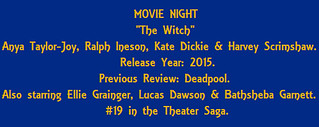
The Witch (2015).


Review #780: The Witch.

Cast
Anya Taylor-Joy (Thomasin), Ralph Ineson (William), Kate Dickie (Katherine), Harvey Scrimshaw (Caleb), Ellie Grainger (Mercy), Lucas Dawson (Jonas), and Bathsheba Garnett (The Witch) Directed by Robert Eggers.

Review
It's been a week since the last review, so on a whim, I decided to look up films in the theater. Of the new ones in release, this one popped up that I hadn't heard of. After a bit of searching over what it was (including the fact that it had premiered at Sundance the year before), I decided to go see this film on a whim. Even though there were only a handful of people there to see with me, the movie was worth the price of admission. The movie (set in the 17th century) certainly has a good atmosphere and setting, while managing to have a fairly entertaining group of characters and not trying cliche techniques to scare the audience. The dialogue (which according to the credits is based off real journals and accounts of the time) takes a bit of time to get used to, but the actors manage to sell the movie and make the characters very believable. The child actors (Scrimshaw, Grainger and Dawson) are not too annoying, and they share a critical scene (Along with Taylor-Joy) that manages to be creepy. The movie certainly does take its time to get going, but the movie eventually gets its footing on the strength of the family dynamic and the interactions between all of them. It's not a movie to watch for blood/gore, but for the creepy tone that it manages to set up with such a simple premise. It's not a great horror film, but it is at least an entertaining movie that keeps itself going from beginning to end.

Overall, I give it 8 out of 10 stars.