Showing posts with label Burt Reynolds. Show all posts

August 5, 2026

City Heat.

Review #2567: City Heat.

Cast: 
Clint Eastwood (Lieutenant Speer), Burt Reynolds (Mike Murphy), Jane Alexander (Addy), Madeline Kahn (Caroline Howley), Rip Torn (Primo Pitt), Beau Starr (Pitt Lookout), Irene Cara (Ginny Lee), Richard Roundtree (Diehl Swift), Tony Lo Bianco (Leon Coll), William Sanderson (Lonnie Ash), Nicholas Worth (Troy Roker), Robert Davi (Nino), Art LaFleur ("Bruiser"), Arthur Malet (Doc Loomis), and Jack Nance (Aram Strossell) Directed by Richard Benjamin (#1024 - My Favorite Year)

Review: 
I have to admit, the key impetus to actually watching this movie was the fact that it was on a DVD pack, specifically a Clint Eastwood set (paired with Pink Cadillac, of all things). Sure, Eastwood is a curious presence, why not try a comedy? I didn't have enough time to see it back in 2024, but it sure seems time to actually watch what all the fuss is about. Blake Edwards penned the original story (once called "Kansas City Jazz") in the 1970s and it eventually found its way to Warner Bros. wanting to have Edwards direct Reynolds and Eastwood together (previously, Edwards directed Reynolds with The Man Who Loved Women [1983]) Somehow, Eastwood had disagreements over the script and his character and Edwards was soon replaced with Richard Benjamin; this was the second of two movies directed by Benjamin to come out in 1984 after Racing with the Moon. According to Reynolds, Eastwood was fine with Benjamin replacing Edwards while saying the dismissal "hurt [Eastwood] badly". Reynolds claimed that he knew the film was going down the tubes ten days into shooting because he saw his role as such: "playing Jack Lemmon in this strange film where people were getting blown away...The public wanted Boom Town or to see us in a contemporary film. They didn't want Dirty Harry vs. the Wimp." As a result of an accident (reported as either a metal chair to the face or falling from a chair and hitting his jaw), this was not a happy experience for Reynolds. As a result, Joseph C. Stinson was credited as a co-writer of the screenplay with "Samuel O. Brown" (get it? S...O...B.?). Expected to be a big hit with a budget of $25 million and released on the same week as Beverly Hills Cop and 2010 in December 1984, the movie made roughly $38 million as a considerable disappointment. Benjamin kept on as a director with films of extremely varied quality such as The Money Pit (1986), Mermaids (1990), and Marci X (2003).

This might be the most obvious case of seeing a movie and watching it die in real time. Sometimes it looks nice and sometimes it comes off as a comedy and sometimes it has some violence worth being in a buddy action movie...but it never comes off as a complete package. For such a "buddy movie", it just seems more like two short films that got cobbled together, with Reynolds seemingly having the more thankless job of trying to carry a film in doing silly lines and getting beat up a bit while Eastwood basically goes "nope" and "yep". Even being a sendup of the gangster movie isn't that fun because the movie just dawdles for 97 minutes with a blithering plot and little else to go which goes as such: two gangs want this briefcase of records but the guy who stole it ends up dead and a game of "where's the briefcase?" tangles up a cop and cop-turned-private eye into an alliance to not only avenge the dead man & his injured girl but also to rescue both of their would-be lovers (as you do) that ends up in both gangs getting plenty of bullets and fire in them. For such a star-studded cast, it's amazing to make a movie that just feels so small. Sometimes I chuckled, sometimes I rolled my eyes: it's the ultimate 6/10 movie, arguably.

The fact that the movie almost gets to a quality finish line is more of a testament to Reynolds than Eastwood, arguably. I've had a soft spot for Reynolds for a number of years because of the varying heights that came with such a fascinating movie star that I knew was going to make for a curious experience when watching a stinker such as, say, this movie or Stroker Ace (released in 1983 that has been cited as the starting point of his downturn as a star). He may have been approaching middle age with shaky ground in terms of public appearance of his charm (his next movie ended up being the misfire Stick [1985]), but I liked what I saw of him here in the same way that one admires the hokum of someone trying to retain the appearance of legitimacy and virility. This is basically important to at least giving the movie a shot (grinning in the face of mediocrity, an American tradition?), because Eastwood and his routine that comes off as dry with the bare minimum in trying to make a pair that might accidentally make you appreciate The Rookie (1990) in the future of mismatched duos. Eastwood looks like he wants to be anywhere else than here and being a "can take this corny crap in stride" is not a compliment. It also extends to Alexander and Kahn, who are each given thankless tasks to pair off the two male leads that goes nowhere in actual charm (Kahn basically vanishes for a good chunk of the film too, making it even harder, but at least she is paired with Reynolds in...trying to do something). Roundtree and Cara are needlessly given little to actually do (besides being hit by a car), and Alexander being on the bottom edge of the totem pole of "what do they actually do?" is less helpful when you wonder why Torn or Davi are just...there. Whether because of Benjamin or studio arrogance of going "Eastwood and Reynolds, what could go wrong for printing money?" or something else, they never come off as much of a team together. As a whole, City Heat came and went with audiences and hasn't exactly rocketed in reputation four decades later. Flawed as it may be, you could find something curious here. 

Overall, I give it 6 out of 10 stars.


Next up: A mystery...

*Truthfully, Reynolds was already on my mind for this month with, say, Rent-a-Cop or Striptease. 

June 27, 2026

White Lightning.

Review #2550: White Lightning.

Cast: 
Burt Reynolds (Bobby "Gator" McKlusky), Jennifer Billingsley (Lou), Ned Beatty (Sheriff J. C. Connors), Bo Hopkins (Roy "Rebel Roy" Boone), Matt Clark ("Dude" Watson), Louise Latham (Martha Culpepper), Diane Ladd (Maggie), R. G. Armstrong ("Big Bear"), Conlan Carter (Deputy), Dabbs Greer (Pa McKlusky), Lincoln Demyan (Warden Sims), and John Steadman ("Skeeter") Directed by Joseph Sargent (#557 - Jaws: The Revenge)

Review: 
I imagine that no summer really starts unless you pick a movie with either good ol' boys or a star you are fond of. Burt Reynolds* had slummed around in television for several years (which included lead roles on Gunsmoke and Dan August) and a few movies of varying quality (100 Rifles [1969], Sam Whiskey [1969]), but it was his talk-show appearances that really got him noted attention before, well, Deliverance [1972] rocketed him into a name for film. Gradually, the films would rise in stature as a leading guy, with 1973 seeing him star in Shamus, The Man Who Loved Cat Dancing, and this movie, which he had worked with the producers previously with Sam Whiskey [1969] (incidentally, that film and Lightning had the same writer with William W. Norton). And yes, this is the movie that Steven Spielberg almost directed. As noted in a 2001 interview, he spent over two months on the film, scouted locations and was on the cusp of doing casting but he came to the realization that he "didn't want to start my career as a hard-hat, journeyman director", instead wanting something a bit more personal. He instead made a play for doing The Sugarland Express, which he ultimately made in 1974. It instead fell to Joseph Sargent (more of a regular TV director than a film director). It might have been his most noted film of the 1970s if it wasn't for his subsequent direction of The Taking of Pelham One Two Three (1974). In 1976, Reynolds returned for Gator, which retained Norton as writer but with a twist: Reynolds as director (Norton was a character unto himself: he later became a would-be gun runner to the Irish National Liberation Army in the 1980s and shot an intruder in his home).

It's a match made in heaven for those who love a Southern tale of 101 minutes filled with a few car chases and a relatively game Reynolds in the reeds of a decent cast that holds it together for a pretty sobering time. Because, yea, it's a movie about getting one over the law, but don't forget that it starts with two guys getting shot on a boat (which is actually captured pretty well for a movie that basically makes one feel the sweat every now and then). It's a bout of obsession and hokum in trying to dodge both the sheriffs and those who don't like the idea of someone working as an informant (in this case the Department of the Treasury), and it is fun even if it meanders along for what could've really been a devious time, but hey, it is a good hellraiser movie. Before you got the Smokey and the Bandit rendition* of Reynolds, you get the inner workings of someone who was homing in gritty charm without straining in credibility of being a man of single-minded determination that is compelling and fun to see him crack through the conman stuff (it isn't easy playing friend and in one case, seducer). Beatty doesn't get as much time as you might think around Reynolds, but he makes for a quality adversary in the vein of a sundown town chief that clearly believes they are the knight of a community and that nobody deserves to be in their way: it's the kind of jagged confidence that is worth respecting from someone like him. The rest of the cast is fairly decent, rounding out the edges of small-town folks who play the line of swindler and swindled to varying effect. It's the kind of movie where the stunts of folks such as Hal Needham (a long-time friend of Reynolds, he first met him during production of Riverboat years prior) shine best, mostly with one particular car stunt in the film: the jump onto a moving barge. It isn't a great movie by any means, but it always end up doing something curious every now and then to make it worth a look, particularly on a warm summer day looking for familiar faces. 

Overall, I give it 7 out of 10 stars.


*I probably give Reynolds a bit of leeway when it comes to what I want to see from him. Hell, City Heat and Striptease have been on the shortlist for months!
*Lest we forget the hair, which was still natural around Deliverance: Burt Reynolds On Toupees, Trump, and Why He’d Never Work with Paul Tho | GQ. Also, if you look hard enough, you'll see Diane Ladd (spelled "Diane Lad" in the credits) and her daughter, Laura Dern, in this film.

August 31, 2024

At Long Last Love.

Review #2249: At Long Last Love.

Cast: 
Burt Reynolds (Michael Oliver Pritchard III), Cybill Shepherd (Brooke Carter), Madeline Kahn (Kitty O'Kelly), Duilio Del Prete (Johnny Spanish), Eileen Brennan (Elizabeth), John Hillerman (Rodney James), Mildred Natwick (Mabel Pritchard), and M. Emmet Walsh (Harold) Written, Directed and Produced by Peter Bogdanovich (#1000 - The Last Picture Show, #1475 - Mask, #2093 - Targets)

Review: 
Admittedly, a handful of films that were thought of as flops are really just because they fit the bill of something worth tearing down because of its star or director being, well, worth taking down a peg. In this case, Peter Bogdanovich might have been an easy target. He had made a tremendous debut feature in Targets (1968) after once being a stage actor, film essayist and critic. Sure, it wasn't a hit with audiences, but it was a damn good thriller. The Last Picture Show (1971) came out of the blue to rip-roaring success. His next film was a homage to screwball comedies in What's Up, Doc? (1972); Paper Moon (1973) was a road feature that adapted a play to pretty good acclaim. And then there was Daisy Miller (1974). The lavish period adaptation of the novella of the same name that Bogdanovich labeled as both "good" and "completely uncommercial" was not exactly a favorite at the time. At Long Last Love (1975) did not have the time or luck to change a perceived slump by Bogdanovich. He was inspired to make the film when he was given a book of song lyrics that had been done by Cole Porter by his then-girlfriend Cybill Shepherd (star of two of Bogdanovich's previous films). It was the first Bogdanovich written entirely by himself (after having co-written a few of his other ones) and it would be one where the actors would sing the song live, which is tough to do if one is not exactly in with dancing on step. It was rushed into theaters and torn apart enough to the point where Bogdanovich printed an open letter of apology. Reynolds stated his belief that the film "Not as bad as it was reviewed. What was reviewed was Cybill and Peter's relationship." Various versions of the film persisted over the years (with different scenes added or missing), which included a cut that wasn't even done by the director. Apparently, a studio editor named James Blakely (a Porter fan) had made an edit of the film (lasting 121 minutes) that honed to the shooting script that was similar to the first preview cut that found its way as the "default" used for streaming. Bogdanovich (having heard of the Netflix version and being delightfully surprised) acknowledged the edition and with a little bit of additions, a "Definitive Director's Version" came out in home media in 2013. But in general, one probably does have to take a little bit of effort to see the film more than other certain flops, particularly when compared to other Bogdanovich films.

Sure, the footwork and singing in certain areas is a bit curious to view for those familiar with musicals. Sure, it has an air of strange elegance that could only come from someone who pushed on making a "jukebox musical" of Cole Porter songs with a loose execution in, well, take your pick. Sure...I actually liked it. It is a playful meet-cute that is full of strange imperfections that seem quite amusing when packed in such a dazzling feature that is old fashioned and yet amusing. These are eccentric "different class" people that are seen doing things such as say, dropping glasses off buildings or casually parking cars with a thud on the lawn. They bumble and stumble in such casual effectiveness that could only come from someone who believed in the actors to basically be like the figurines that are seen to introduce and end the film in that wind-up fashion (complete with a look once described as "Black and white in color"). Reynolds glides through the film with such a casual aura that benefits the proceedings in the charm that arises in offbeat singing/dancing that seems more on the joke in stumbling neatness. Of course, I might be biases because, well, I like seeing Reynolds even in a strange movie like this. Shepherd might have been a lightning rod for criticism, but she doesn't do a terrible job here. Sure, she wavers in certain numbers, but she isn't exactly meant to be playing an angel anyway (goofy brat might be the word here). Del Prete (an Italian singer/songwriter/actor) is adequate, albeit mostly as a straight man (with the obvious qualities in hunky goofiness) to other odd qualities, at least when Kahn is right there to play up this frivolous foursome that really need someone to be there with them for those good times rather than melancholy. It is the support from Hillerman and Brennan in amusement that end up saving the film from dottering away, for which one can be grateful. There are worse ways to hear songs played out than this film, ones where they drone on and on or never really elevate the material, but At Long Last Love just happens to be lightly charming in a way that seems to be an out of its time curiosity that plays with the musical while not forgetting the interest that arises in its Porter jukebox for a chuckler that is about people who happen to sing rather than just a straight to the point singing film. On that note, it is a Bogdanovich movie worth looking into with a curious glance because of the clear delight he has in making a tribute to the old days that I'd affectionate without being beholden to doing everything just as one would expect it to be. It is the kind of odd duckling that belongs in the discussion for viewing not as a flop but as something to marvel as a director's vision that hits its mark.

Overall, I give it 8 out of 10 stars.

Well, here we are with another theme August finished up. Fourteen reviews (one redux) saw a few surprises in the mix from theatrical interests such as Trap and fun times such as Showgirls. I've been trying to get into the spirit of viewing+reviewing movies with the proper amount of commitment that I hope has been maintained to usual expectations.

There was not quite enough time to consider more films to give "acknowledgement" for August, with a few shortlist misses being movies such as: Treasure Planet, Heartbeeps, 1941, City Heat, Quintet, Moment by Moment, and Staying Alive (the latter three have been thought of for Turkey Week before). The future is uncertain for August 2025, but I'm sure there will be a suitable "A" thing for next time around. I'll try to find some interesting films for September 2024 before, well, you know about October and November. See ya soon. 

May 19, 2023

Hooper.

Review #2011: Hooper.

Cast: 
Burt Reynolds (Sonny Hooper), Sally Field (Gwen Doyle), Jan-Michael Vincent (Delmore "Ski" Shidski), Brian Keith (Jocko Doyle), Robert Klein (Roger Deal), John Marley (Max Berns), James Best (Cully), Alfie Wise (Tony), Adam West (himself), and Terry Bradshaw (Brawler) Directed by Hal Needham (#033 - Smokey and the Bandit, #034 - The Cannonball Run, and #945 - Smokey and the Bandit II)

Review: 
The stuntman does not get enough respect, if you think about it. They work hard in a profession where the danger can be apparent for any type of stunt, especially in the old days (Shark (1969) saw a stuntman get attacked and killed by a great white shark and then the producers put the footage in the film and change the title to reflect that...and that film had Reynolds as star). Yakima Canutt was the first stuntman to win an Academy Award, you know, being awarded an honorary one in 1967; it was he who performed the famous drop stunt in Stagecoach (1939). Of course, I mention this because of the fact that I am talking about a movie made by a former stuntman in Hal Needham with a star in Reynolds that was known for doing his own stunts. It was the second film in the career of Needham, who I'm sure we all know and well from Smokey and the Bandit, released one year prior to this film in 1977. The original basis for the film was set in 1975 with Lamont Johnson (best known for TV productions more than his films, which included The Last American Hero (1973)) slated to direct it for Warner Bros., but delays related to the dispute over the original title (The Stuntman) eventually led to Needham becoming involved (incidentally, that film that caused the name dispute, named The Stunt Man, was released in 1980). The screenplay was done by Thomas Rickman and Bill Kerby, while the story was done by Walt Green and Walter S. Herndon. This was the second film with Needham and Reynolds, who were such good friends with each other that it served as one of the inspirations for the dynamic in Once Upon a Time in Hollywood (2019). After the film, Needham would direct seven further feature films (with a handful of TV productions, but we are only talking about his run that ended with Rad in 1986), four of which had Reynolds as a star, albeit with mixed returns.

The following organizations are listed in the credits: the Stuntmen’s Association of Motion Pictures, Inc., Black Stuntmen’s Association of Hollywood, Stuntwomen’s Association, Society of Professional Stuntwomen and Stunts Unlimited. It is definitely a movie made by someone that wants to show perspective in the stuntman in all of the strange ways possible: fun, if not painful when handled incorrectly. At his best, Reynolds had the charisma to make whatever he said come off with wonderful timing, and for the most part, it is true here in a film that is probably more charming than funny, a good ole' boy movie that one is already familiar with if they like stuff such as W.W. and the Dixie Dancekings (1975) or Smokey and the Bandit. But beneath the humor is a movie that has one thing stick out among the stunts: everything is but a fleeting moment, and it always helps to take care of oneself when something of us (whether that involves a profession of risk-taking or say, being a teacher) reaches its end. So yes, it is a movie that hones what Needham seems to like most in filmmaking when it comes to staging crashes in quality spectacle while having the backdrop of moviemaking drama that would be right at home with something like, say, Souls for Sale (1923). Reynolds is self-deprecating and self-aware enough to make charm count double more than if it was a random actor told to play the role to generic macho levels. Inside the freewheeling spirit of a man who cracks jokes with a younger presence meant to take the place of guys like him is someone who has to grasp with just what he is going to do at the moment where everything he cares about goes in a flash being more than just "away in the distance". So yes, beyond the timely instances of people playing games on the highway and having goofball barfights to go with rocket cars is a movie that has the semblance of caring about the stunt person with some sort of heart on its sleeve. Reynolds, who would know more than anyone about having to learn for years what it really meant to be an presence in demand, handles things in the purest sense of charm, is what I am saying. Sure, the dynamic between him and Field is probably not as involving as their last pair-up in a film (the aforementioned Bandit), but they are still ideal in the winning sense of looking like people you would believe could share a room together without straining for words. Vincent is not so much a hotshot newcomer as an inevitability, one who seems totally fine with the idea of seeking the thrill of stunt performance to make himself a name in a town that will use him as they please until the end (if you think about it, Reynolds trying to make his mark with Vincent as basically living the last part of his dream through him seems familiar to those who like to live their fantasy through an actor they see in film). Evidently, the character Klein plays is based on Peter Bogdanovich, who directed Reynolds in At Long Last Love (1975) and Nickelodeon (1976), and Needham worked on the latter film as a stunt double for Reynolds. There is a story that Needham told once about a planned stunt where he would fall through a tree and Bogdanovich asked if he could go any higher, with Needham responding with "I can go as high as you like. You just have to keep adding zeroes to the number on that cheque." Needless to say, it is evident where Klein is coming from as the heel, and he does fine with it. Keith and his old rascal persona makes for engaging support when it comes to seeing how age treats the old hellraisers, while Best (a regular presence in television and film for a handful of decades) provides an amiable dynamic in parts with Reynolds. The film labors itself to relative familiarity by the time you are at the end of its 99 minute runtime, but there are plenty of familiar films that turn out pretty good because of the showmanship displayed in making it seem fitting to watch without waving away what you could see coming (in other words, a punch in the face is only as fun as how much it seems earned to watch play out). If the aforementioned Bandit film was like a deep-fried entree, Hooper is basically dessert, one that has a suitable conviction of showmanship to go with a few charming moments for classic Reynolds fun, which means one's enjoyment of it will basically ride on how much they roll with the stunts that Needham and company wish to pull off.

Overall, I give it 8 out of 10 stars.

May 19, 2022

Redux: Smokey and the Bandit.

Review #033 Redux: Smokey and the Bandit.

Cast: 
Burt Reynolds (Bo "Bandit' Darville), Sally Field (Carrie), Jerry Reed (Cledus "Snowman" Snow), Jackie Gleason (Sheriff Buford T. Justice), Mike Henry (Junior Justice), Pat McCormick (Big Enos Burdette), Paul Williams (Little Enos Burdette), Macon McCalman (Mr. B), Susan McIver (Hot Pants), and George Reynolds (Sheriff Branford) Directed by Hal Needham.

Review: 
"I'll never win an Academy Award. But I'll be a rich son of a bitch." - Hal Needham

I first saw this movie at the age of fourteen in 2011. I found the movie (and I quote) "a load of fun.", one that proved quite humorous and captivating in its sequences involving cars, trucks...you get the idea. Over ten years later, it is interesting to consider how a film can age after 45 years. On May 19, 1977, Smokey and the Bandit premiered at Radio City Music Hall as a Rastar production from Universal Pictures. The way it came together might be as interesting as the actual film, since one has to remember that it was the brainchild of a former stuntman making his debut. Born in Tennessee, Hal Needham served in the United States Army as a paratrooper during the Korean War before entering Hollywood as a stuntman in 1956 (after stints as an airplane jumper and tree trimming), which resulted in work for various productions in television and film, and it was here that he met Reynolds while serving as his double on television in 1959, which soon resulted in a long-lasting friendship (to the point where he lived in the guesthouse of Reynolds for twelve years). He soon did stunt coordination and second unit action, most notably with The Longest Yard (1974). Needham approached Reynolds about doing the film based on his script (originally set for a B-movie target that would have had Jerry Reed as star) when he had trouble getting studios to take him seriously as a director. Reynolds, despite apparently calling it one of the worst scripts he ever read, decided to do the movie with Needham. For better or worse, this is the one film that Needham is best remembered for, despite the fact that he directed a handful of features and television work in the next two decades (his last theatrical film however was Rad (1986)). This would include further collaborations with Reynolds such Hooper (1978), The Cannonball Run films (1981, 1983), and Stroker Ace (1983). The Bandit series would continue with Needham, Reynolds, Field, Gleason, and Reed each doing Smokey and the Bandit II (1980). Smokey and the Bandit Part 3 (1983) saw only Reed & Gleason return for what was surely far less returns than the previous film (which was already a huge disappointment). One further Bandit came around with four made-for-television films that were all directed by Needham in 1994 before he retired in 1999 (perhaps fittingly, his last project was a TV film with Reynolds as the star). Needham died at the age of 82 in 2013, but not before he was celebrated with an Honorary Academy Award as a pioneer in stunt technology and procedures in safety. The writers for the film were Needham and Robert L. Levy (who also served as a producer) for the story while the screenplay was done by James Lee Barrett (author/writer/producer best known for scripts such as The Cheyenne Social Club), Charles Shyer (his first credit), and Alan Mandel.

I could go quite a bit about weird trivia about this movie (like Alfred Hitchcock saying it was one of his favorite films), but it helps to get to the point. The reason the film works so well isn't really because of any great tense moments or elaborate directing (as this is a movie full of improvisation more than anything) There is a good reason this was the second highest grossing movie of the year of 1977, and that is because it captures the essence of entertainment that comes with adventure and humor. It is probably up there as one of the best films with Burt Reynolds as a star (one he cited as the most fun he ever had in making) and definitely a movie you could nickname a "Southern classic". We are talking a movie where Coors Banquet Beer is something to get down to Georgia (at the time, one could not buy or transport the beer east of Oklahoma) in a hurry that features three former television stars, two award-winning singers, a football player-turned actor, and a comedy writer-turned actor. But the main point is this: it may have a loosely-developed story, but it doesn't cloud all the fun and excitement one manages to get from the film, one that is the definitive feature for both Needham and Reynolds in its execution of comedy and adventure. It isn't perfect, but then no movie truly is perfect, and it is the importance of picking movies that one can see again and again that truly matters when it comes to an appreciation of cinema or "Americana" in general; in other words, it wears its appeal and flaws on its sleeve with no filter or shame.

Readers and anyone familiar with cinema of the time know that Reynolds cultivated his lovable rogue persona into stardom with Deliverance (1972) after years of toiling in television and low-budget films. Of course, this film wasn't his first rodeo when it came to car-action films, since White Lightning (1973) was a well-regarded hit in the South. He has the comic timing and confidence required here for a "good ol' boy" movie that winks to the camera with the appeal to everyone (the folks that want to be him and the folks that want to go home with him). Sure, Deliverance might be a tight rival on the top tier of Reynolds movies, but this is the movie I find myself going back to again and again more than anything (besides, his other films with Needham never quite had the same magic). It does seem weird to consider that Field was actually a television presence before finding eventual fame in film, but it was this film, alongside the TV production of Sybil (1976), that helped her break out of just being known as the star of Gidget and The Flying Nun, for which you can credit Reynolds for fighting for her to be cast (arguing that "talent is sexy"). As such, she makes an excellent partner to Reynolds because of her own quick timing and energetic grace that make for instant chemistry (they would star in three other films together). And then of course there is Reed. The Atlanta native grew up with an ambition to be a star in Nashville from a young age, and he eventually proved to be successful in country music (both writing and singing music alongside his guitar-playing). As a close friend of Reynolds, he had appeared with him in a variety of films such as W.W. and the Dixie Dancekings (1974) and Gator (1976), but it is his singing (which won him three Grammy Awards) that he is obviously best known for, particularly with his singing of "East Bound and Down" (written by Reed and Dick Feller), which has endured in my mind for many, many years with its beat and singing, with his energy proving quite infectious as both actor and singer. Gleason was a television icon for two decades, and yet he had time to dabble in film roles alongside singing (his "mood music", I kid you not, actually had one album that stayed on the top ten in charts for nearly three years), and Reynolds personally wanted him for the film, for which Needham would allow him free rein to ad-lib. In fact, it was Gleason who came up with one of the best little sequences of the movie: the one and only scene where Gleason and Reynolds share a scene together, which the two setup with efficient timing; Gleason and Henry make a worthy 1-2 bumbling punch together, which also goes for McCormick (writer on The Tonight Show) and Williams (Academy Award winning songwriter), who each serve as a useful foil for Reynolds. The 96-minute run-time proves just right when it comes to not overstaying its welcome (editors Walter Hannemann and Angelo Ross earned the film's one Academy Award nomination), one that moves from scene to scene with charm that paces itself with its car sequences that are executed crisply without just being loud silly sequences that wreck cars just to wreck cars. There are a handful of scenes one could highlight, such as Reynolds and Reed bumbling through acquiring beer from Texarkana or when Field tries her hand at driving the Trans Am (which still exudes sleek excellence), but the best way to enjoy it is to see for yourself. As a whole, it is the kind of fun-loving movie that packed the right people together for the right movie at the right time for a movie that has endured for 45 years because of how it captures the Americana spirit of fun and good times in all of the excesses that come with doing so for one of the best movies in the career of both Reynolds and Needham, a pairing like no other.

Overall, I give it 9 out of 10 stars.

November 26, 2021

In the Name of the King.

Review #1765: In the Name of the King.

Cast: 
Jason Statham (Farmer / Camden Konreid), Leelee Sobieski (Muriella), John Rhys-Davies (Merick), Ron Perlman (Norick), Claire Forlani (Solana), Kristanna Loken (Elora), Matthew Lillard (Duke Fallow), Ray Liotta (Gallian), Burt Reynolds (King Konreid), Brian White (Commander Tarish), and Mike Dopud (General Backler) Directed by Uwe Boll.

Review: 
Have you ever wanted to see a bad filmmaker get $60 million dollars to make a fantasy ripoff of Lord of the Rings? Here is your chance. Uwe Boll was born in Wermelskirchen, West Germany. He wanted to make movies when he was a kid; he studied at the University of Cologne and Siegen. Of course, he has managed to go viral for all the strange reasons. In 2006, he actually challenged critics who gave him harsh reviews to a boxing match; this resulted in Boll fighting and winning against five participants. I'm sure one already knows that prior to 2006 he had utilized a loophole in the tax system in Germany that meant that he could recieve rebates from his movies if they flopped. In 2015, he tried to crowdfund a film and failed to get the targeted funds; he proceeded to release a video lashing out about failing to fund the movie. Boll initially retired from filmmaking in 2016, doing so he could open up his own restaurant (which actually had fair reviews). However, he has since decided to return to filmmaking. The thing about Boll is that not all of his features have exactly been called terrible (2009's Darfur and Rampage received attention for example). The movie is adapted from Dungeon Siege, an action role-playing game published in 2002. This is one of the numerous video game adaptations he would do in his career, which started with House of the Dead (2003) before expanding to great failures such as Alone in the Dark (2005) and Postal (2007); Boll would direct two sequels (2011, 2014) with decidedly smaller budgets. The movie was done by Brightlight Pictures and distributed by Freestyle Releasing and Vivendi Entertainment in the US while 20th Century Fox did overseas distribution (which explains why I saw a Fox logo on the cover on my DVD). 

Beyond the terrible handling of green screen effects and use of wire fu (as helped by action choreographer Ching Siu-tung) is a hilarious failure. You've got battles that apparently feature ninjas to go along with creatures that are catapulted into the air...while being set on fire (this was written by a man named Doug Taylor, who has exactly the amount of writing credits you would guess). This is 127 minutes of pure tedium, since it is a movie that looks and feels terrible in nearly every frame imaginable, packed with cliches that might make you yearn for the days of Krull. Where did all the money go? Did it really go to packing the cast with a bunch of familiar faces? If that is the case, why does everyone seem thoroughly miscast? I have not seen many movies with Statham as a star, but I do know that he is thought to be a suitable presence for action films in his era (i.e. the 2000s). That said, he is thoroughly unsuited for a film like this, since he looks outmatched in any scene that requires anything other than an attempt at action; the script fails to give him anything to do besides hope he can make these inept words seem useful. Who better to play in a Lord of the Rings "inspiration" than someone from those movies...Rhys-Davies? Well, he is a decent character presence, although one always seems to wonder if he is looking more to when the check will clear rather than a performance beyond "autopilot", and we are talking about a movie that has acting wooden enough to attract termites. Sobieski, Forlani, Loken, and White all suffer from this. Perlman looks like he is waiting to get off the screen and escape. If anybody looks outmatched and out-everything, the honor goes to Reynolds, who as we all know is the sentimental favorite in a variety of mediocre (or terrible) movies on Movie Night. For all of the times he had the knack for curious charisma in any film he did, he also had the knack for having the weirdest film choices ever to cross a screen: Can any man say they have acted with Paul Thomas Anderson and Uwe Boll? He looks befuddled to even be in this role, particularly with that kingly get-up. He grimaces through a role that seems to be suited for has-beens, and while Reynolds clearly had seen better days...there are worse options. At least Lillard seems to know he is in a terrible film, acting with the grand camp value of someone who has decided to go with just having silly fun without looking for a good performance (i.e. range). However, the most dubious performance goes to Liotta, who appears to be wearing street clothes in half of his scenes. He seems to be under the impression that a great evil wizard is best repersented by moving his eyes around while somehow resembling Wayne Newton. His performance in Goodfellas (1990) seems like a lifetime ago (you thought Anderson-Boll was nuts, try an actor who worked with Scorsese and Boll). He is probably just as ill-suited for a fantasy role as Statham is, and the ultimate fight between the two of them is just as hysterical as when Liotta and Rhys-Davies interact with each other (involving swords flying around). As a whole, the fights between the pseudo-orcs and everyone else isn't exactly horrible, but one always has the feeling that Boll is just waiting for the next tax dodge or project to rip off somewhere, complete with a twist near the middle of the movie that makes one go "Oh, we're going that route, are we?". Supposedly Boll had thought about releasing the film in two parts, but he instead settled with having a director's cut released (imagine a two-and-a-half-hour "epic", I bet). Despite its length, the plot manages to be quite inept in moving past first gear, with the only notable thing really happening involving the color starting to look less brown as the film gets to the end, which is handled abruptly. As a whole, this turns out to be a grand joke for those who desire to see what a mismatched cast can do with a mismatched director looking to make money out of a molehill and wind up with one of the dumbest movies I have ever had pleasure laughing at. It isn't exactly terrible enough to be one of the worst, but squeezing a star out of pulp is not exactly an accomplishment.

Overall, I give it 1 out of 10 stars.

Next Time: One must suffer for the crime of believing there is no such thing as a horrible animated movie - Foodfight! (2012). 

June 15, 2021

W.W. and the Dixie Dancekings.

Review #1689: W.W. and the Dixie Dancekings.

Cast: 
Burt Reynolds (W.W. Bright), Conny Van Dyke (Dixie), Jerry Reed (Wayne), Ned Beatty (Country Bull Jenkins), James Hampton (Junior), Don Williams (Leroy), Rick Hurst (Butterball), Mel Tillis (GOB), Furry Lewis (Uncle Furry), and Art Carney (Deacon John Wesley Gore) Directed by John G. Avildsen (#003 - Rocky and #895 - Rocky V)

Review: 
"...turned out wrong but it made a lot of money. It was supposed to be a special, warm and lovely little film. It was important that we not make fun of the people in Nashville as opposed to Nashville (1975). It wasn't that kind of movie. It was a bouquet to Nashville. But I got into a lot of fights with the director." - Burt Reynolds.

"The thing that the film taught me was that I could do something that I had no passion for, that my mechanics were such that I could make it work. There's some satisfaction to that." - John G. Avildsen

There aren't that many films out there where you could describe it as a stepping stone for better films for both its main star and director. Dick Richards was initially thought of in mind for director in 1972, but this did not come to pass (Reynolds would work with him fourteen years later with Heat), but a new director soon came about. This was the ninth feature film for John G. Avildsen, who had specialized in making low-budget movies with plenty of preparation involved that worked with production companies that ranged from the Cannon Group to Troma Entertainment, and it is Joe (1970) that stood out among his early work. The film that rocketed him all the way, however, was the film that followed this movie the next year, which was also a low-budget affair (starring an actor who auditioned for this film) that miraculously became one of the most iconic sports movies ever made in Rocky (1976). As for Reynolds...well, I am stretching this a bit, because he already was a star with stuff such as Deliverance (1972), White Lightning (1973), and The Longest Yard (1974) after a sea of low-budget affairs in television and film. But if one saw this film and Smokey and the Bandit (1977) back-to-back, one might get the impression one was a stepping stone for the other (incidentally, the director for that film in Hal Needham was the stunt coordinator for this feature). Granted, the focus is a smooth-talking conman who likes to specialize in robbing a specific gas station brand (while giving some of the loot to the poor sucker who finds themselves looking at his weapon) but finds himself in need of a good alibi that finds one with a travelling country music band while driving a (modified) Oldsmobile Rocket 88...really the one thing that seems more noticeable between the lovable showoffs in each film is a more interesting presence for both the feminine lead and the authority foil (of course there is also more of Jerry Reed in one of them, so there's also that). As one would like to note, Avildsen and Reynolds (who helped pick the director because of a good word from Jack Lemmon, who won an Academy Award with Avildsen's previous film, Save the Tiger) did not get along with each other during production, as Reynolds described him later as a "picky, arrogant little man", while Avildsen called the movie "one of the most unhappy experiences of my movie career", bemoaning that he did not have the knack of getting what he wanted and satisfying Reynolds; Avildsen was concerned about getting work done in carefully rehearsed details but Reynolds liked to have fun with his entourage of good ol' boys while favoring a loose style of filmmaking (i.e. not a complicated storyboard of sketched out scenes, as argued by Reynolds in his autobiography). The result is a curious venture of comedy that might be thought of as a loose mixed bag, but at least both seemed to have found something to like the film.

Apparently the script by Thomas Rickman would be tinkered extensively for production. He displayed his disgust by asking to write the novelization for the film (one might joke, but I remember reading a novelization of Fantastic Four as a kid), and the only reason one might even know this is because Quentin Tarantino was inspired by what he saw in the novel as compared to the film (which "literally offended" him) to start writing his own screenplays. Welp, differences can always be apparent when it comes to taste, because I found this to be a pretty decent movie. It isn't a great one for either its star or director, but being a stepping stone for better pastures is not a terrible thing when one has enough fun seeing it all play out. It's a silly light movie, filled with bits of Nashville in the singing department with a decent execution of comedy that is buoyed mostly because of the presence of Reynolds (who had a share of hits and misses with films that relied mostly on him, as evidenced by films like the Bandit series). He has the easygoing charm one could see on the stuff that made him a household name (whether that was films or the talk show circuit), which helps a bit that starts with the casual robberies that take hold from time to time. Van Dyke is okay, but she seems more interesting within the music group than with any small attempts at chemistry with Reynolds. The film features the acting debut of Jerry Reed, an Atlanta native that reportedly aspired to be a star in Nashville as a child, and the end result was a lengthy career in country music and it only makes sense to see a country star dabble into the world of acting; Reed would appear in a handful of films with his friend Reynolds (who he directed the following year with Gator). Reynolds may have all the elusive charm, but Reed helps to compliment him the best in actual chemistry, even when they have a brief fight scene. Others who were involved in music included Van Dyke alongside Williams, Lewis and Tillis, although Hampton probably sticks out a bit among the music players in the peanut gallery. Beatty was in his sixth film role (he also starred in Nashville the same year as this film), and one gets to see him for about two to three scenes, but I appreciate his candor when it comes to playing the trick between a legendary singer and the image besides the singing, and it is easy to see why Beatty had such an interesting career in character acting. And then of course there is Carney, making small appearances as the devout authority foil...honestly, he either should have had more time with Reynolds or should have just been cut from the film, because his stone-faced attempts at...something are very okay at best (while I have been all about stepping stones in this review, this was actually the first film role for Carney after winning an Academy Award for Harry and Tonto).

As a whole, what we have is a film befuddled in someway by what it wants to tell in a tale of adventure and romance that likely needed a bit more spark when it comes to being more than a Southern road movie. If one has a liking for Reynolds or the other good ol' folks, however, you will find yourself just fine with what happens here, even if it isn't exactly remembered as one of the best for either Avildsen or Reynolds. It's an average affair with a few chuckles and a little bit of light action that works in some way for whomever happens to encounter it.

Overall, I give it 7 out of 10 stars.

July 30, 2020

Breaking In (1989).

Review #1492: Breaking In.

Cast:
Burt Reynolds (Ernie Mullins), Casey Siemaszko (Mike Lafeve), Lorraine Toussaint (Delphine), Sheila Kelley (Carrie / Fontaine), Albert Salmi (Johnny Scot, Poker Player), Harry Carey (Shoes, Poker Player), Maury Chaykin (Vincent Tucci, Attorney), and Stephen Tobolowsky (District Attorney) Directed by Bill Forsyth.

Review:
"There's always something you want to say. I would not want to make a film that did not say anything, I'm not interested in getting into something that's just a piece of entertainment, a James Bond or an adventure film. I don't enjoy filming that much, in fact I don't enjoy filming at all and to go through all that for the sake of money would just not interest me."
"I'm not sure if I can swagger anymore, but I can limp with the best of them."

It's easy to forget about a director when Burt Reynolds is your star in a comedy. For example, Scottish-born Bill Forsyth first got into films through an advertisement out of high school and ended up doing short documentary films for eight years, notably founding Tree Films with Charles Gormley in 1970. He wrote his scripts for That Sinking Feeling and Gregory's Girl years in advance, but attempts at getting funds did not take hold with the BFI Production Board. He forged on anyway in making the former film, doing so in 1979 on a cheap budget with actors from the Glasgow Community Theatre. Some of the actors from that film would return for his next film, Gregory's Girl (1981), which resulted in positive notices as the film he is best known for (his next film, Local Hero, also received praise), and he received a British Academy Film Award for each film (the former for screenplay and the latter for direction). This was his second and last film done in North America, with the other being Housekeeping (1987). The film was written by John Sayles (behind films such as Return of the Secaucus 7 and Eight Men Out), whose script had been laying around for a few years that Sayles did not think was something he could direct, and Forsyth updated the script. And then of course there is Burt Reynolds, the one shining reason one might pick this film out in the first place (particularly if you are sentimental towards seeing him in something that could be good). Whether the film is good or not, he remained a fascinating actor to watch be a part of the action for over five decades, with this being at the tail end of his popularity, and he took part in the film for very little money due to his interest in the character role (Forsyth had desired someone like John Mahoney for the role, but a push by Act III Communications for someone with a bit of star power eventually led him to approach Reynolds).

It's a shame that this wasn't a success with audiences on release (making less than two million dollars on a budget of over five million), because it is a decent little movie, even if it isn't exactly the most well-known film for either Forsyth or Reynolds (I happened to have come across this on the Internet and went with it on a guess, although a DVD would obviously be a better quality bet). Sometimes you just have to enjoy a shaggy dog robbery story. In a retrospective article about the film, Forsyth himself described it as "an awkward little movie. It’s not an American film and it’s not a European film; it’s ungraspable what it is." There is definately an interesting sort of tone that Forsyth takes to the material, one that doesn't really go for all of the caper cliches that come with a heist film, instead taking an approach to fleshing out two quirky people that find themselves into this certain business with their own distinct mannerisms and approach. One has probably seen the traditional old pro teaches the hotshot story before, but if one presents it with honesty, it usually works out for a decent time. There isn't anything remotely spectacular about it, but there are bits and pieces that are charming, and the main duo also helps out while also having a few little moments of heists that favor moments of dialogue over anything too explosive (which can work out for those patient for it). Siemaszko, having started appearing in films for six years with bit roles and supporting turns (such as Back to the Future) proves lively enough for the film's liking, carefree yet never lacking when on-screen with various situations of charm. Reynolds, with a hitch in his step and a quieter tone than usual, holds to the challenge quite well, still managing to capture a wise world-weary presence without needing to rely on anything hammy (the makeup on him to make him look older looks fine) that we gravitate to pretty well (of course one could gravitate to Siemaszko too, at least when it comes to brash impulse decisions) with comfort. Seeing these folks try to make a living within a strange world of compromise and duplicity makes for a careful movie, not exactly a laugh-out-loud caper, but also not too plaid for curious enjoyment. It certainly is a curious film for both Forsyth and its two stars in Reynolds and Siemaszko, and if you happen to come across it looking for something diverting, you may be fairly satisfied with what you recieve, getting a few chuckles alongside a decent time.

Overall, I give it 7 out of 10 stars.

September 12, 2018

The Best Little Whorehouse in Texas.


Review #1130: The Best Little Whorehouse in Texas.

Cast: 
Burt Reynolds (Sheriff Ed Earl Dodd), Dolly Parton (Mona Stangley), Dom DeLuise (Melvin P. Thorpe), Charles Durning (The Governor), Theresa Merritt (Jewel), Jim Nabors (Deputy Fred), Lois Nettleton (Dulcie Mae), Noah Beery Jr. (Edsel), Robert Mandan (Senator Charles Wingwood), and Barry Corbin (C.J.) Directed by Colin Higgins.

Review: 
Admittedly, some films can have some interesting back-story to them. This film, for example, was adapted from the 1978 musical of the same name by Larry L. King and Peter Masterson, who had developed the musical loosely based on events that occurred in La Grange, Texas in 1973. The two contributed to writing the film alongside director Higgins (who had written films such as Harold and Maude), with this being his third and final directed effort before his death in 1988. Carol Hall, writer of the music and lyrics for the musical, contributed to the music for the film alongside Parton, in her second film role after 9 to 5 (1980). One of the production companies involved with the film is Miller-Milkis-Boyett Productions (named for its three people involved, Thomas L. Miller, Edward K. Milkis, and Robert L. Boyett), with them being responsible for producing shows such as Happy Days and Laverne & Shirley alongside films of their own such as Silver Streak (1976) and Foul Play (1978).

With all of that in mind, the film proves to be a fair if not flawed charmer. It doesn't come off as a surprise that the film fell to cuts (reportedly the original version lasted roughly two-and-a-half-hours), particularly when the film starts and ends with Nabors giving off narration to help with telling parts of the story, and that certainly feels a bit weird for something that lasts 114 minutes. At the heart of trying to provide charm is the duo of Reynolds and Parton, who certainly seem to want to generate excitement, particularly when singing together. For the most part, they do a fine job in providing a chuckle and a smile, but it isn't anything too greatly special that you would see from other musicals. Reynolds pulls off his typical swagger and mischievous charm with the kind of effort you expect from him. Parton comes off as appealing and interesting to watch that I don't find too surprising - making the character come alive with a good sense of humor. Their duet song "Sneakin Around" is a decent one to listen to with a foot-tap or two. DeLuise essentially plays a caricature of any sort of "decency police" huckster with the kind of zip and edge (alongside a wardrobe suited for spectacle) that certainly plays fine against the coziness of Reynolds and Parton. Durning stands out in part due to his song "The Sidestep" that certainly clicks as an ear-worm while also being pretty amusing, particularly for the character played. Nabors (who sings the first song of the movie with "20 Fans") is quirky but a welcome presence for a film trying to balance humor with music. The other members of the cast are okay, but the real focus is the main trio, with occasional parts of raunchiness. The movie moves itself at a gradual pace with trying to go through its material with flashes of singing and humor that comes off okay. Its story does sometimes stumble when it comes to its romance, and the cuts made to the film perhaps play a big part in making it have a bit less meat to it than the aspects with songs. One of the more amusing sequences involves Reynolds confronting DeLuise in the town public square, complete with gruff language and a fountain. While I can say that I knew pretty quickly that it was not going to be a great kind of movie, I found myself enjoying it enough to make the experience worth it.

On a sadder note, I would like to say my respects to Burt Reynolds, who died on September 6. In the eight films I have viewed that have featured Reynolds, there is not one performance that isn't in some way memorable or entertaining. His performance in Deliverance is especially one that stands out amongst other fun times delivered in movies such as The Longest Yard and Smokey and the Bandit. I'll end this with a quote from the man himself - "All you really have in the end are your stories.”

Overall, I give it 7 out of 10 stars.

April 2, 2018

The Longest Yard (2005).


Review #1066: The Longest Yard.

Cast: 
Adam Sandler (Paul "Wrecking" Crewe), Chris Rock (James "Caretaker" Farrell), James Cromwell (Warden Rudolph Hazen), Nelly (Earl Megget), William Fichtner (Cpt. Brian Knauer), Burt Reynolds (Coach Nate Scarborough), Bob Sapp (Switowski), Michael Irvin (Deacon Moss), Terry Crews ("Cheeseburger Eddy"), Bill Goldberg (Battle), Bill Romanowski (Guard Lambert), Brian Bosworth (Guard Garner), Kevin Nash (Sgt. Engleheart), and Steve Austin (Guard Dunham) Directed by Peter Segal (#466 - Nutty Professor II: The Klumps and #826 - Naked Gun 33⅓: The Final Insult)

Review: 
Remember the original 1974 film (#778)? The film managed to generate a good deal of laughs that is finely aware of what it wants to be, complete with a fairly entertaining and brutal game of football, with Reynolds being a key highlight due to his charisma. It may interest you to note that this is the second remake of the original film, with Mean Machine being done in 2001, revolving around soccer. In any case, this is a movie that is mediocre in its approach, not doing anything too new with its material nor being anything too terrible to sit through, but it also isn't anything too noteworthy either. Sandler can't compare to Reynolds in terms of his portrayal of Crewe, not having too much energy nor being particularly funny, but it isn't anything that becomes loathsome to watch, at least. Rock has a bit of wisecracking energy that makes for a few amusing moments. Cromwell does okay with the material he's given. The other inmates are all okay for their moments on screen (such as Nelly and Sapp), even if they are used at times for some cheap gags - for better or worse. The guards don't have much time on screen, but at least they provide themselves to be the necessary foil. There weren't many moments that I got any big laughs from, just a few mild chuckles from time to time, but I can't say that it was consistently funny. It is strange to see Reynolds in the film, who looks a bit tired while serving as a reminder of the contrast between him and the other Crewe; it's just weird to see him star in a remake of a film he did, and I can't imagine that would be the case for something like Deliverance (#975) or even The Cannonball Run (#034). I didn't really get much enjoyment from the gags, but at least the football action is fine to watch. I can't hate the movie nor really give it a ringing endorsement, because it just feels like a middle-of-the-road type of film, where the gags can hit or miss depending on the kind of mood you are in. It won't top the original in any real discernible way, but it also won't be anything offensive to someone's sensibilities. If you're up to watching it, I suppose 113 minutes isn't too much of a chore. For others, I would just suggest the 1974 film.

Overall, I give it 6 out of 10 stars.

July 26, 2017

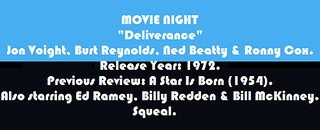
Deliverance.


Review #975: Deliverance.

Cast: 
Jon Voight (Ed Gentry), Burt Reynolds (Lewis Medlock), Ned Beatty (Bobby Trippe), Ronny Cox (Drew Ballinger), Ed Ramey (the Old Man), Billy Redden (Lonnie, AKA the Banjo Boy), Bill McKinney (Mountain Man), Herbert 'Cowboy' Coward (Toothless Man), James Dickey (Sheriff Bullard), and Macon McCalman (Deputy Sheriff Arthur Queen) Directed by John Boorman (#565 - Zardoz)

Review: 
It's interesting that the film (released 45 years ago this month) was adapted onto the screen by the writer of the novel himself, James Dickey, who also has a minor role in the film as well. Notably, the stunts were done by the actors themselves, with insurance not being given in order to cut costs. It is evident early on how rough the film looks and feels, and there is a haunting sort of tone to the environment and atmosphere of the movie, right down to the river. The use of Dueling Banjos (arranged and recorded by Eric Weissberg and Steve Mandel though without the permission of the original writer, Arthur "Guitar Boogie" Smith) in the beginning of the film is incredibly fitting. This is a brutal film that manages to be consistent in its pace once it gets the ball rolling by the first hour, with its run-time of 110 minutes being an acceptable length.

The core four cast (Voight, Reynolds, Beatty, and Cox) do a fine job in how well they play off each other, particularly during the beginning parts and the scenes in the rapids; there is never a moment where their actions feel fake or unnatural, with their fear seeming quite real, with the most famous scene involving the group and the people they find in the mountains. Coward and McKinney are fine villains; stereotype or not, they definitely evoke a good sense of realistic fear. The rest of the cast doesn't have much time on screen, but they certainly do leave an impression, such as Redden and his banjo performance along with Dickey and his appearance near the end. The ending of the film is poignant in how it goes in line with the rest of the film in terms of its shock and awe, with the final shot of the film reflecting that. For some, the film likely detracts from its theme with the amount of violence it has, but I found that the movie was fairly focused enough with its characters and sense of timing that it falls as a classic.

Overall, I give it 9 out of 10 stars.

June 9, 2017

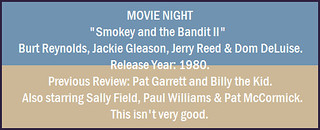
Smokey and the Bandit II.


Review #945: Smokey and the Bandit II.

Cast:
Burt Reynolds (Bo "Bandit" Darville), Jackie Gleason (Sheriff Buford T. Justice / Gaylord Justice / Reginald Van Justice), Jerry Reed (Cledus "Snowman" Snow), Dom DeLuise (Dr. Frederico "Doc" Carlucci), Sally Field (Carrie/"Frog"), Paul Williams (Little Enos Burdette), Pat McCormick (Big Enos Burdette), David Huddleston (John Coen), Mike Henry (Junior Justice), John Anderson (Governor), and Brenda Lee (Nice Lady) Directed by Hal Needham (#033  - Smokey and the Bandit and #034 - The Cannonball Run)

Review:
It's hard to believe it has been over 900 reviews (and six years) since I watched and reviewed Smokey and the Bandit. It is only fitting that I return to do the sequel, after all these days.

When I reviewed the first film in April of 2011, I called it a "load of fun", in part because it really was an enjoyable piece of entertainment. When it comes to the sequel, it is evident quite immediately that it is inferior in pretty much every way to the original. From the comedy to the stunts to the entertainment value to the heart, it is not only a disappointment but it is also a lazy kind of movie. Not only does this feel like a rehash of the first film, it is a bad imitation that only serves producers who wanted to make a profit of the Bandit name. Reynolds himself has admitted his displeasure with the film in interviews, stating how it was an unnecessary sequel, and I can't help but agree.

It's not so much that the actors are terrible, it's the writing that sinks the movie to a level that it never recovers from. Reynolds and Field have decent chemistry when they are simply allowed to interact and not have lines about why their characters broke up in the first place. It would've been better to just have them just be a couple then having this whole thing where they just argue (of course the parts before Field show up where the Bandit is a sad drunk aren't any better). The parts where Bandit has become a sort of folk hero don't really help the film as it does just be a lazy way of invoking the first film over and over again. Reed does a fine job as expected, with "Texas Bound and Flyin" being an adequate title song for the film (though obviously nothing tops "Eastbound and Down"). It's interesting to see Gleason back again, especially when he plays three characters in one scene (through trick photography), and his parts with Henry are useful enough. DeLuise is charming as always, but he doesn't really bring anything to the movie more than just a few Italian phrases; this happened to be filmed around the same time as The Cannonball Run, which while not exactly a great piece of work is easily better than this film, while also having better scenes of Reynolds and DeLuise. The fact that Williams and McCormick don't show up in the movie again after they recruit the main characters also doesn't help, considering they drive the plot (wanting an elephant delivered to a political convention). The fact that everything feels like a caricature doesn't help either.

The only trick that the film seems to have up its sleeve is a big sequence involving 50 cars and semi-trucks piling on each other in the desert, with destruction after destruction. However it only manages to come off as just going through the motions, feeling like a cartoon. The whole movie feels like a dumb cartoon, and it really seems to drag after the first hour or so. It's amusing (in a mocking kind of way) how they don't even end up delivering the elephant to Dallas on time, because of course not. It ends with Justice trying to chase them down on a bus, perfectly encapsulating the lazy nature of a film that comes and goes without a payoff. There are no real stakes, nor are there any moments where I felt like I needed to care about anything that happens. On the whole, the best thing I can say about the movie is that it makes the viewer want to see the original film again. I hope I didn't go too long with my critique, folks.

Overall, I give it 3 out of 10 stars.

February 7, 2016

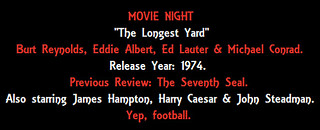
The Longest Yard (1974).


Review #778: The Longest Yard.

Cast
Burt Reynolds (Paul "Wrecking" Crewe), Eddie Albert (Warden Rudolph Hazen), Ed Lauter (Captain Wilhelm Knauer), Michael Conrad (Nate Scarborough), James Hampton (Caretaker), Harry Caesar ("Granny" Granville), John Steadman (Pop), Charles Tyner (Unger), Mike Henry (Rasmussen), Jim Nicholson (Ice Man), Bernadette Peters (Miss Toot), Pepper Martin (Shop steward), Robert Tessier (Connie Shokner), Richard Kiel (Samson), Anitra Ford (Melissa), and Ray Nitschke (Bogdanski) Directed by Robert Aldrich (#105- What Ever Happened to Baby Jane?)

Review
Yes, I'm aware of the timing to be back. In any case, The Longest Yard is a movie I had wanted to review, but I only had recently got the chance to finally watch the film, and what better way to do it on Sunday? In any case, The Longest Yard has a gallery of characters that generate a good deal of laughs, especially Reynolds, who seems to be perfectly at home with this character, filled with that expressionist grin. It's a movie that pulls all the punches, having a good deal of fun, with its own edge of football violence that anyone can associate with the sport. One of my favorite scenes is where Reynolds and another inmate exchange pleasantries (if you'd call it that) of stacking mud onto their pants, with the two getting into a mud-fight. Somehow, seeing the Captain coming out of the car gets them all laughing (even the guards laugh), and I can't help but crack up at everybody having a good laugh in the middle of a swamp. I do love the introduction to the football game, complete with split images of multiple shots. This is a movie for anyone looking for a good time with Burt Reynolds and a bunch of inmates who while being pretty criminal (including at least one murderer), are at least interesting to watch try to play some football, which is fine by me. It's a brutal film, but it is a movie that knows what its doing, and it knows how to make you laugh.

Football players in this movie (because why not?): Joe Kapp, Ray Nitschke, Mike Henry, Pervis Atkins, Ernie Wheelwright and Ray Ogden.

Overall, I give it 8 out of 10 stars.

August 13, 2014

Movie Night: Meet Wally Sparks.


Review #628: Meet Wally Sparks.

Cast
Rodney Dangerfield (Wally Sparks), Debi Mazar (Sandy), Michael Weatherly (Dean Sparks), David Ogden Stiers (Gov. Floyd Preston), Cindy Williams (Emily Preston), Burt Reynolds (Lenny), Lisa Thornhill (Priscilla Preston), and Eamonn Roche (Miller) Directed by Peter Baldwin.

Review
Misery sure loves company, doesn't it? This is a movie with a premise just made for Dangerfield...written by him as well (co-written, but whatever), in a film I'm sure not many remember...and for good reason. The movie feels really, really tired, a film that just flails around like a fish on a beach. Dangerfield does his usual one liners, which are fine, a shame that his character isn't really interesting. The main problem is the premise itself, it looks promising on paper, in the sense that it looks like an average movie that Dangerfield could make better (Oddly enough, the movie Ringmaster starring Jerry Springer would be released a year later, both movies marketed as comedies, about host of trash TV shows). The movie manages to be more boring than funny, like you're going through the motions. The gags feel old after about 30 minutes, and there's still 70 minutes to go, and then it turns into The Man Who Came to Dinner all of a sudden, it doesn't help the movie too much, though at least it reminds you to watch that film again. The characters are standard, though of all of them, I guess Stiers is the best character because any character who gets tired of the main character that isn't just the villain is fine with me. The movie flounders, sometimes trying to be trashy, and sometimes trying to be slapstick, and it garners some success, but not too much. At this point, you might as well watch Caddyshack instead, or Back to School, or Dangerfield's stand-up specials, those are much more interesting to watch, and not this misfire of a film.

Overall, I give it 3 out of 10 stars.

April 2, 2011

Movie Night: The Cannonball Run.

Review #034: The Cannonball Run.

Cast
Burt Reynolds (J.J. McClure), Dom DeLuise (Victor Prinzi), Roger Moore (Seymour Goldfarb, Jr), Farrah Fawcett (Pamela Glover), Dean Martin (Jamie Blake), Sammy Davis, Jr (Morris Fenderbaum), George Furth (Arthur J. Foyt), Jackie Chan (Jackie Chan), Jamie Farr (Sheik Abdul ben Falafel), Terry Bradshaw (Terry), Mel Tillis (Mel), Adrienne Barbeau (Marcie Thatcher), and Tara Buckman (Jill Rivers) Directed by Hal Needham (#033 - Smokey and the Bandit)

Review
EDIT: While I admit that some of my early reviews aren't exactly up to quality that are more evident in later years, I will still admit that this is a guilty pleasure that I can't help but like, especially considering my dad and I used to watch this movie back when he was around. Plus, it's hard to not like Burt Reynolds. As such, some of this review has been edited for clarity.

This is a fun film with good car scenes and all of the above with comedic jokes that aren't that bad, like that other movie I was talking about, but it finds a way to not be similar to it. It finds a way to combine Terry Bradshaw along with Roger Moore in the same movie, even Peter Fonda and Jackie Chan are in it, though I will admit they could be used better. The acting is decent as it's a good funny film. It has its own brand of enjoyment, thought you need to be in the right mood, or you'll be bored by it. Fun fact: This was actually based on a real race held back in the 1970's, called the Cannonball Baker Sea-To-Shining-Sea Memorial Trophy Dash. Take it as a random 80's flick, and you might be compelled to watch it from beginning to end just to see how it goes along.

Overall, I give it 7 out of 10 stars.