
Showing posts with label Bill Nunn. Show all posts

February 27, 2025

Mo' Better Blues.

Review #2350: Mo' Better Blues.

Cast: 
Denzel Washington (Minifield "Bleek" Gilliam), Spike Lee (Giant), Wesley Snipes (Shadow Henderson), Joie Lee (Indigo Downes), Cynda Williams (Clarke Bentancourt), Giancarlo Esposito (Left Hand Lacey), Bill Nunn (Bottom Hammer), Jeff "Tain" Watts (Rhythm Jones), Dick Anthony Williams (Mr. "Big Stop" Gilliam), Abbey Lincoln (Lillian Gilliam), John Turturro (Moe Flatbush), Nicholas Turturro (Josh Flatbush), Robin Harris (Butterbean Jones), with Samuel L. Jackson (Madlock), Leonard L. Thomas (Rod), and Charlie Murphy (Eggy) Produced, Written, and Directed by Spike Lee  (#1255 - Do the Right Thing, #1543 - Inside Man, #1643 - Malcolm X#1976 - She's Gotta Have It#2181 - School Daze)

Review: 
"I always knew I would do a movie about the music. When I say the music, I’m talking about jazz, the music I grew up with. Jazz isn’t the only type of music that I listen to but it’s the music I feel closest to."

Believe it or not, this was the first collaboration between Spike Lee and Denzel Washington on film. 
The inspiration for the movie came from Lee's interest to do a jazz movie with his own perspective after seeing Bertrand Tavernier's 'Round Midnight (1986) and Clint Eastwood's Bird (1988). The script for the film came up when Lee was working on Do the Right Thing (1989), with the first-draft screenplay being written in fifteen days. The fourth feature film directed and written by Lee, the movie was shot in roughly eight weeks with a budget of $10 million. The movie features the music of the Branford Marsalis quartet with Terence Blanchard doing the trumpet, with Delfeayo Marsalis lending assistance to Bill Lee with the producing of the music recordings (this was the last of four films where the Lees worked together, as they soon had a falling out). One isn't actually seeing the actors (most, anyway) playing the instruments, but they sure do a good job looking the part in imitation, which is more than enough. The first of nine movies Lee directed in the 1990s, it was a mild success at the time; the next movie directed by Lee after this one was Jungle Fever (1992).

Overlooked or not, there is something quite soothing about the way the movie flows in looking at the edges that come with trying to work at one's craft at the expense of relationships. It is hard to show maturity and know what one really wants when one could be working on something else, you might say. It is a movie based on mood and energy that is a curious one in basically reflecting its introduction and ending when it comes to parents and their son when it comes to shaping them and making a choice for them (in a movie where the rest of it is comprised of fallout from certain choices made, naturally). There is a crushing pressure one can feel in trying to hold on to themselves and not burn out into the night while also trying to think that everything is totally normal with how they do things within "fundamentals", and that includes one's love life. Undeniably, the sequence involving Washington opposite the two women in bed (at different times, obviously) is the most striking when it comes to misplaced ideas about people. Washington does pretty well with all of that in mind, mainly because he glides from place to place with weary disposition for what he seems to really want in life beyond that smooth facade of confidence (it takes more than talent to be a saint of jazz, shall we say). Basically, he treats the two women (C.Williams and J.Lee, the former making their film debut) in his life like they were items to check out at the store (incidentally, Lee called it a movie specifically about relationships and not a love story). The two women are only seen in that lens but each handle it with clear differences when it comes to timing and, well, allure. The Turturro brothers pop in from time to time to provide a few chuckles in the business interest side (if one ever believed the current times are weird for stereotypes, inquire further about this movie being called "anti-Semitic" and look to now when it comes to how much people like to waste time looking for stereotypes that aren't there). Lee also does pretty well in shaky stature (as one does when finding new ways to play characters in one's own story, which he did for his first nine movies). By the time the movie has its reckoning with certain decisions made in and out of good reason, one has found a pretty good time with the rhythm that the film has accomplished for itself, one filled with worthwhile interest in showing the power of human contact and making one's mind besides drawing it all in the craft. The relationships matter all around us: the music and the people we hold to us and how it matters so much to hold it tight to us as long as we can, which in this sense works out pretty neatly in the long run.

Overall, I give it 8 out of 10 stars.

February 26, 2024

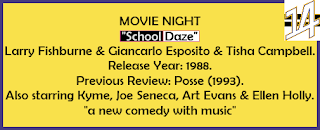
School Daze.

Review #2181: School Daze.

Cast: 
Laurence Fishburne (Vaughn "Dap" Dunlap), Giancarlo Esposito (Julian "Dean Big Brother Almighty" Eaves), Tisha Campbell (Jane Toussaint), Kyme (Rachel Meadows), Joe Seneca (President Harold McPherson), Ellen Holly (Odrie McPherson), Art Evans (Cedar Cloud), Ossie Davis (Coach Odom), Bill Nunn (Grady), Branford Marsalis (Jordan), Kadeem Hardison (Edge), Spike Lee (Darrell "Half-Pint" Dunlap), Darryl M. Bell (Big Brother X-Ray Vision), Joie Lee (Lizzie Life), Alva Rogers (Doris Witherspoon), Jasmine Guy (Dina), and Samuel L. Jackson (Leeds) Produced, Written, and Directed by Spike Lee (#1255 - Do the Right Thing, #1543 - Inside Man, #1643 - Malcolm X, and #1976 - She's Gotta Have It)

Review: 
I don't pretend to know the legacy of certain films, but I do have an interest in the film that comes after one makes their debut feature, particularly if it happens to be one from a director as prominent in black cinema as Spike Lee. School Daze (1988) is curious not only as one released two years after She's Gotta Have It (his formal debut after his student films and shorts, remember) that was followed almost immediately by his third effort in Do the Right Thing one year later. This film was shaped by his experiences that he had when attending Morehouse College (a historically black college in Atlanta) in the late 1970s. Island Pictures, which had distributed Lee's first film, had planned on doing this film as well, but wavering issues in the budget (which finished above $6 million) eventually led to Columbia Pictures acquiring it. Strangely, a movie that talks about sororities and fraternities had a bit of a tough task in finding a place to shoot the film, which included Morehouse (irony?) before Atlanta University was utilized. Apparently, the film had different housing for certain groups of the cast, which led to an unscripted (and filmed) confrontation at a "stepping show". The movie was a modest hit with audiences.

Every so often I have to remember that films of a certain age could actually talk lightly about issues that mattered that seem distinct from now, which starts pretty quickly with a film that starts with someone trying to do a protest about divesting from South Africa. Of course, what really matters for this film is how people treat each other in the facets that come in... colleges and dorms. Within the divides that comes from people of the same color and distinct privileges is a film that also happens to have a few music numbers. I personally don't have any experience with fraternities, but I think we can understand that divides between certain groups and classes is not always black and white as it might seem. Of course, it seems like a fable one tells to try and get people to wake up (almost as if they were in a... daze) to the issues that are mired in the muck beyond arguments over hair. One can say progress has been made in a certain place, but how much of what we say is progress as opposed to being lip service? I liked the movie fine, even though its 121 minute runtime does tend to make one desire the tiniest bit more from its ending, which almost seems to be direct but brief as possibly can be. Fishburne has all the confidence required in a film surrounded by apathy that isn't merely played as a martyr but one with his own biases and charms. The musical numbers are executed with varying effectiveness, but probably the best sequences of the film are in smaller moments. I especially like one scene involving Fishburne and his group going out into town to eat only to confront some locals (which is where Jackson appears briefly) that resent them in their own privileges, because if there is one thing to say about people, it is that there are people who will just look down on anyone who want better for themselves, even to the point of calling them a certain word and say that they'll be like them "just like us". Esposito makes an ideal wannabee with a total absence of awareness for anything but his own group for a distinct act of the public. His narrowmindedness strikes most of all, even with Campbell (and accompanying status in loyalty) right there on the divide of hair and sororities. Amusement is here and there in those selection of scenes for a movie not focused on showing the classroom (Davis having a scene in trying to motivate his football team is a real chuckler). At the end of the day, the black experience is one that cannot be thought as just simple to pin down for easy stereotypes, regardless if one is a college man or not. Living in apathy that just thinks about wallowing in where they are or just being content with a small piece of the action is just not enough when one could also wake up to what's around them. The film is mildly effective in its approach as a whole due to a game cast that makes Lee's second effort at least a useful curiosity to seek out on its own terms.

Overall, I give it 7 out of 10 stars.

January 22, 2024

Canadian Bacon.

Review #2171: Canadian Bacon.

Cast: 
Alan Alda (The President of the United States), John Candy (Bud B. Boomer), Bill Nunn (Kabral Jabar), Kevin J. O'Connor (Roy Boy), Rhea Perlman (Honey), Kevin Pollak (Stuart Smiley), G. D. Spradlin (R.J. Hacker), Rip Torn (General Dick Panzer), and Steven Wright (Niagara Mountie) Written and Directed by Michael Moore.

Review: 
"I made a film for people like me. People who live in Flint, Michigan or Hamilton, Ontario or Sarnia ... another critic said this is the first left-wing film for the mall crowd ... I consider that a compliment. I wanted to present this hybrid of satire and farce with a mix of politics to get people thinking about a particular issue, in this case, why are Americans led like lemmings to war?"

Michael Moore probably doesn't need much introduction, but maybe my reasoning to select this film does. Simply put, this is a film that became an oddity in his career of over thirty years: a feature film with a narrative. Moore was born in Davison, Michigan, a suburb of Flint in 1954. Not many people can say they went from being elected to the school board as an 18-year-old to becoming a director. Granted, the road to being a director had stops along the way, as he had run his own alternative newspaper for several years before a stint at the magazine Mother Jones, which saw him fired as editor. That loss of his job saw him move back to Flint, where seeing the decline of the city because of layoffs from General Motors (as run by Roger Smith at the time) made him want to film a documentary. After years of funding and production, Roger & Me was release in 1989 that was quite the sensation. A choice vote (i.e. no vote) at the Sundance Film Festival in 1991 in regard to the beginning of Operation Desert Storm gave Moore an idea to fester on. The next film Moore did was a short, called Pets or Meat: The Return to Flint in 1992, which, well, raising pets as snake food. He also did television around this time with TV Nation, a satirical news magazine show that was broadcast for two seasons. Anyway, back to the feature film. As mentioned, the idea of a President gaining public support for war against an enemy such as, well Canada, got Moore onto production with Propaganda Films (irony?) in 1993, which was shot on both sides of the USA-Canada border (such as Buffalo, Hamilton, and Toronto). Right before reshoots were to be done, John Candy, who supported Moore every step of the way, died on March 4, 1994. Moore and Propaganda did not get along well for the reshoots (where because of Candy's death meant a handful of scenes were then shot to focus on others), and perhaps his personality does not rub well with certain folks. Haskell Wexler, who shot the film, described Moore as one with "the aw-shucks homespun character that Moore portrays is a complete falsification." The resulting film, released in 1995 on a budget of $11 million, was seen by very few audiences. Moore moved on, doing a book tour and further documentaries (nine as of 2024) across the social, political, and economic topics that interest him, to varying levels of interest.

Honestly, all of that curiosity kind of goes out the window with the result played here. By god, it is so close to being good. It was probably never going to escape that inevitable comparison of Dr. Strangelove, although it at least predates certain films that touch some of the ideas presented here, such as Wag the Dog, another film about a President using the idea of invasion to attract public attention (of course, that was loosely based on a 1993 satirical conspiracy novel). But all that comes through in a sparse 90-minute movie is the thought that this just doesn't click for great laughs. My god! You have Torn and Spradlin (the former is one of Movie Night's favorite people to see on screen) as supporting players for a mediocre lead in Alda and a middling diversion in the quartet of Candy, Perlman, O'Connor and Nunn. You want to like them, and you want to have something to laugh at in those broad jokes (get it? saying beer sucks makes Canadians fight? eh?), but you just get sitcom stuff. Like, heh, sometimes it is funny, but never to a big level for that first hour. The irony of having a handful of recognizable faces is that this is the first film I've seen with Alda (known mostly for M*A*S*H, but I recognize him from The Blacklist [!]) as a lead. He may be playing a "Clintonite". but man is it really not that funny. It begs for something broad, I almost wish Torn was playing the role, because he sweeps the rug right from both Alda and Pollak (mildly funny) in craven fun. Most of the people just don't seem to have that much fun here, where even cameos by Dan Aykroyd and Jim Belushi just make me wonder what brought them on to do listless cameos (eh? get it? public apologies and having people write Canadian slander in English and French?). One really does wonder just what would have been if Candy had been there for the whole production cycle (he died during production of Wagons East (1994), which apparently was worse). The film just can't strike hard for those looking for broad laughs and it can't really gel well as any grand satire because it just doesn't have the chops to really stick a definitive landing, particularly with its third act. It just feels like a collection of sketches run amok. The jokes are just mild and not very entertaining for a whole film, particularly since the ending doesn't even find anything riotous to say about warmongering or in amusement that hadn't been done in better things. Political firebrand or not, Moore just made a movie that wasn't even worth tearing to shreds or defending to death. A six-star rating out of 10 is sadly appropriate here.

Overall, I give it 6 out of 10 stars.
Next up: Byron Haskin and H.G. Wells' The War of the Worlds (1953).

February 23, 2023

New Jack City.

Review #1978: New Jack City.

Cast: 
Wesley Snipes (Nino Brown), Ice-T (Scotty Appleton), Allen Payne (Gerald "Gee Money" Wells), Chris Rock (Benny "Pookie" Robinson), Judd Nelson (Nick Peretti), Mario Van Peebles (Stone), Michael Michele (Selina Thomas), Bill Nunn (Duh Duh Duh Man), Russell Wong (Park), Bill Cobbs (Old Man), Christopher Williams (Kareem Akbar), and Vanessa Estelle Williams (Keisha) Directed by Mario Van Peebles.

Review: 
“Typically, in a gangster movie, you’re emotionally connected with the gangster. If you watch ‘Godfather,’ you connect with the gangster, but in ‘New Jack City,’ you connect, not just with the gangster, but hopefully with the cops — but even more with the victim.”

Cliche as it may sound, the story of a filmmaker in this case of like father, like son. Mario Van Peebles was born in 1957 in Mexico City, Mexico to a photographer mother and a filmmaker father in Melvin Van Peebles. The Van Peebles family moved around between the United States and Europe, although the younger Van Peebles dabbled first in acting in his teens (which included Sweet Sweetback's Baadasssss Song, as you already may know). He studied and graduated in Economics at Columbia College (the oldest undergraduate college of Columbia University, located in New York); he had acted on the advice of his father, who told his son to work hard and advertise while getting a business education. After time spent in the City of New York Department of Enviromental Protection, Van Peebles re-entered acting in the 1980s, which included roles in films such as Exterminator 2 (1984), Rappin' (1985), and Heartbreak Ridge (1986). Van Peebles started as a director in television in 1988 before he got his chance to make a feature with this film. In over three decades as a director, he has done films of varying quality such as Posse (1993) and Baadasssss! (2003) along with countless television projects. The screenplay was done by Thomas Lee Wright and Barry Michael Cooper, while the story was done by Wright. Cooper was a writer for The Village Voice, going from music critic to investigative reporter for the New York City alt-weekly. He wrote an article called "Kids Killing Kids: New Jack City Eats Its Young" in 1987 that talked about drug trade (such as in Detroit). It spurred a meeting with Quincy Jones and eventually a job in re-writing a screenplay that was about a 1970s Harlem heroin kingpin in Nick Barnes (so you can guess how that plays into this film). In 1994, two of Cooper's scripts involving Harlem came out with Sugar Hill and Above the Rim. Wright had been an executive at Paramount Pictures that aspired to be a screenwriter and apparently made a script treatment for what a third film for The Godfather (1972, 1974) could look like. When Paramount was interested enough to have him do an early draft, Wright used experiences in interviews from New York's Little Italy and black kingpins that modeled themselves like the Mafia in Harlem...which was founded by Nicky Barnes.

When you are trying to do a slick piece of entertainment, most might wonder if a resemblance to Scarface (1983) is wise. But New Jack City is still entertaining for what it shows in the contradictions that come in making a film about the rise and fall of one pusher of crack cocaine that has many interesting players that engage with the action in comic-book style energy. It isn't just a movie all about a kingpin or the cops that try to bring him down but instead a film that encompasses both sides of the story that is a deconstruction of the drug trade. In a way, it a refining of what used to be called the "blaxploitation film", one with distinct music and characters that resonate with the flow of the story for what is basically a lyrical action-drama. Of course, it is also a movie that doesn't just roll only in action, because one can always sense the plight of unemployment, social inequality, and systemic racism within the seams. Snipes is the head of where the film works best, one that saw him rocket to further recognition as an actor beyond supporting roles (and for good reason). There is a devilish charisma to everything that he does in this film, one that the writers wanted to show to make one believe him akin to a vampire when it comes to the community. It works exactly to plan because of how much he resonates on screen in presence, sucking our attention as an angel of death, right down to one of the last sequences referring to "my brother's keeper", which is undoubtedly the most effective by the fact that it has lingered as an Internet meme for years (so yes, a somber sequence turning into a moment for humor is far better than you think); the inevitability of where things will lead doesn't degrade the overall experience when it comes to seeing Snipes in a leading role that matters. Ice-T (who got the nickname by his memorization and reciting of excerpts of Iceberg Slim novels) was better known for his music (hip-hop, rap, heavy metal) than an actor, and he apparently got the role because Van Peebles heard him mouth off while in a nightclub bathroom. It is apparent pretty quickly that he makes a quality counterpart to Snipes because of how he manages to hold his own in worthwhile conviction and energy, which makes for quite the pairing when against Snipes in cover or opposite Nelson. Payne and Rock (at that time a member of Saturday Night Live) are the other key aspects of the film that strike interesting chords in the effects of where the trade takes them, whether that involves the decay of brotherly devotion or the attempted decay of one's soul (incidentally, the film has inspired a live stage show that saw Payne return to the role in 2022). As a whole, the 100 minutes feel quite efficient in execution because the movie always seems quite "on", never lingering in unnecessary territory or becoming only just a cliche to pick at. It is a movie with a soul for the moment that still seems quite prescient now, which means that it still has worthy staying power three decades later that is ripe for celebration due to the efforts of Van Peebles and company to make it a worthwhile time to check out.

Overall, I give it 8 out of 10 stars.
Next Time: Tyler Perry...in a non-Madea movie with Why Did I Get Married?

July 6, 2021

Spider-Man 2.

Review #1695: Spider-Man 2.

Cast: 
Tobey Maguire (Peter Parker / Spider-Man), Kirsten Dunst (Mary Jane Watson), James Franco (Harry Osborn), Alfred Molina (Otto Octavius / Doctor Octopus), Rosemary Harris (May Parker), J. K. Simmons (J. Jonah Jameson), Donna Murphy (Rosalie Octavius), Daniel Gillies (John Jameson), Dylan Baker (Dr. Curt Connors), Bill Nunn (Robbie Robertson), Elizabeth Banks (Betty Brant), Elya Baskin (Mr. Ditkovitch), Mageina Tovah (Ursula), Ted Raimi (Hoffman), with Willem Dafoe (Norman Osborn), and Cliff Robertson (Ben Parker) 

Directed by Sam Raimi (#611 - Spider-Man, #1296 - The Evil Dead, #1483 - Evil Dead II, #1495 - Darkman)

Review: 
“I just tried to get even more in touch with the things that I loved about Stan Lee’s great character Spider-Man, and a lot of writers throughout the 40 years at Marvel have contributed to Spider-Man. All the things that I loved about all of their stories, I tried to really get deeper into and connect on a deeper level with the actors, and make it more about the characters and their interaction with one another. I tried to get to the core of what I loved even more.”

It must be amazing to think of an era where superhero movies did not in fact rule the Earth, really. But the dawn of the 21st century shows that they merely lurking in the shadows of entertainment, when you think about it. There is not a long line to get from something like this film to Iron Man (2008) when it comes to adaptation of something from the world of Marvel Comics, much less when it comes to movies beyond just an one-off. Spider-Man (2002) was the sixth feature film adapted from a Marvel character (as created by Stan Lee and Steve Ditko in 1962), coming off the heels of previous works such as Blade (1998) and X-Men (2000), which like this film came from years and years of development (among quite a few scripts); naturally, this film follows along the sequel line among those aforementioned movies (Blade II, X2), and it likely stands as one of the best superhero sequels of its time. It is interesting to note that the first film actually had the character of Doctor Octopus as a secondary villain before Raimi dropped him in order to focus more on the dynamic between the title character and the villain. At the helm for the screenplay was Alvin Sargent (near the end of a lengthy career of writing, which included un-credited work on the first film) while the story came from Michael Chabon, Alfred Gough, and Miles Millar (the latter two are mostly known for their development of the show Smallville; obviously, the movie is a hodgepodge of ideas from each writer - Chabon's proposed script apparently had a love triangle involving Doctor Octopus). 

Most superhero sequels generally tend to raise the stakes by adding villains to the pile for the hero to fight that make the challenge seem tighter (i.e. more than one villain, which was present in more than a few superhero films beyond the Marvel line, such as with the Batman series). And yet, here we are with a movie that has quite a controlled focus with consistent stakes and drama that improves on the original without being as hamstrung by the little things as had been the case with the original Spider-Man (which was a pretty decent effort from a director who clearly appreciates the material). It carries itself with enough weight in responsibility to deliver entertainment with meaningful power and meaningful moments to see and hear. Of course it isn't just an effects show, even though one can be impressed by the crew of John Dykstra, Scott Stokdyk, Anthony LaMolinara and John Frazier (among others) when it comes to the tentacles for its villain that prove a blend of computer effects with puppetry (alongside a harness of course) that definitely serves an improvement when compared to the sequences involving the Green Goblin from before. Maguire (who was nearly replaced by Jake Gyllenhaal because of a near-serious back injury) leads the cast with worthy presence once again, maintaining the sincerity and vulnerability depicted before without seeming generic in his charm or being overshadowed by others too much (heroes get overshadowed by the villain in a handful of films anyway). Dunst matches well with snappy chemistry that balances scenes spent either with Maguire or Gillies.  Franco works with the gradual moments with bitter righteousness that still seems like a worried child when it comes to obsession and taking the mantle his father held (which I guess works pretty well in its little imitation of Hamlet, but seeing Dafoe again is a worthy bonus). Molina proves a worthy adversary, one struck by fate that is quite sardonic in his menace that draws you in from the very first moment with him on screen (at least if you compare him with his scenes spent with Murphy with his time with the AI arms); in other words, he makes for a fun villain that improves upon the dynamic seen between the lead and the adversary from before in terms of showing the nature of power and responsibility. Closing out the cast is a few brief-scene wonders from before with the bright nurturer in Harris and the wonderful blustering comic relief in Simmons. At any rate, the film proves efficient at 127 minutes in balancing its spectacle with effective characterization that draws upon the comics without being beholden to too much cheese or being a show for overdrawn spectacle - Raimi honed his craft with the hero film in Darkman and he has merely improved upon the human aspects of what makes a thrilling and poignant movie that happens to have folks in costumes that builds on the curiosity left by its predecessor while setting its own stage for another adventure without too much trouble.

Overall, I give it 9 out of 10 stars.

August 9, 2019

Do the Right Thing.


Review #1255: Do the Right Thing.

Cast: 
Spike Lee (Mookie), Danny Aiello (Sal), Ossie Davis (Da Mayor), Ruby Dee (Mother Sister), Giancarlo Esposito (Buggin' Out), Bill Nunn (Radio Raheem), John Turturro (Pino), Richard Edson (Vito), Roger Guenveur Smith (Smiley), Rosie Perez (Tina), Joie Lee (Jade), Steve White (Ahmad), Martin Lawrence (Cee), Leonard L. Thomas (Punchy), Christa Rivers (Ella), Robin Harris (Sweet Dick Willie), Paul Benjamin (ML), Frankie Faison (Coconut Sid), Samuel L. Jackson (Mister Señor Love Daddy) Produced, Written and Directed by Spike Lee.

Review: 
When it comes to great movies, there is generally a sense early on its duration where you know this is going to be more than just a good experience of entertainment. For me, the turning point was probably a short sequence involving Aiello and Turturro's characters involving the latter wanting the former to close down his pizzeria and do something else with his life as opposed to serving the neighborhood any longer than has been the case for 25 years. You have had a look into these people's lives over the course of the film up to now (all of which over the course of one day, naturally), so seeing how a conversation can have some certain preconceived notions seem to bubble even further than what has already happened on screen. One lives on his pride for the people that grew up on his pizza while the other feels nothing but loathing resentment, where being accosted by a guy selling pictures on the street means being rude and loud to their face. This is such a vibrant film, one that grasps for what it wants to say about intercity life and the people that accompany it with their respective type of personalities and preconceptions. For what its worth, the film is still relevant three decades after its release now more than ever, seeming in step in terms of its execution of direction from Lee to bring these characters to life alongside a story that clicks without a hitch from start to finish. Aiello is the best of a group with plenty of useful castmates to go around, showing plenty of surly ruggedness one could expect for such an interesting character however one interprets him and his actions. Davis shines just as well, having a mix of humor and dignity with his key role whenever necessary, whether when on screen talking about doing the right thing or something else. Turturro and Edson certainly play the brotherly sided coin with a fair edge, where their differences stand clear alongside brotherly ties without having a safe closure. Nunn plays the key in making his time count, compelling with a boom box as company.

Whether the character is involved with an amusing moment or something more serious, each actor do their part to make it stick with conviction, whether it is the corner-men of Harris-Benjamin-Faison and their cracks through the day or the time spent at the pizzeria and the people working (and mostly talking) on food for the neighborhood, with the two hour run-time slipping by without much struggle. When the film shifts itself from a mix of comedy and drama to a sudden turning point, it hits with a devastating punch - whether one knows anything about what happens in the film or not before viewing, it makes a key point on the nature of prejudice and what makes for the right thing when the moment needs it. In addition to all of this is wonderful cinematographry from Earnest Dickerson, who does well with making the look of the film seem readily consistent to take place over a day with good lighting (in general, it is quite an achievement to make a film in a few weeks on location) and also good music from Bill Lee. It keeps the pedals rolling without betraying its efforts for its conclusion, keeping a roaring spirit that progresses beyond the final reel. On the whole, this is a thoughtful and entertaining film that pulls quite a punch with forming an interesting world come alive and show the layers beneath the quirks, for which one can still learn from now. It is worth a viewing, preferably with a crowd.

Overall, I give it 10 out of 10 stars.