Showing posts with label Ruby Dee. Show all posts

October 25, 2024

Cat People (1982).

Review #2290: Cat People (1982). 

Cast: 
Nastassja Kinski (Irena Gallier), Malcolm McDowell (Paul Gallier), John Heard (Oliver Yates), Annette O'Toole (Alice Perrin), Ruby Dee (Female), Ed Begley Jr (Joe Creigh), Scott Paulin (Bill Searle), Frankie Faison (Detective Brandt; dubbed by Albert Hall), Lynn Lowry (Ruthie), and John Larroquette (Bronte Judson) Directed by Paul Schrader.

Review: 
"Cat People wasn’t successful. It really fell between two stools: it was an attempt to have things both ways, which is to have a classy film and a horror film. Well, the horror audience went and said, ‘Hey, this doesn’t look like a horror film, it’s not for us’, and the sophisticated audience went and said, ‘Hey, this is just a horror film.’ So it wasn’t really satisfying to the audience."

Sure, give a few decades and you can just remake a movie right then and there. The 1942 Cat People had been a team effort that had DeWitt Bodeen write the screenplay as based in collaboration with producer Val Lewton, director Jacques Tourneur, and editor Mark Robson. The process of remaking the film was first brought up by Milton Subotsky before Universal Pictures eventually got the rights and made their own push that took several years of the 1970s (Robert Vadim was interested to direct at one point). You might recognize the screenwriter in Alan Ormsby, the co-director and writer of Deranged (1974) and a variety of other writing projects. Universal tapped Paul Schrader (who once labeled the 1942 rendition as one that he didn't find very good) to direct the film, with most knowing him for his work on scripts such as Taxi Driver (1976) before becoming a director with Blue Collar (1978); he claimed that he had contributed to the writing of the film in terms of its prologue and the ending to make it more distinct from the original, although Ormsby claims otherwise. The movie was a mild success with audiences at the time, or at the very least managed to accomplish the goal of not inspiring a filmmaker to try and do their own remake of a remake four decades later. Schrader has been quoted as saying that in his attempts to do a genre film as a "very salutary exercise" in not being about himself, he ended up making a movie that ranked up there as among his most personal.

The funny thing about the films is that it accomplishes one thing in particular: it sure is distinct on its own merit from the original that you won't mistake it as a copy because of its erotic elements within the perils of flesh. You might remember that the original dealt with a woman (played by Simone Simon) who thought they were descended from a tribe of, well, cat people that may or may not turn into black panthers when aroused (it basically had elements of the noir); the lady in that movie went the whole road to marriage without getting kissed. Here we have a woman who must confront the peril of really having a family tradition of were-cats that must kill in order to turn back. It just so happens to involve a few bits of skin and the mix of effects and cats in a movie best described as lurid curiosity for 118 minutes. If you asked me which movie called Cat People is the better among the two, I think I would throw my hands in the air and shrug at it basically being a dead heat because each are from accomplished filmmakers that represent their era quite well in overall enjoyment vs. rewarding the patience of those who are into what it is selling. Kinski practically lifts the film almost entirely to the realm of curious because of how she acts in the film without really even acting that much to begin with (apparently, she seemed to felt manipulated when it came to her assessment of the resulting film). Her grace really does have the instincts of a cat in frenzied timing that sells the plight of flesh. Whether you compare the two films or not, she sure exceeds Simon when it comes to worthwhile lead performances by a handy margin. McDowell may not be in the movie too long, but he sure is loopy enough to belong in weirdo enjoyment that he sells from the word "go", but I say that as someone who went with the film's peddling of ideas right then and there (you really should just see it right then and there rather than skimming the plot). Heard and O'Toole are fine, albeit on a smaller scale that only works some of the time in trying to do a would-be love triangle that only works for those who like the actors enough in the first place; Heard just happens to be the ideal guy to chase a girl like Kinski in strange pursuer/pursued, as opposed to the mild other. Besides, it is quite the curiosity to see Heard having to engage with the climax in a cathouse blues type of way that really will make or break the film for you when it comes to stupendous suspension of disbelief; I dont know if I would call the film "classy", but even "dedicated" is a better way to put it than,  say, "not fun horror". It is a movie that looks and sounds exactly on point of mystical curiosity, never turning itself off even when not going all-out for effects work (you get some blood anyway). As a whole, it is a strange sensual kind of sensationalism that one will either take right in for scintillating enjoyment or baffled disappointment. It feels good to be on the side of the former but have it your way among the creatures of the night.

Overall, I give it 8 out of 10 stars.

February 25, 2024

Buck and the Preacher.

Review #2179: Buck and the Preacher.

Cast: 
Sidney Poitier (Buck), Harry Belafonte (Preacher), Ruby Dee (Ruth), Cameron Mitchell (Deshay), Denny Miller (Floyd), Nita Talbot (Madame Esther), James McEachin (Kingston), Clarence Muse (Cudjo), Enrique Lucero (Indian Chief), Julie Robinson (Sinsie), and Lynn Hamilton (Sarah) Directed by Sidney Poitier.

Review: 
Admittedly, first-time directors have a tough task upon them, and it is harder when one is also the star of the film as well. Joseph Sargent was the original director in mind for this film, which had a screenplay done by Ernest Kinoy (who had done the script for Brother John (1971), which had Poitier as star), although it had been refined by him and Poitier prior to production beginning. Poitier wasn't fresh to Westerns, as evidenced by his starring role in the 1966 Western Duel at Diablo, although he was second-billed next to James Garner. Sargent had directed a variety of television films and a handful of films such as Colossus: The Forbin Project (1970). However, Sargent was replaced early into production because Poitier (and Belafonte, a friend of Poitier ever since they met at the American Negro Theater years ago) felt that it was focused on just being a Western rather than one that honed to certain values near to them (Sargent wasn't hurt as a filmmaker - perhaps ironically, his 1972 production of The Man went from TV movie status to being released in theaters); note that within values of basically doing a buddy film in the clash of escape within hate is two prominent Native American characters being played by, well, the spouse of Belafonte and a man named Lucero. Poitier took over the production (as done in Mexico such as Durango) and did well enough that Columbia Pictures did not interfere in his filmmaking.  Poitier would be a director for over a decade, directing such films as Uptown Saturday Night (where he starred with Belafonte again) and the highly successful Stir Crazy (1980) before closing it out with Ghost Dad (1990); Poitier died in 2022 at the age of 94.

It is a curious movie to say the least. There had been a handful of Westerns with black actors in prominent roles before this film, such as say, Two Gun Man from Harlem (1938), a musical, or ensemble films like 100 Rifles (1969) or Skin Game (1971 - incidentally, that featured Garner...billed before Lou Gossett). In fact, this wouldn't even be the only Western with black leads, as The Legend of Black Charley was released a few months after this film (incidentally this was also the same year that Black Rodeo, a documentary about an all-African American rodeo that happens to feature Muhammad Ali was released). Really this is probably a bit more familiar to those with experience enjoying Butch Cassidy and the Sundance Kid (1969). It always helps to have film spring to mind actual history such as "Exodusters", which were African Americans that were moving along to places such as Kansas from states along the Mississippi River that started in 1879 (the film is actually set around the late 1860s while dealing with migration attempts out of Louisiana, but you get the idea). Liberation never felt so fun when it comes to the clash of men trying to deal with who they are with or without the gun. Poitier does pretty well in showing the vulnerability that comes with trying to be a man of one's word, which results in an engaging dynamic with Belafonte (a famed singer who acted in roughly over a dozen films). That clash of wills in terms of dogged truth and some form of faith (beyond just saying a huckster) work out well for gripping entertainment in 102 minutes. Scenes such as watching the first meet up with the natives and the two or one involving a distraction-shooting work best in that regard. Mitchell makes a suitable adversarial presence in malice that stokes that flame of fear desired for a film like this, which goes for Dee in quality timing as well. As a whole, the movie works best in the presentation attempt of showing the clash of wills between the races of people that each have belief in their way of life (whether that involves setting for Kansas, wanting to retain cheap labor through fear or living among the land as Natives) that works out on the basis of a confident filmmaker at work. It tells a useful story with two leads that had appreciation for the material put to them for a quality show that carved a useful place as a true Black Western.

Overall, I give it 8 out of 10 stars.

November 24, 2023

Baby Geniuses.

Review #2149: Baby Geniuses. 

Cast: 
Kathleen Turner (Dr. Elena Kinder), Christopher Lloyd (Dr. Heep), Peter MacNicol (Dan Bobbins), Kim Cattrall (Robin Bobbins), Dom DeLuise (Lenny), Ruby Dee (Margo), with Leo, Gerry and Myles Fitzgerald (Sylvester "Sly" & Whit; voices by Miko Hughes), and Kyle Howard (Dickie/Ice Pick) Directed by Bob Clark (#020 - A Christmas Story, #679 - Black Christmas, #1055 - Porky's, #1854 - My Summer Story)

Review: 
"We wanted to go for a more realistic presentation of the concept." - Bob Clark.

Oh no, Bob Clark. This was the guy who did horror such as Children Shouldn't Play with Dead Things (1972) and Black Christmas (1974) before getting to do comedy/dramas such as Tribute (1980). After that, every film of his seems to remind one of a rollercoaster, as for every sleeper-turned-classic such as A Christmas Story (1983)...there was a litany of films that went down the road of audience appreciation such as the following: Porky's (1981 - hit, for better or worse), Porky's II: The Next Day (1983 - hit, somewhat), Rhinestone (1984 - the odd flop), Turk 182 (1985 - flop), From the Hip (1987 - flop), Loose Cannons (1990 - flopped harder), My Summer Story (1994 - little-seen flop), I'll Remember April (1999 - ???)...and then this. The involvement of Bob Clark with what became this film started in 1994. Clark ran into Jon Voight when attending a play and heard about a script that Voight wanted to do with his company that he had formed with Steven Paul in Crystal Sky Productions; Paul came up with the initial concept because he saw two babies communicating to each other once. This script (with multiple writers having gone through it) involved babies. While the script didn't look great to Clark (it involved portals called "Baby World"), he was interested in the short film he was shown involving babies sitting around in a meeting like they were executives (i.e., morph technology). Clark led the charge for a shift in the script that honed to the corporate angle because the other script seemed less "fresh." Of course, Clark had every reason to be nervous with the effects, but Babe (1995) certainly cooled fears a bit when it came to morphing. The effects when it came to the babies fell to the hands of Creative Special Effects when it comes to lips and mouths (alongside other stuff like natural head movements) for the babies for, well, conversation. By default, the CGI is a pioneer of some sort when it came to mouth movement, with credit of course going to babies...hitting their marks along with the use of a 15-year-old little person and a young gymnast for dancing and karate moves. Would you be surprised to hear that the film had a dubious release history? It was first planned for a release in Christmas of 1997 before incomplete effects meant a new target of 1998 and then 1999, and there was even the possibility of just shuttering the film as a Columbia TriStar Home Video release in the direct-to circuit before the movie slithered onto theaters in March of 1999, which managed to garner marginal attention from audiences. Five years later, Clark returned to direct a sequel with Superbabies: Baby Geniuses 2 (2004), now with Voight serving as a star to go with Paul writing the screenplay and serving as a producer. Somehow, that film has a much worse reputation than this film, and it happened to be the last film directed by Clark, who died in 2007 at the age of 67.

Getting kids (age 5-9, apparently) rather than adult voices to voice the babies (such as say, Look Who's Talking [1989]) is probably the least sad thing of the whole thing. What could possibly invite you to waste 95 minutes on a movie that never succeeds in every joke that is attempted? If there was a God, I do not believe that watching babies walk and talk would be high on the priority list. You might as well call it the film most likely to be thought of as having no soul in it. The people who made this film probably did not think much of the film either during or after production, but that doesn't give an excuse for this being one of the worst things I have ever seen. Hell, it shouldn't even be called a film, it should be put in a special garbage can that you would put expired food products in. You might think, oh, well, Monster a Go-Go (1965) is filled with more inconsistencies and worse acting. Well, maybe, but that has the label of being made in weirder circumstances of "make the best out of the footage", what kind of excuse does this Hollywood slop have? Absolutely none. Clark and his team probably thought it was one of those things you can put on for the kids and enjoy, but no, they did not. I can't tell who to feel sorrier for when it comes to being present in such a bad feature here, Lloyd (future voice in Foodfight!) or DeLuise (guy who appeared in past junk such as Sextette, and The Magic Voyage dub); Lloyd's most dubious scene might as well be his second one, when he accesses a computer that only is there to deliver exposition to the audience and serve no other purpose. Well, okay, maybe Turner, because she has more time than each actor and doesn't even get to chew scenery. Imagine my shock, no scene chewing in a movie that has less life on it than the planet Mars. Even if you want to term MacNicol and Cattrall as just sleepwalking through their roles, why should they be given slack? It's easy to say folks are mailing it in, but, well, yea, they are mailing it in as if this was a direct-to-video production, complete with little motivation to do much of anything. They repeat one line four times in quick succession and later do a repeat of a gag where an adult gets tricked into getting hit in the beans after talking about it. The voices coming out of those babies were never going to work with how it looked because it just isn't a useful effect that you would want to see for very long. It is a gag that has run amok for what might as well count for anti-comedy. Truly, this was a sad experience to sit through, because it means that Bob Clark may be one of few people who directed both a vaunted classic and a horrendously awful feature in the same career. Avoid, unless you like garbage.

Overall, I give it 0 out of 10 stars.
Next: The Lonely Lady.

February 15, 2022

Black Girl (1972)

Review #1802: Black Girl. 

Cast
Brock Peters (Earl), Claudia McNeil (Mu'Dear), Leslie Uggams (Netta), Louise Stubbs (Mama Rosie), Peggy Pettitt (Billie Jean), Gloria Edwards (Norma Faye), Loretta Greene (Ruth Ann), Ruby Dee (Netta's Mother), and Kent Martin (Herbert) Directed by Ossie Davis (#1635 - Cotton Comes to Harlem)

Review
Admittedly, it might be surprising that not only are there two films called Black Girl (1966, 1972), it is the non-American feature that is the well-known film (one that would likely be suitable for another time among its world cinema counterparts). But the 1972 film shouldn't be forgotten in the discussion of black family dramas, one that features a fairly solid group cast in a film wrapped in complications. This was the second feature film directed by Ossie Davis, who ended up doing five features all in the decade of the 1970s (this one, unlike Cotton Comes to Harlem, was made independently with distribution by Cinerama Releasing Corporation). The film is an adaptation of the television production/play of the same name by J. E. Franklin. It was made on television first by WGBH Boston '(for On Being Black, a PBS television show) in 1969 before it premiered Off-Broadway in New York City theater in 1971 (Uggams, Stubbs, Edwards, and Greene reprise their roles from the production); Franklin wrote the screenplay for the film, shot in Venice in Los Angeles County. Incidentally, one of the stars of this film in McNeil was featured prominently in the famous stage/film production A Raisin in the Sun (1959/1961).

One has to consider the consortium of castmates involved with varying levels of film experience. Peters had the most film role experience among the main group of actors, since he had acted in a handful of films since 1954 while also dabbling into singing. McNeil acted primarily in television, with this being the last of her four film roles in a career that spanned a few decades (in a strange coincidence that seems to tie the month together, she was inspired to get into acting by Ethel Waters). This was the first major film role for Uggams, a Harlem native who had been involved in show business since she was a child that had resulted in starring roles on Broadway (with a Tony Award in 1967) and television. Stubbs & Edwards appeared in just three films while Greene had two roles (obviously there is Dee, but her role is silent). The result for the film is a fairly effective experience of seeing all the emotions spill out of a family wrapped by self-hatred (or if you want to put it bluntly, losers). Black, white, whatever color one is, the experience of a family wrapped in turmoil is not something limited to just one view when it comes to cinema (television too, but there are differences), because the suffering of life is universal. It is a bit shaky, but the actors are fairly adept at keeping it just above theater-level in useful tension despite a foundation that is sometimes uneven (in getting to the point, mostly). I guess if you prefer movies with feminine leads in a non-action/comedic genre, this might be just up your alley (I'm fine with most stuff, but I can understand the preference for something like Coffy when it comes to black female-lead 70s films).

As it stands, this is the first and only film for Pettitt. She graduated from Antioch College with a bachelor's degree the year after this film and soon moved to London under a fellowship grant. She has continued to work on the stage and as a playwright. It is a tough role for any actress to consider, since it is comprised of reacting to the three-woman front of doubt and indignity and dance, and she makes the best of it. Peters may be billed first, but in reality, he is only in the film for twenty minutes, for which the scene with Stubbs in the park is probably the highlight scene when it comes to the power of showing the fractured family dynamic within memories. Stubbs is a quality foil to Pettitt when it comes to strong parental presences. McNeil is the underlying tie full of crisp charm, while Edwards & Greene serve as tools of spite that work to a point while Uggams has a wedge-size of time that goes okay in serving as the contrast between the others without becoming a high-and-mighty snob. As a whole, the film presents its drama with cloying accuracy when it comes to seeing sniping on screen between people mired in the muck of broken families without finding easy resolutions. It makes for a decent movie (complete with an appropriately ambiguous ending) that deserves a curious look for those in the mindset for that kind of movie with a serviceable director at the helm.

Overall, I give it 7 out of 10 stars.

Next Time: Ganja & Hess.

August 9, 2019

Do the Right Thing.


Review #1255: Do the Right Thing.

Cast: 
Spike Lee (Mookie), Danny Aiello (Sal), Ossie Davis (Da Mayor), Ruby Dee (Mother Sister), Giancarlo Esposito (Buggin' Out), Bill Nunn (Radio Raheem), John Turturro (Pino), Richard Edson (Vito), Roger Guenveur Smith (Smiley), Rosie Perez (Tina), Joie Lee (Jade), Steve White (Ahmad), Martin Lawrence (Cee), Leonard L. Thomas (Punchy), Christa Rivers (Ella), Robin Harris (Sweet Dick Willie), Paul Benjamin (ML), Frankie Faison (Coconut Sid), Samuel L. Jackson (Mister Señor Love Daddy) Produced, Written and Directed by Spike Lee.

Review: 
When it comes to great movies, there is generally a sense early on its duration where you know this is going to be more than just a good experience of entertainment. For me, the turning point was probably a short sequence involving Aiello and Turturro's characters involving the latter wanting the former to close down his pizzeria and do something else with his life as opposed to serving the neighborhood any longer than has been the case for 25 years. You have had a look into these people's lives over the course of the film up to now (all of which over the course of one day, naturally), so seeing how a conversation can have some certain preconceived notions seem to bubble even further than what has already happened on screen. One lives on his pride for the people that grew up on his pizza while the other feels nothing but loathing resentment, where being accosted by a guy selling pictures on the street means being rude and loud to their face. This is such a vibrant film, one that grasps for what it wants to say about intercity life and the people that accompany it with their respective type of personalities and preconceptions. For what its worth, the film is still relevant three decades after its release now more than ever, seeming in step in terms of its execution of direction from Lee to bring these characters to life alongside a story that clicks without a hitch from start to finish. Aiello is the best of a group with plenty of useful castmates to go around, showing plenty of surly ruggedness one could expect for such an interesting character however one interprets him and his actions. Davis shines just as well, having a mix of humor and dignity with his key role whenever necessary, whether when on screen talking about doing the right thing or something else. Turturro and Edson certainly play the brotherly sided coin with a fair edge, where their differences stand clear alongside brotherly ties without having a safe closure. Nunn plays the key in making his time count, compelling with a boom box as company.

Whether the character is involved with an amusing moment or something more serious, each actor do their part to make it stick with conviction, whether it is the corner-men of Harris-Benjamin-Faison and their cracks through the day or the time spent at the pizzeria and the people working (and mostly talking) on food for the neighborhood, with the two hour run-time slipping by without much struggle. When the film shifts itself from a mix of comedy and drama to a sudden turning point, it hits with a devastating punch - whether one knows anything about what happens in the film or not before viewing, it makes a key point on the nature of prejudice and what makes for the right thing when the moment needs it. In addition to all of this is wonderful cinematographry from Earnest Dickerson, who does well with making the look of the film seem readily consistent to take place over a day with good lighting (in general, it is quite an achievement to make a film in a few weeks on location) and also good music from Bill Lee. It keeps the pedals rolling without betraying its efforts for its conclusion, keeping a roaring spirit that progresses beyond the final reel. On the whole, this is a thoughtful and entertaining film that pulls quite a punch with forming an interesting world come alive and show the layers beneath the quirks, for which one can still learn from now. It is worth a viewing, preferably with a crowd.

Overall, I give it 10 out of 10 stars.

April 11, 2013

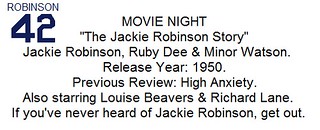
Movie Night: The Jackie Robinson Story.


Review #365: The Jackie Robinson Story.

Cast
Jackie Robinson (Jackie Robinson), Ruby Dee (Rae Robinson), Minor Watson (Branch Rickey), Louise Beavers (Mallie Robinson), Richard Lane (Clay Hopper), and Harry Shannon (Frank Shaughnessy) Directed by Alfred E. Green.

Review
This is an unusual movie, not because it's a film about a baseball player, but the fact that the man that plays the main character based off real life events...is the same guy, starring himself. Basically in a nutshell, Jackie Robinson playing Jackie Robinson. But nevertheless, the film doesn't have any other odd quarks, it is sort of a footnote, released at the mid point of Jackie Robinson's career, and this was the first of a few films about him. The acting is decent, nothing too special. Robinson does okay for what is essentially just Robinson being Robinson. But at least the film has its moments and it at least for what it's worth tells a story. Robinson was the first African American to play in Major League Baseball since the 1880's, and he would be the first of many to come. The film is okay and short to the point at about 70 minutes. Take it for what it is worth.

Overall, I give it 7 out of 10 stars.