
Showing posts with label John Guillermin. Show all posts

November 25, 2025

King Kong Lives.

Review #2474: King Kong Lives.

Cast: 
Brian Kerwin (Hank Mitchell), Linda Hamilton (Dr. Amy Franklin), John Ashton (Lt. Col. Archie Nevitt), Frank Maraden (Dr Benson Hughes), Peter Michael Goetz (Dr. Andrew Ingersoll), Jimmie Ray Weeks (Major Peete), with Peter Elliott (King Kong), George Yiasoumi (Lady Kong), and Benjamin Kechley (Baby Kong) Directed by John Guillermin (#726 - King Kong [1976], #1231 - Shaft in Africa, #1447 - The Towering Inferno#2044 - Never Let Go)

Review: 
Do you remember when they did a remake of King Kong the first time around? The 1976 film of King Kong was the one with the poster that called it "The most exciting original motion picture event of all time." Dino De Laurentiis spearheaded the venture after buying the film rights from RKO-General (whether he did so on the basis of seeing a poster in his daughter's room or because he was brought in to it by Paramount after Michael Eisner suggested the idea of a remake is debatable). The fiery John Guillermin (Laurentiis called him a "talent guy" and also a "strange character" while Guillermin aimed to do a remake that could balance jokes and the "danger of bathos" with obvious sincerity) directed a movie laced with a few hiccups. A Lorenzo Semple Jr-penned script aimed for a light amusing touch for a supposed more sophisticated audience while having the balls to have a lead character named Dwan and had to do a man in a suit because of failed attempts to do a full-scale animatronic Kong*. Even though it may not have been the megahit Laurentiis thought it would be (he actually thought it could rival Jaws [1975]), it did make some money. I watched the movie back in 2015 and thought it was painfully average, especially with its human stars, because when I watch a King Kong movie, clearly, I want to focus on the love story. So, anyway, ten years later. Laurentiis wanted to make another movie for years but couldn't get a good script going, with ideas being floated about Kong going to Russia or even being involved with kids for goofiness. But Ronald Shusett (the co-writer of Alien) and Steven Pressfield pitched an idea of an artificial heart that apparently won him over. As for Guillermin, he had made three flops (Death on the Nile [1978], Crossover/Mr. Patman [1980], Sheena [1984]), but here he was, back for what ended up being his last theatrical film as a director; he died in 2015 at the age of 89. Evidently, documentary filmmaker Charles McCracken did uncredited work on the film in directing the film. 

Apparently, when it came to reviews, they tried to strong-arm Gene Siskel and Roger Ebert in to only showing snippets of the film on TV for their show if they were positive about the film. The movie did make money (most notably in the Soviet Union), but the marketing costs evidently did not help matters for Laurentiis in a movie that has not exactly had many admirers over the years. It's easy to see why. At least the effects for the two Kongs look fine at times. It helps when the rest of the movie is so damn silly that even the 1960s Godzilla movies would tell it to relax. You might remember that Kong was bloodied and fell down the World Trade Center in the last film. Don't worry, the film will tell you that with its reprisal of the ending of the film that is included here...and that Kong actually is in a coma. I think it actually makes me want to check out King Kong Escapes (1967), the one where Toho did a mechanized King Kong. Here we have a movie with half of a good premise: Kong in the backwoods rather than in a big city...or just have it be about the two Kongs. Instead, it tries to play every card on the table with a lack of interest in really given Kerwin & Hamilton meaningful lines. Kerwin apparently was in on the idea that it was an adult fairy tale that would have humor and basically be more a film to show Kong, and, well, I can't blame him there. The two are just stuck in autopilot, even when trying to spruce up the bare minimum in "he's the cocksure dude and she's the smart one". Ashton and the others that deal with Kong result in little to really care for besides calling them disposable, which is a shame, since one could have fun with an adversary that cares about taking down the beast. It just lacks drama or even corny fun, somehow managing the impossible of just appealing to nobody. At the end of the day, this is overblown 10-pound schlock in a five-pound bag of crap that is semi-enjoyable when one knows that the 1976 film was already pretty lame to begin with. For a film that pretty much nobody wanted, you could probably do worse.

Overall, I give 4 out of 10 stars.
Tomorrow: Fantastic Four (2015)

*Carlo Rambaldi, Glen Robinson and Frank Van der Veer won a special Academy Award for the visual effects. Also, unrelatedly, Pauline Kael called the 1976 movie a "romantic adventure fantasy". Ridiculous.

Steven Pressfield wrote in his book The War Of Art : Steven Pressfield : Free Download, Borrow, and Streaming : Internet Archive that he thought the script was going to turn out a hit film. While it wasn't, it at least meant he was an actual pro and he went on to do scripts such as Above the Law and novels such as The Legend of Bagger Vance and Gates of Fire.

July 17, 2023

Never Let Go.

Review #2044: Never Let Go.

Cast: 
Richard Todd (John Cummings), Peter Sellers (Lionel Meadows), Elizabeth Sellars (Anne Cummings), Adam Faith (Tommy Towers), Carol White (Jackie), Mervyn Johns (Alfie Barnes), Noel Willman (Inspector Thomas), David Lodge (Cliff), and Peter Jones (Alec Berger) Directed by John Guillermin (#726 - King Kong (1976), #1231 - Shaft in Africa, #1447 - The Towering Inferno)

Review: 
The temperamental director may be a tough one to rein in, but when they excel in multiple genres or continue to get dependable work, they deserve everything they do. What does one expect from a man called many things from having an "irascible streak" to being a "pain in the ass"? John Guillermin was born to French parents in London. The dawn of World War II saw him join the Royal Air Force before his childhood interest in film got him into documentary filmmaking (with a few bits for a perfume company) and eventually features before he turned 30. He did his time with modest budgeting for Robert Jordan Hill, Vandyke Productions, television productions, and so on; the films that gave him first notice beyond the usual small expectations were Town on Trial (1957) and I Was Monty's Double (1958). He was then hired to do Tarzan's Greatest Adventure (1959), which was also pretty successful. The basis for the film came from a real event that I would hope doesn't happen to you: a man finds his car was stolen. Guillermin had his car stolen and told Peter de Serigny about it, with the latter happening to be a producer. They had a discussion about what if one had their whole livelihood dependent on their car. They made a brief story outline and then approached Alun Falconer to do a full script, with the result being the film here. This was the second of two films released in 1960 with Guillermin as director, after The Day They Robbed the Bank of England (1960).

Admittedly, it is a tantalizing kind of "kitchen-sink noir", one that shows just how far a man can go if they are pushed to the brink of what they deem to be unfair. You know, I actually did suffer a robbery once. It was October 20, 2022, when I foolishly went a path I probably should have thought twice about going in broad daylight. I may have been robbed of some money, but I'll be damned if they were going to steal my cell phone. The point I want to make (aside from not merely asking them to go to hell) is that some things are easy to take for granted until you have to fight for them to stay in the right place. Far from being just a movie about wanting their car back, it also is a movie about wanting to assert themselves as a man once again. For a time, Todd was a name actor with reputation in studio features (such as Disney and 20th Century Fox) after The Hasty Heart (1949) had him in demand. It is clear to see why, because he proves palatable in the panic shown without turning into a whimpering caricature. His refusal to give in becomes our refusal, one that we firmly believe in despite one's thoughts for how sad it all seems when shown up close with Sellars, who can only watch in blistering shock. If you can believe it, Sellers was actually approached to play the lead but asked if he could play the villain instead. Already a presence in various comedies (such as The Goon Show), this would stand out as a distinct dramatic role in his career that had seen him play a few roles making light of authority figures. He excels pretty well here, one who manages to achieve the conniving task of arrogance without being just a bland heavy, one who is more than a guy who at one point smashes a turtle. He never breaks once in his tension as a gritty portrayal of ruthlessness, which works right to where the film must lead to in the final climax (evidently, he was unable to stop from letting the performance not seep into his homelife, which resulted in a tense recollection from his wife). Faith was a pop singer teen idol who tried to make something within acting while only just in his twenties, and he makes a decent showing in the tension of youth and rough reality (as one expects from him and White). I do love the final sequence right after the fight, where a bruised and battered man in triumph drives off with his badly desired car, one who could care less about procedure or anything when being off to rest at his home, one who sits in the dark and finds a surprise awaiting him. With an efficient runtime of 90 minutes and a somewhat interesting music score from John Barry, this results in a pretty neat effort for all involved, one that is wrapped in sincerity in the heart of stubborn nature above all else that rewards the viewer in solid performances that really does not let go of your attention.

Overall, I give it 8 out of 10 stars.

June 17, 2020

The Towering Inferno.

Review #1447: The Towering Inferno.
Cast: 
Paul Newman (Doug Roberts), Steve McQueen (Michael O'Hallorhan), William Holden (James Duncan), Faye Dunaway (Susan Franklin), Fred Astaire (Harlee Claiborne), Susan Blakely (Patty Duncan Simmons), Richard Chamberlain (Roger Simmons), Jennifer Jones (Lisolette Mueller), O. J. Simpson (Harry Jernigan), Robert Vaughn (U.S. Senator Gary Parker), Robert Wagner (Dan Bigelow), Susan Flannery (Lorrie), Sheila Matthews Allen (Paula Ramsay), Norman Burton (Will Giddings), Jack Collins (Mayor Robert "Bob" Ramsay), Don Gordon (Kappy), Felton Perry (Scott), and Gregory Sierra (Carlos) Directed by John Guillermin (#726 - King Kong (1976) and #1231 - Shaft in Africa)

Review: 
"You know, there's really nothing like an exciting film on a big screen. Hopefully, I've made a few in my career."

Here's an idea: How about a film based on not one, but two books? No wait, here's one better, how about one released by two major studios? This film, adapted from The Tower by Richard Martin Stern and The Glass Inferno by Thomas N. Scortia and Frank M. Robinson, was released in the United States by 20th Century Fox and worldwide by Warner Brothers, as Irwin Allen (who would direct the action sequences) convinced them to make one film together rather than just adapting the novels separately for film. There were numerous disaster films of this era, but The Towering Inferno likely topped them all, despite attempts for others to try to raise the heights, considering 1974's output in this film, Earthquake, and Airport 1975 (the sequel to the original film with familiar disaster star Charlton Heston). Simply put, if something existed that had people nearby, by George would there be a disaster waiting to happen, whether that involved rollercoasters (with Sensurround!), football games (sniper or blimp, take your pick), or meteors. The one fitting to helm a big budget action adventure would be John Guillermin, noted for his intense perfectionist attitudes for his film that crept to his stars and producers for a varied career of distinct hits at times in a career that spanned over three decades.

This is an interesting duo for a film, since both Newman and McQueen apparently have the same amount of lines despite the latter not appearing until forty minutes into a 165 minute film (he actually was meant to star as the architect but lobbied for the architect role and got it). One thing this film certainly has enough of is ludicrous spectacle, a film that builds and builds and builds until it nearly becomes too much about a massive fire that engulfs its audience and stars to make for fair entertainment in parts with enough effects and silliness for a lifetime. It is arguable to say which Allen epic is better with The Poseidon Adventure or this, but it can't be denied that they have had their own types of lasting appeal, with both making plenty of money and receiving accolades (mostly technical awards along with title songs, oddly enough) that make them interesting pieces for their era. Newman (who apparently described the film later as a "turkey" before appearing in another Allen film years later in When Time Ran Out) is quite casual here, rolling with the occasional line about safety and exposition without trouble. McQueen (who appeared in three more films before his death after taking a four-year hiatus following this film) is calm and collected in leading the fire aspects that keeps your attention in a balance that favors the two stars without engulfing them in a scenery-chewing contest. Holden, who described his part as one that spends all the time talking on the phone (while clearly liking the money more than the script), does just fine with a role that doesn't really require too much besides just interacting with the occasional figure in a room - as long as he doesn't seem to be lost in the fun, it works out. Dunaway definitely gets close to being lost in all of this, since she only interacts with Newman for a few scenes before being mostly in the background. There are little highlights within the rest of the cast, such as the kindly professional Astaire paired with the equally kind Jones (in her last role), or a snidely Chamberlain, or even sprinkles of football star-turned-actor Simpson and his rescue of a cat (who then only reappears at the end to give the cat away to a survivor, naturally). One is here to see who will come out of alive, and while there may not be as much of a seeable count of vanquished stars, it still makes for a thrilling film at times, if only because of the thought of a building on fire from below does seem pretty scary. There are plenty of spectacle moments such as the stairwell rescue, the outsider elevator debacle and rescue, the daring attempts to rescue people (and cats) from fires, and a two million gallon water climax. For those who seek out something brimming with spectacle and stars that overflow the pot with mostly satisfaction, you can't quite go wrong with this film - a worthy disaster film highlight for its era.

Overall, I give it 8 out of 10 stars.

June 13, 2019

Shaft in Africa.


Review #1231: Shaft in Africa.

Cast: 
Richard Roundtree (John Shaft), Frank Finlay (Amafi), Vonetta McGee (Aleme), Neda Arneric (Jazar), Debebe Eshetu (Wassa), Marne Maitland (Col. Gonder), Spiros Focás (Sassari), Jacques Herlin (Perreau), Frank McRae (Osiat), Nadim Sawalha (Zubair), Thomas Baptiste (Kopo), and Glynn Edwards (Vanden) Directed by John Guillermin (#726 - King Kong (1976))

Review: 
Admittedly, the first two Shaft films (released in 1971 and 1972, respectively) were fun pieces of entertainment for the right time, being on the forefront of the blaxploitation era - riveting movies that had plenty of action and interesting qualities to go around , with a good deal of credit going to its lead in Roundtree alongside direction from Gordon Parks and writing from Ernest Tidyman (writer of the novels that had featured the character beginning in 1970). For this one, both did not return, with the writing being delegated to Stirling Silliphant (mostly known for his work on projects such as Route 66 along with the screenplay for In the Heat of the Night) while Guillermin was brought in as director. This was the third installement of the series - which proved to be the last of the series for over two decades. It ranks as the weaker of the three Roundtree films in terms of general excitement and foundation, but Roundtree keeps it together long enough to make it most worth a watch. It is evident the makers of this film really wanted to keep things fresh, and perhaps they really thought changing the setting to Africa would rake in a few more box office dollars. After all, both of the previous films had each been made for under $2 million while raking in over $10 million each at the box office, so raising the budget a bit should prove good luck - it did not, since the film failed to make its budget back. The film seems a bit too closed in with trying to make a casual adventure action film, complete with James Bond type gadgets in a stick and a story that tries to cover itself with some subtext involving a bunch of 70s sounding topics while only really doing best with its action sequences, which do their part in giving the film a leg to stand on. It feels a bit too long at 112 minutes, dragging in the middle while not recieving much help from its opening or end in makign a proper powderkeg of entertainment go off. Roundtree is the highlight of the film, containing charm and care without having to say too much, stepping into some comfortable if not entirely challenging shoes. Finlay can't really make this role seem any more than just an "Evil Brit" type, but at least he's passable. McGee is fairly charming, although the others aren't too particularly memorable to go along with. It is a film that meanders in a somewhat interesting setting but with conventional execution and not much else to go along with. On the whole, this is a film that just can't quite get itself into gear enough to make a consistent winner, but it may prove just well enough for people wanting some fair action type without too many struggles. It works best when one doesn't give too much thought to how things go down and just let it happen, whether it involves stickfights, a mild climax, and a little passion to go around.

Overall, I give it 6 out of 10 stars.

July 12, 2015

King Kong (1976)


Review #726: King Kong.

Cast
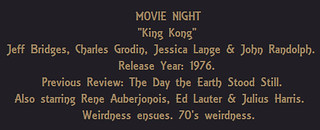
Jeff Bridges (Jack Prescott), Charles Grodin (Fred S. Wilson), Jessica Lange (Dwan), John Randolph (Captain Ross), Rene Auberjonois (Roy Bagley), Ed Lauter (Carnahan), Julius Harris (Boan), and Jack O'Halloran (Joe Perko) Directed by John Guillermin.

Review
If you want to promote your remake of a 1933 classic (#283), here's a good tag line: The most exciting original motion picture event of all time. Granted, this movie is about as original as a baloney sandwich trying to call itself a ham sandwich, but it certainly has a good ring to it, especially when produced by Dino De Laurentiis. Let me make this perfectly clear from the beginning: If it's between this and the original film, stick to the original film. But it could be argued that this film knows that going in, so it tries to do something different, with a campier tone, 130 minutes, and actual filming locations instead of stages. Carlo Rambaldi designed the effects for this film, and he helped construct a 40 foot mechanical version of Kong, which shows up (briefly) near the end of the movie. It's clear that the movie wants to show the technical aspect and then build characters around that. In a way, it works, although the end product is not exactly as grand as it could've been. The motivations and plot are updated into a quest for oil, which I suppose is creative, though it ends the same way as the original...At least they include Kong's heartbeat before he dies, so that's something new. How the cast does depends on what you (the viewer) want: If you like the idea of campy infused people interacting around the main attraction (Kong), go for it. For me, they're okay. They just seem to get in the way half of the time, though Bridges and Grodin (all fashion and hair aside) seem to do okay. Bridges' character cheering for Kong taking down the helicopters is strange, considering he's seen Kong throw people off a log into a pit, crush people on the ground, and throwing debris towards people. And yet, he cheers him as if he's done nothing wrong. If you don't want Lange's character to be eaten, then that's a good thing for you. Like the original, this film's effects are a product of their time, and for most of the movie, Kong looks relatively good, without much light shown, anyway. Near the end it looks a little more fake, but the movie doesn't linger too much on that. No, it lingers more on just about everything else, from the oil to Bridges-Lange, etc. John Barry's music is a highlight. Take this movie for what it is: A jumbled flow of effects and 70's style filmmaking that can be hit or miss. For me, it's sometimes enjoyable, but other times it's just okay.

Overall, I give it 6 out of 10 stars.