Showing posts with label 1919. Show all posts

January 5, 2022

Blind Husbands.

Review #1782: Blind Husbands.

Cast: 
Sam De Grasse (Dr. Robert Armstrong, The Husband), Francelia Billington (Margaret Armstrong, The Wife), Erich von Stroheim (Lt. Erich von Steuben), Gibson Gowland (Silent Sepp), Fay Holderness (The 'Vamp' Waitress), Ruby Kendrick (A Village Blossom), Valerie Germonprez (Honeymooner), Jack Perrin (Honeymooner), Richard Cummings (The Village Physician), Louis Fitzroy (The Village Priest), William De Vaull (Man from 'Home'), Jack Mathis (Man from 'Home'), and Percy Challenger (Man from 'Home') Directed by Erich von Stroheim.

Review:
Well, we've heard of a few films that had a director that also served as writer. But there are fewer that had a director-writer-producer, you must say. Nay, one that might be even harder to find is a director-writer-producer-star adapting his own book into a film. And yet here we are with Blind Husbands (1919), likely one of the most curious debuts of a Hollywood director for the next several years: Erich von Stroheim. He was a character like no other when it came to showmanship, particularly when it came to his journey to moviemaking. He was born in Austria to middle-class parents (operators of a millinery) as Erich Stroeheim. Not interested in the life of business or merchants, he first did volunteer work in military transport with horses and wagons, but he did not last long due to physicality (incidentally, his reported height was 5'6). In 1909, he sailed to the States and identified himself as Count Erich Oswald Hans Carl Maria von Stroheim und Nordenwall. Dubious nobility aside, he first worked as a gift wrapper before eventually moving to the West Coast, utilizing his knowledge with horses in a riding academy in California. He soon found himself in the company of D.W. Griffith, starting with bit parts in the mid 1910s before moving onto Prussian roles late in the era (earning the nickname "The Man You Love to Hate", incidentally). His knowledge of military detail helped get him work in assistant directing, and he soon found an in when it came to a desire to direct for himself, doing so with Universal (headed by Carl Laemmle) in an agreement to star, direct and write alongside designing the sets and editing (at $200 a week in total). Von Stroheim would be noted for his lavish attempts at filmmaking that hindered his overall output: he made a total of nine films, with a considerable amount modified by the studio (most notably with Greed), for which two are lost and two others are missing their original versions; his last directorial film was in 1933, but he persisted in acting until his death in 1957.

This was an adaptation of his novel The Pinnacle. The movie was a considerable success for the fledging studio, even if von Stroheim was probably more irritated at the fact that the movie title was changed (strange, considering the fact that pinnacle in geology refers to an isolated indivdual column of rock in the shape of a shaft/spire). It is a curious debut, an offbeat fantasy film for its main name that looms over everyone with an interesting perspective about lust through the eyes of the folks at the center of it. Consider the fact that there have been plenty of love triangle films over the years, and consider the perspective of the adulterer in the middle of the action. Sure, adultery is a terrible thing, but emotional loss of a spouse beforehand is also a terrible thing to witness. Vulnerability is a terrible thing to have, whether spent in the mountains with oneself or spent with a mix of diminsihing hope and a manipulator willing to take advantage of it. Who is surprised to see von Storheim as the big presence? He glistens in self-importance in a way that makes him both detestable and the prime curiosity that could almost make him draw pity. Of course, the shot of him with a a big grin (and distinct scar) along with a pipe and hands pointing at the camera certainly lend attention. He isn't exactly playing a Don Juan type figure of seduction, you see, instead playing it with flattery to go with impeccable dress sense that works to his advantage in terms of appeal for the time. Besides, sometimes it does help to be a villain to stick out in silent roles, since one might recognize De Grasse for his handful of adversarial roles more so than this film (of course, he was also an early Canadian presence in film for two decades). He does fine here, benign to what is needed in terms of charm when paired with Billington until he is needed to match with von Stroheim in the climax. This ended up being the most famous role for Billington, who acted in a variety of films that are fairly obscure despite her acting for a variety of studios. At any rate, she does well here, playing the vulnerability to the lingering camera with the right emphasis. By the time the film is closing its 91-minute run-time, it has managed to make a useful drama on the perils of desire and neglect that would surely compare with the middle-tier of a growing silent era that would only continue to drive interest in the next decade of the 1920s, with von Stroheim playing a distinct part in that regard.

Overall, I give it 8 out of 10 stars.

Welcome to 2022! Year 12 of Movie Night starts here with a tremendous theme for the first month of the year - Movie Night: New Directors. Yes, you heard that right, Movie Night will feature a variety of directors not previously featured before from various eras and countries. 

Next Time: Sky High (1922).

August 23, 2019

The Roaring Road.


Review #1263: The Roaring Road.

Cast: 
Wallace Reid (Walter Thomas "Toodles" Waldron), Ann Little (Dorothy Ward, the cub), Theodore Roberts (J. D. Ward, the bear), Guy Oliver (Tom Darby), and Clarence Geldart (Fred Wheeler) Directed by James Cruze.

Review: 
How many times can one pick a century-old film to give spotlight to? The decade saw Hollywood rise in stature for film-making in the United States, with several studios rising to the occasion to make their own films, ranging from shorts to roughly an hour. Who better to cover than a film from Paramount Pictures, one of the oldest film studios still in existence that also happens to be the lone major studio still located in Hollywood. In a silent era where plenty of films were lost to audiences after release forever, one can appreciate the ones that did in fact survive for someone to view (particularly for films exhibited for over 95 years, which make for fresh pickings in the public domain), and I would hope that a viewer picks at least one film from this particular era of film-making to look at once in a while. This is a year in which test screenings were only just beginning to be used to gauge reactions to film, after all. Not every film needs to be loud or expressive to be a true winner, although the reverse can easily be said when it comes to how films were back then, which certainly could be spectacular or ridiculous. In this case, this is an okay movie, filled will silly moments to boot aside from a few interesting directing sequences (done through Frank Urson) that accompany a relic like this. It just doesn't feel like the kind of film meant to endure as heavily as other films of its time, where Broken Blossoms and The Grim Game managed to evoke more emotion and thrills in the same year. Each film certainly looks like they came from 1919, but there is a certain energy in the direction or its star that really drive those two films to inspire curiosity that this does not.

What is this film, you may wonder. Well, it's about a automobile salesman who wants to race and also get the daughter of his boss - even winning the big race in the middle of its 58 minute run-time doesn't convince the dad to let go of his daughter to be married unless they wait five years, because...1919, I suppose. Marion Fairfax helped write the scenario based on short stories done by Byron Morgan (Junkpile Sweepstakes, Undertaker's Handicap, Roaring Road), which turned out to be such a success that it inspired a sequel named Excuse My Dust the following year. Reid does fine, even if one doesn't really see that much of him (the auto scenes with him count, I suppose), but what can one really do with a name like Toodles? In the same year that he did this film, Reid suffered an injury to his scalp while in production for The Valley of the Giants. Treatment to relieve his pain at the time meant addiction to morphine that would torment him for the following three years in which he kept working in films before his death in 1923 at the age of 31. Little is okay, although she doesn't really seem to show that much passion (one would expect that from a film that favors its race action a bit more, really). Roberts (introduced to us after a quick shot of a bear to open the film) is also okay, playing to the strings of the plot with reasonable unreasonableness. In the end, this is a fairly mediocre effort that just can't inspire a shift into second gear despite all the chances to do so. You wouldn't hate what you see on screen by any means, but you also wouldn't really like it all that much either.

Overall, I give it 6 out of 10 stars.

October 22, 2015

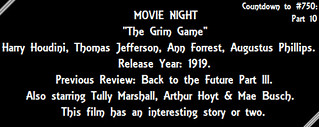
The Grim Game.


Review #749: The Grim Game.

Cast
Harry Houdini  (Harvey Hanford), Thomas Jefferson (Dudley Cameron), Ann Forrest (Mary Cameron), Augustus Phillips (Clifton Allison), Tully Marshall (Richard Raver), Arthur Hoyt (Dr. Harvey Tyson), and Mae Busch (Ethel Delmead) Directed by Irvin Willat.

Review
Ah 1919, where the word spendthrift can be used, and cities (like mine) can be formed (and named) after a land company. Before I get to the film, let me talk a little about the history of the film in the next paragraph.

The Grim Game was Harry Houdini's first feature-length film (though the serial The Master Mystery was released in early 1919) and Houdini would star in films until 1923. Houdini (an expert magician who also debunked spiritualists) died on Halloween Night in 1926, though his legend still shines through today. As for the movie, it also has an interesting story of its own. This film had been considered lost for over 90 years. As it turned out, Larry Weeks, who considered himself Houdini's biggest fan, had a copy of the film in his collection after claiming it from the Houdini estate in 1947. Through the help of film scholars, TCM and the owners of the Houdini Museum and some negotiating, the film was acquired by TCM. A restoration and a new score were done, and TCM showed it as part of their Film Festival on March 29, 2015, with the world television premiere being just this Sunday night.

After all that history, how is the film? Not too bad. For an adventure-drama, it does have its shares of thrills, especially due to Houdini. You get to see him escape from chains and even a straight-jacket, and at one point he even manages to make a gun come out of his sleeves, which surprised me. The "Grim Game" turns out to be a plan hatched by Houdini's character to get his paper that he reports from to survive...by framing himself for the disappearance of his uncle, all by circumstantial evidence. He actually enlists the help of five people (including his fiance) to get this plan done, which includes taking the uncle out for a while to make it seem like he has disappeared. But it goes wrong (naturally), as the uncle is actually killed...by someone. It turns out to be the one person I didn't expect, mainly because I assumed that the one that would get to marry the heiress to the uncle's fortune did it...that, and because he wants to put Houdini in the asylum. But it's not, which I guess makes it less predictable...either way, the movie is at least entertaining, though it does take a while to get to the aforementioned grim game. The climax of the movie is entertaining...because you get to see a mid-air plane collision! Naturally, everyone (real life and plot life) is okay, but getting to see the climax in the air is very well-done. The movie (running at 71 minutes) is well paced, while also showing off some of Houdini's talents.

Countdown to #750: 10, 9, 8, 7, 6, 5, 4, 3, 2, 1.

Overall, I give it 8 out of 10 stars.

February 14, 2015

Movie Night: Broken Blossoms.


Review #695: Broken Blossoms.

Cast
Lillian Gish (Lucy Burrows), Richard Barthelmess (Cheng Huan), Donald Crisp (Battling Burrows), Arthur Howard (Burrows' Manager), and Edward Peil Sr. (Evil Eye) Directed by D. W. Griffith (#415 - America)

Review
I admit to not having covered the 1910's much on this show, as this is only the 4th film from that decade (the others being Mickey, Back to God's Country, and The Poor Little Rich Girl) featured on this show, let us just push that fact aside for now for a movie unlike the other films. This is a movie that manages to evoke sadness over the small rays of hope while never betraying its purpose of tragedy. Gish is instantly likable for the audience, from the sad expressions in her eyes to her forcing a small smile, she makes the movie have an unsettling mood. Barthelmess and Gish are wonderful in the scenes they share with each other. Maybe it's the way they look at each other, or how innocent it all seems, which is a blessing by contrast to the rest of the film's tone. Speaking of that, Crisp is brutally effective at making the movie nearly uncomfortable to watch, with his expressions of anger, which all boils down to the surface with the closet scene near the end. Gish's fearful expressions and Crisp's anger combined with filming in a small set make for a climax that delivers. Yes, it's a sad movie. But this a sad movie that manages to be well made along with having some really effective acting. Because after all, if we just watch happy movies all our lives, we'll never know what to do when we encounter a sad moment in our lives.

Overall, I give it 10 out 10 stars.

July 1, 2014

Movie Night: Back to God's Country.

Review #607: Back to God's Country.

Cast
Nell Shipman (Dolores LeBeau), Charles Arling ('Sealskin' Blake), Wheeler Oakman (Peter Burke), Wellington A. Playter (Captain Rydal), and Roy Laidlaw (Baptiste LeBeau) Directed by David Hartford.

Review
There are many notable people from Canada I didn't cover last year, such as Norma Shearer, Donald Sutherland, Seth Rogen, Dan Aykroyd (whose birthday is today), Michael J. Fox and even William Shatner, and so in honor of our neighbor from the north, I'm reviewing two movies having to do with Canada. 

The first is this film, the second oldest movie ever reviewed on this show, released nearly 95 years ago, and one of the earliest Canadian features, and the most successful silent film in Canada's history. Shipman helped to write the film (which was already adapted from a short story by James Oliver Curwood), and she stars in it as well. The movie lasts about 72 minutes, so it's a breeze to get through, and though the plot may be somewhat paper thin, it at least is enjoyable to watch, though a little music would have helped. The blue tint for night is good looking, and the scenery is nice, the cold near wasteland is fine for a film like this. Shipman is a fine hero to watch, and the rest of the cast is decent, this is overall a decent movie that while starting slow, does manage to entertain, and on Canada Day, I guess that's all that matters. 

Overall, I give it 8 out of 10 stars.
The next film will be Tomorrow Never Comes, stay tuned, as it will be posted in a few hours. Go...Blue Jays?
original image: