Showing posts with label 1997. Show all posts

November 2, 2025

I Know What You Did Last Summer (1997).

Review #2463: I Know What You Did Last Summer.

Cast: 
Jennifer Love Hewitt (Julie James), Sarah Michelle Gellar (Helen Shivers), Ryan Phillippe (Barry Cox), Freddie Prinze Jr (Ray Bronson), Johnny Galecki (Max Neurick), Bridgette Wilson (Elsa Shivers), Anne Heche (Melissa "Missy" Egan), Muse Watson (Benjamin "Ben" Willis / the Fisherman), and Stuart Greer (Officer) Directed by Jim Gillespie.

Review: 
"The joy of this film for me as a filmmaker was in taking [the] elements that we've seen before, and saying to the audience: 'Here's something you've seen before'—knowing that they're saying 'We've seen this before'—and still getting them to jump."

You may or may not know that this came from the writer of Scream (1996). Yes, Kevin Williamson had written a script loosely based on the 1973 novel of the same name, which had been written by Lois Duncan...but that script was done before Scream was even a thought in his mind, with the success of the 1996 movie getting people onto the idea of maybe doing studio slashers, which is where the old script came into play. This was the feature film debut of Jim Gillespie, who previously had done work on television and music videos. Duncan went on record as stating she was appalled by the movie being based on her book (stating specifically that she had a problem with sensationalized violence made to "seem thrilling rather than terrible", particularly since she was the mother of a murdered child); incidentally, Gillespie aimed to film with as little on-screen blood as possible to try and not be gratuitous with the violence. The book was a suspense novel featured a group of teens getting into a car accident (in the book's case, a young boy on a bike) that leads to death for the kid and oddly enough, nobody else. The movie was relatively successful with audiences, at least enough to inspire a sequel called I Still Know What You Did Last Summer in 1998 to go along with a direct-to-video feature (nobody cares), a modern take of the first film for an Amazon show in 2021 (what?), and a legacy sequel in 2025 that was called...I Know What You Did Last Summer (ironically following Scream doing the same thing years earlier*). 

Sure, you remember the movie about a hook-wielding killer terrorizing four teenagers. And you probably had one question on your mind: What the hell? What the hell to any of this? This was Williamson's "straightforward" horror script? To be clear, I will say that I may or may not be a bit generous with horror movies when it comes to assessing them because, well, there are some that are just entertaining even in mediocrity. But not this one. It isn't even the barebones body count (four), and it isn't even just the fact that the characters might as well have been constructed out of a wood board. No, what annoys me the most is that this supposed modern take on the slasher movie is just the same type of hack stuff you could find in Friday the 13th. And that movie was meant to be taken seriously, but with this movie, I thought it was supposed to be a joke, right down to the scene where Hewitt twirls around before screaming into the air what is the killer waiting for. Some might be subservient to any kind of slasher movie when it comes to spectacle, but not me, not for this one. The funny thing is that the killer is pretty terrible at how he targets people, since half the people he kills had nothing to do with the thing that happened a year prior and some of the time he just sneaks up on the people just to...terrorize them (seriously, he breaks into one girl's house to cut her hair down). But it comes in such a tedious little movie, one that aims to say something, anything about what it means to make the wrong choice and have to live with it...and then the ending coughs that up anyway! 

Some folks might consider Gellar to be the highlight of the film when it comes to...acting, but in general, everyone seems to be on the autopilot you could find in any generic slasher, even with the proverbial dark cloud over their heads. They just seem more like they are waiting for the boat show rather than being spooked by what is occurring around them, suffice to say. At least Phillippe is amusing in that veneer of arrogance and privilege for a time, probably far more than you think he will go given the amount of people to be terrorized or otherwise (such as Galecki, who might as well have been a paperweight). By the time the movie has ended its reign of error, complete with the characters seemingly learning about telling the cops about what the hell is going on, you will have gotten the feeling the movie was the equivalent of a toothache. This isn't one of those times where I get mad a slasher for being a slasher, this is just one of those frustratingly mediocre movies to get mad at because there were ideas worth looking into. Why not make a mystery worth watching about people who can't cope with who they are in making the wrong choice? But nah, there was a hook story mentioned in the early parts of the movie so we can have the killer go with hooks because, uh, reasons. As a whole, I Know What You Did Last Summer has a few tiny moments of relief - the chase of Gellar near the end is probably the highlight, at least when not considering the humor at the movie's expense for sheer ludicrous things. But the real moment where you believe things will be good comes here: when you look at the fact the 101 minutes are over, and you can watch a different, more interesting slasher movie. Or just a non-slasher movie. Or, well, whatever. Anything other than middle of the road junk.

Overall, I give it 5 out of 10 stars.
Next up: Pumpkinhead.

*Totally not the point, but I don't give a shit about the reasoning for Scream 5 (2022) being called Scream. It was stupid when Halloween (2018) did it, so if I ever get to the Scream movies beyond the first, you best believe I'm calling the 2022 one Scream 5. Then again, the weird people talking about Scream in recent days about 7 on both sides make me roll my eyes. 

January 31, 2025

The End of Evangelion.

Review #2344: The End of Evangelion.

Cast: 
Megumi Ogata (Shinji Ikari), Kotono Mitsuishi (Misato Katsuragi), Megumi Hayashibara (Rei Ayanami), Yūko Miyamura (Asuka Langley Soryu), Akira Ishida (Kaworu Nagisa), Fumihiko Tachiki (Gendo Ikari), Motomu Kiyokawa (Kozo Fuyutsuki), Yuriko Yamaguchi (Ritsuko Akagi), and Hiro Yuki (Makoto Hyuga) Directed by Kazuya Tsurumaki and Hideaki Anno.

Review: 
"Evangelion is my life and I have put everything I know into this work. This is my entire life. My life itself.”

Naturally. You may or may not have a pretty good idea of what Neon Genesis Evangelion is. The original anime (aired from October 4, 1995 - March 27, 1996) was directed by Hideaki Anno, who had developed the series as a way of dealing with personal responsibility that reflected his depression that he had suffered years prior. Born in Ube, Yamaguchi in Japan, he had an interest in artwork and short films from a young age, which paid off when he read an ad for a film (Nausicaä of the Valley of the Wind) that needed more animators. Anno helped to co-find the studio Gainax in 1984 and worked in animation direction on a variety of films and shows. Royal Space Force: The Wings of Honnêamise (1987) saw him work on key aspects of the design but also saw him affected by the film's failure with audiences. His debut as a director came with the anime Gunbuster (which ran from 1988-89). However, the lack of creative control given to him in his next work with Nadia: The Secret of Blue Water, which came about from a decade-old pitch from Hayao Miyazaki that Anno served as a chief director before handing over duties in the middle of it due to exhaustion (having just seen the anime in its padded length of 39 episodes, well...). Anno suffered from depression for a number of years after Nadia came out. Okay, so there were actually two movies when it comes to the Evangelion feature film project. Neon Genesis Evangelion: Death & Rebirth (as directed by Hideaki Anno, Masayuki, and Kazuya Tsurumaki) came out in 1997 that, well, I didn't feel like covering because it basically is just there for those who don't want to watch the first 24 episodes anyway (to say nothing of the edits such as "Evangelion:Death (True)"). The End of Evangelion was directed by Anno along with his protege Kazuya Tsurumaki, who had directed a handful of the aforementioned anime. Since the release of the film, Anno has directed in both live-action and in anime form, most notably with Shin Godzilla (2016) and, well, a "Rebuild of Evangelion" tetralogy (2007, 2009, 2012, 2021) that served as an alternate retelling of the show that saw Anno and Tsurumaki direct the four films.

Okay, so the final couple of episodes may or may not have confused people (jokingly or not, I interpreted it as "Touch grass"). For all of the labels and things one can discuss in tandem with the anime ("Postmodern", on a religious scale, Freudian, whatever), it really is just one of those times where, well, you just have to experience it for yourself to really absorb what it takes to create something for the public. To be around people is to know that they will let you down just as much as you may let down others but that you just have to keep going in the face of reality. Sure, the anime was a phenomenon because, well, it looked and sounded cool (we do not speak of people that act as fans of characters), but it also was a show that wanted one to actually look at themselves and connections. For me, I took some of it as a mecha soap opera (maybe with a little bit of calling it "self-therapy") and just "rolled with it" while being quite fond of the penguin and "Misato" (thinking back, it doesn't hurt to be the second banana in my rankings). With that in mind, the movie is pretty neat in terms of its animation (and uh, a few choice ideas near the end) and its overall reach in terms of dread that actually could be thought of as bleakly amusing for some. Life is bleakly amusing but if you choose to accept the parameters, you can make your own path, I suppose. When one looks back at both the anime and film, you don't feel like you're watching a cash-grab with the latter because it still seems fresh and interesting to see the introspection, ourselves or otherwise. It rests with Ogata in terms of looking at the anguish and doubts that arise in the dilemma of oneself (each of these people have their illusions that they would rather not see come across). I appreciate that blend of action and psychological/existential horror, which could be highlighted in a variety of scenes, such as the buildup to the climax or the awakening to Asuka. As a whole, regardless of where one is with anime or animation, The End of Evangelion is an experience worth seeking out for oneself. 

Overall, I give it 9 out of 10 stars.

Well, we have finished another New Directors Month. I wanted to open up a bit of variety with the choices this time around, and there were a wide variety of directors (and films) that missed out for the month (which either means I'll get to them sometime in 2025 anyway or maybe do in 2026): 

[Nagisa Ōshima] In the Realm of the Senses, [Douglas Sirk] Imitation of Life   
Tim Hunter's River's Edge, [Monte Hellman] Two-Lane Blacktop, [Terence Malick] Badlands
[Robin Swicord] Wakefield, [Sam Wood] Our Town, [Burt Balaban and Stuart Rosenberg] Murder Inc
[Lars von Trier] Dogville, [Robert Benton] Bad Company, [Frank Beyer] Jacob the Liar (1975)

October 25, 2023

Anaconda .

Review #2123: Anaconda.

Cast: 
Jennifer Lopez (Terri Flores), Ice Cube (Danny Rich), Jon Voight (Paul Serone), Eric Stoltz (Dr. Steven Cale), Jonathan Hyde (Warren Westridge), Owen Wilson (Gary Dixon), Kari Wuhrer (Denise Kalberg), Vincent Castellanos (Mateo), with Frank Welker (Anaconda snake) and Danny Trejo (Poacherck) Directed by Luis Llosa.

Review:
Look, you know what you are getting into with a film like this, especially one released in the late 1990s. The film utilizes a mix of computer-generated imagery and animatronics for its title creature (apparently, one can see an animatronic from the film at the California Academy of Sciences). Hans Bauer, Jim Cash and Jack Epps Jr wrote the screenplay, although it has been stated that Mark Haskell Smith provided a "production draft". The film was directed by Luis Llosa, a Peruvian film critic-turned-director (of course, being a cousin of noted novelist Mario Vargas Llosa is something to note). He got his start as director with Peruvian television shows such as Gamboa and Carmin before becoming a feature director with (where else?) Roger Corman productions such as Hour of the Assassin (1987) and Crime Zone (1989). Perhaps to the surprise of no one, there were follow ups; only Anacondas: The Hunt for the Blood Orchid (2004) was released theatrically, although it retained no original cast members from the first film. Plans to make a reboot film are apparently in motion, which I'm sure is interesting news to those who are familiar with recent creature features such as The Meg (I still can't get over that title). 

Honestly, the film almost overrode my low expectations. You have Ice Cube making a reference to his own songs for a line. You have Jon Voight putting on a Paraguayan accent because, well, okay, sure. You have a snake that reminds me of a gummy worm when it comes to the CG moments to go with an amusingly long snake (with sound effects by Frank Welker). Top it all off, you have a character swallowed up and regurgitated that shows a shot of them blinking right before they are shown dead. Imagine all of this coming in a film about a National Geographic crew looking for an obscure tribe in the Amazon. It sure isn't Creature from the Black Lagoon (1954), but it is the kind of goofy film that would fit just right from one of Corman's old features such as Attack of the Crab Monsters (1957). It probably goes without saying that a handful of sea creature features all seem to owe something to Jaws (1975), whether that involves POV shots or making creatures out to seem more dangerous than they are in the actual wild. Granted, the idea of going out in the jungle is a bit spooky, so having to deal with the idea of a snake that may eat or bite you is at least an idea I wouldn't wish on my worst enemy. But this is about as scary as, well, looking at a snake in a picture book. It is cheesy in every way you would expect that I can only cite as a light negative assessment. Lopez doesn't exactly have much to really do when overshadowed by obvious presences in Cube or Voight, because even being a screamer would be part of a personality. The cardboard "PG-13" folks are there just to come and go, which seems hollow when compared to other cheesy movies. Stoltz is probably given the most thankless role of the whole film, since he is basically put out of commission for half of it, which makes him pale in comparison to the ones that at least get to act in fear of the gummi snake. Undeniably, Voight seems to be the only one giving it his all when it comes to ridiculous mannerisms, a preening cliche if there ever was one to the very end that I'm sure Vincent Price would've blushed at. Hyde probably is the only one of the body-count to make an impression, even if it is a mild laugh. I do appreciate the time taken to build up a killer snake only to have one victim of the film fall at the hands of a guy who chokes a person out with their legs while tied to a board. One can do better or worse with creature features, and this is not exactly a winner, but with its evident qualities of being exactly what you expect from a 90s product that stands more of its time than older-aged films of its ilk (for better or worse), well, you get what you think you get. 

Overall, I give it 6 out of 10 stars.

Next: you might be wondering why Thursdays this month featured Dracula and Frankenstein films. Hell, why not? For the fourth and final time, let's get a doubleheader, starting with Blacula.

June 14, 2023

The House of Yes.

Review #2020: The House of Yes.

Cast: 
Parker Posey ("Jackie-O" Pascal), Josh Hamilton (Marty Pascal), Tori Spelling (Lesly), Freddie Prinze Jr (Anthony Pascal), Geneviève Bujold (Mrs. Pascal) Directed by Mark Waters (#151 - Mean Girls, #204 - Freaky Friday (2003), #236 - Mr. Popper's Penguins)

Review: 
"Basically, what we wanted to achieve was a heightened reality. The situations and characters are out there, but the actors are always coming from a real place. They're not wacky cartoon characters."

Oh hell, sometimes you have to go outside the box when it comes to picking movies involving directorial debuts and, uh, movies with one standout cast member in a limited ensemble. The film is based on the play of the same name by Wendy MacLeod, which originally was brought to the stage in San Francisco for 1990; various productions have been done over the years, which included one run on off-Broadway. Mark Waters adapted the play to the screen to direct, which came after years of waiting. He had seen the play and apparently saw immediate things that he would do to make it cinematic. When he was a student at the University of Pennsylvania, he got the attention of MacLeod and got a manuscript copy from her while saying he was a film producer. It took five years and graduation from the AFI Conservatory with a master's degree in filmmaking, but he eventually found his way to making the film, which was his feature debut. Aaron Spelling and his company Spelling Entertainment helped to finance the film for who else but his daughter Tori to serve as one of the key actors (Waters had planned to fund the film from foreign pre-sales, but hey, why not Spelling and his considerable television presence?). The film was shot over the course of 24 days for a budget under $2 million. Miramax apparently liked what they saw when it premiered at the Sundance Film Festival in 1997 and bought the rights to distribute it, which did not turn out to be a success in limited numbers. Perhaps an attempt at making a Gothic tale with macabre taste about an assassination was doomed from the start to do anything other than mild attention, but this was the year of other "family" films such as The Ice Storm and The Myth of Fingerprints (the latter had also premiered at Sundance that year). Of course, maybe I could do a teensy, tiny, little primer of what the film involves. It is set on Thanksgiving in 1983 and involves a main character that dresses up like Jacqueline Kennedy (Onassis) that has their own neat little secret to go with trips to the funny farm (footage from her tour of the White House is utilized with a young version of "Jackie-O", as played by Rachael Leigh Cook). Oh, and she and her brother have a certain connection that involves details of the assassination of John F. Kennedy. Waters would return to the director's chair in 2001 with Head over Heels.

You know, I had a feeling that this film was going to be an interesting experience, even with its stagey execution with odd dealings. It grew on me for its 85-minute runtime beyond my expectations of just being a mild experience with only a taboo to stick out or just hints. Of course, emotional obsession can make for quite a fun time for those who take investment into that sort of thing for their dark comedies, and it works out just fine for this feature, which goes into the jaws of psychosis and finds that one really cannot stop at the bottom, regardless if one belongs to the class of the rich, who might as well be called "the house of yes". So it isn't a movie about the Kennedys but merely the myth that centers around them. Of course, the film is carried most by Posey, who was once called "Queen of the Indies" for her work within various independent films, such as Party Girl (1995). She is the best part of the film because of how confident she is with such an unpredictable role, one that is extravagantly dangerous without being pegged down as a simple loon. She is captivating in how she grips your concerns for how much obsessive and irrational love can inflict their claws on someone that could pervade everything around them until that is all there is. As such, the scenes spent with Hamilton in the throes of mental anguish provide a quality tete-a-tete between the attempts at trying to be "normal" on one side and trying to, well, see how much things having in common really matters. Bujold is the ever-watching eye that can only help but pay attention to the charade of affluent breeding. Spelling was known for her role on Beverly Hills 90210. I suppose it makes sense that she ends up playing the most "normal" of the limited cast, and she actually holds her own pretty well in being the perfect plain contrast that has the biggest crime of being "normal". Prinze Jr was actually in his second film role here, having gotten into show business because his grandfather told him to in order to "fix what your father fucked up". He may not be close to the best thing about the film, but his odd duck youthfulness gels just fine when it comes to uncomfortable amusement, spent mostly with Spelling in a different kind of charade built on warped desire. As a whole, the film doesn't become too warped in sincerity or camp value to lose sight of what matters in a film about people who are never told no that go with snappy dialogue and useful pacing to make a darkly enjoyable surprise for those who buy into that sort of thing, especially with its final fateful decision. I dug it and where it went in its stagey foundations with a good dark chuckle.

Overall, I give it 8 out of 10 stars.

November 17, 2022

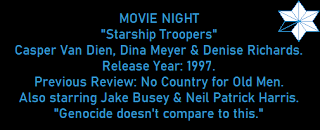
Starship Troopers.

Review #1922: Starship Troopers.

Cast: 
Casper Van Dien (Johnny Rico), Dina Meyer (Dizzy Flores), Denise Richards (Carmen Ibanez), Jake Busey (Ace Levy), Neil Patrick Harris (Carl Jenkins), Clancy Brown (Sgt. Zim), Seth Gilliam (Sugar Watkins), Patrick Muldoon (Zander Barcalow), and Michael Ironside (Jean Rasczak) Directed by Paul Verhoeven (#002 - RoboCop and #632 - Total Recall)

Review: 
You know, this is a strange movie to think about with its reputation in the 25 years that have passed since its release. Edward Neumeier started writing an original script called "Bug Hunt at Outpost Nine" in the time that followed RoboCop, which he co-wrote (with Michael Miner). The script was a bug movie that also happened to be a teen romance movie. However, when Jon Davison noticed the similarities to Robert A. Heinlein's Starship Troopers, the script was kindly modified to fit as an "adaptation" of the book in order to sell better to any interested studios. It was a film made for over $100 million that made its budget back by a slight amount. The reputation of the film has handily improved in later years to where it is considered a "cult classic". Incidentally, there have been four sequels, all released direct-to-video (the lead star in Van Dien reprised his role in two of the films while Ed Neumeier wrote three of them while directing one). If I am being honest, I wonder how a straight adaptation of the novel would have been rather than this ended up. A cursory glance at the plot of the original work notes that they share a similar structure: a young lad (in the book a Filipino) enters the military because of a woman, makes an error but decides not to leave, sees family members in Buenos Aires get nuked, participates in a futile battle on the alien Arachind before seeing a successful raid on the brain caste and queens while seeing a platoon named after him. But the work is more involved in discussing the nature of what a world would look like if only veterans of the military were allowed to vote (also Rico ends up serving alongside his father in the book). Of course, fascism in the eyes of people wanting to label something fascist may just be their personal boogeyman rather than based on facts (but hey, the book is totally about fascism, trust a person on the Internet telling you this). With all of that in mind, the movie is massively average. Satire or not, I found it just a mild movie. It doesn't shock me or enrage me one bit, but maybe that falls to how many movies one has seen over the years. You might think that the fact that folks being unable to "recognize true propaganda" is a bad thing, but you know, Dirty Harry (1971) was labeled a fascist movie, and I don't see people getting weird about it being average in the "entertainment" department. "Joke" or not, an average movie is still average.

Hey, do you want a movie that tells you that violence is the way to solve problems (satire)? Okay then, enjoy a cadre of teen romance cliches sprinkled in for probably longer than you actually think it will be present. Take my perspective on it: Things in this movie only seem interesting when it involves the Arachnids. The movie may think it is pretty funny for itself when talking about "fascism", but my god, sometimes you should just embrace the cliches that people really care about when it comes to "sci-fi action film". Oh, but RoboCop (1987) is a sci-fi satire that was handled great by Verhoeven, you might say. Well, one realizes pretty quickly that RoboCop would be as convincing as a ball of mud trying to be tinfoil if "teenagers" were the lead focus. That isn't to say I despised the characters (because hey, they mostly act like folks who don't think they are bad guys), but there was never a time where I felt this material was anything better than the general schlock you might see from a 1950s sci-fi film about dealing with marauders from abroad or being anything better than the unintentional amusement found in Top Gun (1986). The attempt to turn the idea of a military elite-ruled world (reminder: Verhoeven didn't even finish the novel because it apparently depressed him) into a mockery of politics and culture of modern America is just basically "Beverly Hills 90210 meets Vietnam War". I don't think Heinlein really wanted a government where the military was the head honcho, I just think he wanted to show how one might operate in some twisted way. Hell, consider this quote from Heinlein: "War is not violence and killing, pure and simple; war is controlled violence, for a purpose.” In response to that, Verhoeven and Neumeier have turned his curiosity into mockery, and I guess this is meant to be clever only because it happens to be an adaptation of a particular novel. Keep in mind, I did like the movie fine, but it isn't worth the discussion as some sort of hidden masterpiece. It is a bug movie on par with schlock movies of the past that happens to be made on a large budget with characters that were pulled from a soap opera mixed in with stock characters (who are ungodly more interesting) that results in a silly effects show. The parts involving a possible "Brain Bug" is quite interesting, if only to suggest the idea of fighting an enemy that isn't just an ugly dumb bug, even if more time is spent wondering just how dumb our lead is before he gets the idea of who wants to bone him. It is the B-movie spectacle that I care most about in the long run of 129 minutes, and Verhoeven does stage his adventure with the basic stops one does see coming without trying to pull an anti-climax. Van Dien maneuvers the dialogue of wood with general interest (whether in on the joke or not), but honestly Ironside and Brown are the highlights for me, if only because they are the seasoned pros of hardlined patience that the movie does best. Patrick Harris and Richards end up overshadowed by Meyer, who naturally doesn't get to enjoy all of the climax. Actually, Busey makes a pretty good heel for a time, so there's another little compliment amongst what seems to be me gritting my teeth. At any rate, I wish I liked the movie more than I did. It does just fine in the presentation of spectacle in all of its weird and cheap forms while barely making headway in any other department, working best for those who dig over-the-top movies that may or may not read as "effective" satire. 

Overall, I give it 7 out of 10 stars.

July 8, 2022

Grosse Pointe Blank.

Review #1859: Grosse Pointe Blank.

Cast: 
John Cusack (Martin Q. Blank), Minnie Driver (Debi Newberry), Alan Arkin (Dr. Oatman), Dan Aykroyd (Grocer), Joan Cusack (Marcella), Jeremy Piven (Paul Spericki), Hank Azaria (CIA Agent Steven Lardner), Barbara Harris (Mary Blank), Mitchell Ryan (Mr. Bart Newberry), K. Todd Freeman (CIA Agent Kenneth McCullers), Michael Cudlitz (Bob Destepello), and Benny Urquidez (Felix La Poubelle) Directed by George Armitage.

Review: 
Yes, this was a movie script that was first written by a man who received an invitation to their 10th high school reunion. Michigan native Tom Jankiewicz worked as both an advertising copywriter, a substitute teacher and cashier when he was developing a script that would become this movie, which he started in 1991, which had a variety of characters that were based on people he had known (no, not the lead character). The script, when finally picked up for production, would feature re-writes that saw three people credited alongside Jankiewicz in the final version: John Cusack, Steve Pink, and D.V. DeVincentis. In the end, this was the only feature script that Jankiewicz would see made into a film, although he did serve as a script doctor on a handful of scripts while working primarily as an advertising copywriter and news-writer. In 2013, while participating in a question-and-answer session with college students about the movie, he collapsed and died; he was 49. Now, a film does need a solid director, which is where George Armitage comes into the picture, since Cusack sent him a copy of the script to see if he was interested. Born in Hartford with a move to California as a teenager, he started the road to filmmaking as a film fanatic who happened to study political science and economics at UCLA before being offered a mail room job at 20th Century Fox. He would do work for the studio on television while writing his first scripts in the mail room, most notably with Peyton Place. It was Roger Corman, who was there at the studio to make The St. Valentine's Day Massacre (1967), that helped inspire Armitage on his way to become a filmmaker, particularly his style of letting the actors improvise while getting his day in of shooting; he would write Gas-s-s-s (1970) for Corman (while also serving as an associate producer), and he was impressed enough to have Armitage direct his first film with Private Duty Nurses (1971). Armitage, when presented the script by the four writers, found himself having to guide them to cut down the script in pre-production in order to get it right for shooting (in a sense, he was doing un-credited script work, although he did not want to deal with the Writers Guild and their way of handling credits). It was shot three ways: the written version, a mildly understated version, and an over-the-top version, with the latter being generally utilized to go alongside actor improvisation. This was the fifth feature he directed in his career.

It's funny how you can make a movie about a morally flexible assassin trying to not satisfy their urge and end up having to do so anyway for a solid and clever movie, one that manages to get the finer points of what it really means to try and go home again. It is a coherent black comedy that rewards its viewer with solid characterization in the art of detachment and wry behavior that happens to also have a soundtrack by a member of the Clash. The strength comes from Cusack, wrapped in curiosity and well-placed timing in a character role that requires someone who can eke out something worthwhile in a mess of a character that isn't simply just a calm and collected mercenary. It all comes with the eyes of watching someone who has seen the other side of life and wants to come back, with a little bit of shooting on the side. Driver makes up the other part of the captivating chemistry that comes with the movie in passionate cynicism that has tried to re-invent themselves again and again only to find frustration and hesitancy, complete with sharing a kiss with Cusack from the get-go only to throw a mic on him to do on-the-air blasting in ten years of irritation. Of course, the other members of the cast lend a hand in curious charm, whether that involves Cusack and Cusack sharing brief scenes together or on the phone that matches stoic and chipper attitudes. Arkin makes a reluctant pairing with Cusack that results in a few good moments in the art of attempted conventional therapy. Aykroyd is enjoyably deranged here, making for a quality (union man) ham that makes a quality contrast to Cusack without overstepping him. The setup to get to the climax might be a bit convenient, but one could also find a variety of situations to be a series of convivences and coincidences, which it is really a dandy way of saying that some things are just fun enough to go with things. The 107 minute run-time makes for a pleasant breeze, one that carries its time back home with memories and long-gone people with select moments of action, most notably with a locker-room fight that is executed effectively. As a whole, Armitage and company cultivated a movie with plenty of lasting appeal that has not diminished in the 25 years that have followed the release of this film, one with capable wit and timing from its characters that make it a lingering classic worth checking out.

Overall, I give it 8 out of 10 stars.

June 27, 2022

Redux: Face/Off.

Redux #030: Face/Off.

Cast: 
John Travolta (Sean Archer), Nicolas Cage (Castor Troy), Joan Allen (Eve Archer), Alessandro Nivola (Pollux Troy), Gina Gershon (Sasha Hassler), Dominique Swain (Jamie Archer), Nick Cassavetes (Dietrich Hassler), Harve Presnell (Victor Lazarro), Colm Feore (Dr. Malcolm Walsh), John Carroll Lynch (Prison Guard Walton), CCH Pounder (Hollis Miller), Robert Wisdom (Tito Biondi), Margaret Cho (Wanda Chang), Thomas Jane (Burke Hicks), James Denton (Buzz), and Tommy Flanagan (Leo) Directed by John Woo.

Review: 
On June 27, 1997, Face/Off was released into theaters by Paramount Pictures. It was the third feature film directed by John Woo since his move to America from Hong Kong in 1993. You might remember that Woo had been offered several scripts when he decided to make his first with Hard Target (1993), with one of those being Face/Off. The script was a spec script done by Mike Werb and Michael Colleary, who were graduates of UCLA Film School. The script was written in 1990, with a concurrence of events inspiring them that ranged from seeing White Heat (1949) to hearing about a friend that had to have their face reconstructed from a hand-gliding accident to wanting to have an action movie where the bad guy was just as interesting as the good guy. The script was bought by Warner Brothers, but perceived similarities to another film in their schedule with Demolition Man (1993) hindered them. However, when the option by the studio expired, Paramount Pictures did acquire it and get the ball rolling to make a movie, which started production in October of 1996. Several drafts and several directors (such as Rob Cohen) went hand in hand with several cast members (it was written with Arnold Schwarzenegger and Sylvester Stallone in mind) all considered. One key change was the shift from it being set in the future to being set in the present day (which got Woo on board), although the writer's insistence on keeping the original ending (involving an orphan) would eventually win out in test screenings.

Sometimes you need a cat-and-mouse with tremendous talent presences behind it. I must admit that I was wondering just how much the movie would change in my perceptions since I first saw it when I was a kid in the many movies that is strange to admit when you consider the portion that happened to have an R-rating. And yet, over ten years later, I enjoyed this movie more for what it does in spectacle (air, sea, or land) with resourceful invention and timing that also has two fun actors wholly in their own element in basically getting to play two personalities each. It shows Woo at his best in terms of control of being allowed to make what he wanted to show in kinetic action with his distinct touches that make for a roaring 133-minute feature. Debating the logistics of the premise (the first facial transplant occurred in 2005, although it required the same blood type) is missing the point when it comes to how it manages to be executed with the overall result as an achievement of the suspension of disbelief for a movie that sees the key swap after a half-hour has passed by. Travolta basically has had multiple career phases that have seen him excel (and other roles that didn't quite make him look great) in multiple genres since the 1970s, but one generally sees a trying effort from him no matter what the material requires of him to do. He already had appeared in a Woo production with Broken Arrow (1996), but he excels better here with this role in part because he bubbles chaos with grand confidence that pierces through the suburban setting he is cast into for most of his time (since the lead two only share four scenes together). Having to play a narcissist thrown into the life of staid non-hedonism is quite the challenge, but he makes it worth with the right sense of timing, probably best signified by a scene where he casually straddles into a bomb situation and later throws a cheesy line about intercepting the bomb. With Cage, he could not be any hotter in terms of presence and general engagement than the 1990s, so it obviously makes sense that he excels just as well with the different approach he has with this film, one that requires him to play both a man of chaos and a man absorbed in knowing how said chaos came from one mind. In other words: it is like watching a mouse try to go through a maze without touching the corners, and Cage weaves his way through with capable charm that matches Travolta without either chewing the scenery to hinder the other. Allen is the solid soothing presence in the middle of such offbeat charm, which also occurs with Gershon despite having slightly less time to show the withered patience that comes when matched with Cage. Nivola, in only his second feature role, was reportedly inspired for the voice of his character by a documentary that he was obsessed with at the time in Crumb (1995). The supporting presences also do pretty well in setting the balance for parts with our main leads, like Pounder in trying to make this premise seem believable for one second or a heel in Lynch. This works out pretty well in a daring sort of sense for a conniving agent of chaos. 

As a whole, I enjoyed the action sequences in what Woo has managed to accomplish in its arrangement that plays like gun ballet, one that has taken the lessons learned from Hard Target and Broken Arrow with their hero-villain pairings and refined it to the best possible setup and execution. The climax that goes from a church to a boat chase to a fight on the sand is especially a key highlight in well-done cutting and setup, Woo fan or not. One is simply swept away in the enjoyment factor rather than dare to wash it off as something mindless or goofy, and perhaps that is the reason the movie has endured so well after 25 years of release. At least in my mind, anyway, since it certainly ranks as a nice highlight in both its director and its key stars, who each have had plenty of highlights to treasure in the action genre. With heightened senses from cast and crew, Face/Off faces the danger of its premise with ease and precision that has made it an enduring experience of a thrill-ride.

Overall, I give it 9 out of 10 stars.

June 20, 2022

Redux: Batman & Robin.

Redux #218: Batman & Robin.

Cast: 
Arnold Schwarzenegger (Dr. Victor Fries / Mr. Freeze), George Clooney (Bruce Wayne / Batman), Chris O'Donnell (Dick Grayson / Robin), Uma Thurman (Dr. Pamela Isley / Poison Ivy), Alicia Silverstone (Barbara Wilson / Batgirl), Michael Gough (Alfred Pennyworth), Pat Hingle (Commissioner James Gordon), John Glover (Dr. Jason Woodrue), Elle Macpherson (Julie Madison), Vivica A. Fox (Ms. B. Haven), Vendela Kirsebom (Nora Fries), Elizabeth Sanders (Gossip Gerty), and Robert Swenson (Bane) Directed by Joel Schumacher (#197 - Phone Booth and #217 - Batman Forever)

Review: 
"Look, I apologize. I want to apologize to every fan that was disappointed because I think I owe them that." - Joel Schumacher

On June 20, 1997, Batman and Robin was unleashed onto theaters, one that would serve as the tombstone for Batman movies for eight years. Any plans for Schumacher making a third filmed (tentatively called Batman Unchained) were shelved. Batman Forever (1995) was a clear-cut success for the powers that were in Warner Bros. I can defend the movie as one that decided to eschew the dark sensibilities from before with a tone that could have rivaled the 1960s adaptation in...off-kilter approach. Akiva Goldsman served as the lone writer for the script this time around. No one can defend Batman & Robin. No one. Joel Schumacher apologized for its failures again and again. George Clooney apparently would give you a refund if you told him about seeing the movie in theaters. At any rate, it probably didn't help that Val Kilmer (who apparently had disagreements with Schumacher during production of the previous movie) dropped out of the role of Batman to star in The Island of Dr. Moreau (1996). Keep this in mind: starring with Marlon Brando in what ended up being one of the worst things to happen to novel adaptations was a decision made by someone of clear mind rather than star in this movie. Clooney was chosen to star in this movie due to the success he was having as a star on the television series ER. Schumacher once questioned himself on why he wanted to make this movie. You have to remember that he was a man that loved movies from his adventures watching them due to growing up in a movie theater as a child, so he was not just a man set out to make movies as a tool of studio obedience. Schumacher got to direct movies until 2011 in a career that spanned three decades, while Goldsman got to write scripts of varying quality in mockery/notice for the next couple of decades (even getting his hands on something that calls itself "Star Trek").

You know and I know the movie is bad, but there are technically things to say about it more than the 250 words I thought of it when I saw it just once before. If you remember correctly, there were two television shows with the character of Batman as the focus. The Adam West edition excelled with its tongue-in-cheek manner due to how the actors took the material and rolled with the punches, while the animated series took the best aspects of the Tim Burton movies and made them work well for a half-hour that could work for kids and adults. Batman & Robin is only a good example of what a sell-out looks like, trying to desperately snatch elements from both shows but failing to realize what had made those parts interesting in the first place. Clooney obviously learned a good lesson from starring in a movie where the title role looks like they could be played by anyone with a good jawline. Beyond just staring at the suit with its certain style choices inspired by Greek statues, one sees that Clooney just doesn't have much to really work here, as the script is bereft of anything meaningful to say beyond vapid lines that even Adam West would roll his eyes at. His brief scenes with Macpherson is the equivalent of staring at a wall, to put it mildly. O'Donnell is exactly as I remembered from before: whining and completely out of his element. Him and Silverstone (playing a Batgirl that is related to Alfred rather than Gordon from the comics due to it being more "believable") should have made their own club in how utterly pale in characterization they are in this movie. This is a problem, since one is trying to believe that there is a "Family" angle, and they are as lifeless as broomsticks. Imagine having another movie where a motorcycle sequence is like watching a video game cut-scene. The character of Batgirl is barely even in the movie, as if it was an unintentional tribute to the character being a last-season addition to the 1960s series. Gough probably has the most to do in these four films than anything - go figure that it is the one where he is dying of a fictional ill-defined disease wracked with one convenient factor. The best line he has is one that could have either been used for the series or for parody, since he calls the caped crusader an effort to "master the chaos" that attempts to control fate and death itself (this is of course a movie that also has him scan his brain patterns to the Bat-Computer in anticipation that someone won't follow the rules and fight crime). In that sense, it is good to see him one more time.

The character of "Mr. Freeze" was actually originally called "Mr. Zero" before the 1960s series renamed him, complete with portrayals from George Sanders, Otto Preminger, and Eli Wallach. However, it was the animated series and the voice portrayal by Michael Ansara that helped to define the character in the current age, particularly with the episode "Heart of Ice", and the movie takes a few elements from that episode (incidentally, that animated portrayal would have their own direct-to-video film the year after this film was released). Schwarzenegger managed to get top billing and a hefty sum of money all to spend hours in a chair to have acrylic paint on his face, complete with him wearing a bald cap and LED lights. In my mind, I regard him as a fairly decent actor within his own particular range. Unfortunately, having him do pun after pun after pun with only the bare minimum of drama is not that range. He is amusing to watch, but there is nothing to draw on in actual pathos - you are here to see him lumber around, which works for anyone watching the movie for perverse amusement; unsurprisingly, he doesn't regret starring in the movie. Thurman does not regret her appearance in the film either, and it isn't hard to see why. The femme fatale characterization actually plays well to her strengths when it comes to easy innuendos, which she does pretty well in ways that I had forgotten before. She would fit right in with the 1960s series, complete with shouting "Curses!" when being caught by her own plants (so yes, there is a bit of camp here, or whatever you want to call it). Bane was one of those comic characters that got hot in the 1990s with their own respective interpretation in the animated series, with the most noted moment being the breaking of Batman's back. Here, played by bodybuilder/WCW wrestler Robert "Jeep" Swenson, he is used as a tool that just says one word from time to time that doesn't even get to fight the lead hero. Hell, Glover's brief moments in chewing scenery is more interesting to hear, and he doesn't even make it past the first hour of a 125 minute movie.

For a movie made around $125 million dollars, it really does come off as one of the most expensive B-movies. Talking about a plot to freeze a city is straight out of a rejected James Bond movie, but the fact that the villains involve ice and plants is especially amusing to consider with the differences provided. Look, saying that the movie is one big corporate product is the easiest thing to say about the movie. But if you think about this, it is probably a benefit that the movie came out the way it did. If the movie was actually a moneymaker without such vitriolic reception, maybe the comic book movie would have gone even further in vapid nonsense. Sure, trying to hone in a realistic tone to a comic book movie might not be everyone's taste, but there is a lesson to be had in seeing what occurs when the desire to further a franchise is more apparent than making a worthwhile movie with at least some sort of story to it. At any rate, one can see the de-evolution of the Batman series of films in the span of eight years and then see the evolution of the next Batman series that essentially makes a worthwhile balance. No matter what decade it is, Batman & Robin is a magnificent failure, a great grand gesture of kvetching kitsch that will live in inflamed infamy for all time.

Overall, I give it 4 out of 10 stars.

To anyone who have read these Redux Reviews, I hope you enjoyed them. I know it seemed sudden to do a group of revisitations, but the timing of Batman Returns and Batman & Robin each having special anniversaries had me thinking to look back on the films that preceded them. I have been trying to carefully look back on reviews that to me...needed to be better. As such, I hope these reviews have given you some form of interest, whether in looking upon the comic book material or on perspectives or even just a fun fact. At any rate, there will be a couple more Reduxes in the future along with actual reviews. Suggestions are also welcome.

May 23, 2022

The Lost World: Jurassic Park.

Review #1843: The Lost World: Jurassic Park.

Cast: 
Jeff Goldblum (Dr. Ian Malcolm), Julianne Moore (Dr. Sarah Harding), Pete Postlethwaite (Roland Tembo), Arliss Howard (Peter Ludlow), Richard Attenborough (Dr. John Hammond), Vince Vaughn (Nick Van Owen), Vanessa Lee Chester (Kelly Curtis), Peter Stormare (Dieter Stark), Harvey Jason (Ajay Sidhu), Richard Schiff (Eddie Carr), and Thomas F. Duffy (Dr. Robert Burke) Directed by Steven Spielberg (#126 - Close Encounters of the Third Kind, #168 - Raiders of the Lost Ark, #169 - Indiana Jones and the Temple of Doom, #170 - Indiana Jones and the Last Crusade, #302 - Indiana Jones and the Kingdom of the Crystal Skull, #351 - Schindler's List, #480 - Jaws, #563 - The Sugarland Express, #573 - E.T. the Extra-Terrestrial, #642 - Jurassic Park, #958 - Always, #1068 - Ready Player One, #1305 - Catch Me If You Can, #1478 - The Color Purple, #1520 - Saving Private Ryanand #1528 - A.I. Artificial Intelligence, #1560 - The Adventures of Tintin)

Review: 
"I beat myself up... growing more and more impatient with myself... It made me wistful about doing a talking picture, because sometimes I got the feeling I was just making this big silent-roar movie... I found myself saying, 'Is that all there is? It's not enough for me."

If one remembers correctly, Jurassic Park as both novel and film was major success. The book, published in 1990, was the seventeenth novel written by Michael Crichton, who also tried his hand at directing and writing films from time to time (most notably with Westworld (1973). He had developed the novel for a number of years from a graduate student recreating a dinosaur to wildlife park of extinct animals because of the expense of genetic research. Crichton, who had first met Spielberg when the latter was tasked to show him around the lot of Universal Studios in the late 1970s, would be the director for the film adaptation (at the time, it was the seventh adaptation of a Crichton novel), as Crichton told Spielberg about the novel a year before its publication. When it came time for the film adaptation, Crichton slimmed down the large contents of the novel to about a fraction for the script that he wrote for the film (with later writing by David Koepp). The book was such a success that fans asked Crichton to develop a sequel, which only ramped up with the success of the film. The Lost World (named after the Sir Arthur Conan Doyle novel of the same name) was released one year later by Crichton, and development for a film adaptation started not long after by Spielberg (Crichton did not have involvement with this or any other Jurassic Park movies). The plot between the book and film differs in some ways, as a cursory view of the summary states that the book features the character of Ian Malcolm going a rescue mission to retrieve a paleontologist in "Site B" with five others (that includes two stowaway children as research assistants), as opposed to being a reluctant participant to retrieve his significant other already on the island there to "document the dinosaurs" (the film Hammond is considerably different from the book anyway). It was the only sequel book that Crichton ever wrote, although it did not stop the eventual development of a third Jurassic Park film, which was released in 2001 with ideas and characters from the first novel incorporated into it. 

Technology is a curious thing, with Crichton once describing it as a "manifestation of how we think." Dennis Muren, Stan Winston, Phil Tippett and Michael Lantieri had won Academy Awards for their work in visual effects for the first film, and all but Tippett returned to provide effects. Koepp would also write the screenplay for this film, which he did by himself. Adventures are really, really tough to do again and again. Hell, one should have seen this coming because of how it went for Spielberg the first time he did a sequel to one of his films: Indiana Jones and the Temple of Doom (1984). Think about it: both movies are darker than the original film while also having different cast members with the exception of one (no, Attenborough being there doesn't count since he basically cameos for two scenes). Spielberg himself felt that the reason sequels like the one he made here weren't as good was because of his overconfidence (where one feels since the original did so well, this would be a slam dunk), for which he decided to take his hands off ever doing another Jurassic Park film; at the last minute, he decided to change the ending to include a dinosaur rampage on San Diego, which he planned to save for a third film before realizing he would probably not do a third film. Of course, we are dealing with a movie that has characters that know they are going to an island of dinosaurs, so that also changes the tone a bit for a film long at 129 minutes that features "hunters and gatherers". Technically, it does excel well as a monster movie, since it rolls along with the cliches and execution of a horror movie, complete with characters that have the intelligence size of some random guy you see on the street trying to juggle blindfolded while crossing the street; in other words, it has the thought process of a B-movie that should know a bit better. At least one knows what they are getting into early, since the first scene features a little girl stumbling onto chicken-sized dinosaurs that like the taste of meat that attack her (off-screen). I didn't hate the movie, because I certainly tolerated the long and winding road (read: a road one inch thick) in trying to make adventure that at least gets to a fraction of The Lost World (1925), which it does after dawdling for a time. It's a nice-looking movie with a jagged edge of humor for setting up terror at times, but being an average Spielberg movie is probably more disappointing to view than just watching an average B-movie. 

The strangest thing is that the most interesting actor in the film is one who doesn't even show up for the beginning or its climax: Postlethwaite is the most convincing of the group because one really does believe he is just a guy who wants to be on an island with dinosaurs for the ultimate hunt, one with the most dignity and conviction without becoming a complete caricature in long-winded speeches, which means one kind of would have rather had him as a focus or at least stay a bit into the climax rather than shuttling off (hey, a movie about people trying to get their kicks by hunting dinosaurs can't be that silly). Don't get me wrong, Goldblum is an adequate lead, one who retains his cynicism from before that is interesting before he gets pegged into less chaotic fare with Moore and Chester that makes him not exactly as compelling to view from before, if only because he seems more seeped into the labeling crowd; in other words, he has become a bit ordinary. Moore can only go as far as the script goes with a character that seems scribbled together with minimal things to really do besides making one wonder why the "gatherer" characters seem less suitable than the "hunter" characters to root for. Vaughn is okay here, but the fact that the film helped gain him a bit more exposure on a path to more interesting projects is at least somewhat comforting. Honestly, it is surprising that Chester is the one "kid character" here, because the two kids from the original (Joseph Mazzello and Ariana Richards) appear in a cameo that seems to remind me that their adolescent story worked far better than sequences with Chester and Goldblum trying to play (family) house, which seems corny more than anything. Howard homes in the arrogance expected of the role with decent edge, but the only real selling point is obvious: seeing someone get their just desserts, because heaven knows he might be the only prominent cast member to face true danger. It might be a darker movie than the first film, but it doesn't quite capture much of the same magic that came before it, with its monster mash chase sequences only pushing the film barely over the finish line beyond just being a really expensive B-movie that has to fill some obligations. I did like what I saw from the San Diego scene at the end, even if it was more inevitable in execution more than anything. As a whole, if one wants a few nice effects and an okay story, this would be just fine in the cornucopia of movies that only reach its grasp 70% of the time, which is still better than reaching it only 60% of the time. As a movie that is now 25 years old, perhaps it will age gracefully for the curious who seek it.

Overall, I give it 7 out of 10 stars.

April 23, 2021

Mortal Kombat: Annihilation.

Review #1671: Mortal Kombat: Annihilation.

Cast:
Robin Shou (Liu Kang), Talisa Soto (Kitana), James Remar (Raiden), Sandra Hess (Sonya Blade), Lynn Red Williams (Jax), Brian Thompson (Shao Kahn), Reiner Schöne (Shinnok), Musetta Vander (Sindel), Irina Pantaeva (Jade), Deron McBee (Motaro), Marjean Holden (Sheeva), Litefoot (Nightwolf), Chris Conrad (Johnny Cage), John Medlen (Ermac), J.J. Perry (Cyrax / Scorpion / Noob Saibot, with Ed Boon as voice of Scorpion) Directed by John R. Leonetti.

Review:
The best way to describe this film is with food. The first film is basically the equivalent of a fairly well-cooked dessert for one to eat (for those who want detail, use an éclair). It tastes nice, and one generally will look back on the moment with a bit of relish, even if they know they shouldn't have too much of it. The second film is essentially what would happen if the one of the ingredients was lost in the writing and so the cook decided to replace it and put a bunch of sparklers and streamers on it in order to make sure you don't notice why it tastes like mud. Actually, if you go by what producer Lawrence Kasanoff said, there is apparently one modification to that: imagine if the chef pulled the dish out five minutes before it was fully cooked, since the initial cut that was screened to test audiences and New Line Cinema was meant to have a second run of effects and editing but the studio was so confident that it would make money and be liked that they released the feature as it was. It might be a strange thing to note that Kasanoff has the dubious honor of being behind two odd sequels to movies as executive producer between this and C.H.U.D. II: Bud the C.H.U.D. (1989, which you should hope is the first and only mention of C.H.U.D. II in recorded Movie Night history). At the helm for writing is five writers, with Brent V. Friedman and Bryce Zabel for the screenplay and Kasanoff, Joshua Wexler and John Tobias for the story (you might recognize Tobias as one of the creators of the video game series). You might be interested to note that the director for this film at least had experience with the series...in that the cinematographer for the 1995 film is now the director for the sequel (incidentally, he would not direct again for nine years...with The Butterfly Effect 2, although he would continue on with cinematography work).

To point out all the odd moments in this film would be quite a paragraph, but let's make it a fairly snappy one. The effects have actually degraded from the first film, and it is apt that we see that in the first few minutes of the film (at least after it recounts the first feature's cliffhanger) that leads to the most quotable lines from the feature that goes like this: "Mother...you're alive"/"Too bad YOU...will DIE!" If the dialogue felt a bit silly the first time around, it will feel like a lead weight this time around, made worse by the fact that re-casting most of the actors has only made it felt like one is stuck in a travelling theater show. Characters will be introduced and leave just as quickly, which is stranger with Scorpion and Sub-Zero, who not only come out of the blue from the dead (well, apparently the latter character is the...brother of the one from before and the other is a zombie, but...yeah) but also have a fight scene together (complete with an ice bridge that totally looks like ice if you have never seen it before) and then both disappear from the film entirely. I will give credit though, because they lend to one another amusing scene, where a kidnapping happens and then you hear the voice of Boon saying with no irony the word of "Suckers!" as he leaves stage right. The fact that one of them takes off their mask and talks to Shou about how he isn't ready (because he...didn't participate in the Scorpion/Sub-Zero fight?) and then disappears is the icing on the cake. How about the character of Nightwolf? He talks about three tests that Shou has to go through in order to do the thing that he has to do or whatever...somehow passing the first two tests is all Shou needs, because Nightwolf literally doesn't show up again after that one scene about tests. Raiden revealing his family heritage seems like it should be more impactful, but it manages to hit like a puddle. Characters like Sheeva have the presence of five minutes before she is crushed by a cage (...an action scene was meant to be filmed, but oops). Cables are apparently evident on multiple occasions during fight scenes, since I suppose New Line really believed in the art...of making money. Probably the one bright spot is the music, which continues the electronic trend from the last film (which featured folks such as Buckethead and a music score by George S. Clinton), and it is hard to resist saying that title song from the Immortals one more time.

Shou hasn't exactly improved from the first film, but since the movie doesn't really seem to give him any favors, it would seem forgivable if it was a better project. The silly quest, combined with moments that inspire quizzical responses rather than highlights, combined with a climatic fight scene that has him turn into a terrible CG creation only seals the deal. In that regard, Thompson is a hilariously terrible villain, one that might as well have been tossed out of an episode of Hercules: The Legendary Journeys for being too hammy. I still can't find a reach on Soto when it comes to her acting, because she is basically swept up in a different quality of film this time around, one that is actually too hammy for her to stand out for better or worse. Hess gets to play in the mud and kick a bit, which pairs with Williams for a duo of folks good enough for dinner theater. Christopher Lambert apparently decided that starring in Beowulf (1999, which was also produced by Kasanoff) would be a better prospect than reprising the role of Raiden, so instead one gets James Remar. But at least one can't say Remar is a bad actor, since he has experience in a wide array of features that ranged from The Warriors (1979) to 48 Hrs (1982); of course those movies were villainous roles, but I'm sure that with a better script he might have done better. Here, it seems like half of a performance, one where you are thinking about shambles of a story and the effects around him (take a close look at the opening scene, for example) than the actual character...even the sacrifice is a waste of time. Having a script that was bad enough to chase three of your five primary actors is bad enough, but the fact that the only thing that comes out of it is an endless barrage of fights and effects that aren't as good as before is the true nail in the coffin for the movie. How could New Line see the fight scene at the end between two shambling ugly creations and think that this was even finished? Beyond the need for a polishing, the complete turnover that results from its actors and having too many writers in the room creates an incoherent mess that somehow feels abrupt for 95 minutes. At least there is one reason to watch it: it would make a great movie to laugh at over and over again.

Overall, I give it 4 out of 10 stars.

November 27, 2020

The Postman.

Review #1603: The Postman.

Cast: 
Kevin Costner (The Postman), Will Patton (General Bethlehem), Larenz Tate (Ford Lincoln Mercury), Olivia Williams (Abby), James Russo (Captain Idaho), Tom Petty (Bridge City Mayor), Daniel von Bargen (Pineview Sheriff Briscoe), Scott Bairstow (Luke), Giovanni Ribisi (Bandit 20), Roberta Maxwell (Irene March), Joe Santos (Colonel Getty), and Ron McLarty (Old George) Directed by Kevin Costner (#1497 - Dances with Wolves)

Review: 
"I always thought it was a really good movie! I always thought I probably started it wrong. I should have said something like “once upon a time.” Because it was just like a modern-day fairy tale — it wraps itself up with a storybook ending with the statue. You know, I thought it was a pretty funny movie set against the idea of a Superman — somebody stepping up. But in this case, it’s a very humble guy who's nothing but a liar — delivers mail and burns half of it just to stay alive. So, I like the movie."

This film had long been on my backburner for years for the key reason of my dad having it in his collection. Maybe there was just something fascinating about the films directed by Costner or in its post-apocalyptic action adventure (he never had Costner's third and as of now last work with Open Range (2003) but happened to have Waterworld, go figure). Perhaps this was seven years past due, but I can't imagine how "funny" it would have been to talk about a movie set in the future of 2013. Nay, now one can note the fact it has been over two decades since the release of a film regarded as a big flop with audiences, making one-fourth of its $80 million budget. Of course any film that had a variety of critique could also be spun to argue a small cult following for those who like to defend those from the mainstream. This was adapted from the novel of the same name by David Brin, which was initially composed of two parts with "The Postman" (1982) and "Cyclops" (1984) before subsequent publication as a novel. From what David Brin has stated about the book, he wrote it evidently to counteract post-apocalyptic books and films that he felt reveled in the idea of civilization falling...by making one about the last idealist in a fallen America, since he once described most apocalyptical media as "little-boy wish fantasies"...yea, okay. Plans to try and make a film started not long after publication, although Eric Roth's attempts at a screenplay resulted in a complete reworking of the whole plot and message. Years later, Kevin Costner expressed interest in doing the film, finding the original intent of a tale involving decency and hope without cynicism something that he could do, complete with hiring Brian Helgeland (writer of films like L.A. Confidential) for help with the screenplay (for which he and Roth are credited with). Brin knew that there would be a bit of material to be lost and meshed through with an adaptation, and he noted that some of the decisions made by them to be fine with him in the sense that they kept the soul of the main character and story, focusing more on the first third of the novel as opposed to other parts, since a glimpse at the plot talks about developments that occur in the novel involving talking computers and such. Brin felt confidence in Costner being the one to star and direct in the hope for a film that would feel like Field of Dreams (his wife, at a screening of said film, felt Costner would be right for a book adaptation) more so than Mad Max or the Costner vehicle in Waterworld (1995).

That comparison to Waterworld may prove more prescient to how once sees this film in its ultimate goal. That film was absurd and weird as an expensive B-movie, but it at least felt important to watch play out in its trappings of water without overstaying its welcome. In fact, there were a few crew members that referred to the production as "Dirt World" behind Costner's back. While Brin had his praises and reservations, at least one can be content with Brin not feeling cheated out of something that tried to honor a work rather than junking its material and disrespecting the author. He found it "flawed and uneven but ambitious rendition of my story", one that had wonderful moments and imagery despite flaws that looked better than the critics stated about despite its departures from the book. Of course the obvious similarity between critique and one of Brin's reservations becomes apparent very clearly: It is quite too long for its own good (one wonders just how much trust Warner Bros. had in not insisting further in trimming). You know, when Costner made Dances with Wolves (1990), at least one could say there was some reason for it to tower at three hours in length (a version that extends it an hour longer is a question for another day). This is not the kind of movie that needs to go on and on in its attempts at offering aw shucks hope in the vein of Frank Capra in a play against the type of story reminiscent of Mad Max. Simply put, this is a ridiculous little "fable", one that believes it is past those supposed wish fantasies with its self-aggrandizing that reeks of goo in more ways than one. It makes one appreciate the essence of making a simple movie with nuance and interest better that simply saying how much of a miracle it is to get one's mail. So, what does indeed occur in the apocalypse with hope? Oh, just folks with cars for names, couples who ask the mythic hero to help make a baby, and main characters that engage in Shakespeare with each other. Oh yeah, and Tom Petty basically playing himself. Did I miss anything? Oh yeah, a reason to find this anything other than just "eh...?" - after all, there are some fair visuals and a sometimes sweeping music from James Newton Howard to go with passable acting. One can't exactly stick a great deal of venom into what is generally just a silly way to waste three hours. Costner was quite a busy man, starring in a variety of films that revolved from highlights like the aforementioned Wolves and The Bodyguard (1992) to controversial/dubious material like JFK (1991) and Wyatt Earp (1994) alongside Waterworld. Honestly, he should have cast someone else, because all I see is a Costner performance similar to the ones he did before without as much reach. He loiters from place to place like James Stewart, and it all comes out to sap enough to make an ego tree. Patton is okay, in the sense that one is watching community theater of Shakespeare and nut-job in one. Tate is here and there with blandness, because how does one move past dreams of elevating the art of mail delivery with wood. Williams supposedly has chemistry with Costner, in the sense that if you stick two people in a cabin together for a bit, you might see something there. That, or one just rolls their eyes. Oh, but it is pretty funny to see others get bits and pieces, such as von Bargen and his useful skeptic character acting or...Petty playing Petty, if only because it just makes me wish he also sang in the film to top the cheese on the cake (or better yet, find time to listen to an album of his in full). In all, I wish there was something more interesting presented here with this film, because there is clearly something that could be made interesting with hope through dystopia, but in the end it is just too much length and sappiness to really gel into something that means more than a flicker of light. If it (or the novel) resonates with you, all power to you - whatever works best in delivering some sort of entertainment or message within certain doom.

Next Time: Welp, it's Friday, and you want to see a film from the 21st century, I'm sure. Good, because you're getting Freddy Got Fingered.

Overall, I give it 5 out of 10 stars.

November 18, 2020

Alien Resurrection.

Review #1594: Alien Resurrection.

Cast: 
Sigourney Weaver (Ripley 8), Winona Ryder (Annalee Call), Dominique Pinon (Eom Vriess), Ron Perlman (Ron Johner), Gary Dourdan (Gary Christie), Michael Wincott (Frank Elgyn), Kim Flowers (Sabra Hillard), Dan Hedaya (General Martin Perez), J. E. Freeman (Dr. Mason Wren), Brad Dourif (Dr. Jonathan Gediman), Raymond Cruz (Vincent Distephano), Leland Orser (Larry Purvis), and Tom Woodruff Jr (Lead Alien, Alien Queen, and the Newborn) Directed by Jean-Pierre Jeunet.

Review: 
It is a funny thing to think about the progression of the Alien films. The original film, released in 1979, was a great experience in chilling horror that had its striking power created by inspiration from writer Dan O'Bannon (who co-wrote it with Ronald Shusett) to basically do a horror version of Dark Star (1974) that took inspiration from a variety of sources that revolved from The Thing from Another World to the writings of H.P. Lovecraft that combined with the talent of director Ridley Scott and creature design by H. R. Giger made for one of the best films to ever invade the genres of horror and science fiction. Aliens (1986), directed by James Cameron, moved itself into action sci-fi with particular influences being Robert A. Heinlein's novel Starship Troopers alongside the Vietnam War that ended up making a sequel just as good (if not better) as the original feature. Alien 3 (1992), directed by David Fincher, was a depressing failure in every sense of the word, full of potential that went off the rails to the point that its director disowned it. That film ended with the death of its lead character, and yet here we are, with a cliche title to boot. The film was written by Joss Whedon, whose previous writing credits included Buffy the Vampire Slayer (1992) and Toy Story (1995). Asked how he felt about the film that resulted from his script, his response is probably the most amusing part of the film, as he thought that it "was mostly a matter of doing everything wrong". In any case, one should really begin with director Jean-Pierre Jeunet, who had an interest in cameras as a teenager in France. He did animation, advertisements, and music videos before entering feature films with Delicatessen (1991, the first of two collaborations with Marc Caro) at the age of 38. This was his third feature film effort and only Hollywood production  (Jeunet's next feature in Amélie (2001) proved more fruitful and is arguably his most famous effort). He was picked after other potential names like Danny Boyle and Peter Jackson rejected the offer (the latter found it hard to find enthusiasm to do an Alien film. Not surprising, honestly), with freedom granted to do his own film without too many studio notes involved. There exists an extended cut that restores a few scenes to the film, although Jeunet has stated the original version is the preferred one by him.

Here we are, with a movie that has a fundamental flaw in its premise: Ripley is cloned, with blood samples collected before she died. Somehow, her DNA is mixed with a Xenomorph queen that means she has a embryo in it to raise. So Ripley now has more strength and semi-acidic blood to go along with a link to the aliens. All of this, including the idea that someone wants to exploit the Xenomorphs for further use, is beyond ridiculous. 200 years after the third film, and there's still weirdos trying to play fetch with killer creatures? In the end, should anyone be surprised that this is such a bland movie? The aliens seem to have taken a hike in terms of actual scares (particularly with its offspring at the climax), and the pop-ups of close-up shots at times only serve to make a confused movie that can't seem to figure out exactly what it wants to be. It is too murky in its design beyond just muddled spaceships and attempts at humor, and it all boils down to the idea that only doesn't really care about what's happening at any point. They run around corridors and yell, but who cares? Actually, its even stranger, because the amount of people who come out of here alive is almost more than the entire amount of the other three films combined (six, as opposed to the four here). The acting doesn't really do many favors, not so much because they do awful, but it is more that they can't really hold the film up to anything other than wooden space fare. Weaver is undeniably the most interesting presence, in that the idea of making Ripley one with perhaps splintered loyalty to either human or alien-kind could have potentially made a useful premise to go on, with a hardened edge and less dialogue keeping things semi-interesting. The sequence with the failed Ripley clones is the most effective scene. Ryder does not fare as well, seeming miscast when it comes to trying to keep up in presence when it comes to supposed mystery (i.e. "she's a robot!", following in the tradition of the first two films) that results in wires of wood. Pinon (a regular in Jeunet's films) does okay, and Perlman seems to be enjoying himself in ham-fisted ham, at least (he shoots a spider at one point). Dourdan and others seem too stock to really make a useful impression (Hedaya and his examining the brain before death doesn't count), unless one counts bewildering in the case of Dourif, who spends separate scenes with his face near the glass of an Xenomorph and calling a new baby alien a "beautiful butterfly". And Whedon blamed the execution of his script? No, I think the failure of the film falls on everyone's shoulders starting with Whedon. He wrote five endings! And none of them were actually used, believe it or not. Can you imagine what could have happened if there had been a fifth film on Earth? Weaver wanted to see a good script before doing another film, and perhaps it shouldn't be surprising that there wasn't a sequel done - where else could you go? The next film to involve the Xenomorphs wouldn't be done until the crossover film Alien vs. Predator (2004). Beyond a silly way to bring back Ripley and the Xenomorphs, there is just a fundamental lack of scares and/or thrills to really inspire anything other than a bland 109 minute experience that proves that some film franchises just need to stay un-resurrected. 

Overall, I give it 5 out of 10 stars.