
 Review #1418: The Night Walker.
Cast:
Robert Taylor (Barry Morland), Barbara Stanwyck (Irene Trent), Judi Meredith (Joyce), Hayden Rorke (Howard Trent), Rochelle Hudson (Hilda), Marjorie Bennett (Manager), Jess Barker (Malone), Tetsu Komai (Gardener), and Lloyd Bochner (The Dream) Produced and Directed by William Castle (#369 - House on Haunted Hill, and #1071 - 13 Ghosts)
Review:
"We all have a common interest: bigger and more horrible monsters--and I'm just the monster to bring them to you."
One cannot forget the master entertainer when they think about film, and there aren't many as capable in self-promotion and imagination as William Castle. He was an orphan by the age of 11, but he found inspiration to entertain audiences by seeing the play Dracula (1927-28), which featured Bela Lugosi. He found what he wanted to do in life from watching numerous performances: "to scare the pants off audiences." A meeting with Lugosi led to a recommendation for a position as assistant stage manager for the touring production, and he later dropped out of high school to do a variety of work on Broadway shows such as stage building. He performed his first great stunt of persuasion by convincing Orson Welles to lease out his theater in Connecticut (vacated in preparation for work on Citizen Kane), where Castle would do a play with German actress Ellen Schwanneke. However, regulations regarding actors speaking plays originally performed in their native country meant that Castle had to conjure up a play in German in only two days. This, combined with a telegram from Germany to invite her home to the country she left led to Castle promoting the actress as "The Girl Who Said No to Hitler", which proved successful. He soon found a job with Columbia Pictures, where he would work for a few years as bit player and dialogue director before being slated to direct in 1943. Although he is remembered for horror, he had started his career with The Chance of a Lifetime (1943, a drama), and he would also spring to doing Westerns and noirs, all being B-movies before he decided to shift focus to independent filmmaking for himself. Inspired by Les Diaboliques (1955, which Robert Bloch noted as his favorite horror film), he was inspired to do horror. which he would start doing with Macabre (1958). He was a master of self promotion and imagination, with gimmicks ranging from moviegoers being given a life insurance policy for $1,000 if they happened to die of fright because of the film they watched, vibrating motors that came from military surplus airplane wing de-icers being installed into some of the theater seats to buzz for a key moment with a supposed tingler. In a career of over 40 years, it is the films in the last fifteen years that are most remembered, some for their gimmicks (like 13 Ghosts, with Illusion-O) but some for their interesting qualities (such as House on Haunted Hill). His filmmaking helped inspire other filmmakers such as Alfred Hitchcock (noting the returns for violent B-movies by him) and John Waters (who described him as his idol).
The film was written by Robert Bloch, most known for his novel Psycho, which was adapted into the hit film of the same name that Castle had done his own take of in Homicidal (1961). The pairing of Taylor and Stanwyck seems planned by Castle as a play on the fact that they were married for twelve years. It would be the last film for Stanwyck in a career that had started in the 1920s in stage shows and Broadway before film stardom and eventual shifting to television that she did until her retirement in 1986 and her death four years later. She was cast when Joan Crawford (another classic actress/actor doing horror in the near end of their career in the 1960) declined due to her intent to star in Hush...Hush, Sweet Charlotte (1964). She does a fair job in lending dignity to a film that has a careful touch of suspense that demands conviction and is accomplished without fail. Simply put, you care to follow this character in a film that grows a web of weirdness, betrayal, and deception that is done with careful control to make a solid 86 minute thriller. One should expect nothing less than something to drive some curiosity after a creeping voiceover from Paul Frees involving something about the nature of dreams that have some catchy Vic Mizzy music to dig into your head. Taylor does fine with matching up to growing tension in what is real and what isn't. Rorke, though not in the movie too much manages to make a fair impression of mania (particularly with the makeup for his eyes), while the others prove fine in bits, such as Bochner and his strange alluring presence to accompany the sometimes surreal nature of the film. This particularly proves true for its wedding sequence, involving a buildup to showing some mannequins as viewers. It finds a middle in suspense in its buildup to the climax that doesn't spring too many clichés nor do something completely out of left field for enjoyment. It makes for a pleasant experience with atmosphere and consistency expected from a Castle film that delivers most of what it wants to deliver to its audience without trouble.
Overall, I give it 7 out of 10 stars.

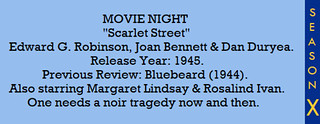 Review #1365: Scarlet Street.