Showing posts with label Reginald Owen. Show all posts

May 14, 2020

Mary Poppins.


Review #1415: Mary Poppins.

Cast: 
Julie Andrews (Mary Poppins), Dick Van Dyke (Bert / Mr. Dawes Sr), David Tomlinson (George Banks), Glynis Johns (Winifred Banks), Hermione Baddeley (Ellen), Karen Dotrice (Jane Banks), Matthew Garber (Michael Banks), Elsa Lanchester (Katie Nanna), Arthur Treacher (Constable Jones), Reginald Owen (Admiral Boom), Ed Wynn (Uncle Albert), Reta Shaw (Mrs. Brill), and Don Barclay (Mr. Binnacle) Directed by Robert Stevenson.

Review: 
"That’s the real trouble with the world. Too many people grow up."

What is there to say that has not been said about one of Walt Disney's greatest triumphs? Winner of 22 Academy Awards, Disney was a pioneer of animation that created with his brother Roy one of the most powerful film companies of the world that in the span of nearly a century has gone from animation to diversifying in live-action, theme parks and other various ventures. He had an interest in drawing from an early age, doing various exercises such as copying cartoons and working with tools like watercolors. As he grew older, he delivered papers and took courses for drawing and cartooning at the Kansas City Art Institute. By the time he was 18, he had joined the Red Cross (arriving after the armistice that ended World War I) and found work as a commercial illustrator. He soon found interest in cel animation (as opposed to cutouts), and he soon joined forces with others like Ub Iwerks to make their own studio (Iwerks-Disney commercial Artists, which was short-lived, and Laugh-O-Gram Studio, which lasted two years). Although too late to save the studio, their last creation, inspired by Alice in Wonderland, led to eventual interest in creating a series of shorts (which led to the creation of a studio to distribute said films, originally named Disney Brothers Studio). Over the course of a decade, they would create numerous cartoons with Mickey Mouse being created in 1928. Disney yearned to expand the studio's range and money by making a feature of his own. He would soon plan the first feature-length cel animated film in Snow White and the Seven Dwarfs (1937), which would take three years to develop amidst arguments with his own brother and wife to try and talk him out of it that was thought to be a futile idea. Simply put, the film was a tremendous success, and several animated film classics would follow in its wake, and live-action segments and features would later follow, and this ended up being Disney's most successful project of the 1960s, one that appeals to both children and adults to this day, an achievement for everyone from longtime Disney director Robert Stevenson to its star in Julie Andrews.

The film was adapted from the book series of the same name by P. L. Travers, who wrote eight children's books featuring the character over a span of 54 years beginning in 1934. As early as 1938, Disney wanted to buy the film rights to the book (owing to his daughters loving the books), but Travers rebuffed efforts for years and years because of her doubts that a feature could do justice to her work (it did not stop CBS from doing a television play of the book in 1949 for their live telecast Studio One, however). In 1961, Travers allowed the rights to be purchased, although she demanded script approval rights (this however was not final draft approval). Considerable changes were made in settling things to film, such as the timeframe being shifted from the 1930s to 1910, a focus on two Banks children rather than four, and a significant lightening of the title character (characterized as slightly vain and stern in the books). The latter change, along with the decision to use animation in some parts and the music (she wanted period piece) did not ultimately please her; when approached in 1993 about turning it into a musical, her key stipulation was that no one who worked on the film be involved with it, although the subsequent stage show that premiered 21 years ended up utilizing the songs from Richard and Robert Sherman, who do tremendous work here (as they did for decades). When it came to star, one could not ask for a greater debut. Andrews had sang with her parents since she was ten years old and had risen to performing on the stage and Broadway by the time she was 19, noted for her work in My Fair Lady (1956) and Camelot (1960). It was the decision by Warner Brothers to pick Audrey Hepburn over her to star in the film adaptation of the former that led to Disney having the chance to have Andrews for this film. Her charm and grace are immediately present to view after seeing her first few scenes, one with a great singing voice and a warm spirit that always seems ready for an interesting time with the children while seeming authentic and firm no matter who she interacts, whether that means children or something odder. Van Dyke, a radio/Broadway/television star (sporting a "Cockney" accent), proves quite amusing to follow up with Andrews, an inviting presence that never seems out of place, whether that involves him singing "Chim Chim Cher-ee" or being part of a laugh riot on the ceiling with Wynn (who proves just as amusing in his one scene). Tomlinson accompanies the film as a capable stuffy authority that holds his own in inspiring curiosity on the other side of the hill (namely, reality). Johns, although not in the film too much, inspires a few flighty chuckles. Doctrice and Garbert do a fine job for the time needed, having that middle ground for child acting that isn't too knowing or annoying to write home about. The others fill in the details of curiosity quite nicely for quirks.

The songs are quite catchy, with one clear choice being "Supercalifragilisticexpialidocious" in driving a smile to one's face. The animation sequences are interesting, aided by a modification from Petro Vlahos in a Technicolor camera that mixed live-action and animation through what is known as the "Sodium Vapor Process", utilized in films such as The Parent Trap (1961) and The Birds (1963) that served as an alternative for bluescreen in order for more accuracy. There is plenty of imagination and charm to be found here, a film that can sing with the best of them in leaving an impression on its audience with its simple but efficient story of growing up without seeming too sentimental or abrupt through a ravishing 139 minute run-time. Behaving well doesn't mean not having fun, really. Could it have been more accurate to its source material, sure, but does it really matter? Is this not a magical film that accomplishes what it sets out to do for its target audience (i.e. anyone)? There is a magic here that one wishes to experience every now and then that make it an easy pick for its era and Disney's line of work.

Overall, I give it 10 out of 10 stars.

March 12, 2020

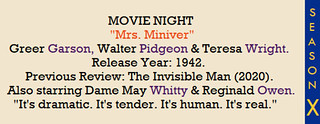
Mrs. Miniver.


Review #1360: Mrs. Miniver.

Cast: 
Greer Garson (Kay Miniver), Walter Pidgeon (Clem Miniver), Teresa Wright (Carol Beldon), Dame May Whitty (Lady Beldon), Reginald Owen (Foley), Henry Travers (Mr. Ballard), Richard Ney (Vin Miniver), Henry Wilcoxon (The Vicar), Christopher Severn (Toby Miniver), Brenda Forbes (Gladys), and Clare Sandars (Judy Miniver) Directed by William Wyler (#509 - Roman Holiday and #1022 - Jezebel)

Review: 
War-time films could come in many genres, and 1942 is a prominent one to spotlight. After all, this film dominated the Academy Awards for its year, winning for Best Picture, Director, Actress, Supporting Actress, Screenplay, and Cinematography. The film is based on a series of newspapers columns for The Times by Jan Struther, which had started in 1937 (with a collection of those columns being published into a book in 1939) on an ordinary sort of woman with ordinary sort of life, with most of the essays being done before World War II was declared, and four writers were credited for adapting it to the screen: Arthur Wimperis, George Froeschel, James Hilton, and Claudine West. At the hand is a director with a prime like no other in William Wyler, who came from working at Universal Studios as a stage cleaner and mover to director of Western quickies in two years. In the next decade, he would hone his craft in a variety of genres from drama to comedy that would lead to plenty of notice with films such as Dodsworth (1936) and Wuthering Heights (1939). A noted perfectionist, he would generally insist on multiple re-takes, which proved to be worth it for several actors, directing 36 actors to Academy Award nominations and 14 to wins, both records. He directed films in six decades until his last with The Liberation of L.B. Jones (1970). Garson and Pidgeon make for a well-rounded bunch of leads (with this being the 2nd of eight collaborations, including a sequel with The Miniver Story eight years later), both having risen from stage to screen (the former in the 30s, the latter in the late 20s) to carry a movie that certainly rouses plenty of spirit and inspiration to make for a solid romance war drama, one wrapped in sentiment under propaganda that makes its mark most of the time.

It certainly rose plenty of spirits, with Winston Churchill once stating that it had done more for the war effort than a flotilla of destroyers, and Franklin D. Roosevelt had ordered the final speech (involving how this is a "war of the people", not just soldiers) broadcast over radio. That speech was written by Wilcoxin (the one who says the striking words) and Wyler the night before filming it. Regardless of its war elements, there is a tender touch to the film that manages to resonate in drama after nearly eight decades that can't be lost to time. It works with a 133 minute pace in holding its family aspects and the looming war together with patience and skill. Garson commands the screen with grace, a courage in the manner of the stiff upper-lip that resonates for her time on screen. Pidgeon does just as much in conveying charm with capable chemistry in the ways you would expect with Garson alongside other scenes when dealing with the war efforts. Wright makes her presence clear any time she is on screen, a vivid and ideal one in a weary-but-able world. A noted actress of the screen (along with her charity work during the first World War) before making her screen debut at 72 in 1935, Whitty strikes attention with no trouble at all, marked with discipline in her nerves in her moments on screen. The other members of the cast do just fine in rounding out the elements necessary to make for capable drama in perseverance. It is the kind of stuff that can drive emotions out for passion, for sacrifice and support that one can still identify with in some way in our trying times today, whether one resides in Europe or elsewhere. For the most part, the film knows where to go in making capable entertainment, and it rightfully endures as a fair gem for both its director and Metro Goldwyn Mayer.

Overall, I give it 9 out of 10 stars.

February 21, 2020

The Great Ziegfeld.


Review #1344: The Great Ziegfeld.

Cast: 
William Powell (Florenz Ziegfeld Jr.), Myrna Loy (Billie Burke), Luise Rainer (Anna Held), Frank Morgan (Billings), Fannie Brice (Herself), Virginia Bruce (Audrey Dane), Reginald Owen (Sampson), Ray Bolger (Himself), Ernest Cossart (Sidney), Mae Questel (Rosie), Joseph Cawthorne (Dr. Ziegfeld), Nat Pendleton (Sandow), Harriet Hoctor (Herself), Jean Chatburn (Mary Lou), and Paul Irving (Erlanger) Directed by Robert Z. Leonard.

Review: 
I did not foresee a thousand word review that took longer to write than it did to get through the film. And yet, here we are.

One needs a bit of history now and then. Or at the very least needs a big show to really drive up attention. This is a film based on the life of Florenz Ziegfeld Jr and his Ziegfeld Follies, which made numerous productions from 1907 to 1931 (with two further revivals after Ziegfeld's death). There were numerous entertainers that appeared in the show over the years, ranging from W. C. Fields to Will Rogers to Louise Brooks to Fanny Brice. Who else to deliver a film with elaborate costumes, dances and sets but Metro-Goldwyn-Mayer, with the most notable set being for the set for "A Pretty Girl Is Like a Melody", which spent roughly $220,000 on a 100 ton, 175 spiral stepped towering rotating volute. The music for the film was done by Walter Donaldson, Irving Berlin, and lyricist Harold Adamson, while Seymour Felix did the dance direction, and William Anthony McGuire wrote the film. I suppose it shouldn't have proved a surprise that this won the Academy Award for Best Picture. It happened to be one of the highest grossing films of the year, right next to another fellow MGM Best Picture nominee with San Francisco. Of course it also shouldn't be surprising that this is a tremendous long spectacle, running 176 minutes (185 for roadshows). One expects a veteran director to serve as a reliable hand for a big production, which is the case with Robert Z. Leonard. He had studied law at the University of Colorado before moving to Hollywood to start his film career acting in various short subjects in 1908. Five years later, he would take up directing the subjects to go alongside his career. It was not long before he got into directing feature-length films, starting with the mostly lost serial The Master Key (1914). In his five decade career, he directed two films nominated for Best Picture and Best Director (this and The Divorcee from 1930). He is known for his association with MGM, where he made most of his features for (starting with their predecessor Metro Pictures) from Peacock Alley (1922) to The King's Thief (1955).

One thing that is easy for me to say is that I don't know too much about the life of Florenz Ziegfeld Jr. After this film, I still don't think I really know much about the man that seems substantial. Even his death is wrongly depicted, as if him dying of pleurisy in Hollywood didn't seem impactful enough to depict for film. It all seems carefree, where the ups and downs seem more catered for its audience to escape with than something that presents anything other than bloated lavishness. In trying to cover all the bases of production value, it soon becomes a hollow experience that seems dated more than anything, although I suppose big-budget effects extravaganzas have some sort of link with this film in attempts at trying to hide hollow plots with some sort of flash. One seems to feel the passage of time of this film like it is taking 30 years rather than three hours. Powell does seem like the man for a role like this, having risen from heel roles in his early years since starting a career in Hollywood in 1922 to leading man roles, most notably with The Thin Man (1934). He starred in five further films in that series, each with Myrna Loy (they appeared in 14 total features together). He received three nominations for Best Actor (1934, 1936, 1947), and although he never won an Oscar, he cultivated a 33-year career with class and charm. I like seeing him here, even if he is playing a role that begs to have at least one flaw show itself on screen. He seems like a nice rogue, but he almost seems lost in a sea of pep and convenience. Loy has the disadvantage of time, since she doesn't show up until over two hours in. In that sense, she pulls off an okay performance playing a living actress (after Ziegfeld's death, she had sold off the film rights to try and pay off his debts and subsequently worked as technical consultant for this film), where one will say it has some stature but not too much else. Rainer (who aspired to be an actress at 16) was in her fifth role in film, having moved from the theatre to film after seeing A Farewell to Arms (1932), describing it as "beautiful". She moved from her native Germany to Hollywood three years later, signing with MGM, with her first American feature being Escapade, which also happened to have Powell and Leonard. She had a peak like no other actress, being the first actress to win back-to-back Academy Awards (Spencer Tracy would do the same for actors for 1937 and 1938), having won for this and The Good Earth (1937). She made fifteen film appearances in her career, owing to the pressure in living up to audience expectations along with dissatisfaction with MGM head Louis B. Meyer with getting roles she found to her liking (as opposed to the other way around). The one highlight scene for Ranier is the phone sequence, a heartbreaker that likely gave her the edge in winning an Academy Award for Best Actress. She does fine with delivering vulnerability, but the film's melodramatic approach does tend to make some of her scenes a bit over-the-top. The others prove hit and miss. Morgan and Brice deliver a bit of levity, but the rest seem to get a bit lost in the shuffle.

There would be further ventures with the Ziegfeld name by MGM, who released Ziegfeld Girl (1941, also directed by Leonard), and Ziegfeld Follies (1946, directed by Vincente Minnelli), which was composed of musical numbers and sketches. At the end of the day, this could prove a curiosity, for either the right or wrong reasons. One could hold up the musical pieces and its designs with some respect, alongside its boundless optimism in the face of marginalizing some of the facts. Or perhaps one could find it to be an overlong affair that can't quite satisfy in every department that creaks with age. I wish I liked this better than I did, because there is some entertainment value present in the film. Its a film that aspires to be the cream of the crop and instead seems to have a bit too much sugariness to really get there and stay on top. 

Overall, I give it 6 out of 10 stars.

February 15, 2020

Of Human Bondage.


Review #1341: Of Human Bondage.

Cast: 
Leslie Howard (Philip Carey), Bette Davis (Mildred Rogers), Frances Dee (Sally Athelny), Kay Johnson (Norah), Reginald Denny (Harry Griffiths), Alan Hale (Emil Miller), Reginald Sheffield (Cyril Dunsford), Reginald Owen (Thorpe Athelny), and Tempe Pigott (Agnes Hollet, Philip's landlady) Directed by John Cromwell (#1008 - The Racket)

Review: 
What is there to say about Bette Davis that hasn't already been said before? Davis is one of the most famous actresses of film to ever grace the screen, but one only needs to point to her six decade career of various sardonic roles that ranged from various dramas that garnered multiple Academy Award wins (two) and nominations (only three other people have more nominations than her ten). One nomination that is not technically recorded is for her role in this film (for which she received write-in votes for in one of only two ceremonies to allow said votes), which is generally considered her breakthrough role. She had started her career on the stage in 1929 before moving to Hollywood the following year to screen test for Universal Studios. She made her film debut with a supporting role in Bad Sister (1931), but her time with the studio was characterized by a dearth of roles before her release from her contract the following year. On the verge of leaving Hollywood, it was the decision of George Arliss to have her cast as the fiancee to his character in The Man Who Played God (1932) with Warner Bros. that gave her the foot in the door she needed, as she soon signed a contract with the studio after they liked the rushes. She would subsequently stay with the studio until 1949, although there were not always easy times. She notably attempted to breach her contract in 1936 when presented an offer to make two films in Britain, owing to be faced to perform in parts she felt were mediocre (incidentally, it was her appearance in a film named The Cabin in the Cotton (1932) that led director Cromwell to want her for this film). In any case, Davis had wanted the un-glamorous role despite the reluctance of studio head Jack L. Warner to let her star in what was to be a production by RKO Radio Pictures. A chance to trade actresses for a part led to RKO being allowed to borrow Davis for this film while Warner Bros borrowed one of their contract players for a film of their own. Davis proved to be dedicated to making this role the first of many noted performances of her career, from hiring a housekeeper with a Cockney English accent to prepare for the role to even designing her own makeup for her final scenes when downtrodden with tuberculosis.

For a film released just as a strengthened Motion Picture Production Code was coming into effect in July of that year, this is sure a daring film to inspire such shock and passion. This was an adaptation of the 1915 novel of the same name by W. Somerset Maugham, which has a mix of autobiographical and fictional elements, as admitted by the author (with both him and the main character having a physical calamity, being an orphan at an early age, and studying medicine). It was the first of three adaptations, with ones to follow in 1946 and 1964. Obviously the work is going to be changed a bit for a film adaptation, especially a 600-page book going down to an 83 minute film. A curious synopsis glance notes that the film only mentions the main character's uncle at the end when he dies, as opposed to showing his experiences growing up with his uncle. The film has a stagey if somewhat dated feel to it at times (this proves true with some of Cromwell's decisions like the perspective shots), but it is the dominant performance of Davis that keeps the film rolling with curiosity. She has a fearlessness and tenacity to making this role worth viewing to see her run the gamut in cruelty, most notably when she chews the main character out near the end. We all have had at least one experience or knew at least one person in our lives with that kind of emotional recklessness, the kind of person we think we need in our lives no matter how they might treat us. It doesn't mean that Howard's character is completely in the right either, but it is a film that uses most of its time (save for its obligatory moralistic line for the ending) to show two people who really just don't belong together who keep lining up that way. Sure, the main character still finds someone to be with after his obsession is lifted, but the film still hits on those basic points without too much trouble. Howard (a man of theatre and film who was an idol in his own right for the decade) comes off as stiffly sensitive, quiet yet fairly easy to follow along with despite some of the offbeat decisions his character can make. With lesser actors, this could've been easily turned into a vamp piece and nothing else. But these two make for a worthy duet to view, which go with a decent supporting cast to make for a decent piece to study. Interestingly enough, this is a film readily available for viewing, since the copyright for this film was not renewed in the 28th year of publication, meaning that this is in the public domain for easy viewing. I recommend this one without any doubt, a fairly entertaining film on the strength of Bette Davis in the role that made her a star worth viewing with interest.

Overall, I give it 8 out of 10 stars.

March 4, 2017

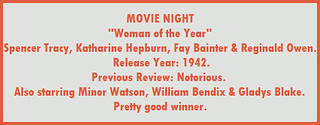
Woman of the Year.


Review #911: Woman of the Year.

Cast:
Spencer Tracy (Sam Craig), Katharine Hepburn (Tess Harding), Fay Bainter (Ellen Whitcomb), Reginald Owen (Clayton), Minor Watson (William J. Harding), William Bendix ("Pinkie" Peters), Gladys Blake (Flo Peters), Dan Tobin (Gerald Howe), Roscoe Karns (Phil Whittaker), William Tannen (Ellis), and Ludwig Stössel (Dr. Lubbeck) Directed by George Stevens.

Review:
It has been a long time since I covered a Tracy-Hepburn film. In fact, the one I covered (#139 - Guess Who's Coming to Dinner) was the last one, so it only seems fitting that after over 800 reviews, I cover the first movie to pair the two actors together. As it turned out, the two would make nine films together in 25 years of work, while this film won the Oscar for Best Original Screenplay, and it is easy to see why. Almost immediately, the chemistry between Tracy and Hepburn comes out beautifully on screen, with Tracy's no-nonsense attitude and levelheadedness meshing with Hepburn's wit and tenderness that is always interesting. Whether by acting or how it was written (done by Ring Lardner Jr. and Michael Kanin), they just click. There's a good amount of lines (both romantic and comedic), in part due to the execution by Stevens and a pretty good cast as well. Bainter and Watson are pretty good together, and Bendix provides a good chuckle or two along with Blake. This is just a movie that has a good time with its main two actors controlling the show with grace and charm, with an acceptable pace of 114 minutes. The movie earns a good payoff, and it does that for the most part, with the conflicts being believable, and the climax being somewhat serviceable. The ending was one that came about due to the reaction to the original ending shown to test audiences, in order to give Tess her "comeuppance". The ending (done over the objection of the screenwriters along with Hepburn) doesn't derail the movie, though this bit of irony (if you want to call it that, though I can't make waffles either) I guess makes the movie go full circle in a weird way. Regardless, the movie is a fine classic that I can recommend without any doubt in my mind due to the way that it is crafted.

Overall, I give it 9 out of 10 stars.

June 18, 2014

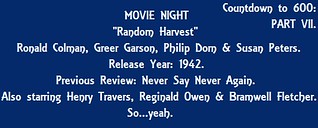
Movie Night: Random Harvest.


Review #596: Random Harvest.

Cast
Ronald Colman (Charles Rainier), Greer Garson (Paula Ridgeway/Margaret Hanson), Philip Dorn (Dr. Jonathan Benet), Susan Peters (Kitty Chilcet), Henry Travers (Dr. Sims), Reginald Owen (Biffer), Bramwell Fletcher (Harrison), Rhys Williams (Sam), Una O'Connor (Shopkeeper), Aubrey Mather (Sheldon), and Margaret Wycherly (Mrs. Deventer) Directed by Mervyn LeRoy.

Review
Romantic films can be many things, they can be pleasant to watch and joyful, or they can be unbearable to watch. This film falls into the first category. Colman and Garson are an excellent duo, and they pair off well each other, they are just perfectly cast, and Colman does a great subdued performance. The supporting cast is fun to watch, even Una O'Connor (evidently she hams it up only in horror films), Reginald Owen is a charm to watch, it's just fun to watch the interactions between everyone. The plot is well crafted, a treat to appreciate. This is a neat little movie practically wrapped in gold paper. This movie is good enough to even be shown on TCM on Tuesday night, picked by none other than guest programmer Gene Wilder (squee!), and I can see why he picked it. It's a good flick to watch, even in summer, I suppose.

Overall, I give it 9 out of 10 stars.

December 21, 2013

Movie Night: A Christmas Carol (1938).


Review #503: A Christmas Carol.

Cast
Reginald Owen (Ebenezer Scrooge), Gene Lockhart (Bob Cratchit), Kathleen Lockhart (Mrs. Cratchit), Terry Kilburn (Tiny Tim Cratchit), Barry MacKay (Fred), Lynne Carver (Bess), Bunny Beatty (Martha Cratchit), June Lockhart (Belinda Cratchit), John O'Day (Peter Cratchit), Leo G. Carroll (Marley's Ghost), Lionel Braham (Spirit of Christmas Present), Ann Rutherford (Spirit of Christmas Past), and D'Arcy Corrigan (Spirit of Christmas Future) Directed by Edwin L. Marin.

Review
Once again, I'm reviewing A Christmas Carol film (#075 - Scrooged, #076 - Scrooge (1951), #079 - A Christmas Carol (1984), #498 - The Muppet Christmas Carol), with actors like Bill Murray in a mediocre comedy, Allister Sim in a fine telling of the story, George C. Scott rather effectively playing Scrooge, to Michael Caine with Muppets. So with all of the other Christmas Carol films around, how is this? It's an okay film, but it feels really cut down. It lasts only about 70 minutes, it omits the part about Scrooge's past romance and Want and Ignorance are sorely missing, most likely due to wanting a family film, as I'm sure many families will enjoy the scene where Scrooge sees his own grave, truly a happy scene. The actors are fine though, Lockhart is okay, certainly a bright and energetic figure. While Reginald Owen isn't necessarily great, he does bring a presence that carries the film to a short, but mostly sweet finish line. Out of all the Christmas Carol films I've reviewed, this isn't the best one by any means, but if you want something short and mostly sweet, this is the one for you.

Overall, I give it 8 out of 10 stars.