Showing posts with label Ivan Dixon. Show all posts

February 27, 2024

Nothing but a Man.

Review #2182: Nothing but a Man.

Cast: 
Ivan Dixon (Duff Anderson), Abbey Lincoln (Josie Dawson), Julius Harris (Will Anderson), Gloria Foster (Lee), Yaphet Kotto (Jocko), Leonard Parker (Frankie), Stanley Green (Reverend Dawson), Eugene Wood (Johnson), Helen Lounck (Effie Simms), Gertrude Jeannette (Mrs. Dawson), Tom Ligon (Teenager), and William Jordan (Teenager) Directed by Michael Roemer.

Review: 
"I recognized everything. It was immediate. I said, 'Oh, I know this. I know what this feels like.''

Independent films don't always get a fair rap. But history does lend some credit to those that really did make an effort to make something worthwhile. This film was released 60 years ago this year as a fairly naturalistic feature that only made a profit upon a re-release in the 1990s. The film was written by Michael Roemer and Robert M. Young, who also produced the film with Robert Rubin (Young served as cinematographer). Born into a Jewish family in Germany, he had been sent to a Bunce Court School (a boarding school) in England in 1939 by the Kindertransport. After time spent in Bunce Court School in England, he moved to the States in time to attend at college at Harvard University, where he graduated with a degree after doing a bit of filmmaking and also met Young, a good friend of his. Roemer worked with Louis de Rochemont for a number of years in production management along with making a handful of educational films. Young and Roemer got together first to do a documentary called Cortile Cascino that would've been shown on NBC in 1962. It was a film meant to show the lives of people living in a slum (Palermitano) in Palermo, Italy, but the footage was thought of as not suitable for TV. The basis for what became this film was shaped in part by Roemer's upbringing (such as his relationship with his father) along with travels spent with Young for a few months in the American South. The film was shot in New Jersey on a budget over $200,000 as a film where "the most powerful, useful political statement would be a human one" with a handful of music from the Motown label. Lincoln was a singer (with one appearance in film as herself in The Girl Can't Help It) and Harris was a male nurse making his film debut.  Roemer's next film in The Plot Against Harry (1969) couldn't find a distributor because of its perceived failure in comedy before 1989 saw attention given to it at the New York Film Festival. Roemer had shot other documentaries as well, such as Dying, which was from the point of view of those near death. As late as his eighties (Roemer still lives, now 96!), he was a professor at Yale. A television film of his in Haunted (1984) was re-released in theaters as Vengeance is Mine in 2022.

The heart of the film is the timeless quality that comes in hard-edged honesty for 95 minutes. It is a sensitive film that doesn't rely on easy piety or easy outs when it comes to the simple story of how the shadow of life under the grip of prejudice and pre-conceived ideas of what one seems to be can wreak havoc on trying to live at all. The illusion of being free is a hard one to see get stripped away from oneself, whether that involves that illusion of being free in their job or one's love having an illusion of freedom from nasty words or complications. In other words: life is hard, and it is going to stay hard regardless of if you have someone there with you or not, but you just have to face the wind and roll with whatever is there to blow against you. Dixon was evidently proud of his lead performance here (released the year before having a long-running role on Hogan's Heroes and becoming a director himself), and it is easy to see why. He has a smoldering honesty that commands the screen in a way that is easily recognizable for those who have ever experienced some kind of misfortune when it comes to perceptions or in a personal matter. He sees Lincoln and goes from thinking of her as one of just desire to of equals when it comes to not just being a background face in the crowd. His frustrations are our frustrations in a way that draws the viewer to think about within our lives when it comes to what one is and is not in the scheme of things (be it stubborn, proud, or otherwise). The sequence of him seeing his son toil as one away from his parent (and accompanying words of why one hasn't made more of the effort) makes it clear of what one has here in those vulnerabilities and hazards to think about. Lincoln is the tender one that makes a worthwhile pairing with Dixon in whirlwind curiosity and accompanying vulnerability. Harris is the key in shaping the film for such a carefully handled amount of time, a smoldering heap on the last legs of a type of person with unyielding tension that makes one wonder how one really could be that good in their first acting role that quickly.  (Dixon was the most experienced of the main cast, as Foster had her debut in 1964 with The Cool World and this). As a whole, the movie ends on its own terms for one's own imagination when it comes to what it means in the idea of feeling so free and where the road can take them. It plays well for now among curious viewers looking for indie films because it is a story we can all look to in tender natural amazement and smile in its imperfect dealing with a imperfect world.

Overall, I give it 9 out of 10 stars.

February 9, 2023

Trouble Man.

Review #1971: Trouble Man.

Cast: 
Robert Hooks (Mr. T), Paul Winfield ("Chalky" Price), Ralph Waite (Pete Cockrell), William Smithers (Captain Joe Marx), Paula Kelly (Cleo), Julius Harris ("Big"), Bill Henderson (Jimmy), Wayne Storm (Frank), Akili Jones (Billy Chi), and Vince Howard (Preston) Directed by Ivan Dixon (#1804 - The Spook Who Sat by the Door)

Review: 
Admittedly, I should have covered this film by Ivan Dixon before I did his most famous one in The Spook Who Sat by the Door (1973), which will celebrate its 50th anniversary this September. As mentioned earlier, Dixon became a director in 1970 after a handful of acting roles, with the most famous role being Nothing But a Man (1964). He had graduated with a degree in drama from North Carolina Central University in 1954 (the theater troupe of the historically black college now bears Dixon's name). He also studied drama at Case Western Reserve University and the American Theatre Wing before he had gotten into acting. It was his five years on the sitcom Hogan's Heroes where he honed his interest of directing, doing so by asking questions about the process of directing and editing when on set due to not having time for film school. The movie was written by John D. F. Black (who had co-wrote the 1971 adaptation of Shaft with Ernest Tidyman), who also served as co-producer with Joel Freeman. The movie was released by 20th Century Fox, albeit with a cheap budget. This was the first major film role for Hooks, who had a few supporting roles in previous films such as Hurry Sundown (1967) along with a regular role in the TV series N.Y.P.D (1967-69); he was also the co-founder of the Negro Ensemble Company. The music was done by famed singer Marvin Gaye in his one and only soundtrack.

The movie was not a major hit upon release, but I would argue that it deserved better than just being thought of as being in the shadow of Shaft (I kid you not, there was a book written by alleged film writers that called this one of the worst films of all time in 1978 - I say "alleged" because it is clearly obvious how times have changed with taste). Both films featured cool lead characters - one that is "hip" and the other being a benefactor to the community. Shaft had a cool leather suit, and T drives a Lincoln Continental. Shaft just happened to strike the perfect note for the perfect moment that even its sequels couldn't reach, but Trouble Man is dedicated to being a hardboiled adventure and mostly succeeds in that goal. For all the naysayers that came with films in the so-called "blaxploitation" genre, film viewers know one thing: cool movies come in all shapes and sizes, and Hooks for an unflappable pillar of coolness. If it wasn't meant to be replicated with sequels, Hooks sure gave his all in terms of steely charm that is both detective and fixer of the best type, one who isn't merely a "West Coast" Shaft, but instead a man with distinctions and timing that we are always curious through and through.  Both of the adversaries gained notice for feature roles in media besides this film: Waite starred in The Waltons, which premiered on television a couple of months before this film while Winfield gained an Academy Award nomination for Sounder, which premiered the same year as this film. At any rate, they make for capable natural foils to Hooks, conniving without becoming cardboard, while Harris provides the necessary "big bad" energy when required. Jones provides a bit of energy to counter Hooks, while Smithers makes a quality authority foil. The best crime thrillers come from how convincing they seem in actually wanting to show something interesting on screen, and I believe this fits most of the steps needed worth checking out for 99 minutes. Under looked for the time, Trouble Man is a feature with plenty to offer for those looking for a mostly-developed crime thriller with a worthy lead actor and style to go along with it.

Overall, I give it 8 out of 10 stars.

Next up: Sounder.

February 17, 2022

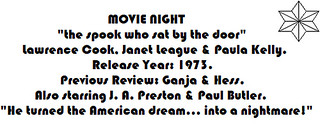
The Spook Who Sat by the Door.

Review #1804: The Spook Who Sat by the Door.

Cast:
Lawrence Cook (Dan Freeman), Janet League (Joy), Paula Kelly (Dahomey Queen), J. A. Preston (Dawson), Paul Butler (Dean "Do-Daddy Dean"), Don Blakely ("Stud" Davis), David Lemieux (Willie "Pretty Willie"), Jack Aaron (Carstairs), Joseph Mascolo (Senator Hennington), Elaine Aiken (Mrs. Hennington), Beverly Gill (Willa), Bob Hill (Calhoun), and Martin Golar (Perkins) Directed by Ivan Dixon.

Review: 
In the end, some movies are just star-crossed. Ivan Dixon made only two films as a director, and this was the last one. Trouble Man (1972), a blaxploitation thriller, had been his debut feature after having started acting in the 1950s, where he worked it theater, television, and film. He is best known for his role in the film Nothing But a Man (1964) and his role in the TV series Hogan's Heroes (1965-70). From 1970 until his retirement in 1993, he would serve as a television director for a number of television shows; he died in 2008 at the age of 76. The film is adapted from the 1969 novel of the same name by Sam Greenlee. The Chicago native had studied political science at the University of Wisconsin-Madison before serving as an officer in both the United States Army and the United States Information Agency (1957-1965) before quitting to dedicate his time to writing. However, with this book, he went through a bit of trouble in getting the book published (he described the experiences in the USIA as identical to the ones depicted to the main character in his book). Apparently, years later he was told by a former FBI recruit that the book was now required reading at the FBI Academy. Greenlee believed that the film was pulled from theaters shortly after its release as a suppression by the FBI (United Artists did not exactly take kindly to it either as distributor); he wrote one further novel before spending time around the world along with teaching screenwriting and talk-radio before his death in 2014 at the age of 84. He lived long enough to see the film finally get a proper release on home video, since it did not receive a release on home video (DVD) until 2004, for which one can thank Tim Reid for finding the negative (packed under a false name by Dixon). Even finding a location to film was a trouble, since the novel was set in Chicago, Illinois, which at that time had Richard J. Daley as Mayor, five years removed from his dubious attempt at presenting the city as a shining achievement with the 1968 Democratic National Convention (incidentally, only his son would exceed his 21-year run as mayor, complete with allegations of corruption just like his father), so Gary, Indiana was chosen for filming. One might be curious about the meaning of "spook", and it is a slang word for espionage alongside a racial slur. The film was written by Melvin Clay and Sam Greenlee while Herbie Hancock (a famed jazz pianist) provided the music.

Keep in mind, Greenlee wanted to show a message of how urban guerilla warfare could be utilized to protect black communities. In fact, most of the $1 million budget would come from black investors. Dixon would only direct one other film before he retired from filmmaking, but he was proud about the film for expressing everything he felt about race. It is a strange thing that this film did not become more popular in a decade when Sweet Sweetback's Baadasssss Song (1971), a film lauded by the Black Panthers as the "first truly revolutionary Black film made" was allowed to flourish (incidentally, that film was rated X while this was given a PG rating). Of course, one may be able to make a film about militancy but making one with anti-establishment ideals to go with that...is not as easy; of course, a television adaptation of the book is planned for release, so there is that. I applaud the efforts of Dixon when it comes to making a fascinating and provocative film in the power of community that strikes with careful precision in building its radical foundation without becoming a pastiche of cliches with easy outs (i.e. it is quite diverting without becoming melodrama-orama). As it would stand, this ended up being the most notable film credit for Cook amidst a handful of film roles. He does quite well in terms in pressurized charm that works the tight rope of determination and restraint. Kelly proves the curiosity in a role that is present for just the start and near-climax, which results in quality moments with Cook (League on the other hand is there to show just what one is missing in chemistry between two adults). Preston is the authority figure destined for conflict that we know is inevitable, but it doesn't make his scenes with Cook any less engaging, since they make a quality pair between the parallels in friends with distinct beliefs. The movie hits most of its marks when it comes to carefully planned moments of satire with regards to the reaction to hypocrisy in the name of affirming action by white people. Of course, the film presents the best way to get back at the system by turning it into a guerilla nightmare, one not just based on hatred for white people (as mentioned in one scene with Cook and Lemieux, who is utilized as "white-passing" member of their group for propaganda). The 102-minute run-time is efficient enough without becoming outright fantasy while having a punching end-sequence to go with it. As a whole, movies like this deserve a look because of just what manages to land in terms of impact in terms of viewpoints and execution, particularly ones that did not get a fair shake back in its day. Nearly a half-century, one can see where we have moved from in the 1970s and where we still have to go in the 2020s when it comes to what it means to be free.

Overall, I give it 9 out of 10 stars.

Next Time: The Bingo Long Traveling All-Stars & Motor Kings (1976)

February 7, 2021

Car Wash.

Review #1637: Car Wash.

Cast: 
Franklyn Ajaye (T.C./Theodore Chauncy Elcott), Sully Boyar (Leon 'Mr B.' Barrow), Ivan Dixon (Lonnie), Bill Duke (Duane / Abdullah), Antonio Fargas (Lindy), Michael Fennell (Calvin), Arthur French (Charlie), Leonard Jackson (Earl), DeWayne Jessie (Lloyd), Jack Kehoe (Scruggs), Lauren Jones (Marleen), Henry Kingi (Goody), Melanie Mayron (Marsha), Garrett Morris (Slide), Clarence Muse (Snapper), Leon Pinkney (Justin), with Richard Brestoff (Irwin Barrow), Carmine Caridi (Foolish Father), George Carlin (the Taxi Driver), "Professor" Irwin Corey (The Mad Bomber), Lorraine Gary (the Hysterical Lady), Richard Pryor (Daddy Rich), and The Pointer Sisters (The Wilson Sisters) Directed by Michael Schultz.

Review: 
"In many films, I want to tell a story everybody can understand. But more importantly, I want an audience to come out of a film with more than what they went in with—thinking, feeling, laughing, crying."

There are quite a few directors and actors who made a name for themselves within African American cinema in the 1970s, and Michael Schultz belongs in the conversation for that era. He attended the University of Wisconsin before dropping out to work in a steel mill and then moving on to study and graduate at Marquette. He made his debut as a stage manager in The Old Glory (1964) Having already been involved in theater productions in high school, he was well-suited for when he moved on to attend Princeton University, where he directed his first play in 1966 (he would manage or direct numerous performances from 1964 to 1974). His staging of To Be Young, Gifted and Black resulted in success alongside a re-staging for television two years later. Alongside entering television for several series, he also moved into films with Together for Days (1972) and Honeybaby, Honeybaby (1974), although his breakthrough would come with Cooley High (1975) with audiences that has been noted as a classic by future directors like Spike Lee. Although Schultz's career moved down a tick with the noted failure Sgt. Pepper's Lonely Hearts Club Band (1978), he continued his work in film and television, and he can still be found in the latter category to the present day.

How many movies are there that involve a slice-of-life portrayal of a job that could be described in the same way one could say about future films about crabby lines of work? Or for that matter, how many are ones that were thought of as intended to be a musical? When the production head at Universal Pictures was pitched the play idea, he hated it, but told producers Art Linson and Gary Stromberg to just get the writer behind Sparkle and make a movie instead. Car Wash is certainly that one, a film that actually had its soundtrack recorded before the film started production in order for the actors to listen to it, complete with using a real car wash (Figueroa Car Wash in Los Angeles) for filming. The soundtrack was done by Rose Royce, and the title song became a number one hit while the soundtrack won a Grammy Award (the film has been argued to be one of the first disco-infused films). Believe it or not, the film was written by Joel Schumacher, who had just one prior writing credit (Sparkle, released the same year), having moved up from costume and set design to writing to eventually directing by 1981 (but not before writing another famed film with disco influence with The Wiz). What we have here is a trove of ensemble fun, one that settles in like a series of sketches as the day (90 minutes) goes by, with an assortment of fair highlights among a few noteworthy check-ins and an interesting closure. Those familiar with films like American Graffiti (1973) will have a fine time with an ensemble piece with radio-infused style and narration. There are some charmers in the cast when it comes to lovable crass folks, such as Ajaye (known for his brief string of comedy albums) and his carefree range of buzzy charm, which goes along with other fun-loving sly folks like Fargas or Kehoe or beleaguered ones like Boyer; on the other side of focus is Dixon (best known for his lead role in Nothing But a Man (1964) and support in Hogan's Heroes), who provides shining struggle to go with the coarse Duke (in his debut film role) that shows the reality of what they do (meager job, meager pay, but one has to do it).

And then of course there are the small bit from notable folks. Carlin (a well-known comic of the counterculture with his second film role) has an interesting time spent with wandering amusement that rambles for a short time. The same goes for Corey and his nutty small turn to set up a gag with a bottle in the air, while Gary plays hysterics to that key breaking moment. Believe it or not, Pryor (a stand-up comic in his prime) making a cameo appearance in the film was not actually planned at first. For one, it was intended to be a fellow named Reverend Ike (who would be playing a character inspired by himself), but when he turned it down, Pryor stepped in (Schultz and Pryor gave differing assessments on the performance, as the former noted the actor as doing numerous variations on one theme that a director has to guide/pick while Pryor thought he should have known better but was under the influence of cocaine at the time to notice) - for me, it's the most interesting appearance, one with a music group to make prime flim-flam benevolence. Be thankful one can see the film in its full form and not have to live in a time with edited TV versions circulating, one of which that takes out the raunchy elements alongside adding/deleting characters (Lindy out for a character played by Danny DeVito, who is all but deleted from the original version except in the background). At any rate, what we have is a deserving favorite by the audience that have warmed up to it in the four decades since its release, one that has a charm worth looking into.

Next Time: Sure, this director has been covered plenty of times before. But it is his portrayal of the life of one of the most famous jazz saxophonists that merits discussion, especially since it wasn't given its due upon release with its key lead performance from Forest Whitaker. Rock the beat for Bird (1988).

Overall, I give it 8 out of 10 stars.

January 16, 2017

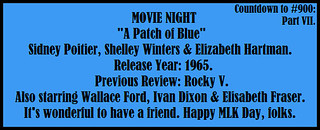
A Patch of Blue.


Review #896: A Patch of Blue.

Cast:
Sidney Poitier (Gordon Ralfe), Shelley Winters (Rose-Ann D'Arcey), Elizabeth Hartman (Selina D'Arcey), Wallace Ford (Ole Pa), Ivan Dixon (Mark Ralfe), Elisabeth Fraser (Sadie), and John Qualen (Mr. Faber) Directed by Guy Green.

Review:
There is something interesting about how the movie paces itself with elements of romance and a touch of good natured humanity. It's not a movie mired in being dated or only relevant for the time, in part because this is still a film that could be made today. Sure, one could be cynical and rail against the literal nature of "love is blind" the movie takes, but I find it to be an entertaining movie in part because of the two leads. There is just something magical and charming about their scenes, where Poitier and Hartman (in her debut performance) simply just click on screen. Hartman makes this naive but charming girl one to care about. Poitier is entertaining as well, showing the right kind of depth and humanity. It's not an innocent movie either, with Winters portraying her character with the right kind of toxic nature that accompanies a movie that has enough punch to be quite effective. Ford (in his last performance) is also quite good in his role, portraying this sad old man without any hint of fakery. You can have scenes where the two are enjoying themselves buying groceries, and other scenes where she tries to navigate herself to the park on her own without help. There is enough emotion and heart that it never feels manipulative nor too sentimental. The movie flows well at 105 minutes, never dragging itself too much while also managing to have a ending that fits the film well in being itself and not going for the easy out. It certainly is a film that leaves itself open to discussion over a good deal of subjects, and it makes the mark of a fairly good movie. While it may not be as influential as Guess Who's Coming to Dinner (#139) was when released two years after this film, A Patch of Blue still manages to leave its mark with the way it presents itself and its characters. Happy Martin Luther King Jr. Day, folks.

Countdown to #900: 10, 9, 8, 7, 6, 5, 4...

Overall, I give it 8 out of 10 stars.