Showing posts with label Billy Wilder. Show all posts

April 7, 2022

Double Indemnity.

Review #1825: Double Indemnity.

Cast: 
Fred MacMurray (Walter Neff), Barbara Stanwyck (Phyllis Dietrichson), Edward G. Robinson (Barton Keyes), Porter Hall (Mr. Jackson), Jean Heather (Lola Dietrichson), Tom Powers (Mr. Dietrichson), Byron Barr (Nino Zachetti), and Richard Gaines (Mr. Norton) Directed by Billy Wilder (#106 - Some Like It Hot, #194 - Ace in the Hole, #422 - The Fortune Cookie, #641 - The Apartment, #809 - Sunset Boulevard), #1384 - Stalag 17, and #1390 - The Seven Year Itch)

Review: 
"I never heard that expression film noir when I made Double Indemnity  ... I just made pictures I would have liked to see. When I was lucky, it coincided with the taste of the audience. With Double Indemnity, I was lucky."


If you can believe it, this was only the fourth directorial effort from Billy Wilder (along with his third since moving to America), who had more experience with scriptwriting (such as Ninotchka (1939), for example). It would also be his first notable effort, one that received considerable attention from audiences and critics (nominated for seven Academy Awards, including Best Picture) that he later called one of his best films. It was an adaptation of the crime novel of the same name by James M. Cain, which was first published in serial form for Liberty magazine in 1936 before being published in 1943 alongside two other stories (Career in C Major and The Embezzler were those stories); he based his novella on a 1927 murder by Ruth Synder, who had her boyfriend kill her husband after having him sign an insurance policy (with a certain clause), with the novel having an insurance agent as the inside man, inspired by conversations had with insurance men. Cain was a journalist before he was a writer, which he started with his first novel in The Postman Always Rings Twice in 1934 (which has had numerous film adaptations). His other most notable work was with Mildred Pierce (1941), which was adapted into a film as well. The plot changed slightly from translation onto the film screen, most notably with the final fate of its main characters, since it wasn't exactly something the Production Code would approve of (of course in the novella, the leads almost escape on an ocean liner together). In fact, the story was mired in development hell for years because of it being deemed "thoroughly unacceptable for screen presentation"; one of the biggest objections made by the Hays Office was to the omission of a gas-chamber execution scene (Wilder did film the scene, but he felt that the closing scene between the two male leads served as a more fitting one). The writers tasked to adapt the film was none other than Wilder and Raymond Chandler, a noted crime fiction writer who dabbled as a screenwriter; Wilder guided the structure and some of the dialogue while Chandler (in Wilder's words) comprehended the dialogue and start his own construction (i.e., not simply just incorporate Cain's words into dialogue). Cain was quite proud of the final result, one that he loved for the changes made because he wished he had thought of those himself.

It may be a cliche to say this by now, but this is one of the prime film noirs of its time (amusingly, not even a moral panic complaint by Kate Smith could stop audiences). It has all the aspects of a great film that would become a habit for its director in later years, one with tight execution and a solid acting trio. It is the kind of movie where 107 minutes runs so smoothly, doing so with great arrangement from Wilder and cinematography by John F. Seitz that capture the shadows one requires from a movie filled with such compelling people and dark corners. One can see the pulpy dialogue from Chandler and Wilder come across with such vivid effectiveness, one that glides across the screen with how it moves the process along in terms of pulp brilliance. MacMurray was generally known for his work in "nice guy" roles (at one point, the filmmakers actually considered George Raft, and yet it is this role that proved one of his most memorable in a lengthy career, one that sees him work so well in cultivating malleable curiosity, driving the story along with dutiful energy (not exactly just a "weak-willed guy", for example); one will find something interesting about the final scene before the climax in the little scene that happens afterwards, where MacMurray tells another character about going to the person they love. Stanwyck (as with her co-star) had a bit of reluctance in doing the role, but she makes it count for such alluring double-sidedness, one who glides across topics like murder without batting an eye, smoldering the screen in a way that makes the interactions between the two of them all the more interesting, right down to their fateful last scene; truly, she exemplifies the femme fatale role to a T. Robinson proves the contrast in a character role that has plenty of time to share with MacMurray in a mentor role that is graceful along with making a bond just as interesting as the MacMurray-Stanwyck sequences. The others (such as Powers as the limp mark) do fine in sharing the stage with the key three. As a whole, the movie is balanced in its aspects that work for any viewer (with or without experience in the noir sense), maneuvering through its quick setup (a man confessing his story on phone) with no cheap tricks that result in a kinetic success. There are a handful of interesting noirs but only so many that are really considered great, and this one belongs firmly in the latter category with no question, serving as one of Wilder's finest achievements in effective casting, music, and all-around atmosphere. 

Overall, I give it 10 out of 10 stars.

April 16, 2020

The Seven Year Itch.

Review #1390: The Seven Year Itch.

Cast: 
Marilyn Monroe (The Girl), Tom Ewell (Richard Sherman), Evelyn Keyes (Helen Sherman), Sonny Tufts (Tom MacKenzie), Robert Strauss (Kruhulik), Oscar Homolka (Dr. Brubaker), Marguerite Chapman (Miss Morris), Victor Moore (Plumber), and Donald MacBride (Mr. Brady) Directed by Billy Wilder (#106 - Some Like It Hot, #194 - Ace in the Hole, #422 - The Fortune Cookie, #641 - The Apartment, #809 - Sunset Boulevard), and #1384 - Stalag 17)

Review:
"Imperfection is beauty, madness is genius and it's better to be absolutely ridiculous than absolutely boring.”

When it comes to bombshell actresses, one that stands out most evidently for their role in popular culture is Marilyn Monroe. She had grown up under a turbulent childhood, with a nonexistent father and a mother that had a mental breakdown that had her committed by the time Monroe was eight years old, which led to years of bouncing around orphanages and lodgers to stay with. She found herself attracting to becoming an actress at a young age, mostly because it seemed like an escape from her real world troubles. Adulthood had plenty of paths for her to take, such as housewife to factory-work to modelling before she eventually took steps to acting, where she made bit part appearances for 20th Century Fox in 1947 before being let go the following year, although it did help her in enrollment to the Actors' Laboratory Theatre, which she found enticing. Her determination in wanting to make it as an actress eventually led to some roles, such as her first lead role with Ladies of the Chorus (1948), or small parts in 1950 films like Love Happy, All About Eve, and The Asphalt Jungle. Soon after she found herself with a contract back with Fox and her popularity gradually rose over the decade that made her a sex symbol, with highlights including Niagara (1953), Gentlemen Prefer Blondes (1953). Through the course of a career tragically cut short at the age of 36 in 1962, Monroe struggled with trying to branch out in roles beyond the bombshell types alongside struggles in her private life such as anxiety and addiction. In any case, Monroe's stature as an icon has endured long after her death, particularly with films such as this one, with one scene involving her dress being blown up by wind to show her legs being a particularly notable one for the decade.

The film was adapted from George Axelrod's 1952 play of the same name, which had run for over a thousand performances with Ewell on Broadway. However, turning the play into an acceptable film for the censors proved to be quite a challenge, with Wilder later stating that he was "straitjacketed" and wished that he had made the film in a later time that would have allowed the affair to be shown in the film, as opposed to it being in the imagination of Ewell's character, along with the fact that dialogue considered racy had to be omitted. In other words, the sin became one of boredom over lust. In any case, this is a fairly decent film, filled with a good deal of laughs that make an adequate farce firmly in the middle of Monroe and Wilder's careers given the circumstances of the time. Ewell makes for a fine panicky presence to go with, talkative to the audience and others with a few chuckles to deliver that make it palatable when faced without scenes with Monroe. She naturally steals the show, a bright presence of charm that commands our attention along with having fair timing with humor. The other members of the cast are okay, filling the 105 minutes around moments not with Monroe with fair patience. On the whole, this is definitely something that has aged a bit for its time, an envelope pusher in search of more to open within romance that nevertheless will prove adequate for those who like something carefully done by Wilder with plenty to highlight in Monroe.

Overall, I give it 7 out of 10 stars.

April 10, 2020

Stalag 17.

Review #1384: Stalag 17.

Cast: 
William Holden (J.J. Sefton), Don Taylor (Lieutenant James Dunbar), Otto Preminger (Colonel von Scherbach), Robert Strauss (Stanislas "Animal" Kuzawa), Harvey Lembeck (Harry Shapiro), Peter Graves (Price), Sig Ruman (Sergeant Johann Sebastian Schulz), Neville Brand (Duke), Richard Erdman ("Hoffy" Hoffman), Michael Moore (Manfredi), Peter Baldwin (Johnson), Robinson Stone (Joey), Robert Shawley ("Blondie" Peterson), William Pierson (Marko the Mailman), and Gil Stratton (Clarence Harvey "Cookie" Cook / Narrator) Produced and Directed by Billy Wilder (#106 - Some Like It Hot, #194 - Ace in the Hole, #422 - The Fortune Cookie, #641 - The Apartment, and #809 - Sunset Boulevard)

Review: 
"Trust your own instinct. Your mistakes might as well be your own, instead of someone else's."

Nobody could quite as versatile as Billy Wilder for film. Born in Austria-Hungary, he found himself wanting to become a journalist from viewing a newsreel (as opposed to prelaw in college or the family business in cakes). He worked for magazines and newspapers in both Austria and Germany, but he eventually found himself wanting to be a screenwriter, with his first credit being for The Daredevil Reporter (1929). During his time in Germany, one notable film he wrote for was People on Sunday (1930), which had notable collaborators such as Edgar G. Ulmer. However, he left the country in 1933 for Paris after the rise of the Nazis. He had his directorial debut with his collaboration with Alexander Esway in Mauvaise Graine (1934) before deciding to leave for America. Over the next few years, he would find himself collaborating on film scripts that gradually found attention, most notably with Charles Brackett. For over a decade, the two would write scripts together (with a few occasions having an additional writer), with the first major hits coming in 1939 with Midnight and Ninotchka. Anxious at the idea of directing and not being confined with just writing, Wilder was given a chance with The Major and the Minor (1942). It was here that he met another important figure in honing the craft in editor Doane Harrison, who had edited Wilder and Brackett's Hold Back the Dawn the previous year. With Harrison on set, Wilder credited him for helping him in technical knowledge in terms of cutting so that there wouldn't be excess footage to deal with. The two would work together for the next two decades. Over the course of the next four decades, Wilder would direct and write plenty of noted successes in genres from noir to comedy drama, such as Double Indemnity (1944), The Lost Weekend (1945), and Sabrina (1954). In his career, he would win six Academy Awards on 21 nominations, with three of them being for screenplay, two for direction, and one for Best Picture.

The film is an adaptation of the Broadway play of the same name by Donald Bevan and Edmund Trzcinski, who had based it on their experiences in a prison camp named Stalag 17B in Austria. When it comes to a war film about prisoners, there certainly wasn't anything like this film before it came out, one that balances dark humor with suspense alongside a claustrophobic atmosphere that makes for a compelling two hour viewing. One key star that was part of some of Wilder's successes for the decade was William Holden, who appeared in three of his features (with one more years later in Fedora). It was the result of these films that elevated him to prime star status, with this being his one Academy Award winning performance of three nominations, although he felt that he didn't deserve to win (instead favoring Burt Lancaster in From Here to Eternity). In fact, he actually disagreed with the characterization of the role (which had Charlton Heston and Kirk Douglas thought of before Holden), since he felt it was selfish and he wanted Wilder to make him nicer, which was rejected. In any case, one finds plenty to draw themselves into Holden and his world, a heel-hero with smarmy complex charm beyond the usual expectations for a film with suspense like this one, which plays to the film's favor in drawing out its traitor twist (kept under wraps by filming in sequential order) through subtlety in both Holden and the camera movement. The rest of the cast keep up with him in establishing the close-knit and hard-driven members contrast with the menace and bluster on the other end. In that sense, the ones who shine best are Strauss, Graves, Brand, Ruman, and Preminger, each delivering a distinct layer that makes the film operate as well as it does without feeling monotonous. There is a key balance of drama and humor that earns the film key moments that can go from a sequence involving a telescope on friendly Russian women to the discovery of the traitor to the whole group. In the long run, this is an entertaining film in a long line of Billy Wilder achievements that merits a watch as a key piece for the decade in balancing drama and humor without too much trouble.

Overall, I give it 9 out of 10 stars.

June 11, 2016

Sunset Boulevard.


Review #809: Sunset Boulevard.

Cast
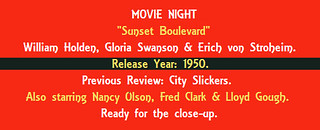
William Holden (Joe Gillis), Gloria Swanson (Norma Desmond), Erich von Stroheim (Max von Mayerling), Nancy Olson (Betty Schaefer), Fred Clark (Sheldrake), Lloyd Gough (Morino), Jack Webb (Artie Green), and Cecil B. DeMille. Directed by Billy Wilder (#106 - Some Like It Hot, #194 - Ace in the Hole, #422 - The Fortune Cookie, and #641 - The Apartment)

Review
The inventive (if not quirky) device of narration by our freshly dead main character certainly sets the tone for what is at all counts a fairly well-made movie that was later added to the National Film Registry as a film noir. Nostalgia is something that we all encounter at least once in our lives, whether it be for a different past time or for our own past. Sunset Boulevard certainly expresses nostalgia in the form of Swanson's character, from her private movie theater that shows her silent movies to playing bridge with a few "waxworks" (played by three silent film stars of the era: Buster Keaton, Anna Q. Nilsson, and H. B. Warner). The transition from the silent era to sound led to new horizons but also the decline of a good deal of the silent stars that had graced the screen and the hearts of moviegoers as well. The cinematography by John F. Seitz is excellent, making the movie look very well shot, particularly the final scene, with Swanson seemingly fading into the glitz of the camera. There's a certain sort of allure that Swanson brings to her character that makes her irresistible to watch on screen - her banter with Holden is especially entertaining. Von Stroheim is also wonderful to watch in his attempts at appeasing this husk of a star, with all of the desperation and pity in full display. Holden does a good job at telling this yarn, with enough quips along the way. One of my favorite lines is about how people don't really know the writing it takes to make a movie, assuming that the actors make it up as they go along. There's a certain mythic quality to these actors of yesteryear that is hard to explain at times but is always present, with a presence as large as Norma Desmond. Sure, one could figure out who killed who soon enough, but it's the spectacle that gives the movie breath. It's a movie with much to remember, from the main trio to the dialogue ("I'm ready for my close-up" being one of them) that makes for a fine thing to watch.

Overall, I give it 10 out of 10 stars.

September 28, 2014

Movie Night: The Apartment.


Review #641: The Apartment.

Cast
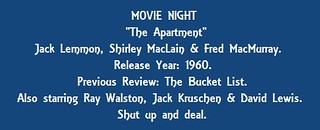
Jack Lemmon (C. C. Baxter), Shirley MacLaine (Fran Kubelik), Fred MacMurray (Jeff Sheldrake), Ray Walston (Joe Dobisch), Jack Kruschen (Dr. Dreyfuss), David Lewis (Al Kirkeby), Hope Holiday (Margie MacDougall), Joan Shawlee (Sylvia), Naomi Stevens (Mildred Dreyfuss), Johnny Seven (Karl Matuschka), and Edie Adams (Miss Olsen) Directed by Billy Wilder (#106 - Some Like It Hot, #194 - Ace in the Hole, and #422 - The Fortune Cookie)

Review
Billy Wilder was a fantastic director who always managed to showcase a theme he wanted to get across with memorable characters being the most notable highlight. And in this movie, there is no real exception, the movie is up to par with Wilder's other work reviewed here. Jack Lemmon is enjoyable to watch, especially when he shares scenes with Shirley MacLaine, the two just connect well with each other, they just have a certain spring to them, especially when they play gin rummy with each other, it's a refreshing scene given the preceding scene before it. The movie has a mix of warm and cold moments, essentially having some sadness mixed with layers of hope, it's good to have some sentimentality. The movie is great to look at, black and white film has many possibilities for looking stylish, and the cinematography by Joseph LaShelle looks wonderful. The movie is a good comedy-drama, it has its moments of both, I especially like the scene where Lemmon keeps switching the channels of the TV during a sponsor commercial, only for there to be an "alternate sponsor". The movie is enjoyable along with being clever, and Wilder is the reason for it, and the perfect person to make a movie like this.

Overall, I give it 10 out of 10 stars.

July 9, 2013

Movie Night: The Fortune Cookie.


Review #422: The Fortune Cookie.

Cast
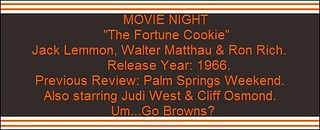
Jack Lemmon (Harry Hinkle), Walter Matthau (William "Whiplash Willie" Gingrich), Ron Rich (Luther "Boom Boom" Jackson), Judi West (Sandy Hinkle), Cliff Osmond (Chester Purkey), Lurene Tuttle (Hinkle's mother), Harry Holcombe (O'Brien), Les Tremayne (Thompson), Lauren Gilbert (Kincaid), Marge Redmond (Charlotte Gingrich), and Noam Pitlik (Max) Directed by Billy Wilder (#106 - Some Like It Hot and #194 - Ace in the Hole)

Review
It was fun to watch the last two Billy Wilder films reviewed here, and so I came into watching The Fortune Cookie with a lot of optimism. I wasn't that disappointed. Lemmon and Matthau play off each other well, and it's usually fun to have actor reappear in these reviews, especially Matthau. Ron Rich does a good supporting job, likable and enjoyable. Judi West (who apparently only made two other films) is alright, and she works alright when combined with Lemmon, which I suppose is enough. There are fun moments, with some funny bits and most of that is generated either by Lemmon, Matthau or both combined, which works out pretty well, and it gives the film a bit more depth, along with warmth. It manages to override the 90 minute cliche of comedies, which I gladly endorse as long as the comedy works, which it does. It has its moments, and 2 hours isn't much to ask for, so I recommend to give this film a shot. You won't regret it.

Overall, I give it 9 out of 10 stars.

July 5, 2012

Movie Night: Ace in the Hole.

Review #194: Ace in the Hole.

Cast
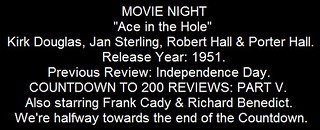
Kirk Douglas (Chuck Tatum), Jan Sterling (Lorraine Minosa), Robert Arthur (Herbie Cook), Porter Hall (Jacob Q. Boot), Frank Cady (Mr. Federber), Richard Benedict (Leo Minosa), Ray Teal (Sheriff Kretzer), Lewis Martin (McCardle), John Berkes (Papa Minosa), Frances Dominguez (Mama Minosa), and Gene Evans (Deputy Sheriff) Directed by Billy Wilder (#106 - Some Like It Hot)

Review
Nearly sixty one years old, this film still has some bite. Originally called The Big Carnival, it was not a success initially, but today it is a classic. Cynical and nail biting to the point, it also has good acting from Kirk Douglas, who is the father of another great actor, Michael Douglas, who I mentioned already (#095 - Wall Street). Both can play alluring roles that charm you into watching the movie. Fun fact: Kirk's real name was Issur Danielovitch. Wilder directed, wrote, and produce, and yet this wasn't much of a success back then. But as time passes, so does opinions, and I feel that way as well. Unrelenting yet still realistic with good noir with a good ending shot to top it off. It might be a bit slow in the beginning, but it all tops out in the end. Countdown to 200: 10, 9, 8, 7, 6...

Overall, I give it 9 out of 10 stars.

March 3, 2012

Movie Night: Some Like It Hot.

Review #106: Some Like It Hot.

Cast
Tony Curtis (Joe/Josephene), Jack Lemmon (Jerry/Daphene), Marilyn Monroe (Sugar), George Raft (Spats), Joe E. Brown (Osgood). Directed by Billy Wilder.

Review
This film still holds up after over 50 years (that of course doesn't matter), and the premise still holds up (this premise being used for other films with some good results (One being already reviewed here), and others...Not so good). The film has alright acting (especially in a comedy) and some good jokes that make this film a classic. It doesn't bore you, it actually make you interested in it, serious or not. Nevertheless, this is a good film that deserves every honor it receives even to this day.

Overall, I give it 9 out of 10 stars.