
Showing posts with label John Sturges. Show all posts

April 23, 2025

Bad Day at Black Rock.

Review #2368: Bad Day at Black Rock.

Cast: 
Spencer Tracy (John J. Macreedy), Robert Ryan (Reno Smith), Anne Francis (Liz Wirth), Dean Jagger (Sheriff Tim Horn), Walter Brennan (Doc Velie), John Ericson (Pete Wirth), Ernest Borgnine (Coley Trimble), Lee Marvin (Hector David), Russell Collins (Mr Hastings), and Walter Sande (Sam, the diner owner) Directed by John Sturges (#427 - The Magnificent Seven#1395 - Gunfight at the O.K. Corral, #1412 - The Great Escape)

Review: 
As one might expect, the genesis for the film came from a story adaptation. Howard Breslin had wrote a short story called "Bad Time at Honda" that was initially published by The American Magazine in 1947. Apparently, Don McGuire was sent to do a screenplay of the film with Joel McCrea in mind to star as an indie or MGM production. Somehow the progression of directors in mind went from George Sidney to Richard Brooks to the final choice, John Sturges (director of such previous films as Mystery Street [1950] and Kind Lady [1951]), while Millard Kaufman was hired by MGM to rewrite the script (both Kaufman and McGuire were credited for the script). Regardless of how old Spencer Tracy was at the time of filming (54), MGM (specifically Dore Schary, near the end of his little run in heading production there) got what they wanted with him as the lead, with the apparent drawing element being that he would be playing one-armed man (well that and apparently jumping at the film when he was told that they were considering Alan Ladd); it would end up being the last movie Tracy made for the studio. The movie was a general hit with audiences and earned its director, star, and writer Academy Award nominations.

For what we say about the past and what we say about present and the ever-unknown future, it is important sometimes to have a movie that reminds one of the times where people made profoundly stupid mistakes. The advent of World War II led to paranoia and probably one of the worst decisions made by an administration in wartime: forcible relocation and incarceration of over 120,000 people of Japanese descent that lasted for several years. Here we have a movie with a slow boil about what happens when people have gotten too comfortable with what they have done (or watched others do) and react to "outsiders" trying to pry things into the light. Sure, it is a crime drama movie, but there are those elements of the Western and noir present even within the vast scale that arises in CinemaScope with a particular setting that might make for a worthwhile pairing with say, High Noon (1952). With our "stranger" character that will arrive just as quickly as he will depart, how many movies have someone go up and compare them to a disease? (the answer is not too many, probably). But the tension and all-around terror that comes through here is a movie that is not afraid to simply let you broil with these crude people because you might recognize that at some point in time, they were as normal as you or me. Now they find that plugging one's ears to the drums of doubt is preferable more than anything, which is quite an unsettling thought, particularly since our one-armed lead is really just a man of the ordinary type of honor: being curious. In that sense, Tracy mines it for all it is worth, approaching folks with an unnerving sort of charm that has the audience watching with intent curiosity (mainly because when thinking of how one would do when thrust into the same spot, one probably has escape on their mind). One just sees a man when they see Tracy, with the whole one-armed thing not coming off as a gimmick and the age just seems to be a number, particularly when it comes to that one particular bar fight, which is an astounding one in its cut-rate efficiency. And then of course there is the cast around him*, who each excel in their own ways of unsettling nature. Ryan in particular is a devilishly terrific adversary, one with such an unsettling nature that comes with bubbling hatred that is quite unsettling to see in all of its layers, and the fact that he played so many hardened folks doesn't make it any less effective. Marvin and Borgnine make for quality heavies to see in the landscape, grim and worthy enough to match against Tracy, while Jagger and Ericson make for quality weak-willed people that are probably closer to reality than any of us would like to admit (i.e. folks who yield to what they see with their own eyes). Brennan closes it out with conviction in his wavering apathy. Regardless of what you might see coming from the film (look how many surprises can you think of for a movie in the 1950s), it still makes for a quality punch when it arrives at its departure point in all-around truth. In general, it is a tight 81-minute feature that manages to carefully reveal the unsettling qualities that arises in unchecked values in the name of "loyalty" that is startling in its effective execution with worthwhile presences and direction to steer it all together.

Overall, I give it 9 out of 10 stars.

*Incidentally, there is quite a load of talent of the movie that seems curious to mention. Tracy you probably already know as an Academy Award winner (twice), but you've also got a three-time winner with Brennan, future winners with Marvin and Borgnine (who won it in 1955 with Marty), a nominee with Ryan, and a previous winner with Jagger.

May 12, 2020

The Great Escape.


Review #1412: The Great Escape.

Cast: 
Steve McQueen (Captain Virgil Hilts), James Garner (Flight Lieutenant Robert Hendley), Richard Attenborough (Squadron Leader Roger Bartlett), Charles Bronson (Flight Lieutenant Danny Velinski), James Donald (Group Captain Ramsey), Donald Pleasence (Flight Lieutenant Colin Blythe), James Coburn (Flying Officer Louis Sedgwick), Hannes Messemer (Oberst von Luger), David McCallum (Lieutenant-Commander Eric Ashley-Pitt), Gordon Jackson (Flight Lieutenant Andrew MacDonald), John Leyton (Flight Lieutenant William "Willie" Dickes), Angus Lennie (Flying Officer Archibald "Archie" Ives), Nigel Stock (Flight Lieutenant Dennis Cavendish), Robert Graf (Werner), and Jud Taylor (Second Lieutenant Goff) Directed by John Sturges (#427 - The Magnificent Seven and #1395 - Gunfight at the O.K. Corral)

Review: 
"He had great faith in the actor. He would storyboard everything. He never talked to me about character or about anything. What was in the script was what was shot; what was on the storyboard was the way it was shot."

You can't get much bigger in escapism in entertainment with war dramas like The Great Escape. It has certainly left a mark on popular culture with all of the homages that have been done in the near six decades since the film's release. It was loosely based on the 1944 mass escape of POWs from the German prison camp Stalag Luft III, which Paul Brickhill (who was in the camp but not allowed to be part of the escape due to claustrophobia) wrote an account of in 1950. NBC subsequently adapted it into a live drama episode of The Philco Television Playhouse the following year. Sturges had been interested in the book immediately after reading it, describing it as "the perfect embodiment of why our side won", a presentation of people from different countries with their own makeup that found a way to defeat the Germans with their own organization. It took a few years for Sturges to find producers interested in doing the film (with his attempts at selling it to MGM failing due to a lack of interest in material that would have a downbeat ending), but eventually he found interest with The Mirisch Company (comprised of three brothers in Walter, Marvin, Harold), who produced numerous hits in the late 1950s and 1960s such as Some Like It Hot (1959) and The Magnificent Seven (1960).

The film started production without a fully completed script. Obviously there are differences between the real-life account of the escape and the film, with requests to omit details about help from home countries of ex-prisoners of war about tools in gift packages being a noted example, with another being in making composites based on real people for the characters of the film (the number of escapees however is the same as the events in 1944 with three, which also includes the details of how they successfully made it home). Although James Clavell and W.R. Burnett are credited with writing the screenplay, numerous revisions were made throughout production (with Walter Newman asking to not have his name credited due to disputes with Sturges, which also occurred a few years prior with The Magnificent Seven). Even showing the daily rushes after a few weeks of filming didn't help much, since McQueen (who had made a request accepted by Sturges to feature him in an extended motorcycle chase) felt his character was underdeveloped. It mattered especially for McQueen, who had made a name for himself over the past few years after starting his career in 1953 that gradually led to starring roles like The Blob (1958) and Wanted Dead or Alive (1958–1961), and this sealed his reputation as a "King of Cool". Interestingly, he wanted his character to be the hero without doing anything overtly heroic that contradicted his detached demeanor.

The movie runs at 172 minutes with gradual pacing that builds its group of capable characters with fair precision that builds and builds towards its escape without becoming suffocated in any sort of way. There is plenty of starpower to see here, particularly since over half of them had at least some war experience (such as Bronson, who was also claustrophobic as his character, owing to working in coal mines as a child) and some even had experiences in a POW camp, such as Pleasance, who even produced and acted in plays for the entertainment of his fellow captives. Each of the main group excels in their own way, drawing presence and charm that inspires tension for what goes on. McQueen, whose screen-time increases as the film goes on, proves tremendous as a sardonic and charming presence, highlighted by the film's most celebrated sequence - a motorcycle chase over the countryside and one quick jump over a fence (done by McQueen's friend Bud Ekins) that is dazzling. At helm for the buildup to the escape is a talented collection of international presences such as TV star-turned star Garner and his honest resourcefulness or British star-director Attenborough and his steely commanding resolve or Bronson's resolved ambiguity or Pleasance's well-mannered dignity. Accompanying them with their own concentrated time is a reasoned Donald, a charming Coburn, and a resourceful Messemer and McCallum. There are plenty of interesting moments to highlight, such as a sequence involving homemade moonshine on the 4th of July (complete with drums), or its riveting sequence in the countryside with a view on various escapees trying to pull through by train, motorcycle and even planes that make its ultimate ending just as resounding. All of this makes for a capable entertaining film that invites one into adventure with plenty of interesting presences and intricate designs that stand as a classic to see at least once.

Overall, I give it 9 out of 10 stars.

April 21, 2020

Gunfight at the O.K. Corral.

Review #1395: Gunfight at the O.K. Corral.
Cast:
Burt Lancaster (Marshal Wyatt Earp), Kirk Douglas (Doc Holliday), Rhonda Fleming (Laura Denbow), Jo Van Fleet (Kate Fisher), John Ireland (Johnny Ringo), Lyle Bettger (Ike Clanton), Frank Faylen (Sheriff Cotton Wilson), Earl Holliman (Deputy Sheriff Charlie Bassett), Ted de Corsia (Shanghai Pierce), Dennis Hopper (Billy Clanton), Whit Bissell (John Clum), George Mathews (John Shanssey), John Hudson (Virgil Earp), DeForest Kelley (Morgan Earp), Martin Milner (James 'Jimmy' Earp), Lee Van Cleef (Ed Bailey), and Jack Elam (Tom McLowery) Directed by John Sturges (#427 - The Magnificent Seven)

Review: 
"Take one for spontaneity."

Everyone needs an entertaining picture. John Sturges could do an entertaining picture when given the chance to do so. He had started in the film business with RKO through a connection to his brother in their Art department, gradually rising from bluebrints to editor in a period of seven years. He subsequently served in World War II under the US Army Air Corps (where he did direction on training films and documentaries with William Wyler such as Thunderbolt) before returning to Hollywood with Columbia Pictures, who gave him his shot at directing with The Man Who Dared (1946), the first of a bunch of b-movies for them, with The Walking Hills (1949) being his first Western. A move to MGM in 1949 led to films with a bit more prominence, where he continued to make dramas, noirs, and Westerns. His most significant film through the studio before he turned independent was Bad Day at Black Rock (1955). Ultimately, Sturges (who favored just one take to get a scene done) would direct over 40 films in a 30-year career before his death in 1992 at 82 years old.

Making a film about the Old West can be an interesting time when there is some historical precedent to it, which has been the case for numerous Westerns about the legend of Tombstone, although most of those films probably didn't have a ballad to them. Of course one isn't going to particularly learn all there is to know about a famed gunfight in a movie like this (particularly an event that in reality lasted less than a minute and had just three people killed), where even an acclaimed Western on the subject like My Darling Clementine (1946) had tinges of inaccuracy (which also featured Ireland), with the formerly considered factual novel Wyatt Earp: Frontier Marshal having risen the late Earp into a famed Old West icon. While this film is not as particularly good on the subject as say Tombstone (1993), this is a solid Western for its era, building itself with quiet ambition and a capable duo in Lancaster and Douglas for a useful climax. Lancaster, the circus performer-turned-war veteran-turned actor (along with occasional producer) resonates with calm authority, which goes well when acting alongside Douglas, as they worked together on several films together. Douglas (another fellow war veteran turned actor, albeit with a rough childhood) commands attention each time he is on screen, a forceful presence even when coughing as the film goes on that showcases plenty of discipline that he was known for. They click the most together, with scenes of the Earp family together being second and everything else being okay at best. Fleming (who had "Queen of Technicolor" as a nickname by others) does okay, but a film with a fictional character to make a romance (Earp married three times, each common-law) doesn't prove to have much structure anyway since she doesn't have as much screen-time anyway, while Van Fleet delivers a few weary wicked moments. Ireland and the other adversaries do fine with stoking tension, which includes a young Dennis Hopper in just his fourth film role. On the whole, while the film can sometimes seem a bit too pedestrian at 122 minutes, there is a fine quality to follow along with its two leads and the conflict which work to serve an action-stuffed climax just the same. It isn't a great Western by any means, but it will serve its purpose of entertainment just the same with its own particular grip of a legend of the Old West for its time.

Overall, I give it 7 out of 10 stars.

July 14, 2013

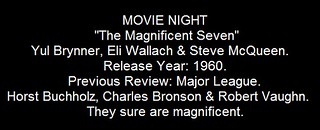
Movie Night: The Magnificent Seven (1960).


Review #427: The Magnificent Seven.

Cast
Yul Brynner (Chris Adams), Eli Wallach (Calvera), Steve McQueen (Vin), Horst Buchholz (Chico), Charles Bronson (Bernardo O'Reilly), Robert Vaughn (Lee), James Coburn (Britt), Brad Dexter (Harry Luck), Vladimir Sokoloff (The Old Man), Jorge Martínez de Hoyos (Hilario), and Rosenda Monteros (Petra) Directed by John Sturges.

Review
The Magnificent Seven is a western style remake of the 1954 film Seven Samurai, which was directed by Akira Kurosawa, a legendary director who had directed 30 films in over 50 years of work. As for this film, the rights were bought for Seven Samurai, and Sturges was brought in to direct, with filming occurring in Mexico, and Elmer Bernstein composing the music score. As for my opinion on the film, it's a well made production. Brynner is effective, doing a fine job in one of the main roles. Eli Wallach is an effective villain, and when he and his bandits meet the Seven about an hour in, the scene is tense, but effective. But Steve McQueen nearly steals the show and while he does have too many lines, he is memorable in his role. The rest of the actors do very well, such as Charles Bronson, but especially James Coburn, who may not say much, but keeps a stone cold image that works well. The scenery is effective, given the tone of the film. This film is entertaining, with good directing by Sturges, and the music score by Elmer Bernstein is one of the best music scores made for film. It's a bittersweet film, and it is an excellent western.

Overall, I give it 10 out of 10 stars.