Showing posts with label Edward Sedgwick. Show all posts

June 19, 2024

Free and Easy (1930).

Review #2219: Free and Easy.

Cast: 
Buster Keaton (Elmer), Anita Page (Elvira), Trixie Friganza (Ma Plunkett), Robert Montgomery (Larry Mitchell), and Lionel Barrymore (director) Directed by Edward Sedgwick (#774 - The Phantom of the Opera, #1774 - The Cameraman, #1937 - Spite Marriage)

Review: 
At last, it was time to hear the words of Buster Keaton in a film. This was the third feature film with Keaton at the hands of Metro-Goldwyn-Mayer, which came after The Cameraman (1928) and Spite Marriage (1929). Followers of Keaton already know that his MGM tenure was the one he regretted the most, but at least those two films were actually liked by people even when it came to studio-maintained mayhem. With this film, one would get the weirdest of the two worlds: a movie where Keaton gets to talk and also gets to be in the foreground in favor of featuring cameo appearances from performers such as Willy Haynes, Jackie Coogan, Lionel Barrymore and, well, also Cecil B. DeMille and Fred Niblo. The film was shot in several languages such as Spanish (the latter was called Estrellados, which had Keaton play opposite a different lead actress) and French (mainly with intertitles, but still). There are three credited writers: Richard Schayer (a career guy behind co-work such as The Mummy) wrote the "scenario", while Paul Dickey did the "adaptation", and Al Boasberg (one of the co-writers of The Generalwas behind the dialogue. Made for roughly $500,000, the film was enough of a hit with audiences that Keaton would continue to do a few more films with MGM, such as his next sound feature with Doughboys (1930) and five further films until 1934.

Poor, poor, poor Keaton. There have been so many good Keaton movies in the previous decade that it becomes apparent not long into this one that he has become a puppet for mediocre setups. Sure, his accent when it comes to voicework is pretty earthy on the ears and he does have some interesting moments when it comes to antics within the backlot. But the romantic triangle is flabby and pathetic, and the overall execution is 92 painfully average minutes that cannot measure even with one of his weaker silent efforts such as say, The Saphead (1920). It is plain and all-around just not interesting to watch a movie dilly-dally on a set when you've seen better days for Keaton in mayhem. You've seen better movies when it comes to "inside a studio" in films such as Show People (1928), which incidentally was also an MGM film. The funny thing about Page was fresh off The Broadway Melody (1929), the original all-talking MGM musical (mediocre as hell to folks like me, but it was a really big thing back then). Her and Montgomery have about as much energy together as a sound test. Probably the one highlight is Keaton getting to audition as an actor and doing such things like bumbling a line about swooning queens. He may be playing a silly boob, but at least he at least is physical enough and committed enough to even try his hand at singing. God help us the film is one of those that thinks it is amusing to have a conversation where characters think they are talking about the same thing but actually are not. I don't even feel like thinking about the downbeat ending, because, well, it seems fitting to give an ending where our hero gets the shaft in a non-memorable movie. In the long run, going from any random silent Keaton feature to this film is practically like night and day. It is a movie that probably would've been better if done a few years earlier because, well, Keaton would've had the time and energy to really make it a worthwhile effort. Instead, it is just not worth the effort to call it a lame movie.

Overall, I give it 5 out of 10 stars.

December 14, 2022

Spite Marriage.

Review #1937: Spite Marriage.

Cast: 
Buster Keaton (Elmer Gantry), Dorothy Sebastian (Trilby Drew), Edward Earle (Lionel Benmore), Leila Hyams (Ethyl Norcrosse), William Bechtel (Nussbaum), John Byron (Scarzi), Joe Bordeaux (Rumrunner), Ray Cooke (The Bellboy), Mike Donlin (Man in Ship's Engine Room), and Pat Harmon (Tugboat Captain) Directed by Edward Sedgwick (#774 - The Phantom of the Opera and #1774 - The Cameraman) and Buster Keaton (#757 - Seven Chances, #762 - College, #805 - The Navigator, #877 - Three Ages, #908 - The General, #926 - Our Hospitality, #941 - Sherlock Jr, #1037 - Go West, and #1058 - Battling Butler, #1173 - Steamboat Bill, Jr,, #1774 - The Camerman)

Review: 
It may be an odd film to term as a "swan song", but this is one such case where it applies. This was the second feature film with Buster Keaton as star at Metro-Goldwyn-Mayer, a decision that he later called the worst mistake he ever made. But The Camerman (1928), his first effort for the studio, was actually pretty good, since it had plenty of spontaneity along with scope to make a fun comedy. As such, Keaton wanted to make his second MGM feature a sound film, but the studio did not have enough of the recording equipment for that they felt was just another comedy. The following year, he did his first sound film with Free and Easy, but Keaton never directed a full feature after this film (which he didn't even receive credit for anyway), aside from a handful of gag direction assignments. In fact, the film was more in the control of the studio, who clearly wanted to cultivate a moneymaker with their star rather than the decent success of the last film. In short: the long and wavering road of improvisation became washed away by a studio that just wanted to see things run smoothly. Well, for the last Keaton silent film, there is one key exception: The film has a musical score and sound effects that come in from time to time. The film runs from 74 to 80 minutes, depending on what kind of print you find of the film.

The story was written by Lew Lipton, while Ernest Pagano also wrote for it, and Robert E. Hopkins wrote the intertitles. It certainly isn't the best Keaton feature when you consider the ones that came before it, but the movie is generally entertaining in the general ways that you would expect to make a worthy high note to finish the silent era for Keaton. His physical performance seems quite adept to what is needed for the general climax (on a yacht) while playing just fine with the loose plotting and scenario. The movie basically seems like two loose scenarios presented into one: a lovable oddball tries his hand at marriage when a lady wants to make someone else jealous (after trying his hand at acting that goes how you would expect) that eventually segues into adventure on the sea when the marriage falls out of hand (before falling into hand). Sebastian does make a decent leading lady in charm, while Earle makes a suitable cad. Undeniably, the highlight sequence might be one where you get to see an attempt by one inebriated person to get another inebriated person to bed without waking them up. The comic timing of the film may feel as fresh as one sees from Keaton, but the scene is still quite diverting in execution. Of course, Keaton participating in a Civil War melodrama play is a last little gasp at Keaton trying his hand at something only to fall down the pit of amusement, which works to the level one would hope in silly falls without riding the joke down to the ground. The climax does have semblances of his previous works such as The Navigator (1924) and Battling Butler (1926), but even familiar Keaton material is still fun material to watch play out, mostly because Keaton still has the energy to make the chuckles come out. As a whole, it is a light charming movie, a last hurrah for Keaton in the silent era that closes out his run of visual gags and physical comedy with a solid enough impact to make it worthy to view last among the accomplishments done by the actor/director. 

Overall, I give it 8 out of 10 stars.

December 20, 2021

The Cameraman.

Review #1774: The Cameraman.

Cast
Buster Keaton (Buster), Marceline Day (Sally Richards), Harold Goodwin (Harold Stagg), Sidney Bracey (Edward J. Blake), Harry Gribbon (Hennessey, the cop), with Josephine the Monkey, Richard Alexander, Edward Brophy, and Ray Cooke. Directed by Edward Sedgwick and Buster Keaton (#757 - Seven Chances, #762 - College, #805 - The Navigator, #877 - Three Ages, #908 - The General, #926 - Our Hospitality, #941 - Sherlock Jr, #1037 - Go West, and #1058 - Battling Butler, #1173 - Steamboat Bill, Jr)

Review: 
“When we made pictures, we ate, slept, and dreamed them.”

Buster Keaton, as is the case with several folks that thrived in the silent era, deserved better. He thrived best as one of the comedy pillars of the silent era, but his popularity underwent its demise not long after his decision to sign a contract with Metro Goldwyn Meyer. Of course, it actually really started with The General (1926), arguably his greatest film. The mixed success of the film at the time led his distributor in United Artists making sure to monitor him more carefully in expenses. With this film, it fell to MGM to try and manage him, with Keaton not even given credit for co-direction; Sedgwick, known for his un-credited work for 1925's The Phantom of the Opera (#774), shouldn't be diminished, since he tried to maintain his authority before quietly telling Keaton to help guide him. Keaton would later call his decision to join one of the worst of his life, one that would last until 1933. Instead of doing all the stunts, now he had stuntmen (after this film, anyway). Perhaps it is a coincidence that a movie involving cameramen name-drops the studio in the film. done by MGM. He wanted Spite Marriage (1929, the film released after this one) to be done ss a sound film, but the studio (headed by Irving Thalberg in production) wanted it to be done simply and under their control. As his workload got tougher in the next few years (which came with attempts at pairing him with Jimmy Durante for three films), his personal life fell apart, and he was fired from the studio midway through the 1930s. At any rate, this film managed to do quite well with audiences, even though it was believed to have been lost because of the 1965 MGM vault fire; three years later, a print was found in France, proving that is important to keep looking (a 1991 print was combined with this one to make the restored version one knows today). The film was written by Clyde Bruckman and Lew Lipton, with Joseph W. Farnham for titles. 

For what it is worth, the studio would show this film to new directors over the next few years about what a well-constituted comedy looked like. It is always hard to say just which Keaton film is the best, because he managed to do so well as one of the masters of the deadpan, the visual gag, and all-around master of charm. Even with a lessened capacity in terms of control with his comedy (i.e. not just him having an idea he could flesh out in the middle), he still is at the top of his game. His expressions in the face of amusing situations manages to never waver, always seeming to zone in on what is needed without becoming a malleable prop or just a stone face. He might not have as many dangerous stunts to pull around, but he still finds ways to make worthy humor come from arranged sequences, such as a street skirmish or sequences in a pool room. Day accompanies him with fair timing that fits what is needed, since one just has to make sure they don't look overmatched when it comes to being together. They match well, and the boat sequence is a useful one to note. At any rate, there are a few folks that Keaton pairs himself with for a gag, whether involving a monkey or with a hapless Gribbon (Goodwin does fine as the stooge). Of course, maybe the biggest smirk on my face comes with his scene at Yankee Stadium (an improvisation on his part), acting out the game to an empty crowd. At any rate, the sequence involving him shooting (or at least attempting) with the camera prove quite interesting, as a sort of film-within-the-film (which in that sense might remind one of Sherlock, Jr), complete with "mistake shots" and a climax with an absolute zinger for a line. The 67 minute run-time is effective to where one might want to see it twice just to absorb those visual gags again and again. It is the last great classic with Keaton in control, and he does everything one might see from him, never seeming compromised or constrained in his comic vision. No matter who stands out as your comic favorite of the silent era, Keaton's The Cameraman is still a great triumph for its era.

Overall, I give it 10 out of 10 stars.

I want to close this review off by acknowledging that today is the eleventh anniversary of the beginning of Movie Night. What a time we live in. 4,018 days since that day has seen 1,774 reviews, which means a review has been done every 2.26 days on average. As always, I wish to express my gratitude to anybody who has had the curiosity to check out this show over the years and anyone who has stuck around to check out what somebody on the Internet has to say about some random movie, whether good or bad. I hope that the years that follow lead to a continuation of interesting films to encounter and ponder about and that you are there to read all about it. Onward to the next row of films for the holidays.

December 24, 2015

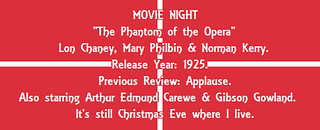
The Phantom of the Opera (1925).


Review #774: The Phantom of the Opera.

Cast
Lon Chaney (Erik, The Phantom of the Opera), Mary Philbin (Christine DaaƩ), Norman Kerry (Vicomte Raoul de Chagny), Arthur Edmund Carewe (Ledoux), Gibson Gowland (Simon Buquet), John St. Polis (Comte Philippe de Chagny), and Snitz Edwards (Florine Papillon) Directed by Rupert Julian (with additional uncredited work by Edward Sedgwick, Ernst Laemmle, and Lon Chaney)

Review
After a bit of shopping on the Eve of Christmas, I decided to watch a film that I had planned to do earlier in the year but had forgotten to. 90 years after its release, all of the cast members had died, but it was only last year that the final cast member (Carla Laemmle, playing a prima ballerina) died, which was also when Soundstage 28, a set made for the movie that was demolished. Naturally, the one scene that is most memorable is the reveal of the Phantom himself, makeup (created by Chaney himself) and all. It shocked audiences in 1925, and it still looks shocking now, in a way that CGI can never duplicate. Of course the sequence in color (with the Phantom as the Red Death, most notably) is also a highlight, particularly for the time it was shown in. It's a melodrama that lasts for...a run time that depends on what version you are watching. The original release was 101 minutes, but when it re-issued in 1930 with sound, it lasted 101 minutes. The version I watched lasted 107 minutes, so I guess I won out with the movie. The movie certainly sets itself well with regards to the mysterious aspects of the Phantom, but also with the character himself, presented as more than just someone who stalks the opera, but one of misery and hope, masked in deformity. Of course he also was once a prisoner on Devil's Island before he escaped, but still. Chaney truly dominates the movie, in part due to the makeup, but also his ability to act so well without sound. The chandelier scene is treated a bit low key (compared to other scenes), but it is enjoyable to watch a chandelier fall down, especially due to its size. This is a technical marvel in terms of its makeup by Chaney, but also a good horror film that was one of the first films in the Universal Monsters series. Go see it.

Overall, I give it 9 out of 10 stars.