Showing posts with label Harold Goodwin. Show all posts

October 4, 2023

The Mummy (1959).

Review #2096: The Mummy (1959).

Cast: 
Peter Cushing (John Banning), Christopher Lee (Kharis / The Mummy), Yvonne Furneaux (Isobel Banning / Princess Ananka), Eddie Byrne (Inspector Mulrooney), Felix Aylmer (Stephen Banning), Raymond Huntley (Joseph Whemple), George Pastell (Mehemet Bey), Michael Ripper (Poacher), George Woodbridge (P. C. Blake), and Harold Goodwin (Pat) Directed by Terence Fisher (#257 - The Curse of Frankenstein, #258 - Dracula (1958), #272 - The Hound of the Baskervilles (1959), #469 - The Revenge of Frankenstein, #833 - Spaceways, #857 - Frankenstein Created Woman, #858 - Frankenstein Must Be Destroyed, and #859 - Dracula: Prince of Darkness#1280 - The Brides of Dracula)

Review: 
"I have always strenuously tried to avoid being blatant in my pictures. Instead, whenever possible, I have used the camera to show things - especially nasty things - happening by implication."

If you recall, Hammer was on a roll with horror films fit for the international tastes. The successes of The Curse of Frankenstein (1957) proved that Terence Fisher was the right and reliable pick for Hammer's big venture in horror, and his subsequent direction of Dracula (1958) started yet another franchise for Hammer. Who better to do a film involving another monster with familiar cast and crew involved? While the film one might think of it as a remake of The Mummy since it has the same time, it actually seems more in line with the three sequels since the last name of Banning and the name of Kharis came from those, while The Mummy's Ghost also involved a swamp for its climax (at any rate, instead of tana leaves, one sees a Scroll of Life). In general, Universal (releaser of those classic horror films) distributed the film under the "International" label for, well, international releases. The film was written by Jimmy Sangster, who had written several scripts for previous Hammer films. Evidently, the writer of the 1932 adaptation in Nina Wilcox Putnam thought it was "disgusting" and was displeased that it was done without her knowledge or consent (ironic, since the resulting film is considerably superior to the older film in most respects). Three further films were done by Hammer with mummies with The Curse of the Mummy's Tomb (1964), The Mummy's Shroud (1967), and Blood from the Mummy's Tomb (1971); of these, only Pastell returned to appear in any of the films from the original cast, and he only appeared in Tomb; perhaps not surprisingly, none of the films were as successful as the original.

It probably would surprise nobody that the film was a reliable success with how efficient it is with being a viscerally gripping feature that exceeds the original Mummy films with plenty to spare. It is a vibrant feature beyond just being in color, to put it mildly. It is familiar routine (lost loves and impending doom) but it is entertaining routine that does not waver from its goals with distracting relief or imbalances. One would like to not play favorites with film-watching when it comes to acting, but I always find myself smiling at the prospect of seeing Christopher Lee in a lead role, even if it involves him under plenty of makeup, which is exquisite. With a role that invites only dialogue for the flashback sequence (for obvious reasons), he makes for a quality threat that has a looming wandering quality of tragedy that makes a distinct monster than if one simply had a stuntman do it all because of the eyes that come out to play; incidentally, he suffered a handful of injuries on the film, such as separating his shoulder for a break-in sequence. This also applies to Cushing, who has the great dignity required to make his leading qualities all the more enterprising for someone to follow along, because heaven knows there is no man that can deliver exposition like he can. Furneaux is the lookalike that is really more of an alluring presence in the latter part of the film, which goes about as well as you would think in passive energy. The supporting cast is fine, although it is mostly headlined by Pastell and his fervent energy. There are a handful of scenes one could highlight, such as the first sight of the mummy rising, or perhaps the story of how the mummy came to be (exposition is great when delivered by Cushing and Lee being present), but the sequence where Cushing essentially taunts Pastell with regard to his beliefs just to stoke the flame a bit probably should be mentioned. At any rate, it is a gripping feature made in the perfect time for Hammer to stoke the flames of spooking its audience in consistent entertaining fashion with a game cast and director to accomplish everything required to make one of the most interesting films involving mummies of its time. For the Hammer fan at heart, this is one of the more entertaining efforts by the company.

Overall, I give it 9 out of 10 stars.
Tomorrow: AIP double feature.

December 20, 2021

The Cameraman.

Review #1774: The Cameraman.

Cast
Buster Keaton (Buster), Marceline Day (Sally Richards), Harold Goodwin (Harold Stagg), Sidney Bracey (Edward J. Blake), Harry Gribbon (Hennessey, the cop), with Josephine the Monkey, Richard Alexander, Edward Brophy, and Ray Cooke. Directed by Edward Sedgwick and Buster Keaton (#757 - Seven Chances, #762 - College, #805 - The Navigator, #877 - Three Ages, #908 - The General, #926 - Our Hospitality, #941 - Sherlock Jr, #1037 - Go West, and #1058 - Battling Butler, #1173 - Steamboat Bill, Jr)

Review: 
“When we made pictures, we ate, slept, and dreamed them.”

Buster Keaton, as is the case with several folks that thrived in the silent era, deserved better. He thrived best as one of the comedy pillars of the silent era, but his popularity underwent its demise not long after his decision to sign a contract with Metro Goldwyn Meyer. Of course, it actually really started with The General (1926), arguably his greatest film. The mixed success of the film at the time led his distributor in United Artists making sure to monitor him more carefully in expenses. With this film, it fell to MGM to try and manage him, with Keaton not even given credit for co-direction; Sedgwick, known for his un-credited work for 1925's The Phantom of the Opera (#774), shouldn't be diminished, since he tried to maintain his authority before quietly telling Keaton to help guide him. Keaton would later call his decision to join one of the worst of his life, one that would last until 1933. Instead of doing all the stunts, now he had stuntmen (after this film, anyway). Perhaps it is a coincidence that a movie involving cameramen name-drops the studio in the film. done by MGM. He wanted Spite Marriage (1929, the film released after this one) to be done ss a sound film, but the studio (headed by Irving Thalberg in production) wanted it to be done simply and under their control. As his workload got tougher in the next few years (which came with attempts at pairing him with Jimmy Durante for three films), his personal life fell apart, and he was fired from the studio midway through the 1930s. At any rate, this film managed to do quite well with audiences, even though it was believed to have been lost because of the 1965 MGM vault fire; three years later, a print was found in France, proving that is important to keep looking (a 1991 print was combined with this one to make the restored version one knows today). The film was written by Clyde Bruckman and Lew Lipton, with Joseph W. Farnham for titles. 

For what it is worth, the studio would show this film to new directors over the next few years about what a well-constituted comedy looked like. It is always hard to say just which Keaton film is the best, because he managed to do so well as one of the masters of the deadpan, the visual gag, and all-around master of charm. Even with a lessened capacity in terms of control with his comedy (i.e. not just him having an idea he could flesh out in the middle), he still is at the top of his game. His expressions in the face of amusing situations manages to never waver, always seeming to zone in on what is needed without becoming a malleable prop or just a stone face. He might not have as many dangerous stunts to pull around, but he still finds ways to make worthy humor come from arranged sequences, such as a street skirmish or sequences in a pool room. Day accompanies him with fair timing that fits what is needed, since one just has to make sure they don't look overmatched when it comes to being together. They match well, and the boat sequence is a useful one to note. At any rate, there are a few folks that Keaton pairs himself with for a gag, whether involving a monkey or with a hapless Gribbon (Goodwin does fine as the stooge). Of course, maybe the biggest smirk on my face comes with his scene at Yankee Stadium (an improvisation on his part), acting out the game to an empty crowd. At any rate, the sequence involving him shooting (or at least attempting) with the camera prove quite interesting, as a sort of film-within-the-film (which in that sense might remind one of Sherlock, Jr), complete with "mistake shots" and a climax with an absolute zinger for a line. The 67 minute run-time is effective to where one might want to see it twice just to absorb those visual gags again and again. It is the last great classic with Keaton in control, and he does everything one might see from him, never seeming compromised or constrained in his comic vision. No matter who stands out as your comic favorite of the silent era, Keaton's The Cameraman is still a great triumph for its era.

Overall, I give it 10 out of 10 stars.

I want to close this review off by acknowledging that today is the eleventh anniversary of the beginning of Movie Night. What a time we live in. 4,018 days since that day has seen 1,774 reviews, which means a review has been done every 2.26 days on average. As always, I wish to express my gratitude to anybody who has had the curiosity to check out this show over the years and anyone who has stuck around to check out what somebody on the Internet has to say about some random movie, whether good or bad. I hope that the years that follow lead to a continuation of interesting films to encounter and ponder about and that you are there to read all about it. Onward to the next row of films for the holidays.

December 8, 2015

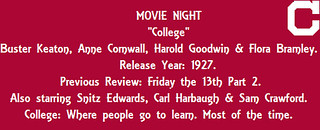
College.


Review #762: College.

Cast
Buster Keaton (Ronald), Anne Cornwall (Mary Haynes), Harold Goodwin (Jeff), Flora Bramley (Mary's friend), Snitz Edwards (Dean Edwards), Carl Harbaugh (Crew Coach), Sam Crawford (Baseball Coach), and Florence Turner (Ronald's mother) Directed by Buster Keaton (#757) and James W. Horne.

Review
Oh the joys of reviewing a movie named College. It is only fitting that I review this movie two days before the second (and last) Final Class Exam that culminates the end of my first semester at my college. To be honest, my first thoughts were that this sounded a good deal like The Freshman (#667), with regards to the premise of a new college student trying to impress someone at a college despite being picked being on, with one of their ideas being to play sports. But I realized that this isn't exactly a tired trope because it still technically works today. The debate of focus of academia vs athletics evidently was even a hot topic in 1927 as it is now. But the movie isn't a discussion of that, it's Buster Keaton being involved in slapstick, with some fun title cards (such as Keaton's academic character talking about athletes such as "Ty Ruth" and "Babe Dempsey") and some highlights such as Keaton trying to play baseball (try being emphasized here) and track and field (My favorite part: Keaton not only misses jumping over a hurdle, he breaks it in half with his face) but also some drama as well. The actors certainly fit their parts well (with Snitz Edwards, who had been in Seven Chances fitting nicely as the beleaguered Dean), fitting the story just fine. One scene that doesn't really age well is the scene where he puts on black-face makeup in order to work at a diner. It doesn't last long (maybe about 3-4 minutes), but it's still strange that he even put it on in the first place. Racist? That's up to you to decide, along with noting the time this was made as well. Despite this, the movie holds up pretty well, and the heart of the movie makes for a relatively fine movie.

Overall, I give it 8 out of 10 stars.