Showing posts with label Cedric Hardwicke. Show all posts

October 16, 2024

The Invisible Man Returns.

Review #2279: The Invisible Man Returns.

Cast: 
Cedric Hardwicke (Richard Cobb), Vincent Price (Geoffrey Radcliffe), Nan Grey (Helen Manson), John Sutton (Dr. Frank Griffin), Cecil Kellaway (Inspector Sampson), Alan Napier (Willie Spears), Forrester Harvey (Ben Jenkins), and Paul England (Detective) Directed by Joe May.

Review: 
You have to be a bit bold to flat out call your movie a sequel to H. G. Wells' The Invisible Man, particularly since well, Wells didn't do a follow-up work to his famous 1897 novel. The 1933 adaptation by Universal (as directed by James Whale) even matched the book in killing off its lead character. But here we are because Universal Pictures loved the idea of doing follow-ups to their horror films and had a hit with Son of Frankenstein (1939). Universal apparently had an interesting time to pick a director and an actor for the title role (thinking of Rowland V. Lee to direct) but eventually settled with May to direct and picked Vincent Price (having originally thought about casting someone familiar like Boris Karloff at first before going for "young and good-looking upcomer"). This was released at the tail end of May's career as a director (having emigrated from Austria to America in the 1930s) as he directed just four further films prior to his death in 1954 at the age of 73. Four writers were utilized for this film: Lester K. Cole and Curt Siodmak wrote the screenplay while May, Siodmak, and Cedric Belfrage wrote the story. The movie apparently was shot over the course of a month in late 1939. The effects were credited to John P. Fulton, Bernard B. Brown and William Hedgcock, which apparently dealt with shooting in black velvet. The next two films dealing with invisible people from Universal were not exactly horror films, but Siodmak wrote both of them (with May being there as well for one of them) with the sci-fi comedy The Invisible Woman (1940) and the action/spy film Invisible Agent (1942). Jon Hall served as the new title character for that film and The Invisible Man's Revenge (1944).

Admittedly, the sequel does have one neat card to play: it isn't merely just doing the last film again, particularly since it seems hard to top Claude Rains and his performance from a few years ago. For one, it is more of a gradual unravelling as one might see from a procedural, complete with a somewhat low-key lead presence (note that "Sir" Hardwicke actually isn't in the film for very long). The justification for how one gets to see a new invisible man is pretty interesting: when framed for murder and on the door for execution, friends resort to helping a guy turn loose and invisible. It has a "fine" pace at 81 minutes that is more interesting when trying to play for effects rather than play itself in showing the locale that is, well, not nearly as effective in relief that one already saw years prior. It probably is more interesting to wonder just what one would end up doing in terms of stability when it comes to the idea of invisibility, and like before it presents someone who gets wrapped up a bit in chaos but otherwise had a genuine idea in mind in going with the whole thing. This was the fourth feature film for Price, who actually would go through a variety of supporting roles (with some top billing) in noirs and period films before getting latched onto as a horror guy by the 1950s. He does just fine for a role that is all about the voice over all, which he plays with concern rather than ham, which probably makes sense. Hardwicke gives the worried elegance of someone doing a job quick and easy while Grey and Sutton at least fill out the movie in casual interest (i.e. a bit of science-babble and babble about their friend). Kellaway isn't even forced to play skeptic to what's going around him, he just plays it straight. As such, it may be a hokey sequel not quite up to the original stuff, but it at least has some commitment to doing drama with some quality effects and useful enough pacing to keep one invested to the bitter end. It's a familiar comfort, go figure.

Overall, I give it 7 out of 10 stars.

April 18, 2020

Around the World in 80 Days.

Review #1393: Around the World in 80 Days.

Cast: 
David Niven (Phileas Fogg), Cantinflas (Passepartout), Shirley MacLaine (Princess Aouda), and Robert Newton (Inspector Fix), with appearances from Edward R. Murrow (Prologue narrator), Finlay Currie (Andrew Stuart), Robert Morley (Gauthier Ralph), Noël Coward (Roland Hesketh-Baggott), Sir John Gielgud (Foster), Charles Boyer (Monsieur Gasse), Sir Cedric Hardwicke (Sir Francis Cromarty), Melville Cooper (Mr. Talley), John Carradine (Col. Stamp Proctor of San Francisco), Jack Oakie (Captain of the SS Henrietta), in addition to Fernandel, Cesar Romero, Reginald Denny, Peter Lorre, George Raft, Red Skelton, Marlene Dietrich, Frank Sinatra, Buster Keaton, Col. Tim McCoy, Joe E. Brown, Andy Devine, and various others. Directed by Michael Anderson (#717 - Logan's Run)

Review: 
"Do not refer to Around the World in 80 Days as a movie. It's not a movie. Movies are something you can see in your neighborhood theatre and eat popcorn while you're watching them....Show Around the World in 80 Days almost exactly as you would present a Broadway show in your theatre."

It should only prove fitting that a film like this was meant to be treated as a major event for the masses, since this was an experience like no other for a decade that had plenty of spectacle to show in a time that desired entertainment that manage to receive accolades for itself. No expense would be spared in making such a monumental exercise of excess, with six million being spent for over 60,000 extras and 70,000 costumes made/rented alongside thousands of actors and plenty of miles traveled to show something to try and impress the viewer, which should only prove appropriate for its producer in Mike Todd. He worked in a variety of jobs after dropping out of high school, such as selling shoes, drugstore soda jerk, and construction businessman before eventually finding interest in Broadway in the late 1930s. Over the course of the next few years, Todd would produce several shows on the stage that ranged from burlesques to musical comedy revues to even an operetta. In the 1950s, he found himself involved with film when he got involved in getting behind Fred Wallers' widescreen process Cinerama, which was featured most notably with This is Cinerama (1952). He soon moved to another venture involving a widescreen process that would bore his name in Todd-AO with Robert Naify in 1953, which would become a theater sound leader for films in the next few decades that simplified its setup to one camera and lens, with the Todd-AO widescreen process being debuted in Oklahoma! (1955).  Todd would reap plenty of benefits from producing this film, winning an Academy Award for Best Picture to go along with four other awards for color cinematography, editing, scoring, and adapted screenplay (which had three writers, including John Farrow, who directed a bit of footage before quitting). Tragically, Todd would die just two years after the film's release in a plane crash at the age of 48.

This was based off Jules Verne's 1872 novel of the same name, which has been adapted to several forms of media alongside film over the past century. Interestingly enough, this film begins by showing snippets from another adaptation of a Jules Verne work in A Trip to the Moon (1902), likely one of the most influential films of its time from noted director Georges Méliès. Both do a fine job when it comes to showing a sense of wonder and imagination, this much is true. In the case of Todd's production, he surely wanted to keep people's attention for 182 minutes with a travelogue around the world that is worth one look for the curiosity of it all, particularly whether to see if it has lost any of its luster to time, which does sometimes seem the case. One cannot deny that Niven and Cantinflas do a tremendous job together, inspiring curiosity and humor at times when together. Niven does his part with the type of dignity and composure that one enjoys for an adventure. Cantinflas, a Mexican icon for comedy then as now, proves to be quite amusing with his antics, such as when gets into a bullfight (as performed by the actor himself). MacLaine (in her third role of her film career) shows up somewhere in the middle of all this, and she nearly becomes lost with all theses presences around, where Newton's bluster proves effective as a foil to all of this. One may very well play a game of spot-the-international star when trying to pass the time when it seems the film is flying up its own ego, whether that means a wordless piano performance from Sinatra or hammy times with Raft and Carradine or one-shot turns like Lorre or Keaton, where half don't even have names to go with their "role", although at least it is nice to see Hardwicke and Gielgud. The film is nice to look upon at times, whether through a costume or some scenery to view upon. It is a film aiming for light-heart entertainment that succeeds on fair craftsmanship in the parts that matter without becoming a complete shell of arrogance that could kill a more pompous ambition. Adventures like this can be fun if one is in the mood for what it is trying to sell and have three hours to spend with spectacle.

Overall, I give it 7 out of 10 stars.

October 10, 2016

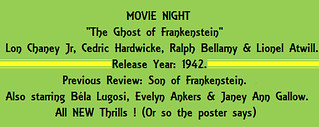
The Ghost of Frankenstein.


Review #845: The Ghost of Frankenstein.

Cast
Lon Chaney Jr. (The Monster), Cedric Hardwicke (Dr. Ludwig Frankenstein/Henry Frankenstein), Ralph Bellamy (Erik Ernst), Lionel Atwill (Dr. Theodore Bohmer), Béla Lugosi (Ygor), Evelyn Ankers (Elsa Frankenstein), Janet Ann Gallow (Cloestine Hussman), Barton Yarborough (Dr. Kettering), Doris Lloyd (Martha), and Leyland Hodgson (Chief Constable) Directed by Erle C. Kenton.

Review
The original three films (#072 - Frankenstein, #394 - Bride of Frankenstein, #844 - Son of Frankenstein) are all entertaining, with Boris Karloff making for a superb monster. This is the first film without Karloff playing the role, with Chaney (who we saw in #260 - The Wolf Man) now taking the role. His performance in this one isn't as interesting, mainly because he never speaks, mainly just lumbering around, more than he did in the last one. The monster this time is wearing a suit (unlike that fur coat from the last one...don't ask how he's back to the suit), and it's a shame that there isn't much to him, save from lifting a girl to try and get a ball midway through the movie. At least Lugosi returns once again, though it isn't as memorably creepy this time. The lines at the end where he talks about living forever are pretty chilling, though. It really a movie only interesting at the end, when the Monster gets some sort of brain surgery. It is a quick movie at 67 minutes, but there really aren't too many great moments to it. I do find it funny that there is another Frankenstein around to operate on the monster (and that the ghost looks like him, too), but also funny that when he looks at the original Frankenstein's notes that it shows clips from the first film. Hardwicke does okay, but he isn't as fun as the other two Frankensteins. The effects are adequate, but it is clear to note this was the first Frankenstein movie made as a "b-picture", with lower budgets and reuse of actors. It's not a bad flick by at means, but it really doesn't seem to do anything new, which is probably why the next film would be a crossover between a familiar monster...

Overall, I give it 6 out of 10 stars.

September 8, 2013

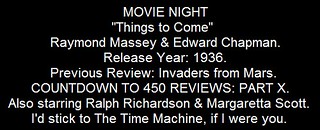
Movie Night: Things to Come.


Review #449: Things to Come.

Cast
Raymond Massey (John Cabal/Oswald Cabal), Edward Chapman (Pippa Passworthy/Raymond Passworthy), Ralph Richardson (Rudolf), Margaretta Scott (Roxana Black/Rowena Cabal), Cedric Hardwicke (Theotocopulos), and Maurice Braddell (Edward Harding) Directed by William Cameron Menzies (#448 - Invaders from Mars)

Review
H. G. Wells devised the plot and dialogue for the film which was adapted from his own novel, The Shape of Things to Come, though apparently scenes were shortened for censors, and learning that he wanted the music to be recorded in response and have the film made around the music is both an intriguing idea and odd at the same time, for 1936 at least. But enough about Wells, there's the film itself, and how it is on the whole, and it's...not too bad. Somewhat dated but never too dull, the actors do alright and the highlight of the film is undoubtedly the effects which have been compared to Art Deco, which isn't a bad thing. The directing by Menzies (Who I just talked about in the last review...) is not too shabby for a film like this. For the time this was made it feels like foreboding, and while this isn't as great as it could have been, it's at least watchable and one of those films that shouldn't be remade, which in the world we live, is an achievement, I suppose. There's just one more film to get to in this countdown. Countdown to 450 Reviews: 10, 9, 8, 7, 6, 5, 4, 3, 2, 1.

Overall, I give it 7 out of 10 stars.

And now, the 450th Review (which will be posted tomorrow night) will be...


August 13, 2012

Movie Night: Rope.

Review #219: Rope.

Cast
James Stewart (Rupert Cadell), John Dall (Brandon Shaw), Farley Granger (Phillip Morgan), Douglas Dick (Kenneth Lawrence), Joan Chandler (Janet Walker), Cedric Hardwicke (Mr. Henry Kentley), Constance Collier (Mrs. Anita Atwater), Douglas Dick (Kenneth Lawrence), and Edith Evanson (Mrs. Wilson) Directed by Alfred Hitchcock.

Review
Before I begin, today is Alfred Hitchcock's 113th birthday (born August 13, 1899). You might be wondering why I'm not reviewing something more known (such as Psycho, Rear Window, Vertigo, North by Northwest) The reason is because I wanted to review something different for a change. The film is an interesting experiment, filmed with long shots with no interruption (In short the effect of a single take while actually being 10), all operating in real time. The performances are good, especially from Stewart and Dall. While the film takes its time before getting to its climax, it is intriguing enough to keep you watching. And lastly, the directing is good. And that is all you need in a good film.

Overall, I give it 8 out of 10 stars.