Showing posts with label Paul Brinegar. Show all posts

October 12, 2024

How to Make a Monster (1958).

Review #2274: How to Make a Monster.

Cast: 
Robert H. Harris (Pete Dumond), Gary Conway (Tony Mantell / the Teenage Frankenstein), Gary Clarke (Larry Drake / the Teenage Werewolf), Paul Brinegar (Rivero), Malcolm Atterbury (Security Guard Richards), Dennis Cross (Security Guard Monahan), Morris Ankrum (Police Capt. Hancock), Walter Reed (Detective Thompson), and Paul Maxwell (Jeffrey Clayton) Directed by Herbert L. Strock (#2097 - Blood of Dracula and #2098 - I Was a Teenage Frankenstein)

Review: 
It is pretty interesting to get to a film that is technically related to other movies. 1957 had seen the release of a handful of features dedicated to teenagers and monsters. It started with I Was a Teenage Werewolf, which came out in the summer before the release of I Was a Teenage Frankenstein and Blood of Dracula as a double feature in November 1957. Each one saw a teen turned into a monster due to the efforts of adults for some sort of weird purpose. Now, with this film (released in July of 1958) we have another film about monsters and nefarious purposes as directed by Herbert L. Strock, who had directed two of those aforementioned films. As was before with the other films, the screenplay was written by Herman Cohen and Aben Kandel while Cohen served as a producer. Supposedly, as claimed by Ed Wood, the film was a rip-off of a script he had sent to AIP (involving a killer actor), although the idea of Wood crying foul at a rip-off of his stuff is actually amusing to me. Strock would direct just three more features after this one, spending most of his time doing television along with editing and producing. The last couple of minutes, as one might have already seen from promotional stuff, does show some masks in color (the same trick as done in I Was a Teenage Frankenstein), which were designed by Paul Blaisdell for previous films such as It Conquered the World (1956), Invasion of the Saucer Men (1957), and The She-Creature (1956). Conway, who had played the title threat in the Frankenstein film, is the one other link to the films here, as done by American International Pictures.

Really this is just a backstage murder procedural that happens to have a lead-in that you'll get to see a few masks. One wonders just if Jack Pierce came to mind when it comes to the script or the performance of Harris for an underappreciated effects man as the lead character. It is the kind of movie that has a clear appreciation for cheap horror and the people who obsessed over the craft. It is amusing to see a justification of John Ashley (a sometimes regular at AIP) do a song as part of "the times changing", because AIP ended up doing their own music-themed films to go with chasing other trends. Anyway, here's a movie involving special makeup cream that can leave one to the power of suggestion while people are dressed up and you have a guy calling his masks his "children". Honestly, I dug it, particularly from Harris, who seems to be having quite the time in fruitful obsession that believes going from fired to murder is totally normal, and he sure sells that nuttiness on point. It is the portrait of a man in delusion of the starkest kind: their craft. Conway and Clarke might not get much to do beside be in makeup, but they make worthy puppets to sell the idea of being ready for suggestion. It is a bit funny to see the ones who get wrapped up as targets for the monsters, because one of them gets the boot mostly because they are too savvy in crime cliches. Trhe climax works out well for those who like to gawk for curiosity at masks and silly souped-up resolutions (the AIP way). In general, this is about on par for decent AIP entertainment in giving you what you expect: silly young folks, a few decent makeup shots, and a neat little climax. It exceeds those "Teenage" films on the basis of having the commitment to have a lead performance worth writing more than two bits about for solid average fare. 

Overall, I give it 7 out of 10 stars.

April 21, 2022

High Plains Drifter.

Review #1831: High Plains Drifter.

Cast: 
Clint Eastwood (The Stranger), Verna Bloom (Sarah Belding), Mariana Hill (Callie Travers), Billy Curtis (Mordecai), Mitchell Ryan (Dave Drake), Jack Ging (Morgan Allen), Stefan Gierasch (Mayor Jason Hobart), Ted Hartley (Lewis Belding), Geoffrey Lewis (Stacey Bridges), Dan Vadis (Dan Carlin), Anthony James (Cole Carlin), Walter Barnes (Sheriff Sam Shaw), Paul Brinegar (Lutie Naylor), Richard Bull (Asa Goodwin), Robert Donner (Preacher), John Hillerman (Bootmaker), John Quade (Freight Wagon Operator), and Buddy Van Horn (Marshal Jim Duncan) Directed by Clint Eastwood (#1252 - Space Cowboys, #1310 - Million Dollar Baby, #1476 - Pale Rider, #1501 - Unforgiven, #1550 - Gran Torino, #1638 - Bird, #1757 - Sudden Impact)

Review: 
"The townspeople did not represent the true spirit of the American pioneer, the spirit that made America great." 

It's interesting to consider the reactions one can have over a Western that dared to do something different with the genre, if only because not many Westerns get criticized by a Western icon - because that quote above is by John Wayne, referring to this feature film, which was the first Western directed by Clint Eastwood (apparently, he had sent a letter to Wayne after this film was released to perhaps star together on a film - go figure). This was his second feature, with the first having been Play Misty for Me (1971), and Eastwood would end up directing a total of six features in the 1970s (all but one featured him as star). Of course, Eastwood had plenty of time to incorporate his vision of the Western hero with six seasons of Rawhide and stardom in Sergio Leone's "Man with No Name" trilogy around him. It wasn't even the first starring feature of his to feature a lead character dedicated to serving some sort of retribution to others that had brought upon him, as could be evidenced by Hang 'Em High (1968). Eastwood's influences in Don Siegel and Sergio Leone prove apparent here, probably helped by the fact that Eastwood included their names on gravestones in the film. The film was evidently inspired by a murder in 1964 of Kitty Genovese, who reporters had said numerous people heard or saw the crime from their apartment building but did nothing (of course, this report was later found to be highly inaccurate). Ernest Tidyman, who had won an Academy Award for his work on The French Connection (1971), wrote the screenplay, although Dean Riesner (a writer on numerous Eastwood films) provided key re-writes.

It's too bad that Wayne thought there was some sort of disagreeable element to making a portrayal of the Old West that differed from what had been seen in dozens of films before it (perhaps he saw something in this film that reminded him of High Noon (1952) when it comes to examining one's conscience, since Wayne also disliked that movie). Well, at least the ones before The Wild Bunch (1969), anyway, because heaven knows the genre has only managed to have one or two highlights in the next couple of decades, and High Plains Drifter is probably one to spotlight for the 1970s, paranoia and all. I welcome any kind of movie that has interest in showing the fear of a town in what they know about themselves, where trying to teach a town courage ends up exposing a lack of moral courage from before. Of course, this is a movie that makes itself starkly different from other films with its hero in the first 25 minutes, so there is that to consider. Eastwood has made an effective film here, one filled with iconoclastic spirit that points the mirror firmly at oneself when it comes to showing conscience and justice. It isn't surprising that the script proposal presented to Eastwood was offbeat enough for him to like it, because it is a lead role that continues what Eastwood liked to do best: the less one says, the stronger one becomes in the imagination of the audience. This results in an efficient production and performance, one that maneuvers his way through with raw enigmatic energy; interestingly, the original script had him as the brother of a marshal, but this was changed to something that could lend itself to discussion. The rest of the cast follows along with worthy reflection, most notably with Curtis. While most of the folks here are representations of the ooze of the morals in town, Curtis is different even when presented as a yes-man to the folks around him, if only because of his eyes, ones that have seen pain despite plenty of friendliness to go around. Bloom is the only other one with a semblance of conscience here, one that eventually festers to the surface that results in a few interesting moments shared with Eastwood, while Hill represents the other side of feminine influence in the town of alleged morals with proper wiles. Ryan is the other highlight among the smarmy folks, one who serves as the ideal conniving presence without having to chew scenery to do so, with the others following along in that regard. Lewis, Vadis, and James do well as the adversaries in simple ruthlessness without needing to see more than what is needed. If you think about it, Pale Rider (1985) is the cousin to this feature when it comes to long & tall mysterious strangers arising from somewhere in a small town, but I think High Plains Drifter is slightly better, if only because it has a jagged edge of humor and allegory that makes its result all the more whole, one that utilizes its 105 minute run-time for gratifying effect in haunting display, complete with a Dee Barton music score to generate a first-rate Western. It isn't perfect, but it makes a worthy first impression when looking on the career of Clint Eastwood - the star and director.

Overall, I give it 9 out of 10 stars.

Note: This one was for Dad.

October 31, 2019

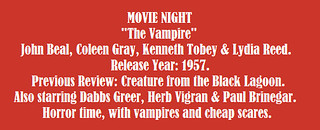
The Vampire (1957).


Review #1291: The Vampire.

Cast: 
John Beal (Dr. Paul Beecher), Coleen Gray (Carol Butler), Kenneth Tobey (Sheriff Buck Donnelly), Lydia Reed (Betsy Beecher), Dabbs Greer (Dr. Will Beaumont), Herb Vigran (George Ryan), Paul Brinegar (Willy Warner), Ann Staunton (Marion Wilkins), and James Griffith (Henry Winston) Directed by Paul Landres (#848 - The Return of Dracula)

Review: 
It does seem like a nice way to tie the month together with a generic-sounding horror film with a vampire, seeing how I started the month with another generic-sounding title film with a werewolf. The one thing that this film shares with that film (aside from being an independent movie) is its science-fiction take on a creature of the supernatural - in this case, a guy turned into a vampire because he accidentally took experimental pills dealing with vampire bat blood and regressing animal minds to a primitive state. The vampire himself doesn't show up for most of its 75 minute run-time (for good reason, as one might say), but at least it is somewhat compelling with its sci-fi/horror crossroad to make it a light curiosity. The acting does tend to do just fine, such as the vulnerable yet humble Beal, who one can at take at face value with his struggle, showing some anguish for a film that badly needs it. The other actors are okay, with Greer generally seeming the most interesting when interacting with our lead, especially when it comes to dealing with the possibility of a "vampire". It isn't so much that the film is boring or such, but it just doesn't have enough of a spark going consistently, particularly with scares. The addiction angle is at least an interesting take when it comes to vampires, but it is amusing to note that the same director, writer (Pat Fielder), and producers (Arthur Gardner and Jules V. Levy) would return to do another vampire film the following year with The Return of Dracula - that actually turned out a bit better when it came to handling its vampire lead, actually. The makeup for the vampire is a bit of a disappointment. It has a lumpy composition, where those big eyebrows and hands make it seem more of a take on Dr Jekyll and Mr. Hyde - of course it should be noted that this creature doesn't have any weaknesses that you would see in any other fictional vampires, where he gets taken down by bullets at the end. I suppose one can only do so much with a low budget (reported to around $110,000), but a tighter design would've gone a long way towards making this a bit more easy to take seriously. Actually, tighter pacing might have also been a big help as well, along with a better way to stage a climax that doesn't just have him just being shot in daylight (no, I am not saying a fight in a dark castle, although that amuses me more than suburban horror). On the whole, this is a film made on the cheap that will do the basic requirements needed that works best when found down the line on a dark cold night with not much else to do.

Happy Halloween. But the fun is not over yet...

Overall, I give it 6 out of 10 stars.