Showing posts with label David Paymer. Show all posts

October 10, 2023

Night of the Creeps.

Review #2104: Night of the Creeps.

Cast: 
Jason Lively (Chris Romero), Steve Marshall (James Carpenter "J.C." Hooper), Tom Atkins (Det. Ray Cameron), Jill Whitlow (Cynthia Cronenberg), Allan Kayser (Brad), Wally Taylor (Det. Landis), Bruce Solomon (Sgt. Raimi), David Paymer (Hollister), David Oliver (Steve), Dick Miller (Walt), Ken Heron (Johnny), and Alice Cadogan (Pam) Written and Directed by Fred Dekker (#006 - RoboCop 3)

Review: 
 “It’s an odd movie. Nobody ever sets out to make a cult movie, but there are movies a wide audience will immediately take to, and there’s NIGHT OF THE CREEPS which is a strange mish-mash of detective story, horror movie, romance, science fiction and comedy. But that’s what special about it. At the end of the day, I’m pleased with it. I pulled it off.“

Admittedly, B-movie tributes or pastiches are perhaps a dime a dozen. Apparently, Dekker came up with the script for the film in less than four weeks. He stated an aim for a "1950s sorority movie", complete with a handful of B-movie cliches, whether that involves nerds, corny characters or monsters. Dekker's first credit was House (1986), which was directed by Steve Miner. Dekker had written scripts for films that hadn't come to fruition (such as one for an America version of Godzilla), but one he did helped get him an agent. When it came to Creeps, the agent gave the script to a number of producers, and Charles Gordon happened to show interest, which eventually led to a production at TriStar for six million dollars (this was the first production for Gordon, who would go on to produce for films such as Die Hard). Aside from a few reshoots (such as a sequence involving a toolshed) and a different ending, the film went off mostly without a hitch, but a limited release of less than a thousand theaters meant that the film was not a hit on release, but it has endured as a cult favorite in some circles. Dekker went on to see two of his scripts turned into films the year after the release of this one with The Monster Squad (which he directed) and House II: The Second Story. If you were wondering about the ending, what is different is that the studio mandated what Dekker called a "cheap scare", as opposed to his idea of an ending that involves a burnt character collapsing to the ground while the zombie slugs move away to the cemetery, where a spaceship is above it (of course the film starts with a spaceship experiment, so I think you can see how that makes sense).

For those familiar with films of its ilk with weird creatures and one-note characters to go with one distinct performances, you will be just fine here. I figured it would be a neat little average film when I first heard of it years ago ("hearing" and "getting off my butt to see it" are different things), and that assessment seems about right here. It is a microwaved dinner prepared with the right instructions and most of the patience required to make it, which involves a few decent effects and a second half that picks up the slack left by the sorority stuff (and a black-and-white opening set in the 1950s) for what you would expect. In theory, the character played by Atkins could've just been a flippant cliché that would've been just fine as the authority figure against the zombie slugs (for whatever reason, there's an axe murderer around at times, dead and alive). Oddly enough though, the performance by Atkins is the best of the whole film (go figure, Dekker recognized it from the audition), because, well, there is a tragic energy to it that is endearing and entertaining from the very get-go. Atkins apparently rates this as one of his key favorites, and it damn well makes sense ; the sequence where he explains being there on the night of finding the axe murderer is probably his highlight scene. Honestly, if you cut down on the teenagers faster and dwell right in on this oddball of fire, the movie would probably be even better, even though Marshall and Lively aren't exactly just chopped liver. Once you get someone going from talking about girls to getting things going with a flamethrower, that's almost all you need. The pursuit of figuring out what's going on is more fun when you have familiarity with the material rather than snide jokes, and for the most part, the film is engaging in grimy gore that is made by someone with spirit of passion rather than huckster spirit. In the end, those who know the machinations of the B-movie will like what they see here. It is the kind of thing you put on late at night and move along with (maybe a light chuckle at the name references because it isn't so ridiculous), one that makes quality entertainment fit for a first timer.

Overall, I give it 7 out of 10 stars.
Next: Killer Klowns from Outer Space.

August 1, 2021

Howard the Duck.

Review #1704: Howard the Duck.

Cast: 
Howard the Duck [Ed Gale and Jordan Prentice (suit performance), Tim Rose, Steve Sleap, Peter Baird, Mary Wells & Lisa Sturz (puppeteers), Chip Zien (voice)], Lea Thompson (Beverly Switzler), Tim Robbins (Phil Blumburtt), Jeffrey Jones (Dr. Walter Jenning), David Paymer (Larry), Paul Guilfoyle (Lieutenant Welker), Liz Sagal (Ronette), Dominique Davalos (Cal), and Holly Robinson (K.C.) Directed by Willard Huyck.

Review:
If I simply told you that this was the first feature-length film based on a Marvel Comics character, would that satisfy your curiosity? Good, because one does desire a little big of history for a movie that really deserves more than a few cursory words for a movie that has certainly turned a few pages since its release on August 1, 1988. The movie was written by Willard Huyck and Gloria Katz, with Katz also serving as producer; indeed, this is a Lucasfilm production, one that makes sense given the connection between Hyuck, Katz, and Lucas. Huyck & Katz had met Lucas as students at the USC School of Cinematic Arts. Huyck had his first film credit with The Devil's 8 (1968), and Katz made her first effort with Messiah of Evil (1973), which she co-directed/co-wrote/co-produced with Huyck. That same year, they would work together with Lucas on American Graffiti (1973), which found sucess with audiences despite nearly being rejected by every film studio of the time. It was at the end of production that Lucas had mentioned his approval of the comic series Howard the Duck (created by writer Steve Gerber and artist Val Mayerik), although a decade passed before production would ever start, and Gerber had already been let go from Marvel by that time, and the series wasn't exactly popular by the time of the 1980s. A wife and husband team, Katz and Huyck would work on four further films together (with the latter serving as a director for three of them) while also doing work for Lucas as script doctors for Star Wars (1977) and co-writers on Indiana Jones and the Temple of Doom (1984). Of course, they didn't have success with every project they wrote for, because that same year also saw the release of Best Defense (1984). Incidentally, Lucas would step down as president of Lucasfilm in order to focus on being a film producer. It may interest you to know that this is the last movie to be directed by Huyck and the second-to-last project for both him and Katz, who each served as a writer for the film Radioland Murders (released in 1994 after nearly two decades of production hell, which also included Lucas as a writer and was also a movie that failed at the box office).

Production troubles, yadda yadda, you might say. But yes, this is an important thing to mention when it comes to a film that at one point was intended to be animated (of course, contractual obligations forced it to be live-action, which probably saved money); it probably didn't help that the design for the title character had to be re-designed a few times in order to make sure a certain media conglomerate would not sue for resemblance to a certain duck. But hey, this is a movie that tries to pass off California as Cleveland. You might notice that there are several folks credited as the title character, which is kind of odd, because how many movies have a mix of dwarf actors, puppeteers, and a Broadway actor? Is it a troubling sign when there are different viewpoints from Katz and Gerber about the title character? Katz stated that the movie was "about a duck from outer space...It's not supposed to be an existential experience", which seems different from Gerber's description of the series as existentialist that has one main point of not having a joke, as if "life's most serious moments and most incredibly dumb moments are often distinguishable only by a momentary point of view." So...yeah, here we are with a PG-rated movie that really seems to be confused on exactly what it wants to be. On the one hand, it certainly tries to be funny along with showing a side of adventure within effects....on the other hand, it also features a title character that is clearly a few years too early for this to be convincing. That duck simply never seems convincing at any point in time, whether because of the eyes or perhaps one never stops thinking about the fact that one is watching folks suffer in suits. It is not quite offbeat enough, particularly when it tries to do a variety of duck puns that seem to mask something that is desperate to be loved for 111 minutes, which seems too long for a film like this. Of course, the first film that comes to mind when relating to this one comes in retrospect: Who Framed Roger Rabbit (1988), which utilized a variety of techniques to make a movie with animated characters interacting with human actors (which ranged from puppets to robotic arms). So yes, this era was certainly interesting for filmmaking with effects, with varying results. Sometimes the effects work here, but if you aren't quite sold on it from the start, you will pretty much be checked out by the time you see a climax involving an ugly beast and exposition. At least the music (a mix of songs by Thomas Dolby and a soundtrack by John Barry and Sylvester Levay) works out pretty well.

Besides, the main cast is fairly decent. It just so happens they are in a movie that deserves better, one that has a tone that wavers wildly without that sense of wonder or engagement. Duck puns and (somewhat dated) effects do not exactly go hand in hand with a movie about a duck and a woman who falls for him, you might say. Thompson fares okay in the sense that one doesn't think too much about the fact she is acting against a hodgepodge effect while trying to stick the landing in singing and timing. Of course, the other highlight is Jones, because seeing him undergo an effects show with the changing of his character from "exposition man" to "Dark Overlord of the Universe" seems more interesting as opposed to the tonal shifts that come from Hyuck and Katz, particularly since Jones seems dry enough to make it all work. This was the sixth film role for Robbins, who had dabbled in theater and television. While I can certainly see why he was cast when it comes to his attempts at timing, honestly he is probably the weaker element among the main three, having a hit-and-miss quality (most prevalent in the Ultralight aircraft sequence, which certainly should have been trimmed down). I respect Gale, who was initially rejected for the role because he was thought to be too tall for the role before he was brought in to do stunts and play the understudy. It doesn't take many guesses to wonder why he took over a grueling role from the initial actor hired when it was a child actor.  Keep in mind, the voice for the main role came after the movie was done, complete with trouble in synchronizing the voice to the movements of the mouth (the lines for the duck were spoken by the puppeteers). The filmmakers actually had hired Robin Williams to do the voice for the film, but he quit (because, hey, you would too if your rhythm is being messed with in timing). Zien has an awkward challenge on his hands, because his timing is always a little mixed out when contrasted with the others, but he almost pulls off making the lead character someone worth wanting to see more of. 

Like I said, if that duck was anything other than a ungodly hodgepodge, one could almost take the movie at face value.  If Lucas thought there was something appealing in terms of film noir or absurdism within the comic series...they sure will be looking hard to find it in this movie. It is a confused effort that manages to be infuriating for anybody who isn't on the two extremes when it comes to this film, which either is thought of as a terrible failure or a cult classic. I am certainly one of those frustrated folks, because there are considerably better mediocre movies that merit "cult status" than this, and it isn't even terrible enough to call a complete failure. It exists on the "eye-roll" part of the curiosity scale, really. Perhaps I shouldn't be surprised that Katz and Hyuck defend the film for what it is (alongside other members of the cast/crew, such as Thompson), stating that while it could have been "edgier and dirtier", it was a movie plagued by studio demands, and Lucas continued to support the film as one that he felt would be later seen in a better light. But hey, I would cope too if it came to a movie that is either a haven for folks who love to pick on muddled messes or for folks who either see a hidden rough gem (of course, there are probably contrarians in that bunch...but hey). Nay, I think it has an exceptionally appropriate place in limbo, a movie that can either be a raw joke or a welcome slice of camp, one that might as well be encased in amber for all time. As the saying goes, take it for what it is worth and go from there.

Overall, I give it 6 out of 10 stars.

Come one, come all, it is time for August to receive its own month. Anniversary in August will dedicate the whole month to films released in that month that will gradually reveal itself over the next few weeks until August 31. Enjoy guessing what movies are to come!

February 20, 2019

Payback (1999).

Review #1191: Payback.

Cast:
Mel Gibson (Porter), Gregg Henry (Val Resnick), Maria Bello (Rosie), Lucy Liu (Pearl), Deborah Kara Unger (Lynn Porter), David Paymer (Arthur Stegman), Bill Duke (Detective Hicks), Jack Conley (Detective Leary), John Glover (Phil), William Devane (Carter), James Coburn (Justin Fairfax), Kris Kristofferson (Bronson), and Trevor St. John (Johnny Bronson) Directed by Brian Helgeland (#372 - 42)

Review: 
The strangest thing about films can be the ways that it can sometimes transition into numerous forms before a final shift into the form that goes to audiences. This film is a particular example of where a director's vision can verge differently from ultimately made it to the screen. Brian Helgeland was making his directorial debut after meeting up with Gibson on the set of Conspiracy Theory (1997), a film that he had written for. During the post-production stage for that film, Helgeland happened to have the script with him when Gibson inquired about the pages he had with him, for which he read the first act of. A few weeks later, Gibson agreed to finance the film with his production company Icon Productions provided they could shoot within 12 weeks. The film is as adaptation of the 1962 novel The Hunter by Richard Stark (pen-name for David E. Westlake), the first of 24 novels from 1964 to 2008 with the character Parker as the main lead. It had already been adapted a movie in 1967 as Point Blank, featuring Lee Marvin, and other novels had been given film adaptations.

Before I talk about the circumstances that led to Helgeland's dismissal from the film, let's talk about how the movie is first. For a neo-noir, it certainly is a decently entertaining one. It maybe a bit routine in terms of its story and action, but it is a road worth walking onto in part because of its dark charm, which in some ways feels like a guilty pleasure. Gibson is certainly up to task in delivering a character worth following with a subtle grin in a film with oddball people basked in noir types. Henry is fairly adept at showing menace for his time shared with Gibson. Bello does fine with her material, sharing her time with Gibson quite well. Liu (playing a dominatrix) is quite quirky. Paymer plays his role with a good deal of sleazy ooze that is pretty amusing. It is amusing to see Coburn briefly, but interesting to see Kristofferson all of a sudden in the film appear; he isn't really too menacing as the big bad but he is at least neat to watch. The movie moves with a dynamic pace to try and garner up excitement along with a chuckle, and it works out fine for the most part, playing to the noir type handily. It is sometimes a bit wobbly with its plot motivations (and its action violence on occasion), but the final product works out mostly because it manages to distract itself enough to where while you can see where "producer's notes" may have stepped in, you can at least find something to watch without too much disapproval. It has a bit of fun with its aspects of revenge without being too demanding.

Helgeland's version of the film was felt to be too dark for a mainstream audience in terms of story, tone, and look. he was fired from the project, which occurred two days after winning an Academy Award for Best Adapted Screenplay for his work for L.A. Confidential (1997). Thirty percent of the film was re-shot (with new material written by Terry Hayes), with John Myhre (production designer) doing un-credited directorial work. Helgeland would have his version of the film (referred to as Straight Up: The Director's Cut) released on DVD in 2007. His version differs from the theatrical version in several ways, such as a shorter length (90 minutes as opposed to the 101 in the theatrical), a female Bronson un-seen by the audience that is voiced by Sally Kellerman, the removal of the narration by Gibson, and the restoring of the look of the film from a bleached tone to one more normal. Honestly, the look is okay as is (even if sometimes it may seem better in black-and-white by simply taking the color out of the screen manually), but at least there exists two versions to compare. I don't have too much interest in watching the other cut, but if you are curious about what makes a movie go in different directions, I'm sure it is right up your alley. The film as is just fine, not being any kind of big statement as a neo-noir action flick, but it will serve just alright for the tastes of people wanting some entertainment.

Overall, I give it 7 out of 10 stars.

original image:


June 7, 2016

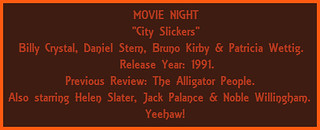
City Slickers.


Review #808: City Slickers.

Cast
Billy Crystal (Mitch Robbins), Daniel Stern (Phil Berquist), Bruno Kirby (Ed Furillo), Patricia Wettig (Barbara Robbins), Helen Slater (Bonnie Rayburn), Jack Palance (Curly Washburn), Noble Willingham (Clay Stone), Tracey Walter (Cookie), Jeffrey Tambor (Lou), Josh Mostel (Barry Shalowitz), David Paymer (Ira Shalowitz), Bill Henderson (Dr. Ben Jessup), Phill Lewis (Dr. Steve Jessup), Kyle Secor (Jeff), Dean Hallo (T.R.) Directed by Ron Underwood.

Review
On the 25th Anniversary of this movie's release, I decided that it would be a good idea to make a review for it and ultimately it turned out to be a great idea. City Slickers is not just a well-made comedy, it is also a movie with layers of drama that manages to give it enough weight to make for a truly entertaining film. The main trio (Crystal, Stern, Kirby) have good chemistry with each other, managing to share some good moments of screen together; one of my favorites is when they are talking about their best (and worst) days, mainly because we get a glimpse at what made them feel their happiest (along with their lowest), as they are trying to capture that spirit again. The movie never feels contrived in either its comedy or its drama, always managing to keep a balance. Naturally, the supporting cast is also a key highlight, with Palance standing out easily, with his first scene having him rope a character to a fence, complete with that chiseled look of his He plays the role with simply and effectively, without any ounce of fakery, and he certainly works well with Crystal, particularly when trying to deliver a calf. He doesn't have all too much screen time, but he is certainly memorable enough and excellent to the core, and his performance managed to snag an Oscar. There is a certain appeal to what these characters are going through, with them trying to use a dude ranch (disguised as a mythic kind of fantasy) to solve their problems, as weird as it may seem. You get to feel for these characters, while also having a laugh at the lines and gags that make up an enjoyable movie. I'd recommend seeing it, one for the jokes, and one for the other elements that give it much needed weight.

Overall, I give it 9 out of 10 stars.

October 8, 2012

Movie Night: Quiz Show.


Review #252: Quiz Show.

Cast
John Turturro (Herb Stempel), Rob Morrow (Richard Goodwin), Ralph Fiennes (Charles Van Doren), Paul Scofield (Mark Van Doren), David Paymer (Dan Elright), Hank Azaria (Albert Freedman), and Christopher McDonald (Jack Barry) Directed by Robert Redford.

Review
This film is based upon the Twenty One quiz show scandal of the 1950's, where the contestants were assisted with the questions by the producers. In short words, cheating. The subject of the film needs a good director and acting to work well. Does it? Yes. The acting works very well, with Turturro, Morrow, and Fiennes being the main standouts. All three portray characters that work in different ways. The film is nailgripping in its drama, being very well delivered, all thanks to the direction by Robert Redford. While it may not be all entirely accurate (This is a rule I should call "The Movieilization Rule"), the film still works out well, giving a good sense of drama and entertainment.

Overall, I give it 9 out of 10 stars.