Showing posts with label Harpo Marx. Show all posts

January 17, 2026

A Night at the Opera.

Review #2497: A Night at the Opera.

Cast: 
Groucho Marx (Otis B. Driftwood), Chico Marx (Fiorello), Harpo Marx (Tomasso), Kitty Carlisle (Rosa Castaldi), Allan Jones (Ricardo Baroni), Margaret Dumont (Mrs. Claypool), Sig Ruman (Herman Gottlieb), Walter Woolf King (Rodolfo Lassparri), and Robert Emmet O'Connor (Sergeant Henderson) Directed by Sam Wood.

Review: 
In fairness, Sam Wood does sound like a name I've covered before. But so it goes. Wood actually was a real estate broker in his young years in California before the growing industry of film for the 1900s eventually became something worth investing time into, starting as a movie assistant and eventually assistant director, most notably with Paramount Pictures for a number of years. He became a director by the turn of the 1910s with Wallace Reid. His efficient nature in getting films done landed him several opportunities to direct for a variety of places over the next two decades, although his longest tenure ended up being with MGM, where he worked in both silent and sound productions starting in 1927. In the middle of his tenure there, Wood ended up as the one directing a key assignment with the Marx Brothers because Irving Thalberg needed a dependable guy to direct the group (now consisting of Groucho, Harpo, and Chico), who had recently departed Paramount Pictures after five features because of contractual disputes that boiled over with Duck Soup (1933). The resulting success led to Wood directing the next Marx movie with A Day at the Races (released in 1937 months after Thalberg's death). For the Marx Brothers, they worked with MGM further on with At the Circus (1939), Go West (1940), and The Big Store (1941). Wood moved on to a wavering list of noted work, most notably with Goodbye, Mr. Chips (1939) before he became a freelance director for the remainder of his career and life, which led to films such as Our Town (1940), Kitty Foyle (1940), and Kings Row (1942). During production of Ambush (1950), Wood died from a heart attack at the age of 66 in 1949. Incidentally, both of Wood's Marx movies served as loose inspiration for the 1992 movie Brain Donors.

With this film, certain parts of the routines were basically workshopped with live stage performances that the brothers did on the road that was performed around the country prior to filming, with Wood traveling with the group from city to city to watch the audience reaction to the gags. The writing credits went to James Kevin McGuinness for the story, George S. Kaufman & Morrie Ryskind for the screenplay while gagman Al Boasberg contributed uncredited dialogue. If Thalberg's idea that the brothers would be best served by having a solid framework to hold up a grab-bag of jokes, well, he probably had a point. Basically, you get a good chunk of Marx mayhem with a handful of gags that come and go with solid efficiency depending on just how much you love seeing a group of oddballs casually loop in and out of affairs that either come off as trivial or just about the right sort of absurd. Obviously, the stateroom sequence is a key highlight of the film in that high-desired quality of rhythm and setup, although I would say the scene with the group trying to evade trouble involving furniture-moving is a nice favorite. Admittedly, the aspects involving Carlisle and Jones is the weakest part of the film, particularly since Dumont is such a solid straight presence anyway. But Groucho is Groucho in terms of just slinging lines full of zip with efficient nature that manages to evoke the charm within conman routines. And of course, there is the usual bumbling from Chico and the not-exactly silent Harpo. As a whole, it isn't hard to see why the Marx Brothers thought A Night at the Opera was one of their favorite films, as it manages to zing on a consistent level with its humor and execution to where one is immediately chuckling with its trio of stars with warm familiarity regardless of how many Marx movies you've seen. 

Overall, I give it 8 out of 10 stars.

June 10, 2022

The Cocoanuts.

Review #1850: The Cocoanuts.

Cast: 
Groucho Marx (Mr. Hammer), Harpo Marx (Harpo), Chico Marx (Chico), Zeppo Marx (Jamison), Mary Eaton (Polly Potter), Oscar Shaw (Bob Adams), Margaret Dumont (Mrs. Potter), Kay Francis (Penelope), Cyril Ring (Harvey Yates), with Basil Ruysdael (Detective Hennessy), the Gamby-Hale Girls, and the Allan K. Foster Girls. Directed by Robert Florey (#531 - Murders in the Rue Morgue) and Joseph Santley.

Review: 
Admittedly, my knowledge of the Marx Brothers is limited in all-around know-how when compared to other classic comedians of film in the 1920s and 1930s like Charlie Chaplin. And yet, the story of how a group of brothers succeeded in vaudeville, Broadway, and film for decades is inherently compelling. They were the sons of Jewish immigrants (their father was a tailor, and their mother handled the affairs of her older brother to enter show business before handling the Marx affairs). Obviously, each of the children had nicknames that stuck with them for their act: Leonard "Chico" Marx, Adolph "Harpo" Marx, Julius "Groucho" Marx, Milton "Gummo" Marx, and Herbert "Zeppo" Marx. Their act had started in the early 20th century with vaudeville before it would start to include comedy in 1912. Gummo and Zeppo left the act in favor of business interests (and World War I). The four Marx brothers made their debut in Broadway with I'll Say She Is, a 1924 musical comedy revue. There were thirteen feature films with the Marx Brothers as the key focus, with two distinct phases (five with four Marx Brothers and the rest with just three). This was their first feature film, but only by accident: they had done a film in 1921 called Humor Risk that was shot in Fort Lee, New Jersey but was never formally released (research from better sources reveal that the film was either not finished or not released). Years went by with attempts by studios to offer up a Marx movie such as with First National Pictures in 1926 and United Artists in 1928. The movie is an adaptation of the 1925 play of the same name, which had been written by George S. Kaufman with music and lyrics by Irving Berlin; Morrie Ryskind served as writer for the movie (obviously not the parts where the Marx brothers came up with things themselves). Florey was born in France but raised in Switzerland before he moved to America at the age of 20 (after writing articles on film and doing film-work in Switzerland), which resulted in a career filled with mostly B-productions (this was his sixth feature after a couple of shorts) along with a handful of television credits before he retired in 1964. Santley on the other hand was an actor, writer, singer and dancer from a young age in the early 20th century before he did his first feature with this movie, his most famous work in a career that ended in the 1950s.

Paramount Pictures would release five films with the Marx Brothers that ended with Duck Soup (1933), and they did not listen to the apparent desire of the Marxes to buy the negative and discard the movie when it was shown in previews, which resulted in success for all. It should only make sense that turning it into a sound feature would be perfect for the growing age of sound movies, which would have two directors responsible to balance out the dialogue in Florey and Santley for the musical elements (such as "When My Dreams Come True", sung by Oscar Shaw and Mary Eaton). The other thing that is important to know about early sound (besides needing static shots with glass booths) is that they actually had to find a way to make sure paper wouldn't ruin the sound quality. Believe it or not, they actually dampened the paper by making it wet. So, with all that in mind, one will probably find this movie to be a moderately engaging experience in differing returns with music and comedy. Obviously, there would be refinements made with the next few Marx vehicles, who kept the sense of anarchy going with sharp lines that wouldn't be just the best thing standing in the way of okay supporting people. Groucho is the easy one to follow with his sharpness in wit, one that maneuvers the 96-minute run-time with efficient hustle, while Harpo utilizes props (like a horn) to wordless effectiveness to go alongside the verbal charmer in Chico, particularly with the "viaduct" scene or with the auction scene (where telling one to keep putting a bid goes wrong). This was the first of seven pairings of the brothers with Dumont, who would basically serve as the straight man (woman in this case) that endured long after the other narrowly straight one (Zeppo, who left in 1933) wasn't there. She handles the humor thrown her way (mainly by Groucho) with refined timing. Zeppo was one described as "handsome, obtuse, slightly wooden" by his brother Groucho, and perhaps one might be forgiven for sometimes forgetting there were four brothers in these movies. But there he is, on the side near Groucho; the plot not involving the Marxes is absorbed by Eaton, Shaw, Francis, and Ring, who are only marginally compelling. As a whole, it is the comedy that drives the movie forward more so than the chorus sequences or the plot involving jewels and would-be romances, but it never teeters too much in general quality (sound is marginable, but this was 1929). It doesn't quite gel into just a "good" movie, but it makes a reasonable start for Marx mayhem that will prove a useful start to further digging in terms of seeing the zany outsider personas of the Marxes, and that makes it a sure winner.

Overall, I give it 7 out of 10 stars.

January 3, 2015

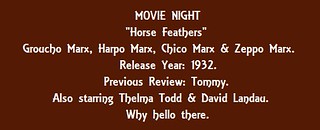
Movie Night: Horse Feathers.


Review #688: Horse Feathers.

Cast
Groucho Marx (Professor Quincy Wagstaff), Harpo Marx (Pinky), Chico Marx (Baravelli), Zeppo Marx (Frank Wagstaff), Thelma Todd (Connie Bailey), and David Landau (Jennings) Directed by Norman Z. McLeod.

Review
In a way, it's been way too long since I touched upon the Marx Brothers (#085 - Duck Soup), but hey, new year, new things, I suppose. As for the movie itself, it's pretty enjoyable. It moves quickly with its gags and pace, which make for a balanced attack of fun. The plot itself could still work today, especially in our competitive world such as this; it's nice to see a plot line that doesn't out date itself. I think the highlight of the movie is probably near the end of the movie, with the football game. My favorite of the Marxes is Groucho, most because his insults just ring more with me. I like the gags used, especially at the end of the movie involving a chariot. Even watching the scenes before it to give that sentence context wouldn't really help, just watch the movie, which is a really fun flick to watch. And, to ring in the new year and because I like this movie especially and recommend it especially, the first perfect rating of the year.

Overall, I give it 10 out of 10 stars.

December 31, 2011

Movie Night: Duck Soup.

Review #085: Duck Soup.

Cast
Groucho Marx (Rufus T. Firefly), Harpo Marx (Pinky), Chico Marx (Chicolini), Zeppo Marx (Lt. Bob Roland), Margaret Dumont (Mrs. Gloria Teasdale), Louis Calhern (Ambassador Trentino of Sylvania), Raquel Torres (Vera Marcal), Edgar Kennedy (Lemonade vendor), Edmund Breese (Former President Zander), and Edwin Maxwell (Former Secretary of War) Directed by Leo McCarey.

Review
This is a classic comedy film, pure and simple. It was underrated in the 30's, but it has developed a rating of highness as time goes by. Things get better as they grow old, and new people like myself will like the first time they see it. It's funny to the last. My favorite scene is the mirror scene as it just makes me giggle as the scene progresses. I recommend it for comedy buffs as it is a comedy all around. Happy New Years.

Overall, I give it 8 out of 10 stars.