Showing posts with label Ben Johnson. Show all posts

May 19, 2025

Dillinger (1973).

Review #2382: Dillinger [1973].

Cast: 
Warren Oates (John Dillinger), Ben Johnson (Melvin Purvis), Michelle Phillips (Billie Frechette), Cloris Leachman (Anna Sage), Harry Dean Stanton (Homer Van Meter), Geoffrey Lewis (Harry Pierpont), John Ryan (Charles Mackley), Richard Dreyfuss (Baby Face Nelson), Steve Kanaly (Pretty Boy Floyd), John Martino (Eddie Martin), Roy Jenson (Samuel Cowley), and Read Morgan (Big Jim Wollard) Written and Directed by John Milius (#323 - Conan the Barbarian [1982])

Review: 
"Films are always pretentious. There's nothing more pretentious than a filmmaker. You know, an egotistical filmmaker who thinks that they're doing God's gift to humanity or something – it's just entertainment. It's not really too much different than the carnies."

Sure, let's focus our attention to another writer-turned-director. John Milius loved to read and from a young age, he did his own short stories that he could "write in almost any style" (Hemingway, for example). One of his early loves was surfing (he once called it a religion of his), but he apparently was guided to film when encountering a marathon screening of the films of Akira Kurosawa.  He studied at the USC School of Cinematic Arts (as taught by Irwin Blacker) and persisted studying there even with an attempt at trying to volunteer for the Vietnam War (which did not work out due to asthma); he has stated that his writing style was guided by his favorite works in literature with Moby Dick and On the Road. Milius started writing scripts in 1968, and he soon found a job with commissions and the story department of American International Pictures. He did a few re-writes with The Devil's 8 (1968), for example. 1972 saw the release of two of his scripts into film: The Life and Times of Judge Roy Bean (he wanted Oates to play the lead instead of Paul Newman) and Jeremiah Johnson. He did uncredited contributions on Dirty Harry (1971) and thus wound up being the first draft writer for the sequel Magnum Force (which was radically changed). By this point, Milius wanted to be a director to have control with his scripts and thus asked AIP if he could direct a film for them, and the result was he chose to do a gangster film over other apparent choices in Blacula or Black Mama, White Mama; the result was Dillinger (1973). Over his career, Milius directed six more movies and wrote a handful of others, whether that was his efforts with the deeply personal Big Wednesday (1978) and Red Dawn (1984).

The real story of Dillinger (once described by Milius as a "pure criminal") goes as such: the Indianapolis native had done a handful of petty thefts before entering and later leaving the United States Navy. He served jailtime for nearly a decade on an assault he did in a botched robbery before becoming a more noted criminal upon his release in 1933 that would include the first of dozens of bank robberies (as done by him and his eleven known co-conspirators in his gang) that saw ten killed and plenty injured; Dillinger was charged with the murder of a cop in that time. The manhunt had agents of the Bureau of Investigation (which soon evolved into the FBI) involved such as Melvin Purvis, since one of Dillinger's crimes was stealing a car and dragging it across state lines. Dillinger was in fact shot and killed on July 22, 1934 after a tip-off. To quibble with the historical accuracy of fact meeting fiction with Dillinger can be researched for oneself (or just look at the "Historical accuracy" page on Wikipedia, I suppose^). Exploits of Dillinger proved an inspiration for various films such as Public Hero #1 (1935), Dillinger (1945; Lawrence Tierney played the title role), Young Dillinger (1965; Nick Adams played the lead), and even later on with Public Enemies (2009; Johnny Depp played the lead)*. Milius was clearly interested in making a folk tale about how people just gravitated to paying attention to a criminal as devastating as Dillinger. In fact, J. Edgar Hoover, the director of the BOI/FBI for over four decades, wrote a statement renouncing gangster films prior to his death (which is read in the credits by Paul Frees): "Dillinger was a rat that the country may consider itself fortunate to be rid of, and I don't sanction any Hollywood glamorization of these vermin. This type of romantic mendacity can only lead young people further astray than they are already, and I want no part of it." In later years, Milius considered the film to be one that is "very crude, but I do find it immensely ambitious", one in which a lack of budget meant being creative with shots and timing.** 

Sure, one might think about Bonnie and Clyde (1967) in terms of sheer audacity, but Dillinger is a movie with quite the punch in crude mayhem that does not wish to sympathize with its main focus but instead just shows the chaos and appeal that could come with a man ready to rob the time he lived in. Oates was a regular in countless Western TV shows and movies and clearly was a pro when given material to actually work with, and this is a pretty neat highlight for his timing here. He has this energy to him that grabs your attention with a certain type of charm that comes with cocksure attitude that knows who to have eating out of the palm of his hand. Johnson actually was quite older than the actual Purvis***, but he is such a pro at this that one wouldn't even think about it because he just has that understated type of charm that might as well be playing in a Western to give it his efforts. It probably works best to see him in the scene where he questions a youth about their perceptions of Dillinger when compared to the government-men chasing him that might as well be a shadow in the eyes of the public that could only have wonder at an outlaw bucking the system (at least, up to a point, this isn't Robin Hood). The rest of the cast make a relatively fine ensemble in the bits and pieces you see them when interacting with, well, the larger-than-life Oates, whether that involves the worthwhile time observing Stanton or even seeing the soon-to-be-prominent Dreyfuss. It is an interesting type of folk tale of mayhem and the nature of idols that come from the meanest and leanest of sources held together by commitment from Milius and Oates to really make it a tale worthy of the drive-in and beyond.

Overall, I give it 8 out of 10 stars.
*Incidentally, Roger Corman's New World Pictures was behind a semi-related Dillinger film with The Lady in Red (1979). He later produced the 1995 TV "speculative fiction" movie Dillinger and Capone that had Martin Sheen as Dillinger and F. Murray Abraham as Al Capone!
** One year after the release of the film, a television movie was written by Milius (albeit co-written by William F. Nolan) called Melvin Purvis: G-Man. It had Dale Robertson play the title role in the pursuit of Machine Gun Kelly. Dan Curtis directed it along with another TV movie involving Robertson as Purvis with The Kansas City Massacre (1975), although Milius was only involved with the first of the two (and didn't even like making it).
***Purvis was born in 1903, for example. He really did have a strange life when you consider that in the three decades after he left the Bureau, he served in the U.S. Army during World War II and even rose to colonel, bought out a person to solely own a radio station, and, well, dying in 1960 by the gun that his fellow agents gave to him when he left the Bureau. Compared to Hoover, Purvis sounds like a neat person. Also, before I forget, *Academy Award winning actor* Ben Johnson.

December 12, 2022

The Getaway.

Review #1936: The Getaway.

Cast: 
Steve McQueen (Carter "Doc" McCoy), Ali MacGraw (Carol McCoy), Ben Johnson (Jack Beynon), Sally Struthers (Fran Clinton), Al Lettieri (Rudy Butler), Slim Pickens (The Cowboy), Richard Bright (The Thief), Jack Dodson (Harold Clinton), Dub Taylor (Laughlin), and Bo Hopkins (Frank Jackson) Directed by Sam Peckinpah (#590 - Ride the High Country, #591 - The Wild Bunch, #944 - Pat Garrett and Billy the Kid, #1439 - Straw Dogs, and #1685 - The Deadly Companions)

Review: 
“As a filmmaker I must look at both sides of the coin and do my best as a storyteller. I have no absolutes. I have no value judgment. Why does violence have such a point of intoxication with people? Why do people structure their day on killing?”

Admittedly, the prospect of Sam Peckinpah and Steve McQueen is an interesting one to ponder, particularly since their only other collaboration was Junior Bonner (1972), a rodeo rider movie. Actually, the original director for this film was Peter Bogdanovich since The Last Picture Show (1971) had made an impression on McQueen and producer David Foster. Foster had been McQueen's publicist before McQueen had encouraged him to become a film producer, and Foster encouraged McQueen to do the film, since McQueen was apparently looking for a "good/bad guy" role. The movie is based on the 1958 novel of the same name by Jim Thompson, and he was slated to write the screenplay for the film (this was the first film adaptation of one of his works since Paths of Glory (1957)). Disagreements would lead to both departing: Bogdanovich was approached by a different studio to do What's Up Doc? (1972), but McQueen got upset at hearing about this, while Thompson would be replaced as writer by Walter Hill, since McQueen was not particularly keen on the ending of the novel: an imaginary Mexican town filled with criminals that was apparently "surreal" in nature, and Peckinpah described it as "written in the fifties, takes place in the fifties, but...really a thirties story". The Hill script was modified by Peckinpah to add a bit more action and make it a non-period piece; Hill felt it was the far and away the best script he wrote. Oddly enough, due to the deal made between McQueen and First Artists, he had final cut privileges on the film, and Peckinpah felt that the actor played it safe with the "pretty-boy shots", and it probably doesn't help that McQueen once admitted to wanting the film to look and feel like High Sierra (1941). While the film didn't receive great reviews, it did make quite an impact with audiences, and it was the biggest hit of Peckinpah's career, with only Convoy (1978) topping it. A remake of the film, this time having Hill listed as a co-writer (complete with retaining the same ending), was released in 1994.

As a heist thriller for 122 minutes, it proves just fine. It is sometimes a tough little film when it sees two characters spend their time in a garbage truck with a hydraulic compactor. It is more of a greasy thriller than an underdog film that McQueen surely thought he wanted, but since it ended up being a hit for everyone involved, I'm sure that pleased him just fine. It makes for a decent heist and a decent chase film, but it does leave one wanting a bit more from its wandering edges. McQueen makes the role count when it comes to the "tough as nails" elements to a character wrapped into a heist straight out of prison, but the elements where he needs to show some sort of tenderness with MacGraw don't particularly sell as well. MacGraw was known at the time for her role in Love Story (1970). Her next role after this film was six years later with Convoy (1978), oddly enough. It isn't so much that she is the weakest element of the film as it is that there is a variety of talent all around her that generates more energy, where even three minutes of Slim Pickens is worth investing a smile. She just comes off as dry, which makes an "on the run with wife and husband" movie more of an obligation than a big thrill. Hell, Johnson just does a few speeches of spiel and you might remember his time in the film a bit more, although at least Lettieri makes a solid heavy fitting for a chase film. Struthers (in her first key film role and fresh in the minds of folks familiar with All in the Family) makes a solid moll, complete with scenes between Lettieri being quite oddball potent. Bright also makes a worthy shifty man in the middle in terms of flim-flam trickery - the locker swap and train sequence makes for a neatly executed sequence between Bright and the main duo. As a whole, it moves a bit too casually in one particular speed to really make anything more than rip-roaring thrills, but Peckinpah still managed to make a conventionally interesting feature that holds up in the ways that matter after a half century because of the way he cuts his action together.

Overall, I give it 7 out of 10 stars.

May 5, 2020

One-Eyed Jacks.

Review #1405: One-Eyed Jacks.

Cast: 
Marlon Brando ("Kid" Rio), Karl Malden (Dad Longworth), Ben Johnson (Bob Emory), Katy Jurado (Maria Longworth), Pina Pellicer (Louisa), Slim Pickens (Lon Dedrick), Larry Duran (Chico Modesto), Sam Gilman (Harvey Johnson), Timothy Carey (Howard Tetley), Míriam Colón (Eedhead), and Elisha Cook, Jr. (Carvey) Directed by Marlon Brando.

Review: 
"You work yourself to death. You're the first one up in the morning... I mean, we shot that thing on the run, you know, you make up the dialogue the scene before, improvising, and your brain is going crazy"

Being an outsider can prove interesting when it comes to cinema, whether you are an actor or director. Marlon Brando certainly proved himself in cultivating a career in the former category with characters on the outside with a great deal of naturalization in acting that made him a presence to behold on screen for several decades, from the highest of highs to lowest of lows, and the 1960s were certainly an interesting one for him in his life and career. He appeared in thirteen films in this decade, which is considerable since it was the most he did in one decade in a 39 film career that spanned over five decades. He grew a reputation as demanding and troublesome on set in this decade with films that audiences felt where inconsistent in quality, ranging from Mutiny on the Bounty (1962, where he had conflicts with director Lewis Milestone), A Countess from Hong Kong (1967, where initial joy to work with Charlie Chaplin turned to disappointment over his directorial style) to Burn! (1969, which he felt was some of his best acting). In any case, this film proved to be a unique experience for Brando, who would direct for the first and only time in his career. He stepped into this because of massive turnover when it came to writing and directing for a film under his production company Pennebaker Productions. For example, the first draft of the script (an adaptation of the 1956 novel The Authentic Death of Hendry Jones by Charles Neider) was done by Rod Serling. Then the plan shifted to having re-writes by Sam Peckinpah with direction from Stanley Kubrick. Calder Willingham and Guy Trosper both contributed to further re-writes, and they ultimately became the writers credited on-screen in the final product. A disagreement between Kubrick and Brando resulted in the former leaving the production weeks before it was slated to began, and the latter volunteered to serve as director.

Perhaps it should prove unsurprising that the film ran for 141 minutes, since Brando had apparently did a first cut that ran for over four hours, since he shot hours and hours of footage that amplified a budget from under two million to six, and it did not return well at the box offices. It certainly is an interesting Western, one that sets a trail of clichés about revenge with attempts to make complex characters with intensity and realism that make a curious movie in Brando's filmography. In a role that seems to pull from historical figures like Billy the Kid, Brando pulls off a tremendous performance, a contradiction of reserved intensity that certainly threads a different needle than the usual "main hero" present in Westerns (fitting in a decade with plenty to offer in that department) that seems fitting of psychoanalysis more than adulation. Malden, noted in his career for his versatility as a character actor with everyman qualities of intensity and authenticity, accompanies him as a father figure with his own complexity as adversary and authority figure filled with half-truths. Johnson and Pickens accompany the film at times with composed grime, while Jurado (who carved an image for herself in both Mexican and American cinema) makes for a calming presence and Pellicer (who appeared in five films before committing suicide at the age of 30) makes for quiet chemistry with Brando. This is a film that soaks with paradoxes of moralities and myths, packing a swift climax that makes a fitting end for such nihilism, even if Brando felt a bit disappointment in how the characters seemed to be "black and white, not gray and human as I planned them." It meanders at times, but at least the cinematography by Charles Lang is nice to look at to make things palpable. On the whole, this is a film with plenty of intensity and ego on display in it its star and director, a fitting curiosity that any actor/director would surely be proud to have done, warts and all.

Overall, I give it 7 out of 10 stars.

April 9, 2020

Shane.


Review #1382: Shane.

Cast: 
Alan Ladd (Shane), Jean Arthur (Marian Starrett), Van Heflin (Joe Starrett), Brandon deWilde (Joey Starrett), Jack Palance (Jack Wilson), Ben Johnson (Chris Calloway), Edgar Buchanan (Fred Lewis), Emile Meyer (Rufus Ryker), Elisha Cook Jr (Frank "Stonewall" Torrey), Douglas Spencer (Axel 'Swede' Shipstead), John Dierkes (Morgan Ryker), Ellen Corby (Mrs. Liz Torrey), and Paul McVey (Sam Grafton) Produced and Directed by George Stevens (#911 - Woman of the Year)

Review: 
“I’ve always been of the opinion that a director should never touch a film without his having a basic knowledge of its contents.”

There have been a countless amount of Westerns to choose from when it comes to picking a film to watch and plenty that came from the 1950s. It should only prove natural that a classic as timeless as this one is came from George Stevens. Born in a family of actors and film crewmen, Stevens honed his craft first as a cameraman with the Laurel and Hardy film series before soon cutting his teeth as a director for shorts and eventually his first feature with the comedy The Cohens and Kellys in Trouble (1933). In the prevailing next few years, he would go on to do comedies and romantic dramas before he left to serve in World War II, which had a diverse selection of stars ranging from Katherine Hepburn and Spencer Tracy (where he directed the first film to feature the two together in Woman of the Year) to Fred Astaire and Ginger Rogers with Swing Time (1936) to Cary Grant with Gunga Din (1939). He served with the U.S. Army Signal Corps as a head of the film unit, which filmed numerous events of the war such as the D-Day landings and shots of concentrations camps such as Dachau. When he returned to direct feature films in 1948, his films darkened in optimism, but he reached success with his ambitious efforts. He won two Academy Awards for Best Director for A Place in the Sun (1951) and Giant (1956), a feat matched by just twenty other directors before he closed his career with The Only Game in Town (1970). Stevens commanded respect from his fellow directors and stars, a man capable of keeping control of the film to himself and not at the whims of producers or big names, believing that films should be respected as more than just a tool to be used to sell products when they were aired on television.

It should only prove fitting that the film has a tremendous tense presence to headline a classic like this. Ladd (a man who tried his hand at extras and bit parts before getting his big break at the age of 29) is precisely the man for the moments required of him in this film, a weary presence that we see ourselves drawn to even before conflict has built itself to a boil. He doesn't have the biggest of backstories or the tallest of heights, but there is plenty to see within his eyes when interacting with the others, such as with deWilde or with Arthur, a graceful presence in her last performance before film retirement. Heflin keeps up with resilience fitting of a community man, while deWilde (who had his Broadway debut at the age of 7) makes a compelling coming of age presence that is crystalized with the final iconic scene with Ladd. The rest of the cast contribute in their own ways, such as a conniving Meyer. Palance utilizes his moments on screen with menacing precision through the way he says his lines, with the highlight being the sequence outside the saloon that builds tension right up until the gunshots are fired (done by shooting into a garbage can), complete with wires to jerk back the actor after being shot, a startlingly effective choice. The film was adapted from the Jack Schaefer's 1949 novel of the same name by Pultizer Prize novelist A.B. Guthrie Jr and columnist Jack Sher. It's interesting that the film turned out so well with the strange difficulties it faced at times with its stars. For example, Ladd, who disliked guns, took 116 takes when it came time to film the shooting demonstration sequence. Palance did not have much experience with guns or horses, and he had trouble in mounting (and demounting) his horse; the one take of him successfully mounting his horse would be used numerous times (along with being reversed for dismounts) during the film. This is a film that went from original plans of 58 shooting days to 75 (done in 1951) with extensive editing done by Stevens that led to delays. And yet here we are, talking about a classic for its decade because of how well-crafted it is, meticulous in its look in sets alongside award-winning cinematography from Loyal Griggs that go with a game cast and startling direction that certainly proved inspiring for future films (such as Pale Rider) while ultimately being a thought-provoking Western of a time that never ages and never dies.

Overall, I give it 9 out of 10 stars.

October 19, 2017

The Last Picture Show.


Review #1000: The Last Picture Show.

Cast: 
Timothy Bottoms (Sonny Crawford), Jeff Bridges (Duane Jackson), Cybill Shepherd (Jacy Farrow), Ben Johnson (Sam the Lion), Cloris Leachman (Ruth Popper), Ellen Burstyn (Lois Farrow), Eileen Brennan (Genevieve), Clu Gulager (Abilene), Sam Bottoms (Billy), Randy Quaid (Lester Marlow), Gary Brockette (Bobby Sheen), Sharon Taggart (Charlene Duggs), Barc Doyle (Joe Bob Blanton), Bill Thurman (Coach Mr. Popper), Jessie Lee Fulton (Miss Mosey), Joe Heathcock (Town Sheriff), John Hillerman (English Teacher), and Frank Marshall (Tommy Logan) Directed by Peter Bogdanovich.

Review: 
Here it is. The big one. I hope to satisfy you folks with the review of this film, which I had been longing to do for quite some time, so what better way than now? It also happens to be a film set and shot in my home state of Texas. Enjoy the show.

It sometimes feels hard to explain the benefits or the highlights of the town you live in, especially if you live in a small city. What does it have that another city doesn't have? Is there much to having civic pride? Based on the 1966 novel of the same name by Larry McMurtry, The Last Picture Show is an interesting look into what makes up a dying little town such as this, and the characters that live in it. Bottoms and Bridges are a fairly effective duo, each having an interesting quality to them that stands out, such as Bottoms' eyes and Bridges' charm, and they both do tremendous jobs that stick out in a cavalcade of stand-out performances. Shepherd (in her debut role) does a spirited job, managing to be interesting along with alluring. Near the halfway point of the film, Johnson's character reminisces about the time spent in a prairie, and the way that he talks about old memories seem like something you could hear from someone in your neck of the woods if you gave a listen. He doesn't have too many lines (in fact he is in the film for nine minutes), but it is the way that he expresses them that makes him an enduring figure in the film, as if he was the soul of the town. Leachman also pulls a capable job, particularly during the climax. The rest of the cast stick out in their own little ways. This film was nominated for six Academy Awards, with Johnson and Leachman winning for supporting roles. These are characters worth watching because these are characters that we can see with fair honesty. They don't suddenly become comic characters for no reason, nor do they become melodramatic, and that serves to be a key highlight and something worth striving for in film today. Is it a bleak film? At times it is, but it also manages to be moving along with enduring, and Bogdanovich is the one responsible for making a movie as put together and complete as this one is.

The city's flatness and empty nature is perfectly captured by the cinematography by Robert Surtees, in part because of how he arranges the shots; the fact that it is shot in black-and-white (decided by Bogdanovich through a conversation with Orson Welles) also helps in showing this town (and its people) with a certain aesthetic that proves fitting for the movie. Everything from the music (with songs from artists such as Hank Williams) to even the clip of the "last picture show" (from the ending of Red River) is planned out in an effective manner. The film proved to be a success upon release, and a Special Edition Director's cut was released in 1992 that added seven minutes to the run-time (making it 127 minutes) that adds a bit to the film's stature. It's a coming-of-age film, but it also is an honest movie that never seems to break its mood nor its intentions. This is a movie worth watching in part because of how it captures the essence of the time it portrays along with its town that seem fresh even after over 40 years since its release.

I just wanted to give a word of thanks to any and all viewers of Movie Night over the past one thousand reviews. It has been a pleasure doing so many reviews in nearly seven years, and I will be the first to say that they have improved in quality over time - but having at least a few people read them (and share appreciation on occasion) feels nice. I do not know what is in store for the next batch of reviews, but I hope that you will enjoy them. Thank you. 

Overall, I give it 10 out of 10 stars.

Attached is a compilation of various celebratory landmarks over the past few years, from the 50th all the way to now. Enjoy:

June 29, 2014

Movie Night: Mighty Joe Young (1949).


Review #604: Mighty Joe Young.

Cast
Terry Moore (Jill Young), Ben Johnson (Gregg), Robert Armstrong (Max O'Hara), Frank McHugh (Windy), Douglas Fowley (Jones), and Denis Green (Crawford) Directed by Ernest B. Schoedsack (#283 - King Kong)

Review
King Kong was a massive success (so good they rushed out a sequel named Son of Kong only 9 months later), and a few re-releases inspired RKO to make another movie about an gorilla, with Willis O'Brien supervising the stop motion effects, with Ray Harryhausen assisting him. The gorilla isn't as big or tall as Kong, but he is more sympathetic (I suppose) and he even gets a happy ending. King Kong had an aura of mystery for the first half mainly because of Skull Island and what it would be. Mighty Joe Young just flat out brings you to Africa without much tension, but I guess at this point trying the same thing twice wouldn't work. The actors in this film are alright, and for once there isn't a shrieking character, and Armstrong (who was Carl Denham in King Kong) is certainly persuasive in the role, he's a very lovable figure, and the most noticeable actor in this film. The effects are great, even if Joe isn't as intimidating as it may seem. The climax of the movie is well enough, it's not everyday you see a gorilla on a moving van. This is an alright movie that runs short but means well. The effects are probably better than the actors, but it at least is good looking, and in the end, I guess that's all that counts to having a good time.

Overall, I give it 7 out of 10 stars.

June 12, 2014

Movie Night: The Wild Bunch.


Review #591: The Wild Bunch.

Cast
William Holden (Pike Bishop), Ernest Borgnine (Dutch Engstrom), Robert Ryan (Deke Thornton), Edmond O'Brien (Freddie Sykes), Warren Oates (Lyle Gorch), Jaime Sánchez (Angel), Ben Johnson (Tector Gorch), Emilio Fernández (General Mapache), Strother Martin (Coffer), L. Q. Jones (T.C.), Albert Dekker (Pat Harrigan), and Bo Hopkins (Clarence 'Crazy' Lee) Directed by Sam Peckinpah (#590 - Ride the High Country)

Review
Yeah, I should've known that I would review The Wild Bunch. I mentioned it previously in the last review, heck I even knew I was going to watch it before I finished my review of Ride the High Country. I was aware of the reputation this movie had, known for its violence, which was quite bloody, for a Western, the genre that normally treated the West like it was a happy place to be, full of villains easily taken down by the good guy. Peckinpah wanted to change all that. The movie begins and ends with violence, but the main point is to try and make it unsettling and according to Peckinpah, "twist it so that it's not fun anymore, just a wave of sickness in the gut." He succeeds with his goal, though it probably won't make people forget all the blood, which is very present all throughout. The action is well directed and the movie is well made, the flashbacks may not be set up always coherently, but they are at least decent to look at. The characters are outlaws, but we still can identify them as relics in an aging world where the West is slowing dying (in fact, one of the best quotes of the movie is about that: "We've got to start thinking beyond our guns. Those days are closing fast."), and the man hunting them down was once their friend. The whole gang of outlaws are still fun though, they may be outlaws, but they're still enjoyable to watch in their antics. The violence may be a bit unsettling (unless of course you can handle it), but it's very well shot and very well made, and Peckinpah certainly deserves credit for a movie that does all it wanted and a little bit more.

Overall, I give it 9 out of 10 stars.

March 31, 2014

Movie Night: Angels in the Outfield (1994).


Review #566: Angels in the Outfield (1994).

Cast
Danny Glover (George Knox), Joseph Gordon-Levitt (Roger Bomman), Christopher Lloyd (Al "The Boss" Angel), Tony Danza (Mel Clark), Ben Johnson (Hank Murphy), Brenda Fricker (Maggie Nelson), Jay O. Sanders (Ranch Wilder), Milton Davis Jr. (J.P.), Taylor Negron (David Montagne), Tony Longo (Triscuitt Messmer), Neal McDonough (Whitt Bass), Stoney Jackson (Ray Mitchell), Adrien Brody (Danny Hemmerling), Tim Conlon (Wally), and Matthew McConaughey (Ben Williams) Directed by William Dear.

Review
In honor of Opening Day, I decided to review this movie because...it was easy to find. Of all the teams that deserve to win a pennant, the Angels (Known as the California Angels in this movie, then the Anaheim Angels, now the Los Angeles Angels of Anaheim. And they say sports is always logical) were probably not high up on the list (Do the word Chicago Cubs come to mind?) to win one. This is a remake of the 1951 classic, and the first big change is the focus on the kids rather then the manager of the hapless team, which I guess makes it not just a copy of the original. The movie focuses more on...depressing "child drama", which I guess makes it more 90's. But it makes it less about baseball, and more of a boring drama that probably felt sappy in the 90's, which makes you want to yell "Get on with it!", over and over. At least you get some nice shots of Angels Stadium, with the Big A sign and all.

I find it funny that this was released in 1994, the year with the infamous baseball strike (Vive Le' Expos!), and canceled the playoffs. Talking about this movie is sort of boring when baseball is in the air, real baseball (though having an Opening Series, then an Opening Night before Opening Day is sort of annoying), with real meaning. The cast are sometimes entertaining (I wish Glover would get more screen time), Levitt is effective in portraying...a kid, I suppose. It's not too hard to do that (Unless you're Jake Lloyd), and Davis Jr pairs off well with Levitt. Lloyd isn't bad, but if you blink long enough, you'll forget he's there. The baseball action isn't bad (the effects are fine for the time, as I barely noticed this was made only 20 years ago), but this is a mediocre movie that is only notable because of all the rising stars in this movie (McConaughey, Levitt, and Brody), and for being a remake. I hope you have a fun Opening Day, no matter how the team(s) you root for do tonight.

Overall, I give it 5 out of 10 stars.

March 17, 2014

Movie Night: The Sugarland Express.


Review #563: The Sugarland Express.

Cast
Goldie Hawn (Lou Jean Poplin), Ben Johnson (Captain Harlin Tanner), Michael Sacks (Patrolman Maxwell Slide), William Atherton (Clovis Michael Poplin), Gregory Walcott (Patrolman Ernie Mashburn), Steve Kanaly (Patrolman Jessup), and Louise Latham (Mrs. Looby) Directed by Steven Spielberg (#126 - Close Encounters of the Third Kind, #168 - Raiders of the Lost Ark, #169 - Indiana Jones and the Temple of Doom, #170 - Indiana Jones and the Last Crusade, #302 - Indiana Jones and the Kingdom of the Crystal Skull, #351 - Schindler's List, #480 - Jaws)

Review
The Sugarland Express was Spielberg's first feature length movie (Duel was a television movie later released to theaters), he also wrote the story to the movie that is based off the true story of Ila Fae Holiday, filmed in Sugarland, and other locations in Texas. Goldie Hawn does a wonderful performance, entertaining to watch, especially when paired with William Atherton, who is interesting to watch. The movie is not as entertaining as Spielberg's other films, but it is at least interesting enough to check out. The movie is shot well, and it is reasonably paced in the beginning, but it almost sputters near the end, it's hard to explain, maybe it's when the trio go through the parade of citizens, it just feels forced. Whatever the case, the movie has its moments, such as the couple who are stranded on the road the whole movie, which is a good chuckle. Check this one out if you want to start watching Spielberg. Or Amblin'.

Overall, I give it 7 out of 10 stars.

January 4, 2014

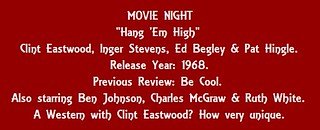
Movie Night: Hang 'Em High.


Review #518: Hang 'Em High.

Cast
Clint Eastwood (Jed Cooper), Inger Stevens (Rachel Warren), Ed Begley (Captain Wilson), Pat Hingle (Judge Adam Fenton), Ben Johnson (Dave Bliss), Charles McGraw (Ray Calhoun), Ruth White (Peaches Sophie), Bruce Dern (Miller), Alan Hale Jr. (Matt Stone), Arlene Golonka (Jennifer), James Westerfield (Prisoner), and Dennis Hopper (The Prophet) Directed by Ted Post.

Review
I had reviewed the Dollars Trilogy that starred Clint Eastwood and directed by Sergio Leone (#015 - The Good, the Bad and the Ugly, #017 - A Fistful of Dollars, #019 - For a Few Dollars More), and the success of the trilogy led to this film, one that Eastwood's business manager (Irving Leonard) described as a cross between Rawhide and Leone's westerns, and I can see why. But how is the film? It's okay. Eastwood is raw but intriguing, and Stevens delivers a contrast despite not having too many scenes, only near the end does she get her chance to shine. Begley and Hingle are good, but it seems the one who is really memorable despite having once scene is Dennis Hopper, he sticks out and rambles, and he certainly made an impression on me for his one scene. The film is raw at times and somewhat interesting and while it may take its time, it's an alright film and it is a film you could watch if you're still reeling from Leone's masterful Trilogy, take this for what it's worth.

Overall, I give it 8 out of 10 stars.