Showing posts with label Rene Auberjonois. Show all posts

June 26, 2020

Eyes of Laura Mars.


Review #1457: Eyes of Laura Mars.

Cast: 
Faye Dunaway (Laura Mars), Tommy Lee Jones (Lieutenant John Neville), Brad Dourif (Tommy Ludlow), René Auberjonois (Donald Phelps), Raúl Juliá (Michael Reisler), Frank Adonis (Sal Volpe), Lisa Taylor (Michelle), and Darlanne Fluegel (Lulu) Directed by Irvin Kershner (#002 - RoboCop 2, #114 - The Empire Strikes Back, and #595 - Never Say Never Again)

Review:
"The thing what you learn in directing is that no matter how complex the shooting, you have to remain sensitive to the people around you or the machine will ultimately take over. If you don't keep in mind the essential humanity of it all, technique will dominate."

This is a film where you can think about what could have been in different hands. John Carpenter had originally written a spec script called "Eyes", which attracted producer-distributor Jack H. Harris (collaborator on Dark Star) to potentially make a film with Roberta Collins as the lead. However, Jon Peters soon caught wind of the script and found it intriguing to potentially do with his then-partner Barbra Streisand as the lead. She ended up not doing the film because of its violent nature (Dunaway being there instead of Streisand is the better choice at least), but she did end up doing the title song for the film. In any case, the film would have script re-writes by David Zelag Goodman (co-writer of Straw Dogs and Logan's Run); Carpenter later described the whole thing as an unpleasant experience, although he would obtain lasting success with Halloween (1978) just two months after the release of his film. Even the director picked wasn't the initial choice: Lindsay Anderson and Michael Miller both passed on the project before Irvin Kershner signed on. Kershner had plenty of study in music and art before becoming a director. He studied at the Tyler School of Fine Arts, the Art Center College of Design, and finally at the University of Southern California School of Cinematic Arts, where he taught photography and took cinema courses. A subsequent still photographer job at the State Department led to further opportunities around the world before he returned back to the United States, where he would start work in television in 1955. He made his feature debut with Stakeout on Dope Street (1958) which happened to be financed by Roger Corman, and this happened to be his 12th film in a fifteen film and 32 year career (who stated that while he believed the initial idea of the film, he did not believe the requirements put on him during production).

One can certainly give plenty of credit to the selection of the cast for this film, which has five tremendous presences headlined by Dunaway, who was quite popular at the time for her dedicated performances in films such as Chinatown (1974) and Network (1976). The one paired with her is Jones, who had cultivated his career in the 1970s with film and television (such as with One Life to Live and Jackson County Jail). If I told you there was a film with tremendous character presence in Dourif, Auberjonois, and Julia, one might really seem like you are in for a really great thrill. Technically one will get a thrill out of the film, but maybe not as much as it really could have been. We are talking about a film that has a character who gets real-time visions of a person who is taking out her friends and colleagues one by one through their eyes, after all (the reason for why she suddenly has these visions are not explained, probably for good reason since I imagine they didn't have a good idea either). It certainly seems promising, since the provocative set-ups for the fashion shoots are inspired by the works of Helmut Newton; there is no bad performance among the core five, either. It just so happens that the film doesn't really have that much mystery going on to it, where eccentricity and style seem to rule the day over making a mystery that seems out of Night Gallery (at least the mediocre episodes, anyway) than anything. It has been argued to be an American version of the giallo genre (Italian films with mystery elements in thriller-horror), although I imagine that if I actually had been familiar with giallo films that this would only seem a pale imitator. Dunaway balances out with dedication and vulnerability that keeps one on their toes for good reason, with a few moments of terror mixed in with a sudden romance with the capably straight-laced Jones. Auberjonois has a few campy moments that seem worthwhile, and Dourif is quite capable in being evasive without being too obvious about it (Julia however doesn't have as much time for ridiculousness). For 104 minutes, we have just four possible people that really could be the killer, and for some it may very well be obvious who it is by the halfway mark, so the only real interest is to see where it may go with its climax. And...it doesn't stick at all. Naturally, the killer just happens to sprinkle a few words before they go to attack the lead about why they are doing it (multiple personalities wasn't my first guess either), and then they haphazardly try to lumber at Dunaway before he tells her to kill him if she loves him. Honestly, I don't know to what to think with this film in a positive light, there just isn't anything here to really make me care about goes on with a premise so obvious and yet so empty in really scaring or captivating anyone that isn't just here for style or casting. I can why some may go for it and see through the flaws to make a cult classic, but for me I just see a half-baked misfire that takes its cast for a house of mediocre mysteries that isn't worth the trouble.

Overall, I give it 6 out of 10 stars.

June 2, 2020

M*A*S*H.

Review #1433: M*A*S*H.

Cast: 
Donald Sutherland (Hawkeye Pierce), Elliott Gould (Trapper John McIntyre), Tom Skerritt (Duke Forrest), Sally Kellerman (Maj. Margaret 'Hot Lips' O'Houlihan), Robert Duvall (Maj. Frank Burns), Roger Bowen (Lt. Col. Henry Blake), Rene Auberjonois (Father John Mulcahy), David Arkin (Sgt. Major Vollmer), Jo Ann Pflug (Lt. 'Dish'), John Schuck (Walter "The Painless Pole" Waldowski) Gary Burghoff (Cpl. 'Radar' O'Reilly), and Fred Williamson (Dr. Oliver "Spearchucker" Jones) Directed by Robert Altman (#900 - Nashville)

Review: 
"I equate this work more with painting than with theater or literature. Stories don't interest me. Basically, I'm more interested in behavior. I don't direct, I watch. I have to be thrilled if I expect the audience to be thrilled. Because what I really want to see from an actor is something I've never seen before, so I can't tell them what it is. I try to encourage actors not to take turns. To deal with conversation as conversation. I mean, that's what the job is, I think. It's to make a comfort area so that an actor can go beyond what he thought he could do."

The 1970s were an interesting time try and push the envelope with films, so it only makes sense to cover one that its director described one that didn't get released but instead escaped. Robert Altman was the right man at the right time to have a breakthrough through directing a film as transgressive as this one. Altman had a long and strange path to this film, with his first writing credit being a co-story effort on Bodyguard (1948). In the next few years, he would direct industrial films for the Calvin Company in his native Kansas City before getting a chance to direct with The Delinquents (1957), an independent hit. It led to Altman having plenty of chances to direct for television, which he would do for over a decade that helped him hone his craft in making things on budget. Altman returned to feature directing with Countdown (1968) and That Cold Day in the Park (1969), although neither had been particularly successful. When it came time to do a film version of MASH: A Novel About Three Army Doctors, several directors rejected the chance, but Altman was the one who ultimately agreed to do it. The 1968 novel had been written by Richard Hooker [Hiester Richard Hornberger Jr], who had served in the Korean War for the 8055 Mobile Army Surgical Hospital that was based on his dramatic and comedic experiences there. The film's success would inspire a broadly popular television series two years later that would match the success of this film. Ironically enough, Altman was not fond of the book or the show, describing the book as "just terrible" and the series as an "antithesis of what we were trying to do", while Hooker also disliked the show. To add on to this, screenwriter Ring Lardner Jr, who had disowned the film for its deviation from his script, would win an Academy Award for Best Adapted Screenplay. Altman, knowing that 20th Century Fox was focusing their attention on their bigger budgeted war films (Patton and Tora! Tora! Tora!), aspired to make his film under budget and without too much trouble so he could sneak through without too much interference from the studio.

The film has quirks to it that would become trademarks of Altman's films over the following three decades, such as overlapping dialogue, an ensemble cast, and improvised performances, which ultimately prove forthright in making a chaotic and irreverent classic. There is a mix of familiar and new actors present, such as Sutherland (who would have a breakthrough in his career starting with films such as these), Gould (who rose to prominence in his previous role in Bob & Carol & Ted & Alice), and Duvall (man of stage, television and occasional film who would become a bigger presence in this decade), while others were fairly fresh in film, such as Skerritt and Kellerman (both having breakthroughs after plenty of prior television work), or Bowen, Auberjonois and others (such as Bud Cort) making their first appearances in film. Each of these actors have their part to play in making this satire come alive with plenty to say and do, most of which resulting in an effective dark comedy. Sutherland does well with such mischief that is balanced from the seriousness of the horrors of war on the operating table that makes for inspired anarchy with his counterpart in Gould, who never seem to be out of step with each other in driving humor through situations without needing to hit one over the head too many times. Skerritt accompanies the action at times with steady timing, while Kellerman and Duvall both make for formidable balances (and targets) of authority to poke around with (although admittedly the film is much rougher on the former in terms of crudeness of jokes). Bowen and Auberjonois step in at times to round out the cast with straight-laced dignity (or at the very least the appearance of it), while others do fine with brief moments (such as a quietly sardonic Burghoff). On the whole, this is a fine film wrapped in cynicism, right down to the title song "Suicide is Painless" from Johnny Mandel and Mike Altman (Robert's 14-year old son), which was mandated by the elder Altman to be "the stupidest song ever written." The film packs a caustic punch for 116 minutes involving the nature of war and the people who have to make the most of it in their own way. It manages to pull through without too many crude stumbles after a half century because of a game cast and capable direction from Altman in making an apt film to mark the beginning of a new decade and new perspective for film.

Overall, I give it 8 out of 10 stars.

July 12, 2015

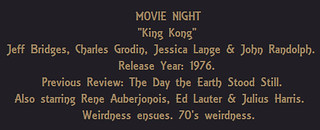
King Kong (1976)


Review #726: King Kong.

Cast
Jeff Bridges (Jack Prescott), Charles Grodin (Fred S. Wilson), Jessica Lange (Dwan), John Randolph (Captain Ross), Rene Auberjonois (Roy Bagley), Ed Lauter (Carnahan), Julius Harris (Boan), and Jack O'Halloran (Joe Perko) Directed by John Guillermin.

Review
If you want to promote your remake of a 1933 classic (#283), here's a good tag line: The most exciting original motion picture event of all time. Granted, this movie is about as original as a baloney sandwich trying to call itself a ham sandwich, but it certainly has a good ring to it, especially when produced by Dino De Laurentiis. Let me make this perfectly clear from the beginning: If it's between this and the original film, stick to the original film. But it could be argued that this film knows that going in, so it tries to do something different, with a campier tone, 130 minutes, and actual filming locations instead of stages. Carlo Rambaldi designed the effects for this film, and he helped construct a 40 foot mechanical version of Kong, which shows up (briefly) near the end of the movie. It's clear that the movie wants to show the technical aspect and then build characters around that. In a way, it works, although the end product is not exactly as grand as it could've been. The motivations and plot are updated into a quest for oil, which I suppose is creative, though it ends the same way as the original...At least they include Kong's heartbeat before he dies, so that's something new. How the cast does depends on what you (the viewer) want: If you like the idea of campy infused people interacting around the main attraction (Kong), go for it. For me, they're okay. They just seem to get in the way half of the time, though Bridges and Grodin (all fashion and hair aside) seem to do okay. Bridges' character cheering for Kong taking down the helicopters is strange, considering he's seen Kong throw people off a log into a pit, crush people on the ground, and throwing debris towards people. And yet, he cheers him as if he's done nothing wrong. If you don't want Lange's character to be eaten, then that's a good thing for you. Like the original, this film's effects are a product of their time, and for most of the movie, Kong looks relatively good, without much light shown, anyway. Near the end it looks a little more fake, but the movie doesn't linger too much on that. No, it lingers more on just about everything else, from the oil to Bridges-Lange, etc. John Barry's music is a highlight. Take this movie for what it is: A jumbled flow of effects and 70's style filmmaking that can be hit or miss. For me, it's sometimes enjoyable, but other times it's just okay.

Overall, I give it 6 out of 10 stars.

July 4, 2013

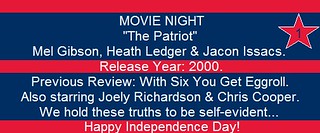
Movie Night: The Patriot.

Review #413: The Patriot.

Cast
Mel Gibson (Benjamin Martin), Heath Ledger (Gabriel Martin), Jason Issacs (William Tavington), Joely Richardson (Charlotte Selton), Chris Cooper (Harry Burwell), Tcheky Karyo (Jean Villeneuve), Rene Auberjonois (Oliver), Lisa Brenner (Anne Howard), Tom Wilkinson (Charles, Lord Cornwallis), and Peter Woodward (Charles O'Hara) Directed by Roland Emmerich (#193 - Independence Day)

Review
The Patriot boasts authenticity in costumes as they do look very nice, and very well made, the filmmakers even consulted the Smithsonian on advice, and it does look like there was real effort made into this film, especially given it's massive attempts at being a Revolutionary film, which isn't easy to do. This film manages to last over 2 and a half hours to try and tell a story that while sometimes veering into melodrama, does manages to be coherent. Whether this is a good film or not depends on what you want in this film. Action? The film has plenty of it, axes and weapon fights about. But if you want a film that has compelling villain that isn't one dimensional, you won't get that. It is not Issacs' fault, he's just the actor reading the lines that make this one dimensional character who is written to be evil without much thought to it. The rest of the actors are alright, and Mel Gibson tries his best. While this isn't a perfect film by any means, it manages to entertain, and it does a better job than Emmerich's previous film, Independence Day, so if you want some roaring action for July 4th and have time on your hands, I suppose this could work for you. Just take it in consideration.

Overall, I give it 7 out of 10 stars.

original: