Showing posts with label Darren McGavin. Show all posts

September 30, 2026

Dead Heat (1988).

Review #2584: Dead Heat.

Cast: 
Treat Williams (Roger Mortis), Joe Piscopo (Doug Bigelow), Lindsay Frost (Randi James), Darren McGavin (Dr. Ernest McNab), Vincent Price (Arthur P. Loudermilk), Clare Kirkconnell (Dr. Rebecca Smythers), Keye Luke (Mr. Thule), Robert Picardo (Lieutenant Herzog), Mel Stewart (Captain Mayberry), and Professor Toru Tanaka (Butcher) Directed by Mark Goldblatt.

Review: 
Well, I suppose any film with the term "buddy cop action zombie comedy" is worth looking into, obscurity be damned. So, who's here and why are we here? Well, it was written by a first-timer with Terry Black (and yes, that is a sibling of Shane Black) that apparently saw uncredited work done by Darren Starr (the future creator of shows such as Beverly Hills 90210 and Sex and the City) and directed by a first-timer in Mark Goldblatt, who is more known for his editing (he later got an Academy Award nomination for Terminator 2: Judgement Day). What could go wrong? Oh, plenty, since this was a late-stage New World Pictures movie that basically screams "help!". Dead Heat didn't exactly gain a curious cult audience, at least when compared to Goldblatt's only other directorial credit with The Punisher [1989]; you can at least find the movie on formats beyond VHS nowadays. Black subsequently wrote for Tales from the Crypt, and he dabbles nowadays as a column writer.

I'm sure you get the picture of the buddy movie with at least two of the following: the wiseass, the no-nonsense guy, the loose cannon, the "new partner", and so on, and so on. Some are better than others with, say, 48 Hrs. (1982) over, well, stuff like this. Sure, you get your bits of things that sound different: a lead character who actually does die in the first 25 minutes (to come back to life via go-go magic resurrection device). It maneuvers itself for 84 minutes with the energy of a zombie for middling jokes, has a storyline that doesn't really go anywhere, and is only bolstered by the occasional gooey effect and seeing name actors pop in for a brief moment. It's barely a buddy movie in general because Williams and Piscopo have the smallest semblance of chemistry together, which is barely preferable to say, being stuck next to the guy at the checkout line who really needs to tell you about the bird they saw in the ceiling*. It never feels worth it to actually experience the gears turning in "gee, dead bodies coming back to be used as henchmen" because it never actively feels exciting to be anywhere near these folks, especially with Frost and Kirkconnell, who basically only exist just to elevate the body-count (which ranges from rapidly decaying resurrected people to a body exploding). Williams (likely best known for Prince of the City [1981]) just feels like he is on autopilot with this film, as if the perils of knowing one is to die a second time feels like a stubbed toe more than a real crisis (to say nothing of that wise-ass final scene).

You might recognize Piscopo from his run on Saturday Night Live or perhaps that one episode of Star Trek: The Next Generation or, well, those moments in time where he dabbled in films (being in an obscure Brian De Palma movie like Wise Guys [1986] is still noteworthy, at least when compared to Johnny Dangerously [1984], Sidekicks [1992], and, well, How Sweet It Is [2013]*). He...does not have it here to make the role anything other than an excuse to string lame one-liners together, as if he simply believes he can ride the macho wave out to be the next Mel Gibson. The highlight is seeing bits and pieces of McGavin, Luke, and Price in this shambling mess about trying to get as much money as possible from dead guys and, well, rich people because if you can't conjure a smile at ol' folks getting at least some sort of paycheck in exchange for basically the bare minimum of things to do, what's left? As a whole, Dead Heat might as well be an apt title for the whole experience: middling action, a lack of real charm for anything going on with its main two guys, and a general feeling that you can find better things to do. So it goes.

Overall, I give it 5 out of 10 stars.


*In fairness, I do go to an H-E-B that does actually occasionally attract birds to fly inside. 

*Or being name-dropped in that one Tom Petty song - "Jammin' Me"

December 26, 2023

Redux: A Christmas Story.

Redux #020: A Christmas Story.

Cast: 
Peter Billingsley (Ralphie Parker), Jean Shepherd (Narrator), Ian Petrella (Randy Parker), Melinda Dillon (Mrs. Parker), Darren McGavin (Mr. Parker - The Old Man), Scott Schwartz (Flick), R. D. Robb (Schwartz), Zack Ward (Scut Farkus), Yano Anaya (Grover Dill), and Tedde Moore (Miss Shields) Directed by Bob Clark.

Review: 
From my review on December 25, 2010: 
This film, is a classic. it's a film that has decent acting (albeit with some overacting at points), a story that has many themes to go with it that connect into one (with some...fantasies by Ralphie) It's funny, but it can also be serious. It's a timeless classic that was once overlooked back in 1983, but it is now considered to be a classic in the Christmas spirit. Merry Christmas, and I hope you watch this film at least once this year, if not twice (as it's on a marathon right now...).
If you have not encountered this film on cable television or on the video shelves, it would be quite a curious achievement for a film that has grown in stature since its release in November of 1983, which is now forty years old. The making of the film was a long and lengthy process that really should start with Jean Shepherd and his unique place among the art of telling a narrative to others. Born in Chicago but raised in Hammond, Indiana, Shepherd had served in the U.S. Army Signal Corps during the second World War before getting into radio that saw him move around various places such as Indiana and Ohio (there was also an attempt at late night television) before his most noted run came at WOR in the New York area, where he broadcasted for over two decades beginning in 1956. Somehow, with a timeslot of 1:00-5:30am, it all came together for those monologues (as opposed to playing music records). Probably his most notable stunt came with I, Libertine, a practical joke novel born in 1956 out of making fun of how bestseller lists were done (where people would just go to libraries and ask for it, complete with listing a publisher and a fake author name), which became such a noted phenomenon that an actual book was created (written by Theodore Sturgeon based on an outline by Shepherd). Shepherd kept busy even when not on radio all the time, whether that involved segment work, commentaries on other radio outlets / in magazine form / the college circuit, or, well, script work in television and this film. In 1966, Shepherd's novel In God We Trust: All Others Pay Cash was published, which came about after Shel Silverstein had encouraged him to put his musings from tape into book form, which saw him help Shepherd with editing and developing. His musings were loosely inspired by experiences that aren't exactly autobiographical but are, well, ones that might seem real to you or me in the ways that matter - it was a hit book. A couple of Shepherd works had reached television (with him as narrator) before and after the release of this film, such as The Great American Fourth of July and Other Disasters (1982) for TV. Shepherd apparently envisioned the film as "Dickens’s Christmas Carol as retold by Scrooge.” Shepherd, along with his wife Leigh Brown, wrote the film with Clark. The Louisiana native grew up in Alabama and Florida and had dabbled in philosophy and football before entering film in horror, such as with Black Christmas (1974). He had an interest in making a film of Shepherd's stories, but he couldn't get funding from MGM until the success of Porky's (1981). The film was done in Toronto for interiors and Cleveland for exteriors, but in that manner of low-budget films having to improvise, a lack of snow meant a variety of tricks used for snow, such as foam. You could watch the film in any one scene and feel right at home, whether that involves the reveal of that primal instinct coming out in going from tears to drawing blood in a fight or those imagined sequences of being a gunfighter or being blind from soap that isn't too different from the delusions one can find as an adult when it comes to assurances. 

The mundane things that make us who we are really do come into account for this film, one that runs for an efficient 94 minutes. Sure, it has the softening of nostalgia (as per Clark to the chagrin of Shepherd), but at the end of the day, we are weird little people every day of the year with our own little things to get hung up on, and such weirdness can be really funny to look at again and again. It was a modest success with audiences of the time, don't forget that part. But why do people like me come back to this film every now and then?  Shepherd once put it best: “Ah, life is like that. Sometimes at the height of our revelries, when our joy is at its zenith, when all is most right with the world, the most unthinkable disasters descend upon us.” One can be playing with their present and boom, something comes up to remind us that things will come and go the way you cannot control, holiday or not. Billingsley proves more than just a vessel for Shepherd to narrate the observations of memories past with his worthwhile timing that make for useful delight. It is a film for the kids and adults because it doesn't dawdle on BS'ing you about where things stand. There are no weak elements to the kid actors because they seep right into the story with no pretensions of being anything other than who they are: vessels to show us the weirdness of growing up in the pains and very few pleasures. Dillon and McGavin hold the film as the paragon of lovingly human people that hold it all together in that great connection of showing family in the clearest sense of making it work in spite of itself. Probably the best way to show that is in that fateful reveal of the last Christmas present where you see the faces of the two as Billingsley opens it (notice that through the previous parts of the film, McGavin's character never talks to Billingsley about a "Red Ryder BB Gun"). The film may seem like one all about the pursuit of an object, but really it is about who we are when it comes to the basic elements deep inside us, whether the calendar says December 25 or not. We lash out in those certain moments, we imagine others as witches or people to liberate with our perspective (hey, saving people with a "BB gun" or writing a theme isn't that too different), we try to do our job until we can start getting the shoes ready to head out, you get the picture. The film may be set in that time of the 1940s, but those desires and impulses are timeless and Clark knows what he can show in a film that doesn't stoop awkwardly in its perspectives. There are no dull moments shown here, and it is that tinge of bittersweet nostalgia that makes it all count in spite of whatever Shepherd may have thought of the whole thing. We connect with the material because there is a chunk of it in us more than we think it is. The films of the old in Christmas-flavoring like Miracle on 34th Street (1947) did their thing in holiday magic of belief, but this is a representation of holiday homespun honesty in the ideal way.

It was at the turn of the 1980s that Shepherd thought to drive an idea for a follow-up to this film. Perhaps it only made sense that he called it purely an exercise to try and make money, since he saw the following that was growing with rerun showings (i.e., royalties), which apparently saw a bunch of showings around the Thanksgiving season rather than just on Christmas Eve (1997 was when the whole tradition of Turner Broadcasting running it for 24 hours straight started, incidentally). My Summer Story (formerly referred to as It Runs in the Family) (1994) retained Clark as director and Shepherd as narrator, which is amusing considering that the two hadn't got along in the first film because of the incessant suggestions that Shepherd tried to give on set that led to Clark not allowing him to be there at all. The second Story film came and promptly died in little-run theaters. A Christmas Story Christmas, a film with a handful of returning cast members, was released in 2022 to a streaming service (gag). At any rate, the enduring element of the film that became more than just a low-budget sleeper is the everyday aspect that makes us chuckle in the holiday sense of the word. The item that one desires and the ways we toil in that wish (child or adult) is amusing when you really look at things, and it only makes sense that it has endured for generations as one to blare from the rooftops again and again. The inflections of mundane life and the odd nature of trying to look back at such things in life make for a great contradiction in the grand scheme of things that make an enduring winner that could only come from Clark and Shepherd in the best of ways.

Overall, I give it 10 out of 10 stars.

September 7, 2021

Airport '77.

Review #1720: Airport '77.

Cast: 
Jack Lemmon (Capt. Don Gallagher), Lee Grant (Karen Wallace), Brenda Vaccaro (Eve Clayton), Joseph Cotten (Nicholas St. Downs III), Olivia de Havilland (Emily Livingston), James Stewart (Philip Stevens), George Kennedy (Joseph "Joe" Patroni), Darren McGavin (Stan Buchek), Christopher Lee (Martin Wallace), Robert Foxworth (Chambers), Robert Hooks (Eddie), and M. Emmet Walsh (Dr. Williams) Directed by Jerry Jameson (#1195 - Raise the Titanic)

Review: 
See, one knows they are dealing with a product movie, because what other movie have the year titled on it? Of course, by this point, the Airport films (1970, 1975) have now evolved past even having an airport involved in the actual plot, since now it deals with the Navy helping to find a fancy plane that crashed near the Bermuda Triangle. The true star is Albert J. Whitlock, who provides the special effects within matte paintings, which is probably the most interesting part of the film (besides having scenes shot in a water tank in Florida, I suppose). By this point, the Airport series has managed to ditch the attempt at thrills, really. You know what you are getting into if you've decided to pick the third film of a series dedicated to making planes and flying as boring as humanely possible. Exposition is the true terror of the sky when it comes to stuff like this, and it is probably not surprising that four writers (Michael Scheff, David Spector, H. A. L. Craig, Charles Kuenstle) were hired to do the film. Jameson may have been more of a TV director than a feature film man, but at least he fitted the occasion of helming disaster-fare (such as TV movies involving hurricanes and elevators in trouble). Even The Poseidon Adventure (1972) managed to evoke some sort of interest within trouble in the waters with a sinking ship, mostly because there is more gusto given by the actors along with better time spent in the water.

Apparently, Lemmon took the role because of he thought it would be fun to do a "blatantly commercial cartoon" (of course, he also was coming off a failure with Alex & the Gypsy and apparently told his agent to accept the next high-paying offer, so...). Eh, he is technically better as a pilot in the acting scale than Heston or Martin, in that he isn't beholden to hammy overtones like the others were - him and Vacarro at least look like they want to be there and act together with believability. Of course, Lee accepted his supporting role because he wanted to work with Lemmon. They do get to share a scene together at least, so one can at least consider the contrast of tastes for certain acting presences over others (i.e. I am always curious to see a movie with Lee in it). This is mostly apparent because he shares most of his segmented time paired with Grant, who gets to play the jealous spouse that also gets to panic the most when disaster strikes - yeah, I don't get it either (apparently, the television version adds more of her, so there's that). At least you get to see her get hysterical and be punched out after trying to open a hatch? Why exactly was Kennedy in this movie? He spends about two minutes in the movie, and he also is the only actor to actually spend any screen-time with Stewart, who might as well have filmed his stages in a box. One can't quite tell which actor is phoning it in more, but I imagine Stewart was quite comfortable with making a movie where he didn't have to speak much and could make a check worthy for his grandchildren to enjoy - this was his fifth-to-last role on film, after all. Cotten and de Havilland are okay, but one isn't really here to see traditional actors if McGavin is jawing exposition right in front of you, right? Honestly, although the film doesn't have as much to generate in weirdo character stuff, at least one can appreciate the small role done by Walsh, who actually had been appearing in a handful of films in bit parts for almost a decade (with this being right before better stuff such as Blood Simple).

At least you can say the Navy wouldn't be embarrassed by participating in this film. The credits even list that the rescue operations are actually utilized by the Navy in similar emergencies, so one can at least appreciate seeing the USS Cayuga being used for something that isn't a waste of time (granted, scenes filmed in water isn't exactly the most interesting thing to watch but your mileage may vary). Look, the movie is no better and no worse than the previous two features in terms of mediocrity. Sure, there are probably a few more things to make fun of here, but it is the same kind of blah movie from before that made money in a time where people were ripe for seeing these kind of movies (making over $90 million on a $6 million dollar budget). Naturally, Airport had to continue with The Concorde ... Airport '79 (1979), so one can only wonder where the adventure of mediocrity can go from there.

Overall, I give it 6 out of 10 stars.

April 16, 2020

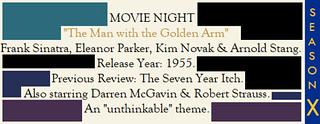
The Man with the Golden Arm.

Review #1391: The Man with the Golden Arm.

Cast: 
Frank Sinatra (Frankie "Dealer" Machine), Eleanor Parker (Sophia "Zosh" Machine), Kim Novak (Molly Novotny), Arnold Stang (Sparrow), Darren McGavin ("Nifty Louie" Fomorowski), Robert Strauss (Zero Schwiefka), John Conte (Drunkie John), Doro Merande (Vi), and George E. Stone (Sam Markette) Directed by Otto Preminger (#657 - Laura)

Review: 
Film almost always seems to generate more interest when it is allowed to push the envelope in boundaries for the time, such as the case with addiction with films like The Lost Weekend (1945) or this one. The 1950s had a clash of television and film that had the latter try various techniques and gimmicks to keep people with the cinema (at least until they realized they could utilize television to their advantage), but it was a decade with shifting tastes for a new key audience of teenagers along with challenges to the restrictive Production Code that would lead to it taking a final beating and end a decade later. One key figure in that fight was Austrian-Hungary director Otto Preminger, who had developed interest for the theater in acting before he was approached to direct for film with Die große Liebe (1931), which proved a success for the 26-year old despite having less experience with filmmaking than with the theater. He emigrated to the United States four years later and soon found a chance to direct on Broadway along with 20th Century Fox through Darryl F. Zanuck, which resulted in two completed films (1936's Under Your Spell (1936) and 1937's Danger – Love at Work) before being fired off Kidnapped (1938) by Zanuck that led to a hiatus for five years. Preminger found his way back to Fox and gradually found his way back to doing dramas and noirs (along with occasional acting) over the course of the next eight years that had its high point with Laura (1944). His challenges with the Production Code took place over two of his films in the 1950s. His 1953 film The Moon is Blue attracted complaints about its treatment of seduction and chastity, with United Artists deciding to release the film without Code approval (which resulted in a few places banning the film from being shown or restricted viewings for adults). He received attention from the code for this film, since it deals with drug addiction (implied to be heroin), a taboo subject in their eyes (other subjects included mixed-race romances and kidnapping). However, Preminger and United Artists persisted on and released the film anyway (both films eventually received PCA codes of approval in 1961). By the time he directed Anatomy of a Murder (1959), a frank courtroom drama film, the PCA did not object this time around. The talented but rough director would do over 35 films before his death in 1986.

The film was adapted from Nelson Algren's 1948 novel of the same name, which was significantly bleaker in tone when it came to its main character, with the most notable change being that he does not survive to the end in the book, having found himself trapped with no way out of his predicament caused by his inhibitions after inadvertently murdering his drug dealer. The changes made by screenwriters Walter Newman and Lewis Meltzer, along with a lack of compensation for his work, did not sit well with Algren when it came time to release. When it comes time to having a prime star for an envelope pushing film, one can't go too wrong with famed singer-turned-actor Sinatra, who studied rehab clinics in preparation for this film. He proves to the task of living up to such a fascinating role, proving to be quite gripping to the audience in his attempts to pull himself upward from a whirlpool of city seduction. Parker proves just as well in controlled anguish that does so while spending most of her time sitting down. Novak provides a warm calm presence whenever on screen, while Stang provides his a seedy and loyal dramatic turn for the notably comic actor. McGavin and Strauss both do well with providing the seedy elements of city life with the kind of conviction and allure one would expect from them. In any case, the film does well with showing a look into a person trying to escape the demons that haunt his personal life and himself, with Preminger and Sinatra doing well in making a capable tragedy seem useful to view, such as a cold turkey sequence with the latter that accompanies the climax. While the film may have aged a bit in the six decades since its release, there is certainly still a power that this film has that can't be swept away for curiosity, and it is a feature that can be recommended for public domain viewing without too much trouble.

Overall, I give it 8 out of 10 stars.

December 20, 2016

Billy Madison.


Review #887: Billy Madison.

Cast:
Adam Sandler (Billy Madison), Darren McGavin (Brian Madison), Bridgette Wilson (Veronica Vaughn), Bradley Whitford (Eric Gordon), Josh Mostel (Principal Max Anderson), Norm Macdonald (Frank), Mark Beltzman (Jack), Larry Hankin (Carl Alphonse), and Theresa Merritt (Juanita) Directed by Tamra Davis.

Review:
Let me get this out of the way early: I don't like this movie. And yet somehow, this manages to be the kind of movie that is digestible, even if it is made of some sort of junk. Much like the other Sandler films done on this show (#045 - Just Go With It and #345 - Happy Gilmore), the gags miss more than they hit (at least for me anyway), though at least this one (like the latter listed) is watchable at 89 minutes. Sandler plays a character with some sort of idiocy that can be endearing, I suppose. I'm just not a fan of his kind of shtick, which just feels tired after a few minutes. McGavin is pretty endearing, probably more than Sandler, despite not having too much screen time. Whitford is somewhat enjoyable as the villain (in a snarky way), because it's like seeing a race for weirdest character, though he loses that to Mostel, playing a school principal...and a wrestler. They are occasionally funny, somehow. Sandler and Wilson have a chemistry (in that it is a word) that sort of helps the movie have some sort of human element. It isn't charming, but it is something. There is a plot, and at least it's one that doesn't hurt the senses. Obviously this isn't a movie for me (or anybody looking for some comedy without easy gags with varying levels of body humor), but I can't really get too worked up about it. Who am I to judge a movie about people who act like fools? The movie flows the way you'd expect, with lame gags and being about as harmless as someone with too much caffeine. Would I recommend it? Of course not. But I can't stop you.

Overall, I give it 5 out of 10 stars.