
Cast:
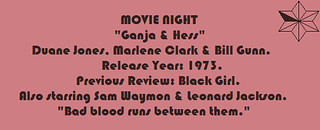
Marlene Clark (Ganja Meda), Duane Jones (Dr. Hess Green), Bill Gunn (George Meda), Sam Waymon (Reverend Luther Williams), Leonard Jackson (Archie), Candece Tarpley (Girl In Bar), Richard Harrow (Dinner Guest), John Hoffmeister (Jack Sargent), Betty Barney (Singer In Church), and Mabel King (Queen of Myrthia) Written and Directed by Bill Gunn.
Review:
"I've liked every script I've ever written, and I've hated every movie made from them."
Bill Gunn made his mark as a writer in the time he had to do it. The son of a musician/poet and an actress/theater director, Gunn was born in 1934 in Philadelphia. He first studied acting as a sixteen-year-old after moving to New York. He starred in a handful of acting performances over the next couple of years (such as his main role in Losing Ground (1982), the first film directed by an African American woman in sixty years), but his truest passion was as an author and playwright in order to escape the frustration of having a lack of creative control as an actor. He wrote 29 plays, two novels, and several screenplays (most notably with The Landlord (1970)). Gunn directed three films in his lifetime, but only this one received any substantial distribution (however, Personal Problems (1980) has had notice); Stop (1970) would have been the second studio film by a black director, but its X rating and premise caused Warner Bros. to shelve it. Gunn died at the age of 54 in 1989 of encephalitis, but his papers live on for archivers to research for themselves. The story of this film is sadly one familiar to those who know of filmmakers who were both ahead of their time and screwed over by flaky producers. Kelly-Jordan Enterprises wanted to make a black vampire film, since Blacula (1972) was quite a hit with audiences. The original print received fair notice from the Cannes Film Festival, but a preview audience screening in New York doomed the film. The distributor, perhaps believing that it needed to cash in on straight horror tastes, sold it to Heritage Enterprises for them to cut the negative (under Fima Noveck), which resulted in a 110-minute movie being cut into one of 78 minutes, complete with a different score and dubbing; this version on VHS went under several titles: Black Evil, Black Vampire, Blackout: The Moment of Terror, Blood Couple, Double Possession, and Vampires of Harlem. The original cut did survive, for which one is fortunate to be available to see under a recent restoration that was done through the help of Kino, the Museum of Modern Art, and The Film Foundation. A remake (with a few imitated scenes shot-for-shot) was done in Da Sweet Blood of Jesus (2014) that was directed by Spike Lee.
It isn't exactly a horror film in the defined sense. For one, the vampire legend is treated more as an addiction alongside spiritualism than one shown through the usual proceedings (i.e., there is blood sucking but not a danger of being killed by sunlight or a stake) - the word vampire is never used. It involves an anthropologist/museum archivist who contracts a blood lust from an African artifact he collected, and he ends up seeing his new assistant do a murder-suicide attempt on him before he arises to drink the blood of the dead body that he stores in his freezer; his wife shows up later, ends up wooed by him and develops a craving for blood. Of course, it's not easy to be someone who has to taste blood to survive, but you get the picture. In that sense, it isn't going to be the clear winner for every horror viewer, but it is definitely deserving to be seen to be believed (especially among the arthouse favorites). It is the kind of movie you might have to see a few times to really absorb its curiosity and daring sense of strangeness, and Gunn should be applauded for having the audacity to make the film the way he did. Jones (in his second and last starring film role, owing to his interests in theater work) and Clark are the ideal pair when it comes to offbeat eroticism when it comes to seeing two folks get in touch with the spiritual side of the desire for blood and long-lasting life. Oh sure, the movie is very evidently a low-budget movie at times, but there is a searing movie here by Gunn to be captivated anyway, if only because it is off-putting enough to inspire further curiosity regardless of limitations or its open ending (well, as open as can be...). In the end, the best thing that can be said about the film is that it can be seen the way it was intended to be seen for folks to seek out. It deserved better, pure and simple, and I think it deserves a place as a cult classic among both black cinema and horror for its verve and capable execution. For a film that will turn fifty next year, there has never been a better time to seek this one out.
Overall, I give it 9 out of 10 stars.
Next Time: The Spook Who Sat by the Door (1973).

