Showing posts with label Michael Anderson. Show all posts

July 26, 2024

The Naked Edge.

Review #2232: The Naked Edge.

Cast: 
Gary Cooper (George Radcliffe), Deborah Kerr (Martha Radcliffe), Eric Portman (Jeremy Clay), Ray McAnally (Donald Heath), Diane Cilento (Mrs. Heath), Hermione Gingold (Lilly Harris), Peter Cushing (Mr. Evan Wrack), Michael Wilding (Morris Brooke), Ronald Howard (Mr. Claridge), and 
Sandor Elès (Manfridi St John) Directed by Michael Anderson (#717 - Logan's Run and #1393 - Around the World in 80 Days)

Review: 
Admittedly, there is a bit of appeal in wondering what the fuss is about with the poster and a certain fact. The film is based on the 1955 novel First Train to Babylon, as written by Max Ehrlich. Joseph Stefano wrote the screenplay adaptation, and if you've seen the poster, that was the writer behind the screenplay adaptation for 1960's Psycho, likely his most famous accomplishment (in general, Stefano was involved more with television writing and occasional producing, such as the original The Outer Limits). Perhaps not surprisingly, the poster, and the last line of the film itself, as told to us by voiceover, do a gimmick similar to that film in not wanting audiences to be seated "during the last 13 minutes" (for a 97-minute film, but naturally it works to tell people to really hold in that break). Of course, now that one has that out of the way, this was the final film for its star in Cooper, who died of cancer on May 13, 1961, a month before the release of the film, which wasn't exactly a hit. He had worked with Anderson before with The Wreck of the Mary Deare (1959); the film was shot in London and at Elstree Studios in Borehamwood, Hertfordshire. 

The runtime is a funny one to have a "don't seat folks for the last couple" trick to, particularly for a film that seems to drag its tension out as much as possible. Really this is the kind of movie where people get suspicious of folks because of having the most amusing choice of words for phrasing, as evidenced by a scene where our lead is telling about raising money for a venture that came out because he "made a killing" on the stock market. One could possibly make a few edits and make it a comedy about a guy who does increasingly outlandish things with his wife that thinks he may be guilty (such as say, asking her to join him on the edge of a cliff - actually, that's in the film). The intro with a stabbing and the time spent with Cushing in the courtroom stuff does appeal to the most basic curiosities of mine, at least. Of course, Kerr was actually a pretty good actress in her own right to match up with Cooper (who was 20 years older than her). She makes those worries and doubts seem workable for something that really would've floundered under the weight of such amusing ambiguity with a lesser actress involved. That isn't to say that Cooper doesn't pair well with Kerr, but I think one can be forgiven for stating that there are times where a weary-seeming Cooper is not so much acting as it is a man trying to push through being tired. Cooper is worrisome enough to make Kerr's queries and fears over what really may be possible (or not) worth watching, although the best scene is with Cilento in terms of force and grace. Portman is at least adequate in the middle. The eventual ending is probably not ideal in the actual rundown, particularly with portions involving a struggle, but that doesn't sink the film completely at least because if one gets far enough to appreciate the film beforehand with its look in terms of cinematography (as shot by Erwin Hillier and Tony White) and bubbling dread, then one can't be too off. As a whole, it isn't exactly the finest hour for its stars or its director, but it has a nice look and probably enough ambiguity to seek out once if the curiosity factor is there enough to go in as cold as possible for its mystery, which for me just manages to make it over the finish line.

Overall, I give it 7 out of 10 stars.

April 18, 2020

Around the World in 80 Days.

Review #1393: Around the World in 80 Days.

Cast: 
David Niven (Phileas Fogg), Cantinflas (Passepartout), Shirley MacLaine (Princess Aouda), and Robert Newton (Inspector Fix), with appearances from Edward R. Murrow (Prologue narrator), Finlay Currie (Andrew Stuart), Robert Morley (Gauthier Ralph), Noël Coward (Roland Hesketh-Baggott), Sir John Gielgud (Foster), Charles Boyer (Monsieur Gasse), Sir Cedric Hardwicke (Sir Francis Cromarty), Melville Cooper (Mr. Talley), John Carradine (Col. Stamp Proctor of San Francisco), Jack Oakie (Captain of the SS Henrietta), in addition to Fernandel, Cesar Romero, Reginald Denny, Peter Lorre, George Raft, Red Skelton, Marlene Dietrich, Frank Sinatra, Buster Keaton, Col. Tim McCoy, Joe E. Brown, Andy Devine, and various others. Directed by Michael Anderson (#717 - Logan's Run)

Review: 
"Do not refer to Around the World in 80 Days as a movie. It's not a movie. Movies are something you can see in your neighborhood theatre and eat popcorn while you're watching them....Show Around the World in 80 Days almost exactly as you would present a Broadway show in your theatre."

It should only prove fitting that a film like this was meant to be treated as a major event for the masses, since this was an experience like no other for a decade that had plenty of spectacle to show in a time that desired entertainment that manage to receive accolades for itself. No expense would be spared in making such a monumental exercise of excess, with six million being spent for over 60,000 extras and 70,000 costumes made/rented alongside thousands of actors and plenty of miles traveled to show something to try and impress the viewer, which should only prove appropriate for its producer in Mike Todd. He worked in a variety of jobs after dropping out of high school, such as selling shoes, drugstore soda jerk, and construction businessman before eventually finding interest in Broadway in the late 1930s. Over the course of the next few years, Todd would produce several shows on the stage that ranged from burlesques to musical comedy revues to even an operetta. In the 1950s, he found himself involved with film when he got involved in getting behind Fred Wallers' widescreen process Cinerama, which was featured most notably with This is Cinerama (1952). He soon moved to another venture involving a widescreen process that would bore his name in Todd-AO with Robert Naify in 1953, which would become a theater sound leader for films in the next few decades that simplified its setup to one camera and lens, with the Todd-AO widescreen process being debuted in Oklahoma! (1955).  Todd would reap plenty of benefits from producing this film, winning an Academy Award for Best Picture to go along with four other awards for color cinematography, editing, scoring, and adapted screenplay (which had three writers, including John Farrow, who directed a bit of footage before quitting). Tragically, Todd would die just two years after the film's release in a plane crash at the age of 48.

This was based off Jules Verne's 1872 novel of the same name, which has been adapted to several forms of media alongside film over the past century. Interestingly enough, this film begins by showing snippets from another adaptation of a Jules Verne work in A Trip to the Moon (1902), likely one of the most influential films of its time from noted director Georges Méliès. Both do a fine job when it comes to showing a sense of wonder and imagination, this much is true. In the case of Todd's production, he surely wanted to keep people's attention for 182 minutes with a travelogue around the world that is worth one look for the curiosity of it all, particularly whether to see if it has lost any of its luster to time, which does sometimes seem the case. One cannot deny that Niven and Cantinflas do a tremendous job together, inspiring curiosity and humor at times when together. Niven does his part with the type of dignity and composure that one enjoys for an adventure. Cantinflas, a Mexican icon for comedy then as now, proves to be quite amusing with his antics, such as when gets into a bullfight (as performed by the actor himself). MacLaine (in her third role of her film career) shows up somewhere in the middle of all this, and she nearly becomes lost with all theses presences around, where Newton's bluster proves effective as a foil to all of this. One may very well play a game of spot-the-international star when trying to pass the time when it seems the film is flying up its own ego, whether that means a wordless piano performance from Sinatra or hammy times with Raft and Carradine or one-shot turns like Lorre or Keaton, where half don't even have names to go with their "role", although at least it is nice to see Hardwicke and Gielgud. The film is nice to look upon at times, whether through a costume or some scenery to view upon. It is a film aiming for light-heart entertainment that succeeds on fair craftsmanship in the parts that matter without becoming a complete shell of arrogance that could kill a more pompous ambition. Adventures like this can be fun if one is in the mood for what it is trying to sell and have three hours to spend with spectacle.

Overall, I give it 7 out of 10 stars.

June 25, 2015

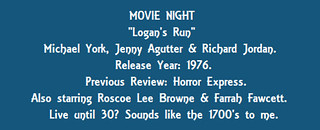
Logan's Run.


Review #717: Logan's Run.

Cast
Michael York (Logan 5), Jenny Agutter (Jessica 6), Richard Jordan (Francis 7), Roscoe Lee Browne (Box), Farrah Fawcett (Holly 13), Michael Anderson Jr. (Doc), and Peter Ustinov (The Old Man) Directed by Michael Anderson.

Review
Logan's Run was a toss up to rate for a while. On the one hand, Logan's Run is a product of its time that is an example of a movie set many, many years into the future (the year 2274, with the book being 2116), which is beneficial in the sense that the movie has free reign to guess on a future none of us will ever see, making the movie have a chance to run wild with the idea of a utopia, the buildings, and...how we dress. On the other hand, it could be argued the movie is dated specifically by the effects, which is why Hollywood has been trying to remake this film for years (and failing at it, I might add), but Hollywood remade Robocop, and that ended...oh you already know. Logan's Run is the kind of movie you'd watch late at night and enjoy, but whether you'd enjoy the movie for how it deals with a utopia's effects on society...or how it treats itself in terms of clothing/effects is another story. I'm trying to make this review as anti wishy-washy as possible, so I'll just say that the movie is fine. York and Agutter are good, and they do make a fine pairing together, which is to the movie's advantage. You could make fun of the clothing...or Box. Box is a robot who lives in an ice cave. Take one look at him, and you'll see. Oddly enough, I was laughing at the part with the cats, because the second half of the movie has a bunch of cats meowing and moving around while the movie plays. But maybe I'm just weird. Jordan is okay, and the supporting cast as a whole is passable, it's one of those kind of movies. I was surprised to see that a bunch of locations in Texas were used (including a Water Gardens), mainly because it's not everyday you see your state in a credits sequence. The effects...are what they are. Monorails are cool to watch, and even the shots of the city look like they took a good deal of time to make, and I even saw a credit for matte painting, which isn't as easy it may seem, so I can give the movie credit. If you enjoy the movie (seriously or mockingly), the effects won't get in the way (rather they might actually be beneficial) of a good time. If you find it's not exactly up to code with your standards...the effects will kill the mood even more. But I can't help but enjoy this strange gem. Maybe you will too. Whether a remake will be made in the future or not, appreciating the movie for what it is makes sense too.

Overall, I give it 8 out of 10 stars.