
Showing posts with label Roscoe Lee Browne. Show all posts

August 17, 2026

Cisco Pike.


Review #2570: Cisco Pike.

Cast: 
Kris Kristofferson (Cisco Pike), Gene Hackman (Detective Leo Holland), Karen Black (Sue), Harry Dean Stanton (Jesse Dupre), Viva (Merna), Doug Sahm (Rex), Roscoe Lee Browne (Pawnshop Owner), Joy Bang (Lynn), Severn Darden (Lawyer), Antonio Fargas (Brother Buffalo), with Don Sturdy (Recording Engineer), and Allan Arbus (Sim Valensi) Directed by Bill L. Norton.

Review:  
My favoritism does ring strong for select folks, admittedly. How many people can beat Barbra Striesand at their own game in trying to be the big fish in terms of actual presence in a movie (I fondly still remember watching A Star is Born (1976) and being amazed its sheer mediocrity). The Brownsville-born nomad was prolific enough at Pomona College that there were ideas of him being a writer, complete with study at the University of Oxford. Instead, he ended up as a jack of all trades in odd jobs (okay there was stuff in the middle of that such as being in the Army), one of them being a janitor at Columbia Records as a wannabee songwriter. He did appear in his first film with the adventure from hell in The Last Movie (1971). Apparently, in the aftermath of drunkenly stumbling through being rejected for a part in Two-Lane Blacktop, he got offered the script for this film and decided against the advice of taking acting lessons for a character that he thought he related to. Inadvertently, this also is a chance to spotlight a forgotten filmmaker that had a brief flash in the sun. Bill L. Norton was the son of William W. Norton, who actually was a writer in Hollywood that ranged from television with The Big Valley to movies with White Lightning [1973]*. As for the younger Norton, he graduated from UCLA and went from writing stuff such as How to Succeed with Girls (1964) and (uncredited) camera operating on movies like The Fortune Cookie (1966). But when film producers looked for any type of "freethinkers" or "hippie" perspective in the wake of Easy Rider's success in 1969, Norton got his chance to be a director with a script (with one working title being "Dealer") that attracted producer Gerald Ayres and Columbia Pictures. Robert Towne was asked to look over the script, with his most noted contribution being the addition of Hackman's character, although he was left uncredited. Lumped in some circles to other counterculture movies such as Getting Straight [1970] and Making It [1971], the movie had its opening premiere in late 1971 before going into limited release in 1972 that resulted middling reviews and a lack of an audience. The next Norton movie was More American Graffiti (1979). While there were a few showings to theaters that still had a print, the movie wasn't available on home media such as VHS or DVD until a release in the latter format in 2006. 

I suppose it makes sense that Norton called it his rendition of La Dolce Vita but set in L.A." In the domain of the Venice neighborhood with things of yesteryear such as the Pacific Ocean Park (closed since 1967). You could consider how Kristofferson considered acting to be as one that could be "just understanding a character, and then being just as honest as you can possibly be" (as said in 1974), or, for what he thought about the movie over 50 years later, one where he mused about what exactly "gave me the audacity to think I could act." The movie coasts along with a lead character that basically is an anachronism going through a travelogue in a type of California (West L.A.) that either runs on the fumes of banality or, well, is curious enough to actually see all the way through its 95-minute runtime. Kristofferson is the drifter, the has-been, the elusive one, the guy in all of us that can't just be one thing without some smart aleck or oddball trying to get one over us (such as trying to not be a dealer). Hackman made the movie right before doing The French Connection (Cisco premiered shortly after Connection). His panicky oddness popping in every now and then (for what could generously be estimated as being less than 20 minutes) is a curious one to see when compared to the familiar comforts of the kooky Black (by this point a recent Academy Award nominee with Five Easy Pieces [1970]) or the splattering of support that comes with Viva or the withered Stanton. Any observation about the movie, positive or negative, basically can be responded to with "it depends, man". The songs from Kristofferson are delightful for those who roll with doing something for the sake of it that basically is the movie in a nutshell: you drift in and drift out and maybe figure something out by the time it all has come to pass (or not). I can't call it a great movie, but a drifting movie with likeable enough folks and music is more than enough to at least call it a possible gem for the curious.

Overall, I give it 7 out of 10 stars.

Next up: Fuck it, it's 20 years old: 8.18.06: SNAKES ON A PLANE

*Honestly, I have no bias against Streisand, I just...never got into watching her movies. Or her songs. I accidentally took nearly 15 years of Movie Night to actually get to a Jane Fonda movie, it isn't exactly a surprise that I've seen two Streisand movies in the span of 16 years.

*Mr. William W. Norton was a strange guy. He crapped on his contributions to movies (once stating that one would only know his films if their "I.Q" [was] low enough"), later moved to Ireland and got mad about Roman Catholic residents getting attacked to the point where he went back to the States to run guns to the Irish National Liberation Army. He got caught and served 19 months in prison. He moved to Central America only to get robbed and killed one of the robbers. He moved around before finally being smuggled back to America. He died in 2010 at the age of 85 while his son Bill still lives.

*Forgot to send a link: LIFE - Google Books

March 11, 2022

The Connection (1961).

Review #1813: The Connection.

Cast: 
Warren Finnerty (Leach), Jerome Raphael (Solly), Garry Goodrow (Ernie), Jim Anderson (Sam), Carl Lee (Cowboy), Barbara Winchester (Sister Salvation), Henry Proach (Harry), Roscoe Lee Browne (J. J. Burden), William Redfield (Jim Dunn), with Freddie Redd (Piano Player), Jackie McLean (Sax Player), Larry Richie (Drummer), and Michael Mattos (Bass Player) Directed and Edited by Shirley Clarke.

Review: 
"When I did The Connection, which was about junkies, I knew nothing about junk and cared less. It was a symbol--people who are on the outside. I always felt alone, and on the outside of the culture that I was in. I grew up in a time when women weren't running things. They still aren't."

You bet it was time to do something a bit more experimental when it comes to focusing on women directors. Shirley Clarke is surely deserving of curiosity, and she would cultivate a career of three decades in her own way. For one, she was actually interested in dance growing up as a child in New York City; she was the daughter of a office furniture manufacturer (and also a bully, as noted by her sister Elaine Dundy). She studied dance at Stephens College, Johns Hopkins University, Bennington College, and the University of North Carolina. Her first film would be in 1953 with Dance in the Sun; the short film was an adaptation of dance choreography. Her influences in becoming a director were films such as The Quiet One (1948, directed by Sidney Meyers), In the Street (1948, done by James Agee, Helen Levitt, and Janice Loeb), and Roberto Rossellini's Neorealist works (particularly Rome, Open City). She would gradually move into other subjects (with concurrent studying at the City College of New York in the mid 1950s), with Skyscraper (1959) being one notable work from that era; that film (in collaboration with Willard Van Dyke and Irving Jacoby) involved the construction of the 660 Fifth Avenue skyscraper. The Connection (1961) was Clarke's first feature-length film, and it was an adaptation of the 1959 play of the same name (originally produced by the Living Theater) by Jack Gelber, who would adapt the material for use in this film. Both play and movie would attract controversy; the plot focuses on the lives of heroin-addicted jazz musicians, and the film would attract further controversy because of its use of an obscene word (the word is "shit", used to describe heroin) that the state of New York banned for indecency; the lack of license did not stop attempts to screen the film anyway, but the police stepped in after it had screened twice, but the film was not favored by audiences (with reviews being more positive abroad than in New York). At any rate, Clarke would continue to make films involving characters perceived to live in the margins, such as with The Cool World (1963 and Portrait of Jason (1967) while later experimenting with video and lecturing until her death in 1997 at the age of 77, and she is surely deserving of attention with her place in cinema. Take it this way: when John Cassavetes directed his first film in Shadows (a key film within American independent cinema done in 1959), he did so with a 16mm camera that he borrowed from Clarke. 

Oh, the experimental part. Well, it is one of the earliest examples of a "found footage" film, predating the dozens of found footage films that are generally used for horror. This is stated in the opening title card, which states that it is the "result" of footage assembled by a cameraman working for a missing documentary filmmaker (the play in comparison was a "play within a play", albeit with a few more characters). Clarke co-produced and edited the film, which takes place primarily on one set (designed by Richard Silbert) with two cameras that feature most of the cast from the original play. The film is whatever you think it is, whether involving drug addiction, or what Clarke believed it to be about with alienation.  It is a wonderful achievement, one that is a representation of the avant-garde scene in all of its curious aspects without becoming engulfed in heavy-handed bloat. It is the logical extension of cinema verité within its frank depiction of American sensibilities in the era of the Beat Generation in the 1960s with a mood of "natural acting". With a mix of improvised acting, jump-cuts, and a simple plot, one will have quite a ball with a film that is basically like a jazz composition. It is everything and nothing you might expect, and the performers all do excellent jobs that draw you in from the jump without letting go. Finnerty was the one member of the cast recognized for his acting in the play (when it was on off-Broadway), and it shouldn't be surprising that he carries the film as one of the primary burning cinders that hold the film for such interest with his blazing sarcasm. Goodrow is also quite worthy in his sniveling human element, which Raphael and Anderson prove to be an interesting pair in varying moods when on/off their element (note the differences between being "on" and "off", after all). Lee displays casual charm when he arrives on screen that makes him quite captivating (incidentally, Winchester is paired with Lee for a time as an person of faith who doesn't see these folks for who they are, which is interesting). Browne (likely the most known of the actors in the film, since he had a career of over four decades) doesn't have much to say within time spent in either the background or within shots without Redfield. Of course, Redfield proves splendid within self-serving amusement too, while the quartet of jazz players accompany the film to great effect. No one ever becomes just a "character", since it has that touch of honesty with alienated people searching for the next certain experience. Really this could be about other addictions, but it also could be about any kind of fragmented people on the outside. I think in that regard the movie is a complete success when it comes to a movie that confronts you without any sort of qualms or compromises.

Overall, I give it 10 out of 10 stars.

Next Time: We will take a momentary detour because of the obligation to detail thoughts on The Batman (2022), which happened to come out this month. As such, Women Directors Month will resume after that review with...

Wings (1966).

September 28, 2019

Legal Eagles.

Review #1278: Legal Eagles.
Cast: 
Robert Redford (Tom Logan), Debra Winger (Laura Kelly), Daryl Hannah (Chelsea Deardon), Brian Dennehy (Cavanaugh/Joe Brock), Terence Stamp (Victor Taft), Steven Hill (Bower), Christine Baranski (Carol Freeman), Roscoe Lee Browne (Judge Dawkins), David Clennon (Blanchard), John McMartin (Forrester), Robert Curtis Brown (Roger), Grant Heslov (Usher), Sara Botsford (Barbara), and Jennifer Dundas (Jennifer Logan) Directed by Ivan Reitman (#026 - Ghostbusters, #031 - Ghostbusters II, #243 - Stripes, and #487 - Twins)

Review: 
It doesn't take too much time to think that this film could seem interesting. The original idea was to make a buddy film involving Bill Murray and Dustin Hoffman, but when those plans fell apart, Redford expressed interest in doing a romantic comedy, which inspired changes to a dynamic reminiscent of Katherine Hepburn-Spencer Tracy films. The screenplay and story were done by Jim Cash and Jack Epps, Jr, with Reitman contributing to the latter. In a sense, this film is a romance. Of course it also happens to have a sense of comedy, thriller, and courtroom drama packed into its two hour duration, which turns out to be a most unwieldy combination. It certainly seems too packed in to really make the impact it wants to make, which results in a thoroughly average film. It complicates itself too much without really getting a feel for the simple things that can make a film tick: just having fun. One instead sees something that is bound to certain excesses (namely its budget of $40 million) and not working as great whenever it tries shifting gears between rom-com and thriller. There either seems to be too many characters or not enough that actually seems worthy enough to invest in. At least the performances are fine to watch, with Redford and Winder coming out the best, since they at least seem like they are having some sort of chemistry together, whether when trapped in buddy scenarios like an exploding warehouse or some other odd scenario, like Redford and his character that likes to tap dance when unable to sleep (gee, where do you think they'll go with that quirk). Hannah and her performance artist-turned-accused robber/murderer does okay, giving off a laugh or two, but she seems stretched pretty thin in actually making her presence really count, odd but harmless. When she actually does try to romance Redford and his character, I'm just twiddling my thumbs more than anything. Dennehy does just fine, snide yet worth seeing. The other members of the cast don't have as much to really do, seemingly there just to fill time and plot, which is a shame. How does one make a buddy movie with lawyers seem so awkward? One cannot help but wonder if this film needed more or less re-working to really hit its mark (it most certainly needed a trimming down). Actually, there exists an alternate version in which Hannah's character is found to be guilty of one of the murders. I guess that could've proved interesting, though I wonder if that version had more focus. The film just comes and goes, whether in the courtroom or somewhere else. At least one might get some sort of enjoyment over spectacle for the film, what with a climax involving a burning building and all, but its setup doesn't really leave much to give investment over. Their fates never seem to be hanging too much in the balance, and guessing who the real culprit is gets to be pretty easy when the others start dying off. It just seems like a movie too safe to either be really funny or usefully dramatic, trying to get its hand in many genre jars and getting only crumbs in return. It's a bland movie, but at least one could probably come out of it without groaning too much for two hours. I can't call it a winner, but it could probably work as a lark if faced with nothing else to do.

Overall, I give it 6 out of 10 stars.

June 25, 2015

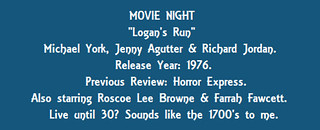
Logan's Run.


Review #717: Logan's Run.

Cast
Michael York (Logan 5), Jenny Agutter (Jessica 6), Richard Jordan (Francis 7), Roscoe Lee Browne (Box), Farrah Fawcett (Holly 13), Michael Anderson Jr. (Doc), and Peter Ustinov (The Old Man) Directed by Michael Anderson.

Review
Logan's Run was a toss up to rate for a while. On the one hand, Logan's Run is a product of its time that is an example of a movie set many, many years into the future (the year 2274, with the book being 2116), which is beneficial in the sense that the movie has free reign to guess on a future none of us will ever see, making the movie have a chance to run wild with the idea of a utopia, the buildings, and...how we dress. On the other hand, it could be argued the movie is dated specifically by the effects, which is why Hollywood has been trying to remake this film for years (and failing at it, I might add), but Hollywood remade Robocop, and that ended...oh you already know. Logan's Run is the kind of movie you'd watch late at night and enjoy, but whether you'd enjoy the movie for how it deals with a utopia's effects on society...or how it treats itself in terms of clothing/effects is another story. I'm trying to make this review as anti wishy-washy as possible, so I'll just say that the movie is fine. York and Agutter are good, and they do make a fine pairing together, which is to the movie's advantage. You could make fun of the clothing...or Box. Box is a robot who lives in an ice cave. Take one look at him, and you'll see. Oddly enough, I was laughing at the part with the cats, because the second half of the movie has a bunch of cats meowing and moving around while the movie plays. But maybe I'm just weird. Jordan is okay, and the supporting cast as a whole is passable, it's one of those kind of movies. I was surprised to see that a bunch of locations in Texas were used (including a Water Gardens), mainly because it's not everyday you see your state in a credits sequence. The effects...are what they are. Monorails are cool to watch, and even the shots of the city look like they took a good deal of time to make, and I even saw a credit for matte painting, which isn't as easy it may seem, so I can give the movie credit. If you enjoy the movie (seriously or mockingly), the effects won't get in the way (rather they might actually be beneficial) of a good time. If you find it's not exactly up to code with your standards...the effects will kill the mood even more. But I can't help but enjoy this strange gem. Maybe you will too. Whether a remake will be made in the future or not, appreciating the movie for what it is makes sense too.

Overall, I give it 8 out of 10 stars.