Showing posts with label Reginald Denny. Show all posts

April 15, 2022

Rebecca (1940).

Review #1828: Rebecca. 

Cast: 
Joan Fontaine (The second Mrs. de Winter), Laurence Olivier (George Fortescue Maximilian "Maxim" de Winter), Judith Anderson (Mrs. Danvers), George Sanders (Jack Favell), Reginald Denny (Frank Crawley), Gladys Cooper (Beatrice Lacy), C. Aubrey Smith (Colonel Julyan), Nigel Bruce (Major Giles Lacy), Florence Bates (Mrs. Edythe Van Hopper), Edward Fielding (Frith), Melville Cooper (Coroner at trial), Leo G. Carroll (Dr. Baker), and Leonard Carey (Ben) Directed by Alfred Hitchcock (#219 - Rope, #223 - North by Northwest, #446 - Spellbound, #447 - Psycho, #450 - Vertigo, #455 - Rear Window, #553 - Strangers on a Train, #800 - Shadow of a Doubt, #910 - Notorious, #963 - The Lodger: A Story of the London Fog, #964 - The Ring (1927), #965 - Downhill, #970 - Mr. and Mrs. Smith, #977 - Frenzy, and #1343 - The 39 Steps, and #1739 - The Birds)

Review:
It does become interesting to consider just how many movies one can see of the late Alfred Hitchcock, particularly since his line of work has taken up nine percent of all films I've ever seen, which is a weird way of saying seventeen films. Of course, the real story is the fact that this was not only the 26th feature film directed by Hitchcock, it was his first directed in Hollywood. Hitchcock was forty years old when he decided to move to Hollywood, having believed that he reached his peak in his native Britain, and it was the efforts of producer David O. Selznick that led to him moving; the two signed a seven-year contract; Hitchcock would end up producing more films by himself than with Selznick, and they would have their disagreements in terms of personality and professionalism when it came to this film, to where they only worked on one other film together in Spellbound a couple of years later, most notably because Hitchcock liked to film a controlled cut without too much extra footage. As such, this is an adaptation of the novel of the same name that had been written by Daphne du Maurier, and it was Hitchcock who had adapted her previous book Jamaica Inn in 1939. Incidentally, the book had been adapted on radio by Orson Welles in 1938, and a stage adaptation had been done by Du Maurier in 1939. Selznick aimed to be quite faithful to the book, as much as one can do with the Production Code, which had one particular rule about spouse death. Hitchcock was a busy man, since this was also the year of release for Foreign Correspondent, which like this film would be nominated for an Academy Award for Best Picture (other films nominated were films such as The Grapes of Wrath, The Great Dictator, and The Philadelphia Story). As it happened, Rebecca would win the award, making it the only Hitchcock film to ever win the honor; Selznick, as the recipient of the award, became the first back-to-back winner for a producer. As such, the screenplay was done by Robert E. Sherwood and Joan Harrison, while the adaptation was done by Philip MacDonald and Michael Hogan. 

Several actors were considered for the main roles, such as Ronald Colman, William Powell, Olivia de Havilland, Loretta Young, among others. Sometimes one needs a Gothic vision to really see the talents of Hitchcock come alive, if only because one wants to see just where the rabbit hole goes in mystery and tortured romance, where the unsaid is more biting than the action. 130 minutes never felt so magnificent when it comes to how Hitchcock has handled the macabre with the terror that comes from memories of a deceased wife that haunts both an estate and the husband himself (incidentally, one never sees the title character nor knows the name of the one of the main characters) that creates such diverting paranoia without becoming a costume show; George Barnes and his cinematography help in that regard to make a stirring film look as alive as it does, and it probably isn't surprising that Barnes won an Academy Award for his work. Of course, the cast is just as effective as the crew. Olivier portrays the vulnerability required with such brooding patience that makes for quite a volatile and curious interaction with Fontaine, one ripped by the past that holds him down further than anything else could, which means one is watching a gripping performance that isn't just a show for Olivier (a talented actor already noted for his performance in Wuthering Heights the year before). Fontaine (the younger sister of actress Olivia de Havilland) had a few key roles in films before this film, most notably Gunga Din (1939), but this was the film that made her a key star (Fontaine however did not care for her typecasting for just melodramatic roles, which would include films done by Selznick like Jane Eyre (1943) and even another du Maurier adaptation in Frenchman's Creek the next year). It doesn't take much to see why she became a star, because her performance is quite excellent, one with the exact type of withering vulnerability required in showing doubt that doesn't become overshadowed by the other members of the cast, and the growing confidence by the second half only helps to make a well-rounded performance of curiosity. Anderson (considered one of the great stage actors of her time) makes a compelling adversarial presence, one who lurks around Fontaine that practically glides from scene to scene (complete with a lack of blinking) that makes the final result all the more haunting. Sanders, when he does show up, makes a perfect cad to view against the others, and the rest of the cast keeps the proceedings dignified and well invested. As a whole, the movie is a classic worth viewing among all the other Hitchcock classics for what is seen and what isn't seen in this Gothic mystery that has the highlights from its director and producer in Selznick without becoming consumed by itself. One can debate just where the film rests among the classics, but one knows by the time the film ends that it is up there in the margins somewhere for what it ends up doing with a master at work.

Overall, I give it 10 out of 10 stars.

December 24, 2021

Christmas Eve.

Review #1777: Christmas Eve.

Cast: 
George Raft (Mario Torio), George Brent (Michael Brooks), Randolph Scott (Jonathan), Joan Blondell (Ann Nelson), Virginia Field (Claire), Dolores Moran (Jean Bradford), Ann Harding (Aunt Matilda), Reginald Denny (Phillip Hastings), Douglass Dumbrille (Dr. Bunyan), Carl Harbord (Dr. Doremus), Dennis Hoey (Williams-Butler), Clarence Kolb (Judge Alston), Molly Lamont (Harriet Rhodes), John Litel (Joe Bland, FBI Agent), Walter Sande (Mario's Hood), Joe Sawyer (Private Detective Gimlet), and Konstantin Shayne (Gustav Reichman) Directed by Edwin L. Marin (#503 - A Christmas Carol (1938) and #532 - The Death Kiss)

Review: 
When it comes to Christmas movies, one has plenty of choices. This might be one of the stranger picks to go along with, if only because there are just so many movies centered around the holiday, complete with a handful that have it in the title. But hey, how many pseudo-anthology movies exist around the holiday? Well, at least if you think about it, given the framing device. It revolves around an eccentric old millionaire (one who likes to open the window after putting bird food in the house and give money to kids that kill rats) that could get committed to the nut house if she doesn't happen to have her three (adopted and fully grown) sons show up to meet the judge on Christmas Eve. This is where Brent, Raft, and Scott all come in, with the middle of the three being the only serious one of the bunch, complete with a brief skirmish with a Nazi. Of course, the latter involves a screwball-ish plot with adoption and undercover cops, so here we are with vignettes that revolve around some sort of vice. Of course, there were a few writers responsible for this film. Laurence Stallings and Richard H. Landau adapted the film from original stories, while Stallings did the screenplay. Of course, two other writers were not given credit for help with the story in Arch Oboler and Robert Altman. This was a Benedict Bogeaus production (having decided to become a producer after having been involved in real estate, radio manufacturing, and zipper-making), and the strange thing is that the firm that helped produce the film soon foreclosed on the film for insolvency, which you generally don't hear about.

Christmas movie or not, there is a great deal of mush to get through with this movie. Technically this film is a mishmash of genres, since it makes attempts to be a comedy-drama with chuckles. Unfortunately, it is lukewarm in its effectiveness, essentially being the equivalent of a roller-coaster ride that consists of a straight path with one curving path at half-speed. It isn't terrible enough to really make fun of (or ignore) nor is it exactly good enough to really sit through more than once. Two moderately okay segments cannot make-up for the rest of its rickety shortcomings, particularly with how predictable it is. It is probably one of the only times you will have a vignette with a fight scene turn out to be the lesser of the vignettes shown. It is a shame too, because Raft clearly deserves better material than what he is given with here, which is bland and not really anyone's speed (the stuff with Shayne is almost cardboard enough to become parody when it comes to cliche Nazi villain stuff). Brent at least seems the part for offbeat hijinks, but it barely goes anywhere in terms of actual interest, with Field's attempts at pep only going so far with a mildly interested person to match. This was actually the last non-Western film with Scott in his career, and he basically does a riff on it with plenty of "aw shucks" charm with a screwy vignette (with Moran), which manages to be more curious than the rest of the other stuff (fittingly, it is the last of the three segments). You might (or might not) be surprised that Harding is packed with plenty of aging makeup (for someone who was under 50 at the time this was made). She would likely be more effective if this was on the stage (i.e. playing to the rafters without much movement from a camera), what with all the carefully planned moments of speech that plays on "doddering" but really comes off as "nice try". Denny, Kolb, and Hoey close out the supporting cast with mild chuckles. As a whole, you get exactly what you think is going to happen for a ninety-minute movie with mild-mannered vignettes: serviceable mush, one that is neither terrible nor great in any regard. It is the kind of thing that can be easily found on the Internet, but the choice is up to those who seek it, because mediocrity can only go so far. I can't quite give it a winning grade, but that is just how it goes sometimes with "okay" movies.

Overall, I give it 6 out of 10 stars.

It doesn't happen often that the film title matches the day...and yet here we are. At any rate, I do have one more review coming for this holiday weekend, but I want to get the greetings out of the way. Have a merry Christmas and a Happy New Year.

February 15, 2020

Of Human Bondage.


Review #1341: Of Human Bondage.

Cast: 
Leslie Howard (Philip Carey), Bette Davis (Mildred Rogers), Frances Dee (Sally Athelny), Kay Johnson (Norah), Reginald Denny (Harry Griffiths), Alan Hale (Emil Miller), Reginald Sheffield (Cyril Dunsford), Reginald Owen (Thorpe Athelny), and Tempe Pigott (Agnes Hollet, Philip's landlady) Directed by John Cromwell (#1008 - The Racket)

Review: 
What is there to say about Bette Davis that hasn't already been said before? Davis is one of the most famous actresses of film to ever grace the screen, but one only needs to point to her six decade career of various sardonic roles that ranged from various dramas that garnered multiple Academy Award wins (two) and nominations (only three other people have more nominations than her ten). One nomination that is not technically recorded is for her role in this film (for which she received write-in votes for in one of only two ceremonies to allow said votes), which is generally considered her breakthrough role. She had started her career on the stage in 1929 before moving to Hollywood the following year to screen test for Universal Studios. She made her film debut with a supporting role in Bad Sister (1931), but her time with the studio was characterized by a dearth of roles before her release from her contract the following year. On the verge of leaving Hollywood, it was the decision of George Arliss to have her cast as the fiancee to his character in The Man Who Played God (1932) with Warner Bros. that gave her the foot in the door she needed, as she soon signed a contract with the studio after they liked the rushes. She would subsequently stay with the studio until 1949, although there were not always easy times. She notably attempted to breach her contract in 1936 when presented an offer to make two films in Britain, owing to be faced to perform in parts she felt were mediocre (incidentally, it was her appearance in a film named The Cabin in the Cotton (1932) that led director Cromwell to want her for this film). In any case, Davis had wanted the un-glamorous role despite the reluctance of studio head Jack L. Warner to let her star in what was to be a production by RKO Radio Pictures. A chance to trade actresses for a part led to RKO being allowed to borrow Davis for this film while Warner Bros borrowed one of their contract players for a film of their own. Davis proved to be dedicated to making this role the first of many noted performances of her career, from hiring a housekeeper with a Cockney English accent to prepare for the role to even designing her own makeup for her final scenes when downtrodden with tuberculosis.

For a film released just as a strengthened Motion Picture Production Code was coming into effect in July of that year, this is sure a daring film to inspire such shock and passion. This was an adaptation of the 1915 novel of the same name by W. Somerset Maugham, which has a mix of autobiographical and fictional elements, as admitted by the author (with both him and the main character having a physical calamity, being an orphan at an early age, and studying medicine). It was the first of three adaptations, with ones to follow in 1946 and 1964. Obviously the work is going to be changed a bit for a film adaptation, especially a 600-page book going down to an 83 minute film. A curious synopsis glance notes that the film only mentions the main character's uncle at the end when he dies, as opposed to showing his experiences growing up with his uncle. The film has a stagey if somewhat dated feel to it at times (this proves true with some of Cromwell's decisions like the perspective shots), but it is the dominant performance of Davis that keeps the film rolling with curiosity. She has a fearlessness and tenacity to making this role worth viewing to see her run the gamut in cruelty, most notably when she chews the main character out near the end. We all have had at least one experience or knew at least one person in our lives with that kind of emotional recklessness, the kind of person we think we need in our lives no matter how they might treat us. It doesn't mean that Howard's character is completely in the right either, but it is a film that uses most of its time (save for its obligatory moralistic line for the ending) to show two people who really just don't belong together who keep lining up that way. Sure, the main character still finds someone to be with after his obsession is lifted, but the film still hits on those basic points without too much trouble. Howard (a man of theatre and film who was an idol in his own right for the decade) comes off as stiffly sensitive, quiet yet fairly easy to follow along with despite some of the offbeat decisions his character can make. With lesser actors, this could've been easily turned into a vamp piece and nothing else. But these two make for a worthy duet to view, which go with a decent supporting cast to make for a decent piece to study. Interestingly enough, this is a film readily available for viewing, since the copyright for this film was not renewed in the 28th year of publication, meaning that this is in the public domain for easy viewing. I recommend this one without any doubt, a fairly entertaining film on the strength of Bette Davis in the role that made her a star worth viewing with interest.

Overall, I give it 8 out of 10 stars.

May 19, 2016

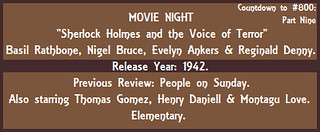
Sherlock Holmes and the Voice of Terror.


Review #798: Sherlock Holmes and the Voice of Terror.

Cast
Basil Rathbone (Sherlock Holmes), Nigel Bruce (Doctor John H. Watson), Evelyn Ankers (Kitty), Reginald Denny (Sir Evan Barham / Voice of Terror), Thomas Gómez (R.F. Meade), Henry Daniell (Sir Anthony Lloyd), Montagu Love (General Jerome Lawford), Olaf Hytten (Admiral Sir John Fabian Prentiss), and Leyland Hodgson (Captain Roland Shore) Directed by John Rawlins.

Review
Following two excellent Holmes films (#583 - The Hound of the Baskervilles, and #721 - The Adventures of Sherlock Holmes) were released by 20th Century Fox in 1939, Universal Studios bought the rights from the Doyle estate to make films about Holmes - updated to the present day. In fact, the opening title card talks about how Holmes (and Watson) is "ageless, invincible and unchanging", with this movie being about Holmes trying to take down a Nazi agent using propaganda through the radio (which did occur during the War). It is an interesting premise, but I can't resist to wonder if there were other movies dealing with plots like this. There is at some sort of mystery to the film, and the movie does move quickly enough, at 65 minutes (if you wonder why I always mention the length of a movie as positive/negative, it's merely a way to try and justify how the movie does with regards to pacing, or if a movie is too long or too short to try and enjoy, for my taste anyway. In this case, the movies does a fine job in terms of satisfying its goal of telling a story with a short length).

While it is a b-movie, it is at least a movie that tries its best to be entertaining while dealing a subject as serious as treason during wartime, not coming off as cheesy, nor too overblown (it's interesting to note that the movie ends with a title card stating to buy war bonds). Rathbone and Bruce are consistent as ever, making for a fine duo that play well off each other. Ankers is also pretty decent, making a good contribution to the plot. Denny (there really isn't spoilers if the movie is over 70 years old, so no complaints) is okay, coming off as so unassuming that you really don't think he's the villain, because...well, it is strange to presume that a member of the "Inner Council of British Intelligence" would be behind all of this - unless he was an impostor, because Holmes is a master at deducing that sort of thing, and it helps that I'll let it slide unopposed. It's a movie that is fairly passable for its time, even if it isn't as enjoyable as the previous films. Bottom line: Take it for what it is worth.

Countdown: 10, 9, 8, 7, 6, 5, 4, 3, 2...

Overall, I give it 7 out of 10 stars.