Showing posts with label Mae Busch. Show all posts

April 7, 2023

Souls for Sale.

Review #1995: Souls for Sale.

Cast: 
Eleanor Boardman (Remember "Mem" Steddon), Lew Cody (Owen Scudder), Richard Dix (Frank Claymore), Mae Busch (Robina Teele), Frank Mayo (Tom Holby), Barbara La Marr (Leva Lamaire), Arthur Hoyt (Jimmy Leland), David Imboden (Caxton), Roy Atwell (Arthur Tirrey), Forrest Robinson (Rev. John Steddon), Edith Yorke (Mrs. Steddon), William Orlamond (Lord Fryingham), Aileen Pringle (Lady Jane), and Snitz Edwards (Komical Kale, the Klown) Written and Directed by Rupert Hughes.

Review: 
Well, there's always room for movies about Hollywood. The movie is adapted from the novel of the same name, which was written by none other than Rupert Hughes. Born in Lancaster, Missouri, he studied at both Case Western Reserve University and Yale University and graduated from each with degrees before the turn of the 20th century. Eschewing the idea of teaching, he decided to become a writer, turning his attention to novels alongside reporting on occasion. He entered film in the 1910s as a writer with films such as The Deaf Mute (1913). His first film as a director was The Wall Flower (1922). In total, he was a director-writer on seven films from 1922 to 1924, although he continued to dabble in screenwriting, which included him introducing his nephew Howard (yes, that Hughes) to the film industry; Hughes died in 1956 at the age of 84. Boardman was actually in her first starring role here. She had dabbled in the stage, but when she lost her voice, she assumed it was dwindling down. Hearing about a contest for "New Faces" by the Goldwyn studio, she entered it and became one of two winners (the other was William Haines) among hundreds of entrants. Paul Bern, a director/writer of what became Metro-Goldwyn-Mayer, helped her with the screentest, turning a disastrous first take into one that got her a contract (incidentally, Haines appears in a small role in this film). She made her debut with The Strangers' Banquet (1922) and did supporting roles with two further films before appearing as star with this film, which ironically is a role about an aspiring actress trying to make it in Hollywood; she retreated from acting after 1935, having had highlights in films such as The Crowd (1928). The film was thought lost for many years until it surfaced in vaults in the late 1980s before it was restored in 2006.

As a whole, the movie is light fun in melodrama and mythmaking. It varies wildly in what genre it wants to be, mostly because it can't settle between the perils of Hollywood on a youth or an oddball serial killer that likes young brides. It doesn't exactly gel well with each other, with only the offbeat title cards (interestingly, "simp" is used here about trying to sell oneself to a person when it comes to trying to act) coming in second in making an odd tone. It is generally involving at 90 minutes though, mostly because one can't help but wonder what little surprise cameo you could see coming, whether that involves Charlie Chaplin at work or whatever. I find it more interesting when it tries to play perspective in what it means to try and be an actor in a grueling industry and the emotions that come with it rather than, well, the moralizing that happens with those title cards. My favorites: an oddball that says when an actor gets into trouble, "they blame the screen" or movie folk that are "factory hard" when rising and leaving early and late. Bottom line, the movie thinks to try and put the stars on a pedestal too highly, especially considering that Hollywood actors like Roscoe Arbuckle had just gone through two trials (with a third happening in the very month this film was released) for manslaughter. In other words: actors may have interesting lives and troubles, but you really can't expect me to believe they have a hard factory life like this. Anyway, the movie itself is just fine, because Boardman does fine with the material, malleable in drama and plucky ambition (despite probably having the corniest name seen in a silent lead character in quite some time). Dix and Mayo try to make this a love triangle, but honestly, I forget sometimes which is which, so go figure that the director is the one who gets the girl over the actor. Interestingly, this was one of Dix's first roles as a film actor. Cody evidently was known for "male vamp roles", so this makes an interesting adversary, even if it tries to play it both ways a bit with the ending (you can do creeping or you can do sympathetic, don't try both). Really, it is the light relief provided by people such as Busch (a future associate of the Laurel and Hardy films) or with La Marr (a vamp icon until her premature death) or with Edwards and his usual presence. As a whole, I wanted to like the film more than I did when it comes to films that have not had the pleasure of being discovered as long as other silent films, but it mostly is just okay. As a weird and odd mess that tries to play melodrama and Hollywood sunshine, it comes off as a strange amusement that can work if one is in the mood for certain expectations.

Overall, I give it 7 out of 10 stars.

Five to go.

May 9, 2022

Foolish Wives.

Review #1838: Foolish Wives.

Cast: 
Rudolph Christians (Andrew J. Hughes; Robert Edeson from the back), Miss DuPont (Helen Hughes), Maude George (Her Highness Olga Petchnikoff), Mae Busch (Princess Vera Petchnikoff), Erich von Stroheim (Count Wladislaw Sergius Karamzin), Dale Fuller (Maruschka, a maid), Al Edmundson (Pavel Pavlich, a butler), Cesare Gravina (Cesare Ventucci, a counterfeiter), and Malvina Polo (Marietta) Directed by Erich von Stroheim (#1782 - Blind Husbands)

Review: 
Sometimes you need a romantic epic drama. Yes, one with a person that serves as director, co-producer, writer, and star. And yes, one with Erich von Stroheim behind the wheel for his third time around the director's chair (all with Universal Pictures), with this following Blind Husbands (1919) and The Devil's Pass Key (1920, a lost film), which generated success with audiences and publicity alongside a raise. This would be a project that would feature an elaborate production of spectacle and melodrama with large re-creations built by the studio to try and mimic the French Riviera and the Mediterranean coast. This would turn into a production that would require the extensive attention of the studio with its technicians that drove Universal to promote Irving Thalberg to head of production to try and bring von Stroheim into control. Believe it or not, von Stroheim actually wanted the film to be released "as is", which would have run long enough to have to be shown on two consecutive nights. With a cost of over one million dollars that had a shooting time of nearly a year to go with half a year in editing with countless extras, interiors, and sets, it one perhaps isn't surprised to find von Stroheim as a possible successor to the legacy of D. W. Griffith, particularly since Griffith was a mentor to him for a time. However, this would be the last time that the director would have complete control over a film, as his next film in Merry-Go-Round (1923) would see him clash with Thalberg to the point where he was fired after six weeks (this time he did not have the luxury of using his power as star and director to create a stalemate, since he wasn't acting in that film); he was fired from Universal. Greed (1924) would have been his great epic...but von Stroheim would find himself clashing with the newly established man in charge of production in Thalberg; von Stroheim would direct five further times in the next eight years, but none were as successfully realized.

One wonders just how much von Stroheim enjoyed being at the center of all the attention when it comes to spectacle like this, because simply stating the plot may not be enough to get the whole point across about how oddly effective the film is, one century removed from its release. You can point at the fact that the director ordered actual caviar and champagne for banquet scenes, or the fact that he effectively is playing the devil with all of the romances he goes off on that go from married women to a half-wit to a maid, but my favorite little moment is the time a book is seen in a shot called "Foolish Wives by Erich von Stroheim" that ends up closing the film. It all seems to fit together for a movie built on facades, either in the time taken to make facades that look like the real locations or the facades of the people in the film to hide who they really are. The restored version of the film runs at 142 minutes, so you'd better believe you are getting plenty of time to spend with the oozing qualities of von Stroheim, because he easily is the best part of the film, controlling the camera whether in front of it or behind in terms of stage presence in conviction that you believe through and through (i.e. one sees a swindler that could swindle someone straight out of a melodrama). DuPont does okay as the romantic interest, filled with calm grace mixed with a bit of nativity that makes for fairly curious moments spent being pursued by the other main lead. Christians died midway through production, which means that the second half of the film features the character he was playing shown with his back to the camera (since Edeson is playing the character from the back). The performance is therefore murky to quantify, because the role is already one destined to be dwarfed as a "normal" foil to the director at any rate. George and Busch make fair facades of alleged dignity that pays off with the last scene in particular. Fuller and the rest are fine, even if it is the climax that is more memorable than actual sequences of chemistry attempted with the star, which features fires and sewer stuffing. As a whole, it may be more of a spectacle movie than a movie filled with deep plotting, but it is entertaining spectacle that generally rewards the patience of its viewer by pulling out the stops necessary to get where it wants to go in the folly of facades without hammering one in the head with piety. Instead, it presents a tale of decadence and stays where it wants to go right until it needs to stick the landing in appropriate measures that doesn't fall into mockery. Whether one likes this film or Blind Husbands, it is clear to see where von Stroheim gets his interests in terms of making useful spectacle with facades in human nature that make for distinct films that are very much his own (warts and all) that served its time well that could still reach a viewer today.

Overall, I give it 8 out of 10 stars. 

October 22, 2015

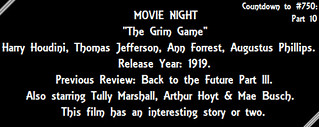
The Grim Game.


Review #749: The Grim Game.

Cast
Harry Houdini  (Harvey Hanford), Thomas Jefferson (Dudley Cameron), Ann Forrest (Mary Cameron), Augustus Phillips (Clifton Allison), Tully Marshall (Richard Raver), Arthur Hoyt (Dr. Harvey Tyson), and Mae Busch (Ethel Delmead) Directed by Irvin Willat.

Review
Ah 1919, where the word spendthrift can be used, and cities (like mine) can be formed (and named) after a land company. Before I get to the film, let me talk a little about the history of the film in the next paragraph.

The Grim Game was Harry Houdini's first feature-length film (though the serial The Master Mystery was released in early 1919) and Houdini would star in films until 1923. Houdini (an expert magician who also debunked spiritualists) died on Halloween Night in 1926, though his legend still shines through today. As for the movie, it also has an interesting story of its own. This film had been considered lost for over 90 years. As it turned out, Larry Weeks, who considered himself Houdini's biggest fan, had a copy of the film in his collection after claiming it from the Houdini estate in 1947. Through the help of film scholars, TCM and the owners of the Houdini Museum and some negotiating, the film was acquired by TCM. A restoration and a new score were done, and TCM showed it as part of their Film Festival on March 29, 2015, with the world television premiere being just this Sunday night.

After all that history, how is the film? Not too bad. For an adventure-drama, it does have its shares of thrills, especially due to Houdini. You get to see him escape from chains and even a straight-jacket, and at one point he even manages to make a gun come out of his sleeves, which surprised me. The "Grim Game" turns out to be a plan hatched by Houdini's character to get his paper that he reports from to survive...by framing himself for the disappearance of his uncle, all by circumstantial evidence. He actually enlists the help of five people (including his fiance) to get this plan done, which includes taking the uncle out for a while to make it seem like he has disappeared. But it goes wrong (naturally), as the uncle is actually killed...by someone. It turns out to be the one person I didn't expect, mainly because I assumed that the one that would get to marry the heiress to the uncle's fortune did it...that, and because he wants to put Houdini in the asylum. But it's not, which I guess makes it less predictable...either way, the movie is at least entertaining, though it does take a while to get to the aforementioned grim game. The climax of the movie is entertaining...because you get to see a mid-air plane collision! Naturally, everyone (real life and plot life) is okay, but getting to see the climax in the air is very well-done. The movie (running at 71 minutes) is well paced, while also showing off some of Houdini's talents.

Countdown to #750: 10, 9, 8, 7, 6, 5, 4, 3, 2, 1.

Overall, I give it 8 out of 10 stars.