Showing posts with label Joseph L. Mankiewicz. Show all posts

April 30, 2024

Sleuth (1972).

Review #2204. Sleuth (1972).

Cast: 
Laurence Olivier (Andrew Wyke) and Michael Caine (Milo Tindle) Directed by Joseph L. Mankiewicz (#750 - All About Eve, #1378 - People Will Talk, #1798 - No Way Out)

Review: 
In 1970, the play Sleuth came out to the stage to tremendous success as created by Anthony Shaffer. He had worked as a barrister and a copywriter before his calling as a writer. He based the play as a take on the mysteries written by author John Dickson Carr to go with inspiration from his friend Stephen Sondheim and his penchant for game-playing (incidentally, the first and only screenplay Sondheim wrote was done with Anthony Perkins involving mystery with The Last of Sheila (1973), as inspired by scavenger hunts that were done by who else but Sondheim and Perkin). The result was a Tony Award-winning play that had a variety of British actors playing the two roles, such as Anthony Quayle acting opposite Keith Baxter, with a run-on Broadway happening in the autumn of 1970. Two years later, he was brought on to write the screenplay for the film, one that has just two actors but had credits that listed fake names to fool the audience for a bit (the movie does the same thing). The film rights were purchased fairly quickly, and Shaffer expressed interest in Alan Bates to play opposite Anthony Quayle (who had played the Andrew role on stage originally) ...but when one finds Laurence Olivier, how does one say no? Through the rejection of actors such as Albert Finney and Bates came the bringing of Michael Caine to play opposite Olivier. Shaffer would be a bit busy as a writer, as his first screenplay went onto the screen in 1971 with Mr. Forbush and the Penguins before 1972 saw both Sleuth and Frenzy released. He wrote a handful of screenplays until 1993 that ranged from The Wicker Man (1973) to his last effort in Sommersby (1993).This was the 20th feature film directed by Joseph L. Mankiewicz. Although he worked on the screenplay for a would-be adaptation of a novel called Jane in his later years, Sleuth ended up being his final film prior to his death in 1993 at the age of 83. In 2007, a new version of Sleuth was filmed that had Kenneth Branagh as director to go with Caine now the old pro playing against a younger one, this time playing against Jude Law in a movie that apparently didn't use any dialogue from Shaffer's original script. It probably didn't go as well as when Caine was in that other who-dun-it Deathtrap (as released in 1982, for which some have compared it to Sleuth, although really they arent that similar), that's for sure.

Not many movies can say that they have pros for every cast member, but this is one of those times where the fun isn't so much just the mystery but the fact that you get 138 minutes of two absolutely invested actors in their element for a film that shows a relish for methodical entertainment. When it comes to cat-and-mouse games, it really doesn't get any better than this, and it does certainly lend itself to going into it with as little to know as possible besides the fact that one really can get too absorbed into one-upping the other person. When Olivier encountered Sondheim at the end of filming, he apparently stated that he based his performance off him. Olivier puts his best foot forward in that grand display that arises from an aristocratic display that could only be shown for all of its degrees of tone and reaction by a pro that knows it is the utmost importance to not have it seem like just a bit to play for the straight gag. For all the people that know (and knew) the power of Olivier in a role with meat to play, there are probably almost as many people who know how damn good Caine can make a role within the first few scenes he appears in. The differences between him and Olivier when it comes to curiosity and upbringing for the film make a compelling double act that lends each the chance to explore how far pride can go, particularly among the higher classes. Caine excels in those razor-sharp exchanges that become more and more predicated on the idea that if someone has to win, the loser is going to be buried one way or another. It is the kind of movie to sit back with a drink and just enjoy slowly over the course of the film. Even when one has an idea of where the film might go with its tête-à-tête, the ride never seems to loosen up, and this is for a film with plenty of scenes in a house with plenty of atmosphere and staging to spare (such as with its one particular laughing electronic toy). In the end, however one finds themselves watching this film in the progression of mystery and thrills, one will have plenty to enjoy within its contained dedication shown by all involved in its execution from its director right down to its actors for all that one could ever want.

Overall, I give it 10 out of 10 stars.

February 10, 2022

No Way Out (1950).

Review #1798: No Way Out (1950).

Cast: 
Richard Widmark (Ray Biddle), Linda Darnell (Edie Johnson), Stephen McNally (Dr. Dan Wharton), Sidney Poitier (Dr. Luther Brooks), Mildred Joanne Smith (Cora Brooks), Harry Bellaver (George Biddle), Stanley Ridges (Dr. Sam Moreland), and Dots Johnson (Lefty Jones) Directed by Joseph L. Mankiewicz (#750 - All About Eve and #1378 - People Will Talk)

Review:
“If the fabric of the society were different, I would scream to high heaven to play villains and to deal with different images of Negro life that would be more dimensional. But I’ll be damned if I do that at this stage of the game. Not when there is only one Negro actor working in films with any degree of consistency.”

There were film noirs that also existed within the realm of social consciousness. Boomerang! (1947) dealt with following the rule of law, Crossfire (1947) was a mystery that gradually revealed a message against antisemitism, Panic in the Streets (1950) dealt with trying to stop the plague. What we have here is a film of blind rage...specifically, racist rage, complete with a hallmark film debut for Sidney Poitier. Born in 1927, Poitier grew up in the Bahamas before moving to the United States as a teenager, where he would serve in the United States Army during World War II. Right after the war ended, he applied twice to the American Negro Theatre, where he would study acting - he broke into Broadway in 1946. He was under contract for a play when he decided to take a screentest for this film, not expecting to actually receive the part. However, director Joseph Mankiewicz saw something he liked in Poitier (who actually fibbed his age to say he was five years older than his actual age). Poitier became a star in the next two decades in his way to becoming the first major African American film star, one who became the second black actor to win an Academy Award before he shifted focus to directing in later years; Poitier passed away this year at the age of 94, and he is generally remembered as an icon who made a difference with his integrity as a filmmaker. 

The script was done by Lesser Samuels and Mankiewicz, as the former had a son-in-law doctor (Philip Yordan provided uncredited contract script work). Mankiewicz modified the story to be more of a noir with the viewpoint of Poitier rather than an observation of black medical hopefuls. Darryl F. Zanuck, the head of 20th Century Fox (the studio that released the antisemitism expose Gentlemen's Agreement three years prior), personally supervised production of the film. Of course, the original script apparently ended with a gruesome murder, but the studio did not want to leave audiences with a hopeless feeling (which honestly seems like a good decision). Seven decades later, this 106-minute film certainly pulls enough punches within an outspoken flair for useful storytelling and a message that still stings curiosity without turning into predictable mush on any count. It is the story of a man trying to dig his way out of an awful situation: trying to prove themself when a racist is breathing down their neck (complete with inciting a riot). The unshakable object meets the immovable force when the facts are not enough to stop rage, and this still seems like something that could be seen today.

You have to remember that Widmark had captivated the screen with Kiss of Death (1947), so to see him in a scuzzy role filled with venom is not too surprising. He proves startling effective as the simmering bully, one who balances the line between caricature and terror, since he serves as a reflection of people who would rather blame race rather than confronting themselves for why their lives are the way they are (in that sense, he makes the audience uncomfortable and thus does it right). Of course, Poitier can't be forgotten, even if he is billed fourth despite having the brunt of screentime. Filled with self-doubt and pride, he makes an astonishing debut here (incidentally, Widmark and Poitier became friends during production, and he would even go so far as to apologize to him after certain takes), with the enmity between the two leads being quite palpable when it comes to a match of pride. McNally is fine here, although one can see the seams of a character that could've seeped into self-righteousness. Darnell fares better in the conflict of which strife matters most to her (i.e. the scuz-ball saying things in her ear or her crappy life) that makes the climax (and its fateful last words) fairly worth it.

The supporting cast is nicely assembled, revolving from the warm presence of Smith to the tense Johnson. Additionally, this is the onscreen debut of Ossie Davis (in a brief uncredited role), and he appears with wife Ruby Dee briefly for the first time of numerous occasions where they were paired together on screen. The film was not a major success, likely owing to objections from select censor boards due to its content (what with the whole race riot and all, although I wonder if they were totally fine with all the racial epithets), with Chicago fearing it would incite riots (which as we all know is bullshit) before cuts were made regarding the riot. Of course, Mankiewicz already had another film ready to release later that year with All About Eve (1950), while this film is less well-known (incidentally, each film would have their script nominated for Academy Awards). At any rate, this is a film anybody would be proud to have been a part of, and it is definitely one worth seeing for what it manages to do for the time as a socially conscious movie with a worthwhile debut from an actor that was just getting started.

Overall, I give it 8 out of 10 stars.

Next Time: Carib Gold.

April 6, 2020

People Will Talk.

Review #1378: People Will Talk.

Cast: 
Cary Grant (Dr. Noah Praetorius), Jeanne Crain (Deborah Higgins), Finlay Currie (Shunderson), Hume Cronyn (Prof. Rodney Elwell), Walter Slezak (Prof. Lyonel Barker), Sidney Blackmer (Arthur Higgins), Basil Ruysdael (Dean Lyman Brockwell), and Katherine Locke (Miss James) Written and Directed by Joseph L. Mankiewicz (#750 - All About Eve)

Review: 
A good movie comes from a variety of aspects, whether through its actors or through its director in telling a story worth experiencing on screen. Joseph L. Mankiewicz. He had started in Hollywood as a titles writer because of his brother Herman (an accomplished writer in his own right, notably co-writing Citizen Kane), eventually moving on to writing scripts such as Skippy (1931, where he earned his first Academy Award nomination). He worked for Paramount for a few years before moving to MGM to write and eventually produce films as a well (although he did un-credited work on numerous productions of his). He shifted to 20th Century Fox and found his chance to direct, which he did with Dragonwyck (1946). He soon reached prime success with A Letter to Three Wives (1949) and All About Eve (1950). Both films won him Academy Awards for Best Director and Adapted Screenplay. In total, Mankiewicz made twenty films (with one documentary and one TV film) from 1946 to 1972 before his death at the age of 83 in 1993, with other notable films of his being Julius Caesar (1953), Cleopatra (1963), and Sleuth (1972).

The film was adapted from the German play Dr. med. Hiob Prätorius by Curt Goetz, which had been adapted into a film one year prior in West Germany (which Goetz co-directed along with playing the title role) and would be done again in 1965. The 1950s were still a time for a Production Code (with power that withered considerably) that tended to butt itself in to films touching certain aspects of life , such as wedlock pregnancies or taking one's life, but that didn't mean films couldn't find ways around it with cleverness or some amiable star power, which works itself out with folks like Mankiewicz and Grant at the helm. This is an interesting comedy-drama, one wrapped in casual composed charm from Grant (as one could expect) and a measured presence from Crain that makes for a sly and clever time that aims for sophistication over convention in terms of life with medicine. It has a foundation that can still be applied today, where a good film is like medicine in being more than a bunch of parts to jam together but one that needs good care and belief in one's director, which works adequately enough for 110 minutes. Currie carries through with support as a careful presence that isn't forgotten from the screen for too long, while Cronyn contributes an adversarial role with the right sense of condensation and envy and Slezak delivers some light charm. There are quite a few interesting moments to highlight, such as Grant dealing with composing music with a student/faculty orchestra, or the misconduct hearing with composed sly tone and humor. It might not be the best film in the Mankiewicz portfolio, but it is still a worthy one worth checking out for its charm and reach for drama alongside comedy that stands for itself as a fair gem for the 1950s.

Overall, I give it 8 out of 10 stars.

October 23, 2015

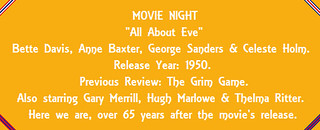
All About Eve.


Review #750: All About Eve.

Cast
Bette Davis (Margo Channing), Anne Baxter (Eve Harrington), George Sanders (Addison DeWitt), Celeste Holm (Karen Richards), Gary Merrill (Bill Sampson), Hugh Marlowe (Lloyd Richards), Thelma Ritter (Birdie), Gregory Ratoff (Max Fabian), Marilyn Monroe (Miss Casswell), and Barbara Bates (Phoebe) Directed by Joseph L. Mankiewicz.

Review
Based off "The Wisdom of Eve" by Mary Orr, All About Eve is a movie that held the record for most Oscar nominations (14) until Titanic tied it over four decades later, with five actors receiving nominations, and one (Sanders) winning. In fact, Joseph L. Mankiewicz won two Oscars for the movie (Best Director and Adapted Screenplay). 65 years later, the movie is heralded as a classic. And why not? It is great. It's interesting that the big highlight in a movie all about Eve is not Eve herself, but Bette Davis and her tremendous screen presence. She is always interesting to watch and always entertaining, especially when interacting with the cast. Baxter is effective in making her character come off as innocent and helpful...for a while, anyway. Her scene with Holm in which she would will be willing to use Karen's deep friendship with Margo as leverage just to get a part shows the extent of Eve's manipulation. But while her ambition got her out of one problem along with getting her this far, it may have gotten her into another situation...but the movie ends on a different character, named Phoebe. The final scene, with her taking the award and imagining herself winning one is certainly fitting. Sanders manages to ingrain his character into the narrative. He may be snide. but his way with words is much more devastating. His scene with Baxter at the end, is especially well-done, as the movie comes full-circle. The movie begins with Eve winning an award for her performance in a play...but maybe in a way she hasn't won. She won the award, but perhaps at the cost of her heart, in a sense. One actress who also is in the movie, though brief, is Marilyn Monroe, whose character also plays a role in regards to Eve's rise. Monroe doesn't get much to do, but she is interesting to watch, especially when being guided by Sanders in his attempts to give her a career. The movie certainly looks well in both fashion and just in general, with the Costume Designers (Edith Head and Charles LeMaire) winning an Oscar for it. Bottom line, the movie is interesting to watch, especially if you love big performances and love big classical drama.

Thank you for reading this 750th Review. I hope you enjoyed it.

Overall, I give it 10 out of 10 stars.

For all of the appreciation over the past 750 reviews, I made a collage detailing from the first big landmark (and the number before it is, as customary)...all the way up to now. Thank you. Enjoy.