Showing posts with label Harry Shannon. Show all posts

April 30, 2025

The Lady from Shanghai.

Review #2373: The Lady from Shanghai.

Cast: 
Rita Hayworth (Elsa "Rosalie" Bannister; singing voice by Anita Kert Ellis), Orson Welles (Michael O'Hara), Everett Sloane (Arthur Bannister), Glenn Anders (George Grisby), Ted de Corsia (Sidney Broome), Erskine Sanford (Judge), Gus Schilling ("Goldie" Goldfish), Carl Frank (District Attorney Galloway), Louis Merrill (Jake), Evelyn Ellis (Bessie), Harry Shannon (Cab Driver), and Wong Chung (Li) Produced and Directed by Orson Welles (#200 - Citizen Kane, #1366 - The Stranger)

Review: 
Sure, let's talk about Orson Welles. Citizen Kane (1941) is probably the most electrifying debut for any director to start out with, much less make for a career, and the fame it gained later is endless. But, well, one film does not define a career, so what happened next? Welles had his next film with The Magnificent Ambersons in 1942, complete with a mansion set that apparently had walls that could be rolled or lowered to deal with the camera. Unfortunately, Welles did not have the final cut privilege that cut the movie pretty down, but even in an edited form, people still like to talk about the movie. For a few years, Welles acted in film along with doing plenty of work in radio before he came back into directing with The Stranger, released in 1946 to general success (so much so that you can even find the movie in the public domain). For this movie, apparently it came at the behest of needing money. Specifically, Welles was directing a musical with Around the World and asked Harry Cohn of Columbia Pictures if he could borrow money and in exchange would do a movie for no further fee. When it came to adaptation material, the movie is based on the 1938 novel If I Die Before I Wake, as originally written by Raymond Sherwood King. Apparently, William Castle had brought the book to the attention of Welles. Apparently, Cohn did not like the rough cut done by Welles (after shooting had ended in early 1947) and insisted on studio-reshoots (Cohn was not particularly big on a movie described in a Welles biography as having "expressly Brechtian aspirations" and apparently found the movie hard to comprehend) that inflated the budget to go along with extensive editing ordered that basically cut a sequence of mirrors from twenty minutes to about three (stills survive); William Castle, Charles Lederer, and Fletcher Markle apparently did uncredited work on the script. The movie indeed was shot in various locations, ranging from San Francisco to Acapulco and on the actual yacht Zaca. The result was a movie that was not particularly loved in America but found favor in Europe before getting people to look further into it in later years (as one does with certain "flops"). Welles would direct seven further movies (along with a special case and a documentary about one of his own films) in his lifetime. A remake was considered in the early 2000s but never got off the ground.

Sure, it is an oblique kind of noir, filled with varying moments of general interest in the ruminations that come with guilt and innocence. But it is a really entertaining movie that entraps you for 88 minutes with efficiency that comes in the web of mystery and strangeness present here. It is a dreamy doom that is all successful because of the efforts of Welles behind and ahead of the camera, one that keeps attention for most of its time not so much in where the plot is going to go but where the web is really going to end up with these people. Somehow, it never occurred to me that I hadn't watched a Rita Hayworth movie before. There were a handful of movies she became known for from Only Angels Have Wings (1939) to Separate Tables (1958), but Gilda (1946) was the one that most probably know because of her femme fatale role (the long and short version of Hayworth is that she was the daughter of dancers), although, well, this is a movie where her hair was cut short and bleached to be platinum blonde (evidently, Cohn was aghast at this decision). Her aura of mystery and wandering nature is pretty neat here though, hair or otherwise (I'll be real, I am not too big on appearances anyway, how do you think hair reflects on me?). She glides through the film with the efficiency of a jagged knife that you can understand in why someone would just drop themselves for (or in the case of Welles, narration for a good chunk of it). Sloane and Anders round out the important parts of the cast in worthwhile scuzzy jaggedness (the former was a noted regular actor on film/radio), popping in and out with resounding amusement at the absurd world one is inhabited in with dubious lawyers and weird ambitions. The movie benefits greatly from the on location filming, because, well, you can't have every noir involve the same four walls, locale does help. The courtroom stuff is probably the only part of the film that comes close to being sluggish, but the chase sequence to cap the movie off, complete with a devastatingly beautiful sequence of mirrors (which obviously people can recognize in other stuff that "borrowed" from it) that you really need to see for yourself. The ending closes it all down in a sort of irony that could only come in wanting to ensure that even getting to live is not the way to total freedom. As a whole, this is a fun movie, bewildering in its strange scenarios and webs with committed people to hold it all together that is more than just a studio-cut movie but a curiosity all on its own.

Overall, I give it 9 out of 10 stars.

October 6, 2024

The Mummy's Ghost.

Review #2265: The Mummy's Ghost.

Cast: 
Lon Chaney Jr (Kharis), John Carradine (Yousef Bey), Robert Lowery (Tom Hervey), Ramsay Ames (Amina Mansori), Barton MacLane (Police Inspector Walgreen), George Zucco (High Priest Andoheb), Frank Reicher (Professor Matthew Norman), Harry Shannon (Sheriff Elwood), Emmett Vogan (Coroner), and Lester Sharp (Dr. Ayad) Directed by Reginald Le Borg (#1179 - The Black Sleep)

Review: 
Okay, so here we are with another Mummy film (in the timeline of 30 years after The Mummy's Hand as established by The Mummy's Tomb). It's hard to believe that this is the third of the four Kharis films released from 1940 to 1944, and yet here we are. It is funny that Zucco returns for this film, having apparently survived being shot and going down the stairs from the last two films just so he can go assign the task of getting the mummy to the character played by John Carradine (creatively called Yousef Bey, after the last film had used named the follower character Mehemet Bey and the 1932 film had used "Ardath Bey"), who was busy enough to be on four Universal horror films (the others being The Invisible Man's Revenge, House of Frankenstein, House of Dracula). The film was written by Griffin Jay, Henry Sucher, Brenda Weisberg, as based on a story by Jay and Sucher. The movie was shot quickly in August/September of 1943 but wasn't released until June of 1944. This is also yet another movie where a priest tries to get involved with a woman while trying to deal with Kharis. Oh, and reincarnations involving people thought to be the long-dead woman lover, which you might recognize as being from the 1932 Mummy film. The movie was done by Reginald Le Borg, an Austrian who had moved to the States in 1934 that rose from staging in film to bit part actor to directing by the late 1930s. He had made films for the Office of War Information during World War II but got to be part of Universal in 1943 for a handful of their films, most notably the first three "Inner Sanctum Mystery" films; he didn't care for his horror films, but he was a craftsman of several films in the B-level for many years.

You are not getting anything different that you saw in Tomb or Hand, but are you really that surprised? Sure, those movies weren't actually that good, but you could at least say they tried. Here, there just isn't anything to really grouse about, and this is a movie with Carradine in it. He just doesn't get that much to really do when compared to the stuff you saw before when it comes to goofy priests. Lowery might as well be an actual broomstick. Ames has one defining characteristic: a streak of white in her hair, which clearly means danger and sleepwalking. Since one knows that Chaney had a painful time with the makeup (couldn't even scratch an itch), it does amuse to see him try to go around with one good arm (such as with a fence). The people in the film sure have a fun time trying to avoid him, and it is pretty funny to see in a giant case of steps for the climax. Probably the most amusing thing about the movie is the use of a dog to help guide the people around to find the mummy, because then one can make a lazy Lassie joke. Nah, actually, my favorite joke is that a few times the movie has someone ask "Amon-Ra" to aid his quest and I could simply say "but Amon-Ra (St. Brown) plays in Detroit." The only thing that saves the movie is the ending, because for once, you don't get to have a happy ending wrapped up in the last five minutes. I do wonder just what the headline writers or folks did when it came to the time after the swamp episode ("Men Swamped By Swamp", anyone?). In conclusion, nothing has been improved from before in a series of serviceable but wholly "not particularly good" 1940s Mummy films. Making one have to debate between Hand and Tomb for the "best follow-up to The Mummy until being blown out by the 1999 rendition" is a sad task indeed.

Overall, I give it 6 out of 10 stars.

September 13, 2023

High Noon.

Review #2083: High Noon.

Cast: 
Gary Cooper (Marshal Will Kane), Thomas Mitchell (Mayor Jonas Henderson), Lloyd Bridges (Deputy Marshal Harvey Pell), Katy Jurado (Helen Ramírez), Grace Kelly (Amy Fowler Kane), Otto Kruger (Judge Percy Mettrick), Lon Chaney Jr (Martin Howe), Harry Morgan (Sam Fuller), Ian MacDonald (Frank Miller), Eve McVeagh (Mildred Fuller), Morgan Farley (Dr. Mahin), Harry Shannon (Cooper), Lee Van Cleef (Jack Colby), Robert J. Wilke (Jim Pierce), and Sheb Wooley (Ben Miller) Directed by Fred Zinnemann (#1377 - The Men)

Review: 
"Sheriffs are people and no two people are alike. The story of High Noon takes place in the Old West but it is really a story about a man's conflict of conscience. In this sense it is a cousin to A Man for All Seasons. In any event, respect for the Western hero has not been diminished by High Noon."

It is never a bad time for a Western, particularly ones with interesting stories beyond the camera. The film is based on the short story "The Tin Star", as seen in 1947 in Collier's magazine that was done by John W. Cunningham. Carl Foreman (the credited screenwriter of the film) claimed later that he had written an outline that apparently seemed similar to Cunningham's story, which led to him buying the rights to the story. However, Richard Fleischer claimed in his autobiography (written decades after the fact) that he had helped Foreman develop the story while they had been working together in The Clay Pigeon (1949). Anyway, let's talk about Foreman for a bit. He had studied at the University of Illinois at Urbana–Champaign as a teenager, dropped out to seek out Hollywood, went back to Illinois to study at the John J. Marshall School of Law, and then dropped out of there to work a variety of jobs (writer, reporter, and even carnival barker) before eventually returning back to Hollywood by the late 1930s; during that time, he became a member of the Communist Party, which he left by the dawn of World War II, which saw him serve with the U.S. Army Signal Corps. Foreman had done his first writing in film with the 1941 film Bowery Blitzkrieg in an uncredited manner, but he got onto a more regular pattern of work with story/writing credits for Dakota (1945) and So This Is New York (1948) - the latter was the first Foreman made in association with Stanley Kramer (who he met when they both were serving in World War II). There would be a handful of films that Foreman made as a writer for Kramer's company, which included The Men (1950), as directed by Fred Zinnemann. At any rate, Foreman's career took a beating due to the House Un-American Activities Committee (HUAAC), who labeled him as an unfriendly witness after he admitted to being a party member but did not want to name names. He later called the film a parable against blacklisting, one that seems apt when considering that Kramer essentially shortchanged him when it came to having him sell his share in the company and even tried to get him booted off the production prior to the meeting with the HUAAC (because he feared he would be implicated by Foreman, assocation or not). Living mostly in London for the rest of his days, Foreman was given the cold shoulder from Hollywood for the rest of the 1950s that saw him either work on the side away from Hollywood or with modified credit that ranged from The Bridge on the River Kwai (1957); he also did a hand of producing in addition to writing for films such as Mackenna's Gold (1969); Foreman died in 1984 at the age of 69.

Fans of the Western know that Howard Hawks made Rio Bravo (1959) as a response to what he thought about this film that he felt didn't make much of a good Western, which naturally starred John Wayne (incidentally, he called High Noon "un-American", which is probably the silliest thing ever said by Wayne in the 1950s). Of course, Zinnemann years later responded by saying he wished Hawks would leave his films alone, so there's that. It seems only apt to have Cooper here, since the film that made him a key presence for bigger things in film was The Virginian (1929), which incidentally was a film that dealt with a man recently finding love in the West having to deal with the ramifications of an old foe coming into town for revenge in a shootout. The amusing point in all of this is that the two films are basically the same in quality anyways, ones that serve as being pretty good for what they are with distinct human qualities that make for a useful Western. The anguish and fear shown in its lead character (with credit going to Zinnemann and cinematographer Floyd Crosby) make a resounding effort to make a panicky piece of entertainment that makes a suitable morality tale that also is a sharp real-time thriller of conscience. In the end, a town may be a town, but it is nothing if there are no good people willing to stand side by side with folks in need of help, whether that involves men bound to their duty and honor or not. It is the kind of film that enforces the idea that beyond the one person bound to serve and protect folks sees them exposed for who they are (cowardice, resentment, jealousy, or bad timing) when the cards are down, which isn't always the easiest thing to confront when seeing human nature that leads to a man needing to make a decision (in Zinnemann's words) "according to his conscience." Cooper makes the ideal lead to make this grand quandary worth watching, which works pretty well when presented with a collection of various recognizable presences that make the lineup of human frailty (well, aside from the Quaker and an assertive presence of who stands by their man most) that even overshadow the outlaws (a quartet led by MacDonald), which somehow seems right. Kelly makes a decent pacifist in the middle, but really the most suitable presence to counter Cooper in pursuit is Bridges or Jurado, who each show the side of just what past loyalties mean when it comes to pride. The climax proves worthwhile in showing the chase of just how much pride and devotion mean when staring at a frontier where guns are in the picture rather than the idea of safety. As such, High Noon is a worthwhile effort in showing the nature of man and pride in a story that is distinct from the general Western tales and myths that arise from gunslingers and towns of man and dirt. Analyze all you want about just where the best Western lies, but this one is a pretty good one to go along with no matter where you encounter it in your travels.

Overall, I give it 9 out of 10 stars.

April 11, 2013

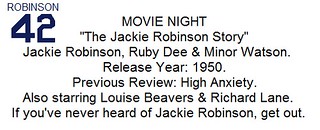
Movie Night: The Jackie Robinson Story.


Review #365: The Jackie Robinson Story.

Cast
Jackie Robinson (Jackie Robinson), Ruby Dee (Rae Robinson), Minor Watson (Branch Rickey), Louise Beavers (Mallie Robinson), Richard Lane (Clay Hopper), and Harry Shannon (Frank Shaughnessy) Directed by Alfred E. Green.

Review
This is an unusual movie, not because it's a film about a baseball player, but the fact that the man that plays the main character based off real life events...is the same guy, starring himself. Basically in a nutshell, Jackie Robinson playing Jackie Robinson. But nevertheless, the film doesn't have any other odd quarks, it is sort of a footnote, released at the mid point of Jackie Robinson's career, and this was the first of a few films about him. The acting is decent, nothing too special. Robinson does okay for what is essentially just Robinson being Robinson. But at least the film has its moments and it at least for what it's worth tells a story. Robinson was the first African American to play in Major League Baseball since the 1880's, and he would be the first of many to come. The film is okay and short to the point at about 70 minutes. Take it for what it is worth.

Overall, I give it 7 out of 10 stars.