Showing posts with label Maurice Moscovitch. Show all posts

February 29, 2020

Love Affair (1939).


Review #1350: Love Affair.

Cast: 
Irene Dunne (Terry McKay), Charles Boyer (Michel Marnet), Maria Ouspenskaya (Grandmother Janou), Lee Bowman (Kenneth Bradley), Astrid Allwyn (Lois Clarke), Maurice Moscovitch (Maurice Cobert), Scotty Beckett (Boy on Ship), and Frank McGlynn Sr. (Orphanage Superintendent) Directed by Leo McCarey (#085 - Duck Soup)

Review: 
Sometimes, one just needs a quaint romance film. In that sense, I suppose it shouldn't be surprising to have it be from Leo McCarey. A graduate of USC Gould School of Law, he tried his hand at various professions from law to songwriting before being hired by Tod Browning as an assistant director in 1919, based on a referring by actor and future director David Butler. His subsequent work with Hal Roach at his studio helped with skills in humor for gags, such as with the Our Gang series or shorts with Charley Chase (who McCarey felt appreciation for helping him in his career). He started his feature career with Wild Company (1930) and had a career of four decades with numerous headline stars ranging from the Marx Brothers (Duck Soup) to Dunne and Cary Grant (The Awful Truth, 1937) to Bing Crosby (Going My Way, 1944), with his work resulting in three Academy Awards (twice for direction, once for story). This film was the work of five writers: Delmer Daves, Donald Ogden Stewart, S.N. Behrman for screenplay and director-producer McCarey and Mildred Cram for story.

I will admit that this film does succeed in working some of its charm on me to win me over. In lesser hands, this could have proven to be a mawkish and overly sentimental mess, particularly with its second half turn. However, a smooth duo and gentle direction makes this worth a look, particularly with a fair pace at 87 minutes. Dunne does a tremendous job here, pulling off an expressive and graceful performance that resonates with the charming and absorbing Boyer. The rest of the cast is decent enough, such as a warm but quick appearance from Ouspenskaya. Of course the turn with having one of the leads being run over nearly derails the experience. I suppose not telling your lover about the fact you couldn't walk to avoid being a burden could make sense (I favor brutal honesty), but McCarey manages to make the eyes focused on how these two will adjust apart rather than rolling over, where improvisation rules the day more than predictability. When it reaches its end, one will find satisfaction with how it served for entertainment, accomplishing what it sets out to do without too many troubles. At least one can say its main stars liked their experiences, since Dunne and Boyer both described it as their favorite in their careers, and the two would later star in two more films together. Interestingly enough, this film has been remade twice. The first was in 1957 with An Affair to Remember with Grant and Deborah Kerr directed by none other than McCarey again. It was then remade under the original title in 1994 with Warren Beatty, Annette Bening, and Katherine Hepburn with direction by Glenn Gordon Caron. In any case, one can find this in the public domain and not regret their decision, a film with some passion and effectiveness from its stars and director that go together nicely.

Overall, I give it 7 out of 10 stars.

March 2, 2018

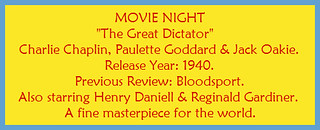
The Great Dictator.


Review #1054: The Great Dictator.

Cast: 
Charlie Chaplin (Adenoid Hynkel - Dictator of Tomania / A Jewish Barber), Paulette Goddard (Hannah), Jack Oakie (Napaloni - Dictator of Bacteria), Henry Daniell (Garbitsch), Reginald Gardiner (Schultz), Billy Gilbert (Herring), Maurice Moscovitch (Mr. Jaeckel), Grace Hayle (Madame Napaloni), Carter DeHaven (Bacterian Ambassador), Emma Dunn (Mrs. Jaeckel), Bernard Gorcey (Mr. Mann), Paul Weigel (Mr. Agar), and Chester Conklin (Barber's Customer) Directed by Charlie Chaplin (#353 - Monsieur Verdoux#599 - The Kid#600 - City Lights#759 - The Gold Rush#775 - Shoulder Arms#820 - Modern Times#923 - The Pilgrim#1025 - The Circus, and #1041 - A Woman of Paris)

Review: 
The Great Dictator was Charlie Chaplin's first true sound film, along with his first without his character of "The Tramp", which he had utilized for his silent films. In any case, the film was released a year after the beginning of World War II, with Chaplin playing a parody of Adolf Hitler and Oakie playing a parody of Italian dictator Benito Mussolini, although it was noted by Chaplin in later years that had he knew about the horrors of the concentration camps, he wouldn't have made the film. The film manages to be brilliant in utilizing comedy, satire and drama without having either of its elements being lost in excess, being a funny but also brave movie that holds its principles together by finding a balance in its two environments, with credit going to Chaplin and his script. Chaplin also does a tremendous job in both of his roles, having a fine distinct nature that works well within the mistaken identity parts later on, with the dictator parts having numerous highlights with all of the gestures and posturing that definitely strikes a chord. The parts with the barber might remind you a bit of the Tramp, although he plays it more of a outsider type that certainly fits. Goddard does a fine job in her parts on screen, having fine chemistry with Chaplin at points. Oakie does a stand-out job, having the correct amount of bombast and stature that makes for amusing rapport with Chaplin when they are both on screen together, particularly one scene involving chairs. Daniell and Gardiner also do fine jobs in their parts, distinct in their roles within the dictatorship that leave room for amusement. The rest of the actors do fair jobs in their roles. There are numerous great sequences and gags involving both slapstick and language, with one of my favorites being the ballet with a globe, which is helped by the music by Meredith Willson and Charlie Chaplin, fairly brilliant in its own right that has a fine timing to them that helps contributes to the flow of the film effectively for several scenes. The cinematography by Karl Struss and Roland Totheroh (a regular for some of Chaplin's films) is acceptable for the movie and its look.

The film does run finely at 124 minutes, never feeling too long. I will state that the climax of the film feels a bit sudden, particularly since it ends with a speech, which is an inspiring piece at least, so I can't blame Chaplin for wanting to incorporate it in a film he had all control over. Since that serves as the last point for the film, it is strange to wonder what would've happened after that point in the film, although apparently a folk dance sequence was apparently going to serve as the finale, and there were also plans to include shots of people from all over the world that would accept the message of peace, but these were abandoned after a bit of shooting from Chaplin. In any case, the movie isn't ruined by the last part, so take his words for what you will. The film was nominated for five Academy Awards (Outstanding Production (now known as Best Picture), Best Actor, Writing (Original Screenplay), Best Supporting Actor (Oakie), & Best Music (Original Score), although it fell short each time. It has since been selected by the Library of Congress for preservation in the National Film Registry, and it is easy to see why. This is a brilliantly made movie that serves as a fine piece of entertainment for all ages that belongs with the rest of Chaplin's classics for a look.

Overall, I give it 9 out of 10 stars.