
Showing posts with label Jack Lambert (A). Show all posts

July 14, 2023

The Killers (1946).

Review #2041: The Killers (1946).

Cast: 
Burt Lancaster (Pete Lund/Ole "Swede" Anderson), Ava Gardner (Kitty Collins), Edmond O'Brien (Jim Reardon), Albert Dekker ("Big Jim" Colfax), Sam Levene (Lt. Sam Lubinsky), Vince Barnett (Charleston), Virginia Christine (Lilly Harmon Lubinsky), Jack Lambert ("Dum-Dum" Clarke), Charles D. Brown (Packy Robinson), Donald MacBride (R.S. Kenyon), Charles McGraw (Al), William Conrad (Max), Phil Brown (Nick Adams), and Jeff Corey ("Blinky" Franklin) Directed by Robert Siodmak (#468 - Son of Dracula, #797 - People on Sunday, and #1826 - The Suspect)

Review: 
In 1927, Ernest Hemingway's short story "The Killers" was published in literary form. Set in his home state of Illinois, it details two hitmen entering a restaurant with an owner and a cook alongside a patron named Nick Adams, which Hemingway wrote from his own experiences. The two hitmen suddenly take Adams and the cook into the kitchen to tie them up while telling the owner that they were hired to kill a prizefighter expected to enter the place soon. Of course, when the guy doesn't show up, the hitmen leave while Nick is sent to a boarding house to warn the man about the job, but Nick is told to do nothing because it is futile for there to be attempts to save him from his fate. Hemingway later stated, "That story probably had more left out of it than anything I ever wrote. I left out all Chicago, which is hard to do in 2951 words." The entirety of that story is told in the first twenty minutes of the 1946 film adaptation (the killing depicted isn't in the actual story, of course). This was the fourth adaptation of a Hemingway story, following in the wake of A Farewell to Arms (1932), For Whom the Bell Tolls (1943), and To Have and Have Not (1944). The screenplay is credited to Anthony Veiller, although it was said in later years that Richard Brooks and John Huston contributed to the script in uncredited form. At the helm as director was Robert Siodmak, who had directed films in his native Germany and France before being driven to America by the rise of Nazism each time. He had done his fair share of genres, although most know his film noirs or B-movies that made him a "actor's director". This would work wonders for Burt Lancaster, who was making his film debut. He actually had an early interest in theatre productions and the circus from a young age, but injuries had him give up the circus. After serving in the U.S. Army in World War II, he took up acting and made an impression on Broadway in a flash. Mark Hellinger, who produced The Killers, happened to need another unknown to make up the cast after getting Ava Gardner from doing pretty much nothing at MGM (Wayne Morris and Sonny Tufts were the initial choices in mind for the role played by Lancaster). He got a tip about Lancaster (near the age of 33 when this film was released), who had signed a contract with Hal Wallis but hadn't made anything for release until Hellinger tested him and decided to sign him on. The film was an audience hit and received four Academy Award nominations that year (directing, editing, score, and screenplay), for which it received none. In 1964, a second adaptation of the story was done in film (after being thought of as too much for television) with Don Siegel as director that had Lee Marvin, Ronald Reagan, and Angie Dickinson as stars.

The premise sure is an interesting one to setup a noir, particularly one built for 103 minutes where one of the key characters is dead right then and there. But it is the journey in the way that things are shot or lit that matters when the scenarios matter most with femme fatales, double crosses, and the good ol' setup for a bag of dough. It isn't often you get a cast filled with so many dependable actors (future or at the moment), whether as stars or not. O'Brien is the one observing all of the pieces moving across the board that has the air of inevitability that he does well with, maneuvering through the tension with good timing. Lancaster is a lean block of excellence, one who generates screen presence in a near instant that delivers well among the flashback sequences told (aside from the one of his death, which he handles pretty well to begin with) in a malleable force of nature. He will only end up in one path, but it is the choices that are made there that make it interesting to see the level of challenge it takes for anyone to try and escape their big desire. It's clear to see how his face became one to reckon such desires in further films. Gardner makes a solid femme fatale, one who has the allure required to drive tension into the heart of anyone, a devastating display of dashing duplicity. The rest of the cast follow along in worthy interest for the subject at hand, whether that involves the heavy or the key part of the crisscross of who is fixing who. The robbery sequence itself is executed quite skillfully, done with resounding timing without wasting a moment. By the time the film has maneuvered its way through all of the twists and turns that come with "the best laid plans of mice and men often go awry”, the final result is a lean and mean noir that shows the potential of its stars in a solid effort from Siodmak and company. The fatalistic nature of the whole affair makes for a solid entertaining ride that merited the highest praise from Hemingway, who once called it "the only good picture ever made of a story of mine." That pretty much says it all right then and there.

Overall, I give it 8 out of 10 stars.

May 6, 2021

Machine-Gun Kelly.

Review #1674: Machine-Gun Kelly.

Cast: 
Charles Bronson (George R. 'Machine Gun' Kelly), Susan Cabot (Florence 'Flo' Becker), Morey Amsterdam (Michael Fandango), Richard Devon (Apple), Jack Lambert (Howard), Frank DeKova (Harry), Connie Gilchrist ('Ma' Becker), Wally Campo (Maize), Barboura Morris (Lynn Grayson), Lori Martin (Sherryl Vito), George Archambeault (Frank), Robert Griffin (Mr. Andrew Vito), Michael Fox (Detective Clinton), and Larry Thor (Detective Drummond) Directed by Roger Corman (#368 - The Little Shop of Horrors, #684 - It Conquered the World, #852 - The Terror, #931 - Not of This Earth, #1007 - Attack of the Crab Monsters, #1039 - Five Guns West, #1042 - War of the Satellites, #1136 - Gas-s-s-s, #1147 - X: The Man with the X-ray Eyes, #1186 - A Bucket of Blood, #1423 - The Wild Angels, and #1425 - The St. Valentine's Day Massacre)

Review: 
Admittedly, one really has to spread out the time spent in what I would like to call the AIP Zone. The hundreds of films that came from the studio of American International Pictures in that nifty little era it encapsulated could make for quite a few interesting marathons, and it only makes sense to encounter Roger Corman yet again. By this point in time, Corman had directed over a dozen films in the span of three years, and he did so in a variety of genres that ranged from westerns to science fiction, although he would dabble in the field of crime films and noirs (Rock All Night (1957) is one of Corman's favorites). Well, there is that other distinction to note for this movie in seeing Charles Bronson in a leading role. The Pennsylvania native (who changed his name from Buchinsky on advice that his name might affect his career) had started appearing in films and television early in the decade that eventually grew into supporting roles of note with Apache (1954). The same year that he would star in this film also saw him with a lead role on television in Man with a Camera, which ran for two years on ABC; at any rate, he would move on from middling support roles to leading support acting (incidentally, this would not be the only film Bronson did for AIP, as he would co-star in Master of the World three years later). Interestingly enough, the role was actually not initially viewed with him in mind, as Dick Miller at one point was announced as the star. Robert Wright Campbell served as the writer for the script, and this was the second of six movie scripts that he would do for a Roger Corman film.

You may or may not recognize that this is loosely based on the exploits of the criminal of the same name (a nickname given to him by his second wife, Kathryn, who had bought him the weapon), one of the numerous criminals that was referred as a public enemy to justice (alongside others of the 1930s, for which filmmakers would cover in cinema, and AIP released this film as a double feature with The Bonnie Parker Story), although his crimes dealt with bootlegging and robbery. His infamous moment occurred when he had kidnapped tycoon Charles Urschel for ransom in July 1933 (keep in mind, kidnapping became a federal offense in this year); when you think about it, the real story behind the capture is interesting, because Urschel actually played a key part in the capture of the suspects by noting the evidence around him (namely the sounds that he could hear when blindfolded and held captive for nine days). Two months after the kidnapping, Kelly alongside his wife and others were arrested, and the myth is that he apparently had surrendered to FBI agents - obviously, the mythmakers had to stretch the report of Kelly just raising his hands in the corner and saying nothing. At any rate, I doubt that the real Kelly (who died after serving 21 years in prison, for which he was teased by some as "Pop Gun Kelly" because of the stories he told) was afraid of death like the person depicted in this film, and yet here we are with a fairly interesting movie. It probably isn't a great historically toned film, and it definitely is a pretty cheap movie (made for about $60,000 in ten days), but there is an interesting quality to its efficient pace that works far better than it should. Corman wanted to make a movie about a criminal that was "just a coward and a giver", one that didn't hone to the Robin Hood mold that he felt gangster films usually went to. In other words, we have a movie about a criminal couple that has a considerable difference of power that one would be surprised to see from its time - a robber that might brandish a big weapon but is a meek man defined by the person behind him. It doesn't exactly raise any new heights to the gangster genre, but there is something affable about its grip in tension when it comes to the dynamic between Bronson and Cabot in the drive for the elusive "more". Bronson would find his mark with steely roles in later years, but there is something curious about what he manages to do when it comes to making Kelly out into a somewhat complicated being. That isn't to say that he is turned into a man of sympathy, but there is something here that seems raw and relevant in the way one would see a junkyard dog on and off its leash (the pace of violence isn't too gratuitous either, which actually matches up with its title character well - aside from the moments where there's a tiger present to spook up folks scared of big cats with teeth). Cabot called this film the most satisfactory of the six that she made with Corman, and it isn't hard to see why. She does quite well here, devastating in her zeal when it comes to maneuvering the machinations that come from acting as part of the one-two punch when it comes to wheeling and dealing. In other words, she doesn't become or chew the scenery to the detriment of the film (which can happen in weaker films that only have one thing in mind). She compliments the criminal aspect of this tandem with a show of composure that plays on instinct when it comes to impulse. The movie relies on these two playing that dynamic for 80 minutes that generally works out; that isn't to say the other actors aren't anything special, but I think you know what I mean when it comes to a weary man if his weapon is missing (besides, hearing about a guy losing his arm to a tiger is probably more memorable than a kid being a hostage). The fear of death isn't exactly something that one can make fun of in any case, especially when one thinks of the choices made to get where they are in that moment, which could happen to you just as much as what happens here. As a whole, while it certainly plays fast and loose with facts, the fact that it tries to play around with the idea of not needing a blaze of glory moment combined with Bronson and Cabot make for a far more interesting movie than what it could have been. It moves with the shadows for clean-cut pulp that certainly can make for quite a guilty pleasure. 

Overall, I give it 8 out of 10 stars.

April 15, 2020

Kiss Me Deadly.

Review #1389: Kiss Me Deadly.
Cast: 
Ralph Meeker (Mike Hammer), Albert Dekker (Dr. G.E. Soberin), Paul Stewart (Carl Evello), Juano Hernandez (Eddie Yeager), Wesley Addy (Lt. Pat Murphy), Maxine Cooper (Velda), Cloris Leachman (Christina Bailey), Gaby Rodgers (Gabrielle/Lilly Carver), Nick Dennis (Nick), Jack Lambert (Sugar Smallhouse), and Jack Elam (Charlie Max) Produced and Directed by Robert Aldrich (#105 - What Ever Happened to Baby Jane? and #778 - The Longest Yard, and #1014 - The Dirty Dozen)

Review: 
"The power is for the director to do what he wants to do. To achieve that he needs his own cutter, he needs his cameraman, he needs his own assistant and a strong voice in his choice of writer; a very, very strong voice on who's the actor. He needs the power not to be interfered with and the power to make the movie as he sees it."

A director can come from anywhere if their heart is set on it. The descendant of prominent family members of wealth and society, Robert Aldrich found himself with plenty of pressure to succeed in the line of other Aldriches before him, with his father being a newspaper publisher while others had served in office or in war. He attended both Yale and the University of Virginia, but he found himself at odds with his family when it came to his beliefs that were less focused on wealth and money than his family was, particularly with the advent of the New Deal in lieu of the Great Depression. He dropped out of studying economics for a chance at working at RKO Radio Pictures as a production clerk at the age of 23, which resulted in him being disinherited. From this, he would work his way up to positions higher up such as associate directing and producing to writing and directing for television (which he viewed as a crash course for directors in terms of rushed schedules). He worked for a variety of directors for a decade such as Lewis Milestone, Robert Rossen, Charlie Chaplin, and Jean Renoir, learning from their strengths and weaknesses about the fundamentals of filmmaking. In 1953, at the age of 35, Aldrich made his directorial feature debut with Big Leaguer, a low-budget baseball movie that he felt was good, but not what he wanted to express in the film medium. Aldrich found his next effort more to his interest with World for Ransom the following year, and he soon found himself hired by Burt Lancaster for two Westerns in Apache and Vera Cruz (1954), with the relative success of those films helping in him forming his own company in The Associates and Aldrich. In total, the fiercely independent and rambunctious Aldrich would direct 29 total films before his death in 1983 at the age of 65, having a rapid work pace that was equaled with his constant use of crew members like editor Michael Luciano or composer Frank De Vol for several of his films.

It probably isn't a surprise that certain types of people felt this film was a menace to juveniles in terms of delinquency, which was the case of one government commission. Of course the material the film was adapted from attracted its own kind of attention for its violent content (which led to trouble in adapting the generally cold-blooded killer detective to the screen acceptable for the standards of the time) for its hardboiled character of Mike Hammer, which Mickey Spillane featured in thirteen novels over the course of 49 years. The film was an adaptation of the novel of the same name, which was the sixth of thirteen novels (with the series continuing after the author's death in 2006). This was the second of three Spillane novels to be turned into a film in this decade (the other two being I, the Jury and My Gun is Quick). The writing for the film was done by A.I. Bezzerides, who changed the novel's adversary of Mafia gangsters while also adding the nuclear suitcase aspect (as opposed to the pursuit of certain substances in the book) along with changing the occupation of the private eye to divorce case P.I, with Bezzerides noting that he wrote the script with contempt and quickness, which apparently did not sit well with Spillane. In any case, this is a wonderful film noir, filled with plenty of intrigue and tension with a dynamite cast and execution from Aldrich and cinematographer Ernest Laszlo. Meeker leads the film with cynical conviction, a blunt instrument of macho nature that fits the film's maze of brutality. The rest of the cast follow along in varying levels of principle that range from the cleverly understated Rodgers to the hard-line authority in Addy to the careful menace of Dekker. Of note is the debut of Broadway-turned-television actress Cloris Leachman, who appears for the first couple of minutes in a key role that sticks out in panic. In any case, one finds themselves swept up in the film in its path, whether that means having our lead break a record or hurt someone's fingers or even when it comes to explaining the mysterious glowing whatsit. By the time one has spent 106 minutes with the film, you will find yourself electrified by a film that lands most of its punches with precision and paranoia that makes for an explosive climax, which has thankfully been restored in recent years (for decades, the film abruptly ended on a shot of the burning house that made it look like the lead had died looking around the house as opposed to ending on the beach). On the whole, this is a fine gem in Aldrich's body of work that stands today as a neat noir for a prime decade of thrills and paranoia for audiences to gaze upon.

Overall, I give it 9 out of 10 stars.

February 13, 2018

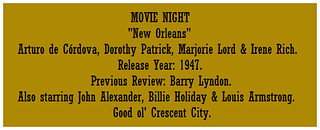
New Orleans.


Review #1047: New Orleans.

Cast: 
Arturo de Córdova (Nick Duquesne), Dorothy Patrick (Miralee Smith), Marjorie Lord (Grace Voiselle), Irene Rich (Mrs. Rutledge Smith), John Alexander (Col. McArdle), Billie Holiday (Endie), Louis Armstrong (Himself), Richard Hageman (Henry Ferber), Jack Lambert (Biff Lewis), Bert Conway (Tommy Lake), Joan Blair (Constance Vigil), with Woody Herman and His Orchestra, Zutty Singleton (Drums), Barney Bigard (Clarinet), Kid Ory (Trombone), Bud Scott (Guitar), Red Callender (Bass), Charlie Beal (Piano), Meade Lux Lewis (Piano), and Mutt Carey (Trumpet) Directed by Arthur Lubin.

Review: 
A film with Louis Armstrong and Billie Holliday? Admittedly, that is a pretty good way to attract interest in a film, particularly one that titles itself after the city that help create jazz. However, if you are looking for a good musical showcase, you may find yourself a bit disappointed. The film is a love story - between a high society girl and a casino owner, while being a fictionalized version of the rise of blues. The biggest problem with the movie is that it falls prey to relying on its conventional story parts more than its musical talents. It's not so much that the main two leads (de Cordova and Patrick) are awful or anything, it's just that they aren't particularly inspiring people for the energy that the movie looks like it should have. Holiday (in her only film role) and Armstrong (who had appeared in numerous films prior to this one) prove to be more entertaining than the duo in part because they aren't bound down to the plot-line so heavily.

I'm reminded of Stormy Weather (1943, #841), which also featured African American performers. In that film, the plot wasn't anything too particularly inspiring, but it also never managed to find itself in the way of showing the musical talents. One could also cite other musicals that featured numerous talents with plots that weren't as flimsy as what New Orleans does. It could've been a love letter to jazz, but it instead feels like a half-hearted note. For a film that is as mediocre as it gets, the musical parts with Armstrong and Holiday are top-notch, being quite beautiful and engaging. The film runs at 90 minutes, which isn't a bad length. Would I recommend it? I suppose that if one can recommend watching awful movies in order to see it to believe it, I guess that recommending this for its musical bits and not much else is okay. It won't garner a positive review, but it will merit a honorable mention at least.

Happy Mardi Gras folks.

Overall, I give it 6 out of 10 stars.