Showing posts with label Vince Barnett. Show all posts

October 20, 2025

The Corpse Vanishes.

Review #2447: The Corpse Vanishes.

Cast: 
Bela Lugosi (Dr. Lorenz), Luana Walters (Patricia Hunter), Tristram Coffin (Dr. Foster), Elizabeth Russell (Countess Lorenz), Minerva Urecal (Fagah), Angelo Rossitto (Toby), Frank Moran (Angel), Vince Barnett (Sandy), and Kenneth Harlan (Editor Keenan) Directed by Wallace Fox.

Review: 
Okay, sure, the 1940s had a few oddball movies that can be called "horror", at least the ones that aren't part of Universal (such as, in part, The Inner Sanctum Mysteries). But fret not, you have Monogram Pictures here to distribute a cheapie movie mystery horror, complete with finding the one actor they could corral for appearing when not busy with other things: Bela Lugosi. When Lugosi wasn't busy doing stuff like Frankenstein Meets the Wolf Man (1943), he did a handful of movies for Monogram with Sam Katzman as a producer. Lugosi wanted to do movies that weren't horror (ironically his popularity had received a boost in 1938 because one man did a double feature involving Lugosi's Dracula) and yet here he was, complete with doing opiates to treat his chronic sciatica and doing stage appearances. The film was written three-fold: the screenplay was done by Harvey Gates (a veteran writer who apparently wrote around 200 movies before he died in 1948), while the story was done by Sam Robins and Gerald Schnitzer. The movie was directed by Wallace Fox, who did over 50 movies that started at the tail-end of the silent era to 1951. 

Okay, let's just say the plot of the movie straight out: a mad doctor aims to target the gland fluid of virgins to help his vain wife from straight up dying of old age. But, well, what's the "corpse"? Uh, well, when the doctor gets his orchid to unwitting brides on their wedding day, the flower knocks the lady out in a way that makes people think they are dead and therefore make the body a sitting duck to finagle out to his totally normal lab. Naturally the one investigative force that moves the plot is a reporter that gets directed to an orchid expert: the doctor, who happens to have a few folks in his cellar in a crazy woman and two sons in a dwarf and a strong half-wit. Needless to say, the movie isn't exactly good, but if you did films such as The Death Kiss (1932) with Lugosi around, you might find something curious in its lurid ideas, mainly because it is just 64 minutes long. Lugosi lumbers around a bit with the usual routine that he does with basically being aloof in saying or leering whatever he has to do, most notably when he talks about finding a coffin more comfortable than a bed. Otherwise the movie is mostly by-the-book in monotone nature, as if just showing a dwarf, a lumbering brute and saying a few weird things is going to be enough. It is ridiculous (particularly the fact that it is an orchid of all things), but you are basically chuckling at the film rather than being all into it such as say, Plan 9. The body count isn't even that lurid, since the only people that are shown to get it are just some of the villains (it occurs to me I didn't bother to think about if the brides were okay). The fake-out for the climax is at least funny because even the villain thought it was a goofy idea to try and do a bride-trap (seriously they try to lure the villain with a "bride" but then it goes to a quick climax because the bad guy takes out the reverend). The movie is too silly to really do anything too morbid about old people wanting to stay young, but so it goes. As a whole, The Corpse Vanishes is nothing particularly special, but it may have a strange lurid taste for those who like the plumb the depths of old movies from the way way back that has a few odd little moments to go along with the general Lugosi performance that comes with movies like this. It's a creaky movie but you can't blame the movie for being what it is.

Overall, I give it 5 out of 10 stars.

July 14, 2023

The Killers (1946).

Review #2041: The Killers (1946).

Cast: 
Burt Lancaster (Pete Lund/Ole "Swede" Anderson), Ava Gardner (Kitty Collins), Edmond O'Brien (Jim Reardon), Albert Dekker ("Big Jim" Colfax), Sam Levene (Lt. Sam Lubinsky), Vince Barnett (Charleston), Virginia Christine (Lilly Harmon Lubinsky), Jack Lambert ("Dum-Dum" Clarke), Charles D. Brown (Packy Robinson), Donald MacBride (R.S. Kenyon), Charles McGraw (Al), William Conrad (Max), Phil Brown (Nick Adams), and Jeff Corey ("Blinky" Franklin) Directed by Robert Siodmak (#468 - Son of Dracula, #797 - People on Sunday, and #1826 - The Suspect)

Review: 
In 1927, Ernest Hemingway's short story "The Killers" was published in literary form. Set in his home state of Illinois, it details two hitmen entering a restaurant with an owner and a cook alongside a patron named Nick Adams, which Hemingway wrote from his own experiences. The two hitmen suddenly take Adams and the cook into the kitchen to tie them up while telling the owner that they were hired to kill a prizefighter expected to enter the place soon. Of course, when the guy doesn't show up, the hitmen leave while Nick is sent to a boarding house to warn the man about the job, but Nick is told to do nothing because it is futile for there to be attempts to save him from his fate. Hemingway later stated, "That story probably had more left out of it than anything I ever wrote. I left out all Chicago, which is hard to do in 2951 words." The entirety of that story is told in the first twenty minutes of the 1946 film adaptation (the killing depicted isn't in the actual story, of course). This was the fourth adaptation of a Hemingway story, following in the wake of A Farewell to Arms (1932), For Whom the Bell Tolls (1943), and To Have and Have Not (1944). The screenplay is credited to Anthony Veiller, although it was said in later years that Richard Brooks and John Huston contributed to the script in uncredited form. At the helm as director was Robert Siodmak, who had directed films in his native Germany and France before being driven to America by the rise of Nazism each time. He had done his fair share of genres, although most know his film noirs or B-movies that made him a "actor's director". This would work wonders for Burt Lancaster, who was making his film debut. He actually had an early interest in theatre productions and the circus from a young age, but injuries had him give up the circus. After serving in the U.S. Army in World War II, he took up acting and made an impression on Broadway in a flash. Mark Hellinger, who produced The Killers, happened to need another unknown to make up the cast after getting Ava Gardner from doing pretty much nothing at MGM (Wayne Morris and Sonny Tufts were the initial choices in mind for the role played by Lancaster). He got a tip about Lancaster (near the age of 33 when this film was released), who had signed a contract with Hal Wallis but hadn't made anything for release until Hellinger tested him and decided to sign him on. The film was an audience hit and received four Academy Award nominations that year (directing, editing, score, and screenplay), for which it received none. In 1964, a second adaptation of the story was done in film (after being thought of as too much for television) with Don Siegel as director that had Lee Marvin, Ronald Reagan, and Angie Dickinson as stars.

The premise sure is an interesting one to setup a noir, particularly one built for 103 minutes where one of the key characters is dead right then and there. But it is the journey in the way that things are shot or lit that matters when the scenarios matter most with femme fatales, double crosses, and the good ol' setup for a bag of dough. It isn't often you get a cast filled with so many dependable actors (future or at the moment), whether as stars or not. O'Brien is the one observing all of the pieces moving across the board that has the air of inevitability that he does well with, maneuvering through the tension with good timing. Lancaster is a lean block of excellence, one who generates screen presence in a near instant that delivers well among the flashback sequences told (aside from the one of his death, which he handles pretty well to begin with) in a malleable force of nature. He will only end up in one path, but it is the choices that are made there that make it interesting to see the level of challenge it takes for anyone to try and escape their big desire. It's clear to see how his face became one to reckon such desires in further films. Gardner makes a solid femme fatale, one who has the allure required to drive tension into the heart of anyone, a devastating display of dashing duplicity. The rest of the cast follow along in worthy interest for the subject at hand, whether that involves the heavy or the key part of the crisscross of who is fixing who. The robbery sequence itself is executed quite skillfully, done with resounding timing without wasting a moment. By the time the film has maneuvered its way through all of the twists and turns that come with "the best laid plans of mice and men often go awry”, the final result is a lean and mean noir that shows the potential of its stars in a solid effort from Siodmak and company. The fatalistic nature of the whole affair makes for a solid entertaining ride that merited the highest praise from Hemingway, who once called it "the only good picture ever made of a story of mine." That pretty much says it all right then and there.

Overall, I give it 8 out of 10 stars.

January 27, 2014

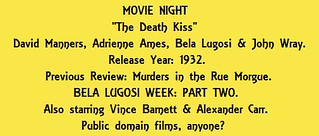
Movie Night: The Death Kiss.


Review #532: The Death Kiss.

Cast
David Manners (Franklyn Drew), Adrienne Ames (Marcia Lane), Bela Lugosi (Joseph Steiner), John Wray (Detective Lieutenant Sheehan), Vince Barnett (Officer Gulliver), Alexander Carr (Leon A. Grossmith), Edward Van Sloan (Tom Avery), Harold Minjir (Howell), and Barbara Bedford (Script Girl) Directed by Edwin L. Marin (#503 - A Christmas Carol (1938))

Review
The point of this week is not just to review Lugosi, but also to give some of his films a bit more recognition, such as this public domain film from 1932. The movie starts out okay, not too shabby. It quickly sets the plot up, essentially a murder mystery, with an interesting tile sequence hat may be the best scene in a short movie. Lugosi doesn't really have much screen time, more of a supporting role that lets Manners take over, which is sort of disappointing, because Lugosi was a distinct actor even when he didn't speak. Bela Lugosi, David Manners (John Harker) and Edward Van Sloan (Van Helsing) are reunited, one year after all three were in Dracula (#071), and while they may not have much interaction, it is  at least interesting enough to be a fun fact to note. And if you're wondering, no the movie is not a horror film. As much as the title sounds like one, it's really just the title of the film within the film in which the murder happens. The movie itself flows okay, it veers between mystery thriller and comedic idiocy. It just feels standardized and not exactly exciting. It does have some moments of brilliancy, such as the idea of having the film revolve around a studio and the film projector being mysteriously filled with acid just as the murderer is about to be revealed but it doesn't save the movie. The film isn't awful, it's just not that good, and if you came for Lugosi, you will be disappointed. Next time, I will be delving into the 1940s for Part Three of Bela Lugosi Week.

Overall, I give it 5 out of 10 stars.