Showing posts with label David Oyelowo. Show all posts

November 27, 2025

A Sound of Thunder.

Review #2477: A Sound of Thunder.

Cast: 
Edward Burns (Travis Ryer), Catherine McCormack (Sonia Rand), David Oyelowo (Marcus Payne), Ben Kingsley (Charles Hatton), Jemima Rooper (Jenny Krase), Wilfried Hochholdinger (Dr. Lucas), August Zirner (Clay Derris), Corey Johnson (Christian Middleton), Heike Makatsch (Alicia Wallenbeck), Armin Rohde (John Wallenbeck), and William Armstrong (Ted Eckels) Directed by Peter Hyams (#233 - 2010: The Year We Make Contact, #326 - Timecop)

Review: 
Hey, ever read A Sound of Thunder? Well, there were rumblings of making a film adaptation of Ray Bradbury's short story of the same name (as originally published in 1952) since at least 2000, when Renny Harlin and Pierce Brosnan were tapped to work on it for Franchise Pictures, with Thomas Dean Donnelly and Joshua Oppenheimer tapped to write the script (Gregory Poirier later worked on the screenplay to get credit with the duo, known for co-adapting Sahara). They wanted to fast-track production before a possible actor strike, but the following year saw Harlin taken out for Peter Hyams and eventually Edward Burns was cast over Brosnan, who wanted re-writes. Franchise Pictures went down under during post-production, which got in the way of a movie that was meant to be $55 million. In 2004, Franchise filed for Chapter 11 bankruptcy. The movie was being filmed in Prague when an actual flood hit the area that saw re-scheduling and a post-production that went on for nearly two years. Previsualized software (and sub-contracted work) was used to basically save time what became a nightmare. This was the 18th feature film for Peter Hyams, who had previously started the 2000s off with The Musketeer (2001), which didn't exactly rock the world. After this, he made two more movies: Beyond a Reasonable Doubt (2009), a movie that may actually have even less of a reputation than this movie, and Enemies Closer (2013), a film that had a limited US release; the then-66 year old also shot for Universal Soldier: Regeneration (2009), as directed by his son.

In the future of 2055...people spend money to go back in time to wait for a guy to tell them when they can shoot a dinosaur dead. Sure. It almost seems too easy to say this movie is really, really bad. There's something to be said about a movie that talks about "time waves" and "Heisenberg Uncertainty Principle" with the confidence that audiences would just accept the malarkey that comes across for a mess in both visuals and as a time travel movie. What you get here is a bland movie, one that has a handful of bad green screen effects and dopey-looking creature effects that would've seemed ripe for an Irwin Allen movie. But even if the effects were magical or invoked some sort of interest, it was not going to override the lack of an interesting story that can't really evoke the Bradbury story. The original story wasn't really much besides saying "careful about stepping on something, otherwise everything goes to hell because, that insect was important millions of years ago" (the name of the story came from the firing of a rifle), but here you get a movie where for whatever reason the changes to the timeline happen from wave to wave that makes plants and stuff grow weirdly. All from a mess-up where trying to shoot up a dinosaur that was planned to die (notice how shooting the gun doesn't have an effect on the stuff around the dinosaur). With how the characters have to go on a trip to see who messed up with the stepped-on thing, I wonder if someone watched The Warriors a bit too much. It also lacks an interesting hero or villain to really latch on to, and that's even with the presence of a white-haired Kingsley. Burns might as well be transparent with how he brings nothing to the table as the lead focus: there isn't a sense of guilt or adventure to anything he goes through, and McCormack can't actually make the consequences of time travel seem compelling either. You would think Kingsley would know better than to do stuff like this, but between him trying to be "funny" here and a "villain" in BloodRayne (2005), I suppose money does win out. The others don't end up any better, mostly being used to basically serve as fodder (given that the ending never seems in doubt, obviously the dead-count is back to zero). There just isn't anything to laugh with in terms of humor or anything to really gawk at for interest, and the climax is all about...using a few seconds to say the right thing and save the insect. As a whole, even when knowing that the film took years and years to actually realize its vision, there is no slice of hope to be found here with how bland and uninvolving it all is.

Overall, I give it 2 out of 10 stars.
Next up: Twisted Pair.

February 26, 2021

Selma.

Review #1646: Selma.

Cast: 
David Oyelowo (Martin Luther King, Jr), Tom Wilkinson (Lyndon B. Johnson), Carmen Ejogo (Coretta Scott King), André Holland (Andrew Young), Tessa Thompson (Diane Nash), Giovanni Ribisi (Lee C. White), Lorraine Toussaint (Amelia Boynton Robinson), Stephan James (John Lewis), Wendell Pierce (Hosea Williams), Common (James Bevel), Alessandro Nivola (John Doar), Lakeith Stanfield (Jimmie Lee Jackson), Cuba Gooding Jr. (Fred Gray), Dylan Baker (J. Edgar Hoover), Tim Roth (George Wallace), Oprah Winfrey (Annie Lee Cooper), Ruben Santiago-Hudson (Bayard Rustin), Niecy Nash (Richie Jean Jackson), Colman Domingo (Ralph Abernathy), Omar Dorsey (James Orange), Ledisi Young (Mahalia Jackson), and Trai Byers (James Forman) Directed by Ava DuVernay.

Review: 
"You know, the thing that I was really interested in doing with the film is making King more than a catch phrase, more than a holiday, more than a street name in a black neighborhood, more than a stamp, more than one speech. I mean, I wanted him to be a man, a living, breathing man."

It's interesting to find a new voice for film, particularly when it comes to ones that took their time to march forward with their own stories to tell. Ava DuVernay grew up in California, but during her summer vacations, she would travel down to her father's childhood home in Alabama, near the city of Selma. The experiences spent with her father, who had seen the marches from Selma to Montgomery in 1965, would prove a lasting influence. She studied at the University of California, Los Angeles in English literature and African-American studies, but her first career interest was in journalism. It was not long before she shifted into public relations, for which she would work in for a few years. She made her first venture into film with a 2005 short (Saturday Night Life) before making her first documentary with This Is the Life (2008) and her first theatrical effort with I Will Follow (2010). The film was written originally by Paul Webb, although DuVernay would do uncredited re-writes during production. The original director in mind was Lee Daniels, with Oyelowo (who starred in DuVernay's second film, Middle of Nowhere) having to lobby for years to be considered as star, with intentions of casting Liam Neeson and Robert De Niro as Johnson and Wallace before DuVernay came in.

At any rate, what we have here is a fairly stirring film. It runs on the energy to stir emotion about a story it wants to tell involving a march for freedom that came not from one man but from many that came from various backgrounds with their own parts to play. It is pressure that matters most here, one that shows the drive for the vote as a collective. It is the fury of being counted after years of being stepped on that viewers will likely see through the lens of the present alongside the past, where literacy tests fading away don't mean an easy aftermath. If the accuracy is to be debated, at least one can't say the film doesn't have the vision to look like a crisp period piece, right down to shooting on the Edmund Pettus Bridge. Oyelowo manages to step forward and does well with strength for a tough task at hand with making King out to be more than just an icon heard on old tapes. He carries the film along with calm measured patience, one who we can see as the main face of a movement with no long doubt or thinking of him as just the entire landscape. In other words, what we have is someone with aspirations to go with flaws just like someone you would know without being relegated to biopic sticking points. Wilkinson does just as well on the other side of the film's line of focus, having his own presence of immeasurability, one that mixes with Oyelowo in the struggle for the right to have others be heard going through the game of policy. Ejogo goes well for her part in soothing measurability in time usually spent paired with Oyelowo, a pillar of strength in her own ways that fits well for the first portrayal of C. King on film (Ejogo had played the role 13 years prior in a production for HBO in Boycott, which dealt with the Montgomery bus boycott). Others stick out in their own ways, such as a persevering Holland or with James. Appearances by Stanfield and Roth stay with the viewer after they leave the screen, for varying reasons.

The strange thing that arises from the dialogue might be the fact that I did not realize that King's speeches were actually under copyright, for which that meant the script had to dance around that with re-spinning of dialogue (Dreamworks and Warner Bros at the time had been given a license for those speeches for a biopic...in 2009, and a decade has passed with no biopic). As one might expect from a historical film, there was a bit of wringing with some of its aspects in depicting certain moments, with the debate being discussed probably just as much as the lack of award nominations for the film as a whole. With a moment like Selma that still had some of the players (both in the march and less connected) still alive, this is particularly interesting, such as the statement from Andrew Young, who stated that most of the film was true while having quibbles with the portrayal of the relationship between Johnson and King. Consider the statement made by DuVernay, who felt that she is a storyteller, not a historian when it comes to a film that isn't a documentary. Honestly, sometimes a film can still be great even if it isn't 100% to the point, such as the case with Malcolm X (1992), which had its own omissions and composites within artistic license (Lee's vision of Malcolm X might as well correspond to a statement DuVernay made involving history being interpreted though the lens of one who reads or experiences it). Quibbles over the portrayal of civil rights moments is nothing new, as noted with films such as Mississippi Burning (1988), for example. But hey, does it count for the film if it speaks to things about King's life that I didn't know beforehand (such as Mahalia Jackson being called by him to sing to him)? Maybe it is an indictment of what we know and don't know from studies in school when it comes to folks like James Reeb or with Jimmie Lee Jackson. There may be many Bloody Sundays, but that doesn't mean it is easily forgotten, particularly when it is one that can be seen on your screen with your own eyes. In that sense, the film does fairly well for itself in generating tension and deep curiosity for the events of 1965 in what happened then and what has happened since then, one that organizes itself with flourish in 128 minutes of events and pace that mostly hits the mark. It isn't a perfect film, but it still manages to do well enough for itself in gripping entertainment to pull a punch where it is still needed now.

Next Time: Closing time comes for Black History Month on the movie side, for which we end with Fences.

Overall, I give it 9 out of 10 stars.

July 12, 2014

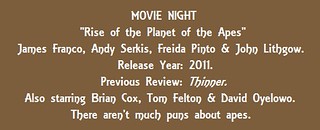
Movie Night: Rise of the Planet of the Apes.


Review #615: Rise of the Planet of the Apes.

Cast
James Franco (Will Rodman), Freida Pinto (Caroline Aranha), Andy Serkis (Caesar), John Lithgow (Charles Rodma), Brian Cox (John Landon), Tom Felton (Dodge Landon), David Oyelowo (Steven Jacobs), Tyler Labine (Robert Franklin), and Karin Konoval (Maurice) Directed by Rupert Wyatt.

Review
I admit, maybe I should've watched and reviewed this movie earlier in the year, or even earlier, but mistakes happen, so here's my chance to rectify that. So how's the movie? You know who makes the movie better than just good? Andy Serkis as Caesar. It is just more than performance capture, it's watching Serkis just disappear into the role, you forget about the fact that it's a person's movements being captured and later being turned into looking like an ape. It's fun to watch Serkis act in a sense without speaking, though he does have lines near the end, which genuinely surprised me, especially his last three: "Caesar is home", which is really touching to me for some reason. Maybe it's because his plot line closes smoothly, and the movie works best when focused on the apes. That's not to say the human cast is bad, but Serkis steals the show. Franco does fine admittedly, and his scenes with Serkis work well. Pinto is okay, but she doesn't really get much screen time to do anything, even Lithgow has stuff to do (though my praise of Lithgow is 90% due to his performance and 10% because you don't see Lithgow much anymore, unless you capture a Third Rock from the Sun rerun or watch Shrek), but at least the cast is enjoyable at times. The effects are good, it's fun to watch the apes when they march on the Golden Gate Bridge. The story is alright, I suppose, the movie is entertaining enough, and the end scene is brilliant and just makes you want more, like a sequel, which came out yesterday. This is a movie that while not as good as the original Planet of the Apes, is at least a good origin story.

Overall, I give it 8 out of 10 stars.