Showing posts with label Melvyn Douglas. Show all posts

May 11, 2023

Angel (1937).

Review #2008: Angel.

Cast: 
Marlene Dietrich (Maria, Lady Barker / "Angel"), Herbert Marshall (Sir Frederick Barker), Melvyn Douglas (Anthony 'Tony' Halton), Edward Everett Horton (Graham), Ernest Cossart (Chris Wilton), Laura Hope Crews (the Grand Duchess Anna Dmitrievna), Herbert Mundin (Mr. Greenwood), and Dennie Moore (Emma MacGillicuddy Wilton) Produced and Directed by Ernst Lubitsch (#1026 - The Shop Around the Corner#1358 - To Be or Not to Be, #1881 - The Love Parade)

Review: 
Ernst Lubitsch actually once was a production manager for Paramount Pictures, you know. Yes, when it comes to mainstream prominent names of directors running a studio, there really is just one name to consider, and Lubitsch didn't even last that long in the position. In fact, he did not last long after at Paramount after 1936, with this being his penultimate film there. Since 1928, he had made most (not all) of his features there, which went from The Patriot to Bluebeard's Eighth Wife. But not all directors can stay in one place, even if they do provide a touch of interest. Angel is also important in the discussion of Dietrich, because it was her last film with Paramount under contract, with her next feature not being until Destry Rides Again in 1939. The film was based on a play called Angyal by Melchoir Lengyel. Guy Bolton and Russell Medcraft wrote the film while Samson Raphaelson and Frederick Lonsdale wrote the screenplay. It was the only time she starred in a Lubitsch film, and she was paired with Marshall, who had starred in Lubitsch's Trouble in Paradise (1932), one of a handful of films he would do as a leading man (which included a good deal of romances). 

The touch that Lubitsch provides to making a quality light drama is to keep one's interest firmly upon these sophisticated people and the mishaps that makes romance one to amuse with rather than be afraid of it. It runs at a careful pace of 91 minutes that shows the dynamic that comes together in a love triangle that is seemingly more than two people and one's workload. It is the movie that shows just how much sense one is not going to make when it comes to the nature of men and women, with the latter being particularly apparent. Dietrich plays things with the solemn dignity required in a role that has her cherished in different ways when paired with Marshall or Douglas, which makes sense when you see the dynamics of marriage being contrasted with a night of odd adventure. She is vulnerable even in her grace that seems different her time spent with Josef von Sternberg when it comes to cherishment. Marshall (who appears last among the triangle, intentionally presented as such when it comes to a man presented as a "League of Nations" man) does pretty well as the middleman of romance, a gentleman that clearly has affection for his wife, but it is evident to see how much of his affection for his wife runs in tandem with his affection of his work, which works to the levels needed when it comes to the inevitable climax. Douglas fills the key piece of the triangle as the obsessive man struck between his connection with an old friend and the connection that he believes he has with someone that seems apt to be called "Angel". Simply put, it is charming to see one have a helpless obsession when it comes to what we know is coming with the inevitable confrontation over just what is going to happen with the choice of a woman. There is some comic relief when it comes to Horton and Crews, since one cannot have romance without onlookers present to see from afar that are just living in their element, which is probably best stated in a scene where a few butlers are taking back plates of food meant to be ate for a meal between the love triangle only to find that two of them did not eat a bite. By the time one has gotten to the end of the film in its lovely presentation of the inevitable of irrational decisions made in the name of passions, you have found that your time has been spent quite well, one where the director and the cast are working hand-in-hand in making sophisticated entertainment. It should make a good time for those who are interested in Lubitsch or Dietrich, that much is clear.

Overall, I give it 8 out of 10 stars.

May 11, 2020

Hud (1963).


Review #1411: Hud.

Cast: 
Paul Newman (Hud Bannon), Melvyn Douglas (Homer Bannon), Brandon deWilde (Lonnie Bannon), Patricia Neal (Alma Brown), Whit Bissell (Mr. Burris), Crahan Denton (Jesse), John Ashley (Hermy), Val Avery (Jose), George Petrie (Joe Scanlon), and Curt Conway (Truman Peters) Directed by Martin Ritt.

Review: 
"I make the kind of films that not too many people get to make in this town, though sometimes I've had to take the risk myself"

One cannot simply make a good film without some sort of sensitivity and knowledge of how to maintain a production and the aspects that go with it from cast to tone. Martin Ritt was a director known for his socially conscious films, concerned with the human condition while making sure to film with a careful hand and careful approach to his stars, which served him well over the years. Born in 1914, he grew up in New York City but attended college in North Carolina, with the latter experience shaping his vision in wanting to show the struggle of inequality. He moved to the theater not long after graduation, shifting from theatre groups (as actor and director at times) to the Federal Theater Project to the Group Theatre where he met Elia Kazan (in later years Ritt would do work at the Actors Studio when Kazan could not make a class). After serving in World War II under the US Army Air Forces, he had shifted some of his focus to television, but the prevailing fear over red influence into entertainment trapped him on the blacklist for a few years. A few years later, he directed his first feature film with Edge of the City (1957), which depicted a interracial friendship. In the course of over three decades, he would make several notable films, such as The Long, Hot Summer (1958, which also starred Newman), Sounder (1972), and Norma Rae (1979).

The film was adapted by Harriet Frank Jr and Irving Ravetch (who co-produced the film with Ritt) from the 1961 novel Horseman, Pass By from Larry McMurtry, the first of six of his works to have been adapted into film (with others being notable films like The Last Picture Show and Terms of Endearment). The key change made in adapting the novel was in expanding the character of Hud to be the main focus, as opposed to Lonnie. The film was shot over the course of four weeks, with most of it being done in the Texas Panhandle, with some time being spent beforehand to rehearse with the cast to have them delve into their roles before shooting. This is a feature with a tremendously well-rounded quartet (with Douglas and Neal winning Academy Awards for their performances), headlined by Newman. The method actor had risen from theatre work to feature film roles in the 1950s, and he had spent a couple of days in a Texas ranch working and sleeping in a bunkhouse to prepare for the role. He pulls off a magnificent performance here, a charming monster who lives for himself and the tastes that go with said figure that swaggers over the conventional lead focus for the time, sinking with ease into such a rough role. To the surprise of Newman and Ritt, audiences found a liking to this amoral character, who they thought would not be accepted as a heroic character, with Ritt believing it being a reflection of the counterculture that would engulf the latter part of the decade. Perhaps it is evident in a quote from the film that talks about how a country changes its look by who we admire, and one must make up their mind over what is right and wrong. In that sense, theatre-turned-film star Douglas matches up with principles and a weary but unbroken spirit that reflects his ranch with measured composure. When it comes to deWilde, he holds his own as a yearning youth at a crossroads that all growing youth find themselves, and he does it with plenty of conviction. Neal, a member of the Actors Studio that appears for just twenty minutes, makes the best of her time with a relentlessly compelling performance, filled with worn-out cynicism and wit. The other key highlight is James Wong Howe (a pioneer of cinematography for six decades) and his stark cinematography, which captures the depth of such a landscape like the Panhandle with tremendous contrast and shadows that make for a devastating effect for a reasonably paced 112 minutes. This is a film that sets its own trail of where one can go in their life without needing to draw it out for the audience, with four capable performances and direction to drive a film that drives hard to questions that aren't easy to get to but prove fairly worth it in the long run. It reaches most of the marks it wants to make while serving as its own kind of Western melodrama worthy of a watch for its vision of the countryside.

Overall, I give it 9 out of 10 stars.

July 1, 2015

The Changeling.

Review #722: The Changeling.

Cast
George C. Scott (John Russell), Melvyn Douglas (Sen. Joseph Carmichael), Trish Van Devere (Claire Norman), Eric Christmas (Albert Harmon), John Colicos (De Witt), Jean Marsh (Joanna Russell), and Roberta Maxwell (Eva Lingstrom) Directed by Peter Medak.

Review
As Canada Day slowly ended today, I decided to celebrate Canada once again with this film mainly because it sounded too interesting not to. While the movie is set in Seattle, it was mostly filmed in Canada, more specifically Vancouver, incorporating shots of some Seattle landmarks and Vancouver landscape. In fact, the house featured in the movie was actually a modern house with a Victorian facade added on. As for the movie itself, it's pretty good. The atmosphere of the movie is well-maintained and helps contribute to an interesting movie that is both engaging and chilling. Scott has a commanding presence that keeps the movie on track, and he has a good rapport with Van Devere and Douglas. It's a movie that develops itself surely and steadily, making for good mystery while also having good thrills as well, especially at the end. I like the set they used for the house, and I also like the shots of both Vancouver and Seattle, which look nice. It's a good movie that has some scares while also being engaging. The movie runs well and never seems to drag on while also managing to keep a consistent tone and never waver. Ultimately, it's a good gem of horror. I hoped you enjoyed your Canada Day, and if you're not Canadian (like me), at least listen to O Canada once.

Overall, I give it 8 out of 10 stars.

edit-2026: revised image

June 7, 2015

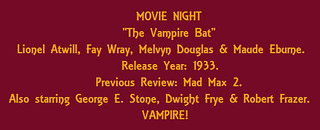
The Vampire Bat.


Review #708: The Vampire Bat.

Cast
Lionel Atwill (Dr. Otto von Niemann), Fay Wray (Ruth Bertin), Melvyn Douglas (Karl Breettschneider), Maude Eburne (Gussie Schnappmann), George E. Stone (Kringen), Dwight Frye (Herman Gleib), Robert Frazer (Emil Borst), and Rita Carlisle (Martha Mueller) Directed by Frank R. Strayer.

Review
Well, it's certainly a quick movie. At 63 minutes, this is a movie that was released just a month before another Atwill-Wray movie would be released (Mystery of the Wax Museum), but this one was released by Majestic Pictures, a studio known for cheap flicks made quickly. And since this is in public domain, you can find this movie anywhere on the Internet. But the question is would you want to? That depends. The sets look nice and scenic, fitting well with what the movie is trying to do so quickly. The characters are fine, save for Eburne's comic relief character, an anxious panicky character who almost ruins the balance that Wray and Douglas have with each other. Atwill is a good lead character (who pops up in numerous 1930's films). The ending is at least something different from most vampire films, though your reaction may vary on your level of disbelief. Extra points for having Dwight Frye as a supporting character, which is always welcome. If you're up for some quick cheap horror thrills, I'd say this movie is for you. Is it an old flick? As the old saying goes, 82 is the new 40. Or 30.

Overall, I give it 7 out of 10 stars.

September 3, 2014

Movie Night: Being There.


Review #636: Being There.

Cast
Peter Sellers (Chance the Gardener/Chauncey Gardiner), Shirley MacLaine (Eve Rand), Melvyn Douglas (Ben Rand), Jack Warden (The President), Richard Dysart (Dr. Robert Allenby), Richard Basehart (US Soviet Ambassador), David Clennon (Thomas Franklin), Fran Brill (Sally Hayes), and Ruth Attaway (Louise) Directed by Hal Ashby.

Review
What we have here is a movie based around a simple man who may have secrets that even he probably doesn't know about. The best quote to describe this movie is also the quote used to end the movie: "Life is a state of mind." My thought on this is that life is merely our mood at the time, if we feel a certain emotion, then that is how life is to us at that point. It varies, like our moods. But Chance is a different case. He's a man who spent years gardening and watching television. That's all he had done, until he was kicked out. His life evolves purely out of accidents out of his control, the movie's implications are still hilarious though. This was Peter Sellers' last movie released when he was alive, and he makes the most of it with a perfect performance for a character as strange as him. His walking, his face and most of all his delivery make for a really interesting performance. The rest of the cast is also good, MacLaine works best with Sellers, and Douglas nearly steals the show from Sellers, the main three cast members all manage to be intriguing characters, yet they also manage to feel so real. The movie has its moments of drama, though it also manages to be a very good comedy. It has its subtle moments, such as the music that plays when Chance leaves the house and cross the street for the first time. The end scene is yours to interpret, much like how it's your decision to interpret exactly who Chance is. This is a movie with a great deal of quirks, the biggest one being its biggest strength, and that just happens to be Peter Sellers.

Overall, I give it 10 out of 10 stars.

October 13, 2013

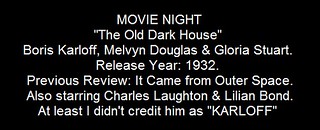
Movie Night: The Old Dark House.


Review #465: The Old Dark House.

Cast
Boris Karloff (Morgan), Melvyn Douglas (Roger Penderel), Gloria Stuart (Margaret Waverton), Charles Laughton (William Porterhouse), Lilian Bond (Gladys Perkins), Ernest Thesiger (Horace Femm), Raymond Massey (Philip Waverton), Eva Moore (Rebecca Femm), Elspeth Dudgeon (Roderick Femm), and Brember Wills (Saul Femm) Directed by James Whale (#069 - The Invisible Man, #071 - Frankenstein and #394 - Bride of Frankenstein)

Review
Naturally, this was based off a novel, Benighted by J. B. Priestly, this film being made just after Whale's success with Frankenstein, with Karloff also in this film, as a mute butler, and while this isn't his strongest performance, it is an effective one. The film sets itself quickly, probably due to the short length, or to not delay the inevitable, and while most of the visitors of the house aren't really memorable by any means, save for Charles Laughton, who seems to try and liven the film up. The film has its scares and excellent lighting, which all boils down to the climax involving Douglas and Wills, with Karloff joining in briefly. Elspeth Dudgeon, despite her short screen time, helps contribute to the film and the suspense. The film is tense and while it struggles to overcome its feeble minded characters, it certainly is a breeze to get through and Whale does a fine job, house and all.

Overall, I give it 7 out of 10 stars.