Showing posts with label Norman Z. McLeod. Show all posts

July 7, 2022

It's a Gift.

Review #1858: It's a Gift.

Cast: 
W.C. Fields (Harold Bissonette), Kathleen Howard (Amelia Bissonette), Jean Rouverol (Mildred Bissonette), Julian Madison (John Durston), Tommy Bupp (Norman Bissonette), Tammany Young (Everett Ricks), Baby LeRoy (Baby Elwood Dunk), Morgan Wallace (Jasper Fitchmueller), Charles Sellon (Mr. Muckle), Josephine Whittell (Mrs. Dunk), Diana Lewis (Betty Dunk), and Dell Henderson (Charles Abernathy) Directed by Norman Z. McLeod (#688 - Horse Feathers, #1346 - Topper, and #1829 - Topper Takes a Trip)

Review: 
There are quite a handful of movies one could watch that feature W. C. Fields (silent or sound), whether it features him playing a hard-drinking misanthrope or an everyman. Generally, the characters he played in those movies (starring roles at least) were in the former category, but this is one of his roles in the latter. Jack Cunningham is the credited writer for the movie, although it is the adaptation material that matters most. J.P. McEvoy was the original author of the musical revue that became The Comic Supplement, a 1925 production that had W.C. Fields write his own scenes (incidentally, when he did film scripts, he liked to go under false names like Otis Criblecoblis); you may remember that Fields had done many years of vaudeville and Broadway before he did movies. Fields was a vaudeville star. Fields cribbed routines from the 1910s and 1920s with this film, most notably with the sketch involving a back porch that he had done in It's the Old Army Game (1926). Fields was quite busy in 1934, with this being the sixth feature he appeared in that year, with a sudden decline in health eventually leading him to less roles over the next couple of years.

Fields obviously knows what is best when it comes to light fare that feature select wisecracks for 68 minutes that has the bare minimum in plot for a decent experience. He handles the routines presented here with careful timing and preparation that stages things exactly the way one hopes for, whether that involves a scene where he tries to go to sleep amid a series of inconveniences. Being the hen-pecked man in the middle works out for the most part when paired with Howard in razor-sharp edge more so than the child presences in Rouverol and Bupp that are more in the background with occasional bits to pop in (such as a picnic or a winding sequence with a mirror). This is the third and final feature to feature Baby LeRoy in a Fields movie (he and Fields also made cameo appearances separately with Alice in Wonderland (1933), also directed by McLeod), with the first two being Tillie and Gus (1933) and The Old Fashioned Way (1934). Yes, there was a time when babies were billed like this; Ronald Le Roy Overacker was featured in ten movies from 1933 to 1935. McLeod stated that Fields had a phobia of the baby (and infants in general) to the point where he swore at the baby in front of the camera. Honestly, there isn't much to really say about him, since it's just one scene of a baby doing things that are meant to be wacky like touching a molasses spigot or whatever. Young, Wallace, and Sellon are all featured in one scene with the grocery store: one plays a blind man that Fields tries to make him not suffer mishaps, one who really wants kumquats, and a bumbling fool. This works out for a couple of chuckles in a vignette Fields handles with worthy consistency to the foils presented to him in arrangement. In total, a steady amount of sequences that run for a few minutes at a time make for a decent experience, one that goes pretty much the way you think a movie ostensibly about a man trying to buy an orange grove. The fun is seeing what gets accomplished in generating humor with its key man freewheeling his way through for leisure and laughs that make for a decent experience to breeze through for those with an hour to spare or for those who want to see a Fields movie in his era of effectiveness.

Overall, I give it 7 out of 10 stars.

April 16, 2022

Topper Takes a Trip.

Review #1829: Topper Takes a Trip.

Cast: 
Constance Bennett (Marion Kerby), Roland Young (Cosmo Topper), Billie Burke (Clara Topper), Alan Mowbray (Wilkins, Topper's butler), Verree Teasdale (Mrs. Nancy Parkhurst), Franklin Pangborn (Louis), Alexander D'Arcy (Baron de Rossi), Spencer Charters (Judge), Irving Pichel (Prosecutor), and Asta the dog (Mr. Atlus) Directed by Norman Z. McLeod. (#688 - Horse Feathers and #1346 - Topper)

Review: 
You remember the 1937 movie Topper, do you? Well, maybe not, but I'm sure a little refresher would not hurt. The original film featured Cary Grant, Constance Bennett, Roland Young, Billie Burke, and Alan Mowbray in an adaptation of the 1926 novel of the same name by Thorne Smith. The movie was about newly-dead folks who come back as ghosts and decide to do a good deed in order to be stuck in limbo, which involves helping their stuffy and tired friend - wacky hijinks ensue, at least what you would call hijinks from the 1930s. McLeod, a director of comedies such as Monkey Business (1931), returns as director and all except Grant in the main cast return for this film, while Jack Jevne and Eddie Moran return to write the sequel, with Corey Ford joining as screenwriter. Perhaps not surprisingly, the film features footage taken from the 1937 film as a recap, complete with a thanks given to Grant for allowing the footage to be used. A sequel followed in 1941 called Topper Returns, which retained Young and Burke. 

Instead of a husband learning to loosen up (alongside his social climbing wife), now we have a story about a ghost trying to bring them back together as opposed to divorce - perish the thought of him trying to explain that the only friend he is seeing is a friendly ghost, who now is accompanied by a ghost dog. Oh, and there is a trip to Paris that sees all of them together and I think you know how it ends. Honestly, the only thing that might be a highlight is the effects by Roy Seawright, who received the only Academy Award nomination for the film for Best Special Effects. Bennett and Young are fine actors, but man I was not really that invested in this film. It exemplifies all the average qualities of an average movie that is just not quite my thing, since it is barely funny and barely that compelling, mostly because I see a movie that is going through the motions with ghost hijinks that aren't really that clever to see actually play out. 80 minutes go by with creaky maneuvering that never really incites a big guffaw or even a big groan, not even for the dog (of The Thin Man notice). Young is staid as ever, but it felt more interesting the first time around with him as a foil. Bennett may be playful, but the movie is sorely lacking her having Grant to play on as a proper freewheeling duo with charm for the proper bubbly flavor. Instead, it comes off as milk that seems spoiled in the wrong light. Burke seems there for the ride more than anything, not really making it any funnier or less enjoyable, which basically means a neutral result (Mowbray is hardly noticeable). It's hard to even come up with many highlights or odd scenes to really spot besides just saying "oh, that's a thing". There are basically two roads of thought when it comes to films from the 1930s: good ones you can recommend without too much trouble, and ones that are harder to watch or recommend. So, with the sequel to Topper, it's all up to you.

Overall, I give it 6 out of 10 stars.

As boring as this review might seem, at least one interesting thing happened this week: 

THE RIO GRANDE VALLEY VIPERS WON THE NBA G-LEAGUE CHAMPIONSHIP! Imagine seeing your region winning a championship for the fourth time in twelve years. What a feeling.

February 25, 2020

Topper.

Review #1346: Topper.

Cast: 
Constance Bennett (Marion Kerby), Cary Grant (George Kerby), Roland Young (Cosmo Topper), Billie Burke (Mrs. Clara Topper), Alan Mowbray (Wilkins), Eugene Pallette (Casey), Arthur Lake (Elevator boy / Bell boy), Hedda Hopper (Mrs. Grace Stuyvesant), Virginia Sale (Miss Johnson), and Elaine Shepard (Secretary) Directed by Norman Z. McLeod (#688 - Horse Feathers)

Review: 
One needs a gimmick sometimes to make a comedy click with interest. One involving fun-loving ghosts haunting their stuffy friend sounds like a good one to go with. The main trio of actors involved with this film each have their own versatile qualities to help make this a quite enjoyable experience. Bennett was known for her work in melodramas alongside comedies that made her a prime star of the 1930s (having also made the shift from silent to sound films), while Grant was slowly gaining recognition for his suave charm (having moved from vaudeville to film in 1932), and Young was known his diverse work in comedies, mysteries, and dramas. Of course a film needs a good director to lead the actors together, with Norman Z. McLeod being a worthy one to help with comedy. The WWI fighter pilot-turned film-man started his career as an animator with comedy shorts, and it was his skills as a gagman that would serve him well for his eventual directing career. His big break was assistant director on the 1927 film Wings, and he had his directorial debut with Taking a Chance (1928). Before his death in 1964, McLeod directed films with notable comedy actors that ranged from W. C. Fields to the Marx Brothers to Bob Hope. The film was an adaptation of the 1926 novel (known as both Topper and The Jovial Ghosts) by Thorne Smith. The sequel novel Topper Takes a Trip (1932) would also be adapted into a film in 1938, with a further film named Topper Returns (1941) coming to theaters a few years later. Young and Burke appeared in all three films, while Bennett and Mowbray appeared only in the sequel. In any case, this is an entertaining comedy, full of charm with little moments and entertaining chemistry between Bennett, Grant, and Young that makes the 97 minutes go without too many hitches. It's a silly charmer (for a film that has its main couple die in the first 25 minutes, anyway) that runs its gags to good mileage, whether that involves sight gags where special effects help make things look like they move on their own (such as a ghost driving a car) or whimsical screwball dialogue (which helped sell Grant on doing the idea when hesitant on the supernatural material). Bennett and Grant thrive on inspiring fun and charm, while Young succeeds on his dryness alongside a daffy Burke. Playful and absurd, it should be no surprise that turned out the way it did as a neat little supernatural comedy gem, deserving of a watch to see charm display itself on screen with such effective power that is executed well enough to make for interesting entertainment.

Overall, I give it 8 out of 10 stars.

January 3, 2015

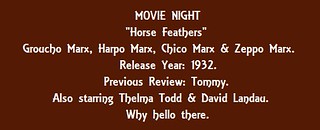
Movie Night: Horse Feathers.


Review #688: Horse Feathers.

Cast
Groucho Marx (Professor Quincy Wagstaff), Harpo Marx (Pinky), Chico Marx (Baravelli), Zeppo Marx (Frank Wagstaff), Thelma Todd (Connie Bailey), and David Landau (Jennings) Directed by Norman Z. McLeod.

Review
In a way, it's been way too long since I touched upon the Marx Brothers (#085 - Duck Soup), but hey, new year, new things, I suppose. As for the movie itself, it's pretty enjoyable. It moves quickly with its gags and pace, which make for a balanced attack of fun. The plot itself could still work today, especially in our competitive world such as this; it's nice to see a plot line that doesn't out date itself. I think the highlight of the movie is probably near the end of the movie, with the football game. My favorite of the Marxes is Groucho, most because his insults just ring more with me. I like the gags used, especially at the end of the movie involving a chariot. Even watching the scenes before it to give that sentence context wouldn't really help, just watch the movie, which is a really fun flick to watch. And, to ring in the new year and because I like this movie especially and recommend it especially, the first perfect rating of the year.

Overall, I give it 10 out of 10 stars.