Showing posts with label Keith Carradine. Show all posts

August 25, 2021

A Gunfight.

Review #1716: A Gunfight. 

Cast: 
Kirk Douglas (Will Tenneray), Johnny Cash (Abe Cross), Jane Alexander (Nora Tenneray), Karen Black (Jenny Sims), Keith Carradine (Young Gunfighter), Dana Elcar (Marv), Raf Vallone (Francisco Alvarez), Eric Douglas (Bud Tenneray), Robert J. Wilke (Marshal Tom Cater), and Paul Lambert (Ed Fleury) Directed by Lamont Johnson. 

Review: 
Sure, there are two interesting things to note about this movie. For one, this was funded by the Jicarilla Apache Tribe, of which most live in the state of New Mexico that have a significant portion of their income come from oil and gas wells. It was documented at the time as one of the first movies entirely funded by Native Americans, and it is perhaps ironic since it is a Western without any Native Americans. Of course, the other thing is that it features legendary singer Johnny Cash in an acting role. It was actually his third appearance in a motion picture, having starred in Five Minutes to Live (1961) and being featured as himself in The Road to Nashville (1967); of course, there was also the The Johnny Cash Show (1969-71), which had an episode featuring him with Douglas (who at the time of filming was approaching 55). This movie was released 50 years ago today, one that was made for $2 million while distributed to limited audiences by Paramount Pictures (at least, that is what one assumes, since there aren't that many contemporary reviews for it and you likely had never heard of it until today).

So yes, here we are with a movie that certainly tries to be offbeat and interesting in the differences from the usual expectations of a Western...in that the gunfighters seek the opportunity to make money to fight, as opposed to some sort of simmering difference between them, and they even arrange to duke it out in an arena fit for bull-fighting (get it?). 88 minutes take up time for what is meant to be an interesting look upon the dark side of folks with a lust to see people kill for sport. Of course, it also thinks it is clever by having more than just a swift finish at the arena with an imagined sequence at the end, so here we are. Boy, what a mediocre movie. The movie was written by Harold Jack Bloom (also a co-producer), best known for his work in television alongside his work on The Naked Spur (1953) and You Only Live Twice (1967). For his part, Johnson was also pretty familiar with Westerns from his TV work on stuff such as Have Gun - Will Travel along with a plethora of TV movie work that was fairly noted by audiences. Honestly, if you want a movie that shows the price of a killer trying to live with himself after a killing, you might as well just stick with Shane (1953). A Gunfight manages to be as generic as the title, one that is even bereft of the quality of oddness that could be possible with a Western meant to draw on weirdos wanting to see people kill each other. I have seen and heard more interesting moments come from people trying to justify a bizarre sports opinion than anything that comes from this movie, really. Ideally, one could do with just Cash and Douglas. A character study movie with just them might have worked if it was a more limited cast, since each are decent here. Cash never seems to be outmatched, collected in his weary pauses that looks for a different time than the one he is set upon - i.e. this isn't a star vehicle or a gimmick. Douglas simmers just as well like an opportunist ready for the big moment with confidence (granted, it is hard to top stuff with Douglas when Lonely Are the Brave (1962) exists). It takes quite a bit of time to see them meet, and it is probably an odd sign that there is nothing more interesting at any point before or after than when they meet and talk to each other (this includes the gunfight), since they play off each other with neat banter that at the very least makes this look like something more than just "uh huh, next." Well, that's not quite true, because Carradine is technically a curious and brash presence to see for like five minutes. Everyone else though is pretty much exactly what you might see coming, from the doting presences of the people close to the lead performers to the side folks, et cetera, et cetera. You might get more insight into the curiosity of folks wanting to see blood drawn at a horror convention. Honestly, by the time it lumbers to the fight, the interest is fairly mild as to just which choice the movie goes with...and yes, the fight is swiftly accomplished before being followed by imagination. I suppose it is meant to show the perspective of how neither gunfighter really wins despite being alive - uh huh, sure. You might as well just have them shoot to kill simultaneously if you want to pull a cheap message, particularly since I really care more about the idea of bringing interesting presences together rather than the usual Western stuff (i.e. a movie with presences doesn't mean one wants something with ego). Sure, the genre was still going okay in the 1970s, but this was the year of different types of Westerns like Billy Jack and McCabe & Mrs. Miller to grab the attention of audiences, and A Gunfight just doesn't have the confidence required to really make a meaningful statement that counts. Despite having Cash and Douglas, it proves to be just too average everywhere else and thus flops out in the overall end game - it might be a curiosity, but folks will find a movie with the bare minimum of filling rather than a show to look for.

Overall, I give it 6 out of 10 stars.


January 16, 2021

The Long Riders.

Review #1625: The Long Riders.

Cast: 
David Carradine (Cole Younger), Keith Carradine (Jim Younger), Robert Carradine (Bob Younger), James Keach (Jesse James), Stacy Keach (Frank James), Dennis Quaid (Ed Miller), Randy Quaid (Clell Miller), James Whitmore Jr (Mr. Rixley), Kevin Brophy (John Younger), Harry Carey Jr (George Arthur), Christopher Guest (Charlie Ford, Nicholas Guest (Robert Ford), Shelby Leverington (Annie Ralston), Felice Orlandi (Mr. Reddick), and Pamela Reed (Belle Starr) Directed by Walter Hill (#1072 - 48 Hrs, #1091 - Last Man Standing, #1139 - Supernova)

Review: 
"I'd been dying to do a Western for years. I just like 'em. There's a kind of an idyllic quality that surrounds the shooting of them, it seems like a more fundamental film process, more to me what movies are about than clearing crowds off a city street."

The legend of outlaws has spanned a variety of media for over a century, and it is the intrigue of seeing the Old West and all the storytellers that can come from it that make it an interesting curiosity. Whether it is the ballad, or the dimestore novel, or the Western, there always seems to be an interesting idea waiting at the barrel for someone to make seem fresh. There had been various perspectives on the James legend, with one of the more recent films done before this one being The Great Northfield Minnesota Raid (1972), so it would only make sense for yet another adaptation of the James legend (of which there were at least fifteen prior to 1980), albeit with a twist - brothers playing brothers. The idea for the film came about after James and Stacy Keach had starred in a production on television together nine years prior, in which they had played the Wright brothers. James had the idea to play Jesse, while Stacy came up with financing as producer and financer for the play that James wrote. It was briefly staged in New Jersey and Off-Broadway, but they eventually decided to make it into a film for each of them to be involved, and they enlisted the help of Bill Bryden and Steven Phillip Smith to develop the screenplay (the Keaches would also serve as producer alongside Tim Zinnermann). Enlisting the Carradines came in the form of J.Keach approaching Robert Carradine during their time in the production of the TV film The Hatfields and the McCoys in 1974 about being involved with the film, and they soon approached David and Keith with the prospect of doing it, which they eventually agreed. The Quaids came after that, but finding the fourth group came after a bit of turnover, as the Bridges brothers (Jeff and Beau) could not do the film due to schedule conflicts, and it later fell to the Guests (incidentally, the Bottoms family of Joseph, Timothy, and Sam wanted to star as the Youngers). Interestingly enough, a Carradine had already been involved in an adaptation about the legend of Jesse James and Robert Ford, as the eldest Carradine in John (who had four of his sons become actors) had played the latter subject in two films with Jesse James (1939) and The Return of Frank James (1940). That particular film was noted by Walter Hill as the best film made about the Younger-James brothers in terms of character truth, even if the historical accuracy was low.

United Artists agreed to help produce the film if they found a suitable director. Walter Hill certainly fit the mold of a man wanting to tell a good story. The Long Beach native grew up with an interest in film from a young age, although he once thought of being a comic book illustrator before he went into writing and eventually directing in order to tell his own stories. He has described his films as "rather retro", with his genre films generally trying to capture a serious framework within action that take inspiration from Sam Peckinpah among others - after all, he had worked with the director with The Getaway (1972); the clearest influence seems to be The Wild Bunch (1969), particularly with its use of slow motion for certain sequences of violence. Most (but not all) of his films can be argued to have elements of the Western genre, since Hill has noted his liking of complexity with a foundation on simple stories (Hill has argued they are essentially Old Testament morality tales), and this is the fourth feature film that Hill directed. It is a pretty good effort, one that does well with trying to capture a mosaic of the time and landscape that came with folks in the Old West that happen to engage in moral choices involving robbery and murder. In other words, it isn't just a straight action Western, nor one that gives focus to any one individual, instead being just a balanced film with a midwestern feel that makes its 99 minutes count with usefulness. There have been adaptations of the James story since this film (most notably with The Assassination of Jesse James by the Coward Robert Ford), but this film still stands for itself after four decades because of its capable charm, although it wasn't a big hit with audiences upon release (Keach has maintained that the film made a profit, although United Artists was likely thinking about the other Western they released that year that nearly sunk the studio - Heaven's Gate), making just a bit under double its $9 million budget.

When it comes to the first group of brothers, one can say that David proves the best in relative interest, as he is the most adept in charisma without having to strain for it. This seems most apparent during a sequence involving Reed and a new love interest, which naturally ends in a knife fight with a rope for them to chew on and duel. Keith and Robert do fine with a little less time to show, although the sequence with the Pinkertons and an unfortune cousin is a good one. The Keaches do well in their balance of laconic steel (mostly with J.Keach), one that doesn't aim for straight sympathy for the James brothers but instead lets them paint the picture for one to judge - their scene on horseback jumping through the window is likely the best image and moment from the film. The Quaids have a reserved amount of time on screen (most likely due to cutting from the studio), but they do well with being members of chaos (chained or not) that don't fall into the background, mostly with Randy. The Guests lurk right where they need to be in terms of calm sniveling, while Reed and Whitmore Jr fill out the edges in terms of allure and lingering authority that make for a off-kilter balance of a film, revisionist in its approach without seeming like a film relying just on a gimmick. It hits with a worthy punch in its look upon the landscape and the outlaws that became names to remember, no matter the efforts of authority like the Pinkertons or even the firing of a barrel to stop it. While it may not be Hill's best effort, it serves as an interesting start to a productive decade of work that packaged plenty of thrills within some of the confines that made the Western what it was without being chained to it exclusively, and it is a curiosity worth looking into today.

Overall, I give it 8 out of 10 stars.

April 29, 2019

2 Days in the Valley.


Review #1212: 2 Days in the Valley.

Cast: 
Danny Aiello (Dosmo Pizzo), Greg Cruttwell (Allan Hopper), Jeff Daniels (Alvin Strayer), Teri Hatcher (Becky Foxx), Glenne Headly (Susan Parish), Peter Horton (Roy Foxx), Marsha Mason (Audrey Hopper), Paul Mazursky (Teddy Peppers), James Spader (Lee Woods), Eric Stoltz (Wes Taylor), Charlize Theron (Helga Svelgen), and Keith Carradine (Detective Creighton) Directed by John Herzfeld.

Review: 
Sometimes you just need a crime movie about people who share in common the fact that they are just a bunch of weirdos - whether you have seen this type of movie before or not. They aren't exactly winners, but they have some sort of "unrealized potential" (as described by writer/director Herzfeld) - and it all comes together to make an okay film. Herzfeld's previous experience with direction of films was primarily television specials and movies (such as his two works with ABC Afterschool Special in 1980 and 1981), with one theatrical release with Two of a Kind in 1983. Admittedly, the cast listing is likely to prove more interesting, since you have a movie that can say it has scenes with key highlight stars such as Aiello, Headly, Mazursky, Spader, Stoltz, and Theron making for a feature that probably should have been better. It won't serve as anyone's favorite film to watch for anyone's marathon, but at least there is enough here in terms of charm and occasional action to make it a fair use of 105 minutes. It sure tries to move itself swiftly with tricks and twists, some of which that work and others that mostly feel like a tap on the door rather than a big blast. It is at least sometimes present with a sense of dark humor that rolls alongside a plot connecting its dots together across people in the San Fernando Valley, which goes well enough. Its the interactions that can come from it that make this roll through the bumps, such as Aiello and Headly, or Mazursky (a director who can't go through ending it all in a cemetery because his yapping dog is with him) with Mason. Easily, the one who I revel in watching is Spader, who walks right through playing a slimy creep like this without struggle, whether acting with Aiello and a clock or with Theron. Aiello is also pretty fun to be with, wry and useful to be around with, such as when having to interact with these other nuts (including the one he thought would work fine as his other hitman partner). The time spent with Daniels and Stoltz isn't too particularly long, but it is fine to see how they act within the lines of the cop angle of the film - one with cynicism, one with ambition. Hatcher falls as the weak point, not being as interesting to follow with, minus one fight with Theron that actually is pretty amusing to see go down. Cruttwell is somewhat amusing, but he doesn't really have much to do for the second half. The best that can be said for the film is that it doesn't overstay its welcome, bookending itself with some charm and decent entertainment (with a worthy enough climax) - it isn't perfect, but there is something here worth curiosity, due to its assembled cast and where they go from there. It is a movie that finds itself on a road going 76 on a 70 limit, having a bit of movement without going off the rails or all the way still.

Overall, I give it 7 out of 10 stars.

January 31, 2017

Nashville.


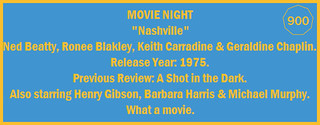
Review #900: Nashville.

Cast:
David Arkin (Norman), Barbara Baxley (Lady Pearl), Ned Beatty (Delbert Reese), Karen Black (Connie White), Ronee Blakley (Barbara Jean), Timothy Brown (Tommy Brown), Keith Carradine (Tom Frank), Geraldine Chaplin (Opal), Robert DoQui (Wade), Shelley Duvall (L. A. Joan), Allen Garfield (Barnett), Henry Gibson (Haven Hamilton), Scott Glenn (Pfc. Glenn Kelly), Jeff Goldblum (Tricycle Man), Barbara Harris (Albuquerque), David Hayward (Kenny Frasier), Michael Murphy (John Triplette), Allan F. Nicholls (Bill), Dave Peel (Bud Hamilton), Cristina Raines (Mary), Bert Remsen (Star), Lily Tomlin (Linnea Reese), Gwen Welles (Sueleen Gay), Keenan Wynn (Mr. Green), and Thomas Hal Phillips (Hal Phillip Walker) Directed by Robert Altman

Review:
Nashville is quite an experience, that much is for sure. It takes place over the course of five days, and yet it still manages to have one of the biggest assemblages of cast that work together to make for such an interesting movie of expression. There is no real main character, nor is there ever a moment where the film loses balance over what it wants to be: a film with people as diverse in nature and as interesting as the city it sets itself in. Even some of the settings (such as the Grand Ole Opry and the Parthenon in Nashville that is used for the climax) seem to reach out as their own character, with their own kind of blemishes just like these characters. For me, my favorites in the film were not so much because of likable they were, but because of how interesting they managed to be, with Beatty, Blakley, Chaplin, Gibson, and Tomlin being the big standouts who really have their own noticeable traits and flaws that one can see in themselves or others. The scene where Tomlin and Beatty are with their (deaf) children is especially telling in making these characters significant with a good degree of subtlety. The characters don't veer too much into cliches in part because they seem so real and seem so authentic to the vision of the film.

Even minor characters (like Welles or Black) are ones that we can still relate to, even if they aren't as high up on the success trail. Goldblum (in a voiceless but constant role) is also pretty memorable, in part because of the tricycle he rides throughout the film. DoQui and Welles certainly make a good pair together in the time they share together on screen. Phillips (and the dialogue that his voice is heard from for a good part of the film) is good in conveying the reach of his character without having to show him. There are so many scenes with their own range of emotion and feeling, where even a scene where Chaplin is talking poetic about buses in a junkyard is great. The film has a great deal of quality music (all done live, and by the actors themselves), all of the songs working intricately with the scene it goes with, such as with "I'm Easy"a key standout, sung by Keith Carradine, who carries the song with the right sense of tension and emotion (fun fact: this song won the Oscar for Best Original Song that year). The film doesn't try to resolve the plot threads in a concise manner, letting it up to the viewer to see where the path of these characters go from there, especially with a climax that is great in its surprise and its final beat with the last song ("It Don't Worry Me"). Nashville is a movie that does not try to bait and switch the realities of the time it was made in, and its impact can still be felt and related to over four decades after its release.

I hope you enjoyed this review, the 900th review done since this show began 2,234 days (over six years) ago. It is obvious (to me anyway) that Movie Night has progressed significantly in terms of quality and the kind of film that gets a shot at being covered. Though the show has gone on its own kind of pace, I hope that Movie Night continues to evolve in a positive way and that you all continue to enjoy this, even if in a small way. This is still a good hobby of mine, but it is also an excellent hobby to do every so often. Thank you all.

Overall, I give it 10 out of 10 stars.