Showing posts with label Michael Curtiz. Show all posts

October 7, 2024

The Walking Dead (1936).

Review #2267: The Walking Dead.

Cast: 
Boris Karloff (John Elman), Ricardo Cortez (Nolan), Edmund Gwenn (Dr. Beaumont), Marguerite Churchill (Nancy), Warren Hull (Jimmy), Barton MacLane (Loder), Henry O'Neill (Werner), Joseph King (Judge Shaw), Addison Richards (Prison Warden), and Paul Harvey (Blackstone) Directed by Michael Curtiz (#125 - Casablanca, #416 - Yankee Doodle Dandy, #505 - The Adventures of Robin Hood, #529 - Mildred Pierce, #719 - Mystery of the Wax Museum#1370 - Life with Father)

Review: 
Sure, of course Warner Bros. thought they could have some fun making a horror film. Sure, you can see the clear inspiration when it comes to having Boris Karloff star as a lumbering man back from the dead, particularly since this came out a year after Universal's Bride of Frankenstein (1935) ...but here it is arranged within the trappings of a gangster film. Of course, the obsession with trying to bring back people from a fate worse than a broken leg wasn't limited to the current day. The "perfusion pump", for example, is shown for a moment during the pivotal resurrection scene. This glass device was designed by Charles Lindbergh and Dr. Alexis Carrel to try and keep organs functioning outside of the body (the process can be explained better in articles such as this); Lindbergh wanted to find ways to help his sister-in-law, who had a bad heart. Labeled as a "mechanical heart" in some circles, Lindberg and Carrel were even featured on magazine covers for their invention (better ways of "organ perfusion" eventually came around in the next couple of years, naturally). In 1935, a film wad made called Life Returns, which featured the exploits of Dr. Robert E. Cornish, a biologist that had an interest in restoring life that tried using a teeterboard/see-saw to try and get the blood flowing of the dead...it technically worked, albeit not perfectly, on dogs (interestingly, the film didn't exactly get a great release). Incidentally, Karloff would star in two subsequent features in the following years dealing with resurrection with The Man They Could Not Hang (1939) and The Man with Nine Lives (1940), which took inspiration from Cornish. Evidently with this film, Karloff was slated with little dialogue to speak before he raised issue with said matter. Five people were given credit for the writing: Ewart Adamson, Peter Milne, Robert Hardy Andrews and Lillie Hayward wrote the screenplay, while Adamson and Joseph Fields wrote the story. The movie was directed by Michael Curtiz, a particularly busy director in the 1930s that had some experience in horror (among others in the 30+ films he did in the decade) with Doctor X (1932) and Mystery of the Wax Museum (1933).

Okay, you're going to love the way the "resurrected" man decides to handle being framed for murder. After he is brought back from being electrocuted, he seems to have developed a certain type of clot in his brain that gives him a strange knowledge of just who had framed him. Oh, but it gets better, he actually gets his revenge, in perhaps the most curious way possible. Of course, the film is pretty fast and loose at getting there with a 66-minute runtime. Karloff proves a quality knowing presence to unnerve the soul when it comes to second sight with select times to speak or just stare. The funny thing about this horror/crime feature is that there isn't really much of a villainous presence or even a ham actor. Gwenn might be the lead scientist presence, but it ends up coming off as just warm curiosity that is fine for someone with as much experience on stage and film as you'd expect from him (one can take a guess what film you would recognize that voice from). Churchill and Hull are serviceable enough when you consider that the rest of the folks don't have much to do besides being casually terrorized after the execution. Okay, so the array of deaths that happen in the film are done not by any one man but are actually a string of accidents that just happen to involve our lead character because of his "sense" of knowing who led to his death. Probably the most amusing is a guy nervous about who just stumbled in to confront him that decides to run only to encounter a train. The movie has plenty of shadows and fog to keep things looking ideal rather than just being a Frankenstein cheapie. In general, the movie is a quietly solid one, not rocking the boat too much in unnerving horror (the resurrection scene might be the most involving for the sheer execution of it, although the last scene is interesting) but generally working well with one's expectations. This is the kind of movie you can sense was made in a few weeks by professionals that came and went to get things done without too much fuss (five writers, but still) that will prove up to code.

Overall, I give it 7 out of 10 stars.

March 26, 2020

Life with Father.


Review #1370: Life with Father.

Cast: 
William Powell (Clarence Day Sr), Irene Dunne (Vinnie Day), Elizabeth Taylor (Mary Skinner), Edmund Gwenn (Rev. Dr. Lloyd), ZaSu Pitts (Cousin Cora Cartwright), Jimmy Lydon (Clarence Day Jr), Emma Dunn (Margaret the Cook), Moroni Olsen (Dr. Humphries), Elizabeth Risdon (Mrs. Whitehead), and Martin Milner (John Day) Directed by Michael Curtiz (#125 - Casablanca, #416 - Yankee Doodle Dandy, #505 - The Adventures of Robin Hood, #529 - Mildred Pierce, and #719 - Mystery of the Wax Museum)

Review:
"I put all the art into my pictures that I think the audience can stand."

What better way to accompany the 1940s than a family picture based on established material of the time? The film was based on the 1935 autobiographical book of the same name by Clarence Day, Jr, who had based it on episodes of humor in his family life, specifically his father in the 1890s. He died of pneumonia that year, but a follow-up book called Life with Mother was published posthumously in 1937. Two years later, the books were adapted into a play called Life with Father by Howard Lindsay and Russel Crouse, which ran for 3,224 performances in nearly eight years, and it still ranks as the longest running non-musical play on Broadway. The film was adapted to the screen by Donald Ogden Stewart (who you might recognize for his work on films such as Love Affair and The Philadelphia Story). It should prove no surprise that the film came from prolific director Michael Curtiz (who was 38 when he left Hungary for Hollywood, who could do a variety of genres through his own kind of visual style involving camera movement and lighting that combined with his intense style of activity (such as skipping lunch), with his friends nicknaming him "Iron Mike" for his fitness; in his 49-year career, he directed a total of 166 films before his death in 1962. 

It is evident from the roughly $4.7 million budget that Warner Brothers wanted to make a big achievement in making this book-turned-play-turned film an engaging one that draws on the humor that its brash patriarch inspires, with varying results. I can't necessarily say that this is a great comedy, since it does tend to veer on the edge of being dated, but there is a decent cast and useful production value that makes it a fair curiosity. Powell commands the film with fairly amusing results, drawing a few laughs in his attempts in family humor with his type of bluster that seems somewhat relevant for a family comedy. Dunne (in a role that she found rattlebrained that took coaxing to do from Curtiz) accompanies him with her own kind of charm, matching in dignity through fair chemistry with Powell. Taylor, who had risen to teen star earlier in the decade with National Velvet (1944), does well with grace whenever on screen, having the most presence among the teenagers and children despite having scattered focus. Gwenn contributes with warmth and dignity that is to be expected from him.  The film treads okay at 118 minutes, showcasing a 3-strip Technicolor tale of a comedy of manners that inspires chuckles more than yawns, even if it is entirely predictable (regardless of what era it was made in, I suppose). Life with Father is an average film with prominent talent and a prominent place because of its public domain status that makes it a decent gem worth looking for its look at a quirky family and the situations that come with them.

Overall, I give it 7 out of 10 stars.

June 27, 2015

Mystery of the Wax Museum.


Review #719: Mystery of the Wax Museum.

Cast
Lionel Atwill (Ivan Igor), Fay Wray (Charlotte Duncan), Glenda Farrell (Florence Dempsey), Frank McHugh (Jim), Allen Vincent (Ralph Burton), Gavin Gordon (George Winton), Edwin Maxwell (Joe Worth), and Holmes Herbert (Dr. Rasmussen) Directed by Michael Curtiz (#125 - Casablanca and #416 - Yankee Doodle Dandy, #505 - The Adventures of Robin Hood, and #529 - Mildred Pierce)

Review
Remember House of Wax (#271) with Vincent Price? Mystery of the Wax Museum is the original version, made by the same studio (Warner Brothers) that would make the remake 20 years later, with this movie based off an unpublished story, The Wax Works. This movie utilizes two-color Technicolor, a unique system utilized in some films (like the 1925 version of Phantom of the Opera), although the reception to the system was lukewarm due to the perceived artificial qualities it projected. This was one of only three films that Warner Brothers had under this system, and the last. Anyway, the movie's color actually helps set the mood very nicely because its artificial quality here makes the movie seem creepy, which for a movie like this, works. It works for a mystery like this, which moves quickly and never seems padded, setting its characters up and their motivations just fine. Atwill and Wray are the highlights, both having good scenes, sometimes together. The movie is quickly resolved, and I'm impressed at how it managed to be just effective, without having to resort to much final thoughts. It's a movie that looks good in its own way while being a fine little mystery that can be good for anyone looking for a quick 30's film to watch.

Overall, I give it 8 out of 10 stars.

January 25, 2014

Movie Night: Mildred Pierce.


Review #529: Mildred Pierce.

Cast
Joan Crawford (Mildred Pierce Beragon), Jack Carson (Wally Fay), Zachary Scott (Monte Beragon), Eve Arden (Ida Corwin), Ann Blyth (Veda Pierce Forrester), Butterfly McQueen (Lottie), Bruce Bennett (Albert Pierce), Lee Patrick (Maggie Biederhof), and Moroni Olsen (Inspector Peterson) Directed by Michael Curtiz (#125 - Casablanca and #416 - Yankee Doodle Dandy, and #505 - The Adventures of Robin Hood)

Review
Mildred Pierce is a classic film noir (Which is why this film is in the National Film Registry, along with other films such as The Maltese Falcon, D.O.A, and other various films) that also manages to be a very gripping drama. Joan Crawford has a powerful performance as Pierce, she makes the movie whole, and she gives her all to make this more then just a film noir. The other actors are good, they certainly work well with Crawford, and they are also fun to watch. Ann Blyth is really effective at her acting in this film, especially with a character so brutal. Curtiz does a fine job directing and the film itself never has a bump or a sluggish moment in it, and the ending is certainly satisfying.

Overall, I give it 9 out of 10 stars.

December 23, 2013

Movie Night: The Adventures of Robin Hood.


Review #505: The Adventures of Robin Hood.

Cast
Errol Flynn (Robin Hood), Olivia de Havilland (Maid Marian), Basil Rathbone (Sir Guy of Gisbourne), Claude Rains (Prince John), Patric Knowles (Will Scarlett), Eugene Pallette (Friar Tuck), Alan Hale Sr. (Little John), Herbert Mundin (Much), Melville Cooper (High Sheriff of Nottingham), Una O'Connor (Bess), and Ian Hunter (King Richard the Lionheart) Directed by Michael Curtiz (#125 - Casablanca and #416 - Yankee Doodle Dandy) and William Keighley (#501 - The Man Who Came to Dinner)

Review
This is the first film I've reviewed that starred Errol Flynn, along with the first of Olivia de Havilland, and they both are impressive, especially when they are paired together in scenes. Flynn is quite the adventurer and he does an extremely great job in the action scenes and the swashbuckling. Basil Rathbone (who I wanted to talk about in more detail when I eventually got to reviewing The Hound of the Baskervilles) is an effective adversary, getting a good fight with Robin at the end, but also being a good foil as well. Claude Rains lurks around as a fine villain that while not having a fight scene, is still a useful villain. The rest of the cast are effective at entertaining, especially Herbert Mundin, who while not given much to do, makes an impression, at least for me anyways. The action is excellent and the Technicolor give the film a colorful, yet memorable look. This is a well made, excellent adventure film that hasn't dated much, if at all.

Overall, I give it 10 out of 10 stars.

July 4, 2013

Movie Night: Yankee Doodle Dandy.

Review #416: Yankee Doodle Dandy.

Cast
James Cagney (George M. Cohan), Joan Leslie (Mary Cohan), Walter Huston (Jerry Cohan), Richard Whorf (Sam Harris), Irene Manning (Fay Templeton), George Tobias (Dietz), Rosemary DeCamp (Nellie Cohan), Jeanne Cagney (Josie Cohan), and Eddie Foy, Jr. (Eddie Foy, Sr.) Directed by Michael Curtiz (#125 - Casablanca)

Review
Patriotic in its approach and with newcomer to Movie Night - James Cagney, this is a grand attempt at making good patriotism and making a good biography. Cagney does an electrifying job, dancing, singing, acting, done with care and well refined. The rest of the actors including Walter Huston, do well, making a mark. The directing works, and the music and songs flow well, hitting the spot, and making for good entertainment. This film was released just after Pearl Harbor, in 1942, and I understand this gave a new boost of patriotism, which was well needed. Happy Birthday to the United States of America, which is 237 today.

Overall, I give it 10 out of 10 stars.

original: 


April 14, 2012

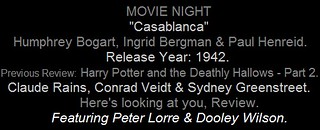
Movie Night: Casablanca.


Review #125: Casablanca.

Cast
Humphrey Bogart (Rick Blaine), Ingrid Bergman (Ilsa Lund), Paul Henreid (Victor Laszlo), Claude Rains (Captain Louis Renault), Conrad Viedt (Major Heinrich Strasser), Sydney Greenstreet (Signor Ferrari), Peter Lorre (Signor Ugarte), and Dooley Wilson (Sam). Directed by Michael Curitz.

Review
This film is a classic, as it has reached its 70th Anniversary, as it still entertains then and now. This was my first time watching this film (I watched it a day ago yet wrote the review a day in advance), and I like this film. I like how it get better in the last hour, with everything getting interesting and all. The acting is brilliant, with Bogart and Hepburn being the standouts. This film shows the ever good example of romance in a tale, which is...Not to over sap it. The film has romance, but it does not over ride the film into sappiness material. The film has memorable lines, a good pace, and a way to captivate audiences after 70 years.

Overall, I give it 10 out of 10 stars.