Showing posts with label Joseph Campanella. Show all posts

May 25, 2020

The St. Valentine's Day Massacre.


Review #1425: The St. Valentine's Day Massacre.

Cast: 
Jason Robards (Al Capone), George Segal (Peter Gusenberg), Ralph Meeker (George "Bugs" Moran), Jean Hale (Myrtle), Jan Merlin (Willie Marks), Clint Ritchie (Machine Gun Jack McGurn), David Canary (Frank Gusenberg), Harold J. Stone (Frank Nitti), Frank Silvera (Nick Sorello), Joseph Campanella (Albert Wienshank), Richard Bakalyan (John Scalise), Charles Dierkop (Salvanti), John Agar (Dion O'Bannion), Joseph Turkel (Jake Gusik), Bruce Dern (Johnny May), and Paul Frees (Narrator) Produced and Directed by Roger Corman (#368 - The Little Shop of Horrors, #684 - It Conquered the World, #852 - The Terror, #931 - Not of This Earth, #1007 - Attack of the Crab Monsters, #1039 - Five Guns West, #1042 - War of the Satellites, #1136 - Gas-s-s-s, #1147 - X: The Man with the X-ray Eyes, #1186 - A Bucket of Blood, and #1423 - The Wild Angels)

Review: 
"There comes a time when the public conscience needs jolting and in St Valentine's Day Massacre this is our intention. It is also certain that the movie will make money - crime is always box office."

As one would say, give people what they want and they will come see it in theaters. One can talk for ages about the ways that Roger Corman has served film well in making them fast, cheap and generally good that have served him well in a long-lasting career as producer and director. This is an unusual film in his lineup because of his collaboration with a major studio in 20th Century Fox, as opposed to his usual independent filmmaking. He had expressed an interest with making a film with a major studio, and he attracted the attention of Columbia Pictures. Cracks seemed to form almost immediately, as his submitted ideas (a biopic of Baron Von Ritchhofen, this film, and an adaptation of Only Lovers Left Alive) were considered too strange while their ideas seemed too ordinary to him, with Corman believing in giving the audience "something a little more complex artistically and intellectually. To show something you can't see on TV leads inevitably to unusual material." Perhaps predictably, he would never end up making a film for Columbia, leaving the production of A Time for Killing (1967) early on. However, he would be granted a chance with Fox, since I suppose one can't resist the urge to do business with a proven director for fast and effective moneymakers, with this being a particularly interesting year for evolving tastes (the first coming to mind being Bonnie and Clyde).

Corman would have to modify certain aspects of his plan to make the film with the studio, however. For one thing, he wanted Orson Welles to play the lead role with Robards as the character of Moran. However Fox felt that he was undirectable and could potentially try to take rein of the director's chair from Corman. Ideas to film in Chicago were soon shifted to the Fox backlot, and Corman even re-used sets from other movies. While given seven weeks and $2.5 million to make a film, he felt most comfortable with tighter budgets, although he generally felt more comfortable as producer than directing, with this being the sixth-to-last film that he directed. He strived to make an authentic and accurate gangster film, right down to the climax and having the bodies lie where they fell in the original crime photos. The portrayal of Capone by Robards was the third in a feature film (after the first by Rod Steiger in the eponymously titled film in 1959, which also had The Untouchables premiere on TV), and Corman would return to the subject as producer for Capone (1975). In that matter, this is a decent ensemble piece with careful plotting that shows its criminal underside without trouble to make a 100 minute tale resonate with a bit of shock value. It isn't one of Corman's greatest achievements, but it at least one with ambition and the tools to try and make things work out with its buildup to the massacre with gradual use of Frees as narrator to describe the characters and their actions. Robards and Meeker stand out the most in the cast. Although it might have proved more fruitful to have had Welles in the title role, Robards makes the most of it with scene-chewery that makes for well-seen bluster whenever the time is needed to raise voice. Meeker contrasts this with his own type of conniving spirit of conviction, while Segal, Stone and the others follow along in making for some interesting unsavory people to look at for a time that doesn't lead one to want some sort of authority opposition or some sort of comic relief. On the whole, this is a decent little movie from Roger Corman in something a bit different from his usual tactics of filmmaking that still retains his usual drive to make quality entertainment that lives up as a decent gem for its era.

Overall, I give it 7 out of 10 stars.

April 1, 2019

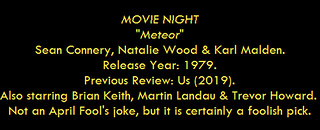
Meteor.


Review #1204: Meteor.

Cast: 
Sean Connery (Dr. Paul Bradley), Natalie Wood (Tatiana Donskaya), Karl Malden (Harry Sherwood), Brian Keith (Dr. Alexei Dubov), Martin Landau (General Adlon), Trevor Howard (Sir Michael Hughes), Richard Dysart (Secretary of Defense), Henry Fonda (The President), and Joseph Campanella (General Easton) Directed by Ronald Neame (#673 - Scrooge)

Review: 
What is a meteor? One definition (at least according to a cursory Google search) is that it is a " small body of matter from outer space that enters the earth's atmosphere, becoming incandescent as a result of friction and appearing as a streak of light." Perhaps the definition doesn't give the movie's big threat proper credit, since this is a disaster film released to ride on the popularity of films of its ilk released in the 1970s such as the Airport films (1970, 1974, 1977, 1979), The Poseidon Adventure (1972) and countless others  - with this one being distributed by American International Pictures and funding from Hong Kong studio Shaw Brothers. This was one of numerous AIP films in the 1970s that differed from the usual fare they had delivered in previous decades, with less focus on horror and more focus on other genres (whether it involved kung fu, blaxploitation, or something else), with an increase in budgets. This film, unlike others released by the studio, proved to be a failure, making less than $10 million on release with a budget over $15 million. This led to the demise of AIP, which soon merged with Filmways, Inc and stopped distributing films by 1980. In any case, the hands that attempted to guide the film might have seemed promising. Stanley Mann and Edmund H. North were the writers for the film, with the latter being responsible for writing films such as The Day the Earth Stood Still (1951) and Patton (1970). Much like the disaster films mentioned already, this one also boasts a collection of big-name actors of its time to supplant the roles.

With all of that in mind, it sure is strange that this film turns out to be a dud. How does one make a film racked with only the bare minimum of suspense and mild special effects? How does one make a film where the energy of the cast and the people they are playing fight blandness? By the time the actual meteor shows up for its climax, the level of excitement jumps up a percentage point, since it means it's almost over, even if the tension levels by this time are nearly non-existent. This probably would've fared better as a comedy, actually. Imagine a bunch of people flailing around talking about a giant rock hitting the Earth in your driest voice, and you have this movie basically summed up. As nice as it is to see Connery be pulled into this ridiculous mess, he isn't too particularly interesting - whether that it is due to the script or due to being on autopilot waiting to get done with this mess (and the check to clear) is up to you. Him and Wood don't have much chemistry with each other, but it really is more because it just feels like filler before scenes of exposition/meteor stuff take the stage again. Keith is fine, and he does provide a bit of humor to a film that is practically begging for some action. Malden proves okay with his gruff if not stock kind of role. Landau goes over-the-top for a role without any real sort of depth to it besides being adversarial to the others. The other members of the cast make brief appearances that come and go as they please. The effects are okay, but they don't really elevate this material to any real sense of enjoyable spectacle, with one sequence utilizing footage from Avalanche (1978) alongside tons of artificial snow for background shooting. The sequence involving the subway and the mud surely must've proven interesting to think of as effective in concept - but it just seems more of a waste of money and time (along with a pain for any actor having to act in mud). This mish-mash in quality for the effects can be attributed in part because numerous visual effects teams came and went during production due to being fired for the quality of effects delivered on a small budget (no doubt due to the budget focus on the actors) - the shots involving building collapsing near the end was actually just re-used footage from building demolitions. Ultimately, it is the lack of any interesting characters or situations that prove fatal to the film. It becomes evident quickly that there isn't much in the way of tension, since the idea of the meteor actually hitting the Earth never really seems all that likely. The film actually ends with a notation about a report named "Project Icarus", a student project done in 1967 at the Massachusetts Institute of Technology that involved students in a systems engineering class to make a plan to use rockets to deflect or destroy an asteroid in the event of a possible collision with Earth, which led to a book release the following year. One would likely be better off reading the report than watching the film, actually. It disappoints on a basic level as entertainment with its actors and it disappoints on a level of spectacle that makes this a chore for all but people with nothing better to do.

Overall, I give it 4 out of 10 stars.