Showing posts with label Andrew Robinson. Show all posts

April 29, 2026

Shoot to Kill (1988).

Review #2532: Shoot to Kill.

Cast: 
Sidney Poitier (Warren Stantin), Tom Berenger (Jonathan Knox), Kirstie Alley (Sarah Renell), Clancy Brown (Steve), Frederick Coffin (Ralph), Richard Masur (Norman), Andrew Robinson (Harvey), Kevin Scannell (Ben), Michael MacRae (Fournier), Milton Selzer (Mr. Berger), Les Lannom (Sheriff Dave Arnett), and Robert Lesser (Agent Minelli) Directed by Roger Spottiswoode (#171 - Tomorrow Never Dies, #191 - The 6th Day, #1205 - Air America)

Review: 

Admittedly, I picked this movie to clear a few obligations of mine, mainly in my director logs (as one does when "this movie or this movie?" is not enough). I came across Roger Spottiswoode and figured, why not talk about one of his movies? The Ottawa-born director was the son of a documentary filmmaker that had made films for the war effort for the National Film Board of Canada. He started his film career as an editor (once stating that his school was in the cutting room), rising from doing work on commercials to being the co-editor of Straw Dogs (1971). He was approached to direct for the first time with the horror film Terror Train (1980), which was a light success. He took over the production of the troubled The Pursuit of D. B. Cooper that came out the following year before doing Under Fire (1983) and The Best of Times (1986), which were not major successes at the time. All of this collides with the return of Sidney Poitier to the big screen, as he had not starred in a film in eleven years (having spent a good chunk of his time directing). The story was written by Harv Zimmel, who in turn co-wrote the screenplay with Michael Burton and Daniel Petrie Jr, with the latter serving as a co-producer. For whatever reason, outside of North America the movie was called "Deadly Pursuit" (one of the working titles was "Mountain King"). Over the next couple of decades, he would direct a variety of films along with ones for television to varying levels of quality such as Turner & Hooch (1989) or And the Band Played On (1993). 
 
Sure, it might be easy to call this one routine, what with it being a buddy thriller in the mountains between two people who get through a few personal disagreements to work together in pursuing one pretty obvious goal. It's a machine of familiar aspects, right down to changing the locale for the final pursuit...and I love stuff like this. It's a fun movie for the execution that it holds in its hand of entertainment, one where you can playfully ask questions about its premise and not feel the need to come up with an answer (or, "cope", if one is younger). Who cares about why just one FBI guy is present to chase a killer when it is so much fun to see the revolving door of moments that come from Poitier and Berenger. It helps that Poitier (who turned 60 in 1987) hasn't lost his touch when it comes to selling the movie with poise that is basically unshakable even when in a different element (as one does when stolen jewels turn into folks having their eyes shot out), and it pairs well with the hardened Berenger (always a charmer*, I would say) for a few chuckles in the crisscross of trying to move forward in a locale that curves on a whim, such as say, a bear encounter. It helps that the movie takes some time to actually reveal just who is the killer is (okay you already can tell by the billing) to pair along with Alley (decent, if not exactly comparable to someone like Brown) and others for a bit of smooth tension, because there is a bit of a mean streak with the body count. Seriously, you get a few people thrown off ledges to pair with an experience that eventually climaxes with shooting a gun in water, it is the kind of movie you slip on at night and just enjoy the ride. Both actors get to run the process of what they know best in their environments without underselling the other person. This was a movie made when films still liked to actually strive for a landscape to look upon with pride (it was mostly filmed in British Columbia, as one does when being set in the Northwest), suffice to say. As a whole, Shoot to Kill is a pleasant thriller for all involved, maneuvering through its 109-minute runtime with a good sense of adventure and fun that doesn't waver in its entertainment value regardless of how familiar it might seem because its charms are too good to resist.
 
Overall, I give it 8 out of 10 stars.


*Berenger is a sentimental favorite of mine, I think, mainly because I re-watch Major League every year.

*By the way, this movie actually has a 100% rating on Rotten Tomatoes. Seriously.

June 28, 2025

Cobra (1986).

Review #2392: Cobra (1986).

Cast: 
Sylvester Stallone (Lieutenant Marion "Cobra" Cobretti), Brigitte Nielsen (Ingrid Knudsen), Reni Santoni (Sergeant Tony Gonzales), Andrew Robinson (Detective Monte), Brian Thompson ("Night Slasher"), John Herzfeld (Cho), Lee Garlington (Officer Nancy Stalk), Art LaFleur (Captain Sears), Marco Rodriguez (Supermarket Killer), Ross St. Phillip (Security Guard), and Val Avery (Chief Halliwell) Directed by George P. Cosmatos (#818 - Rambo: First Blood Part II, #1177 - Tombstone)

Review: 
Sure, it is loosely adapted from a book. But the real curiosity might be from the fact that the script for the movie was inspired by a failed idea. You might remember that Sylvester Stallone was the serious candidate to star in 1984's Beverly Hills Cop (after the attached actor in Mickey Rourke dropped out) at least before he made his script revisions. Apparently, he was once quoted as saying "Somehow, me trying to comically terrorize Beverly Hills is not the stuff that great yuk-festivals are made from. So I re-wrote the script to suit what I do best, and by the time I was done, it looked like the opening scene from Saving Private Ryan on the beaches of Normandy." The bottom line is that Stallone's revisions were just not suitable to film (particularly in the budget) and, well, you know the rest. Stallone was credited writing the screenplay while the "based off" material was the 1974 novel A Running Duck, as written by Paula Gosling. Interestingly, the novel was later published under a different name in Fair Game and Andrew Sipes filmed an adaptation of the book under that title in 1995 with William Baldwin as star. The finished version of Cobra runs at 89 minutes after extensive battles with editing, since the MPAA originally rated it as an X, and it probably didn't help that it was released in the wake of Top Gun (1986). Deleted sequences from the film do exist online, if one is curious to search for it, anyway (one small scene for example, has a kid delivering a present to the police that is stated to be a hand). This was actually a co-production between The Cannon Group and Warner Bros. (only the logo of the latter is seen, naturally), and Stallone would be involved with the two again with Over the Top (1987).

It's very amusing to make a Dirty Harry pastiche with two of the actors from the first film (Robinson and Santoni) in it, don't you think? There might be some who believe the film would serve as a comedy to lampoon the over-the-top nature of the movie, what with its view of a character taking extrajudicial measures to get things done and the occasional one liner (those people probably think MacGruber is just as funny as Cobra or go on Reddit). Well, I take that back, he starts the film by listing crime statistics of burglaries happening every 11 seconds and violent crimes happening every 25 seconds and so on. It is a pretty terse 89-minute movie, but I think you can see how someone could enjoy the proceedings, particularly with the curious observation that Stallone saw the lead character as "Bruce Springsteen with a badge." Even in its average qualities that mark it as roughly equivalent to Cosmatos & Stallone's previous collaboration with Rambo: First Blood Part II (as released one year prior), there is something curious to watch with a movie that basically comes off as a supercut of all the cliches possible for strange delight: villains with understated motives? attempts at levity for romance in the middle of mayhem? A secondary character exchanging quips with our lead that gets setup for getting wounded in an ensuing firefight? A grisly finish to close out the proceedings? All that and more is present here, and it goes to show that you can include plenty of familiar aspects of an action movie and seem pretty enjoyable anyways. Edits aside, there is an energetic presence to the film that comes out quite clearly even if it wasn't going to a series of movies. Stallone might've had a bit of an ego present with being part of filming, but there is still something worth watching him engage with the proceedings, which might as well be blueprint for further smart-ass heroes going against free-wheeling bad guys in the future with Stone Cold (1991). It doesn't really mean great chemistry with Nielsen (Stallone's wife at the time), but I can imagine worse. Thompson may not exactly get much to really do as the heavy (okay, there's a cult that likes playing with axes, I expected less anyway), but I like it anyway, he just has a ferocious energy that inherently watchable, particularly when it comes to the climax (okay, it ends with him on a hook, but still). You get the "heh, that's nice to see" with folks such as Santoni and LaFleur, suffice to say, mainly because it's hard to make an unenjoyable wiseass accidentally in an action movie. Robinson* and character apparently was meant to be the real bad guy of the movie, complete with a planned sequence involving a tattoo at the end. Even here there is still a wiseass energy that I can't help but like from Robinson, cliches be damned. The supermarket sequence and the climax are fair enough highlights in mayhem, at least for those who know that what they get here is mainly stuff that wouldn't be too removed from a Dirty Harry offshoot (the ones who don't hesitate to label those movies as "fascist" would probably get more blubbery in criticizing it, but, well, the eyes only roll so much). Cobra might be thought as the litmus test for seeing one's taste in the same way in the same way that one can tell if someone is prevaricating you in explaining things as evasively as possible**. You either get with it or don't, as Cobra is a lubricious but worthwhile piece of entertainment. 

Overall, I give it 7 out of 10 stars.

*See, I don't hate Reddit, here's a source from there, as Robinson was quoted on there as calling Cobra: "The worst movie I was ever in... well, there are a few that qualify, but on another level Cobra was one of the best things I've ever done because it gave me the down payment on our house of 30 years."
**I heard that one word earlier, so why not use it?

November 6, 2020

Hellraiser.

Review #1589: Hellraiser.

Cast:
Clare Higgins (Julia Cotton), Ashley Laurence (Kirsty Cotton), Andrew Robinson (Larry Cotton), Sean Chapman (Frank Cotton), Robert Hines (Steve), Doug Bradley (Lead Cenobite), Nicholas Vince (Chattering Cenobite), Simon Bamford (Butterball Cenobite), Grace Kirby (Female Cenobite), and Oliver Smith ("Skinless" Frank / Frank the Monster) Written and Directed by Clive Barker.

Review:
"I see no reason to apologise for any kind of generic formation. As you know, you go back to some of the most striking images, the most lasting images, in cinema, and they come from horror films. Some people think horror films are some sort of second-class filmmaking, and the only way we can hope to bypass that thinking is by being proud of the fact that we do it."

"There was no doubt in my mind that this unnamed guy with the pins in his head had a certain je ne sais quoi that a mattress-delivery guy didn’t."

As goes the writer, goes the director, you might say. Clive Barker was originally an author, having studied at the University of Liverpool in English and Philosophy. Barker had an eclectic amount of influences growing up in terms of media that ranged from authors such as Herman Melville (such as Moby Dick, once described as his favorite novel) to William Blake to films as well. He did work in the theatre at first with plays starting in 1967 (while also occasionally doing work with 8mm and 16mm film) before moving into writing with 1985, which focused on horror and fantasy. The source material for this film was his second work in The Hellbound Heart (1986), a novella, which drew upon his experiences in hustling as a prostitute (as he did when needing to pay bills as a struggling writer). Barker was spurred to do his own film based on the experience of seeing two of his stories be turned into films (described as "cinematic abominations" by him, since he wrote both screenplays) in Underworld (1985) and Rawhead Rex (1986), with an intent to direct something cheap - enter Roger Corman's New World Pictures, which gave him $900,000 to fund the film. The design of the film was inspired by his experiences at night clubs (such as seeing people pierced for fun). He was inexperienced at the art of directing, but he managed on with a mix of fairly tolerant cast and crew that did not balk at the first time director (the one stipulation that the studio did have however came with dubbing some of the accents to make what was a British tale seem more American).

What we have here is a horror film of the senses, mixing pain and pleasure for some interesting visceral moments. It sets most of its 93 minutes within the confines of a house horror film that builds tension with its ooze of atmospheric dread that make it understandable to see why there was more than one Hellraiser film. In fact, there were nine subsequent films, with Barker helping to write an outline for Hellbound: Hellraiser II as its executive producer before taking less duties with the third film while Bradley starred in seven of those sequels, and a television series was recently announced to be in development. In any case, the film sticks out among others of its decade in its difference from the popular aim of the time in slashers - there are moments with blood, but it seems more serious with its approach than say, A Nightmare on Elm Street [1984] (although each are equally qualified in horror). To me, there are moments that remind me of the vampire story, what with a character that desires blood while being confined to a certain place for the day for others to help do his bidding, although an inspiration for the film was actually the urban legend of "The Devil's Toy Box". In any case, the real threat involves the Cenobites, who can't tell the difference between pleasure and pain that can be angels or demons depending on one's perception that seemed to have a repulsive glamour (with a design inspired by S&M clubs, as stated by Barker).

One starts at first with Higgins (an actress of the stage in native London and Broadway), one who we follow along with in pursuit to deception and lust that nevertheless is compelling to follow. Laurence goes along with curiosity on the other side of pursuit with the box without being turned into a vehicle for cheap screams (her and Higgins would return in the sequel). Robinson (best known for his villainous role in Dirty Harry) also does well here as the family man needed to contrast the macabre (at least to a point). Chapman captures craven crawling with the moments needed in pursuit as the last key of the human puzzle needed in nature. The Cenobites sure are a highlight in design, and it only seems fitting that Bradley (a close friend of Barker for over a decade prior to this film) would eventually take bigger focus with each passing film, dignified in quiet tone that seems reminiscent of Christopher Lee's portrayal of Dracula - fine by me, obviously (it should be noted that the eventual name given to his character was not actually by Barker but by the crew). In general, the film works best in grisly terror for what one sees and feels from terror from the deep dark senses that found a following and place within horror that stood beyond the litany of follow-up sequels that came after it in the three decades that followed because of what Barker did to keep his vision to make the screen.

Next Time: House of 1000 Corpses

Overall, I give it 8 out of 10 stars.

January 3, 2017

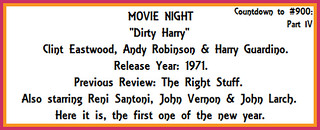
Dirty Harry.


Review #893: Dirty Harry.

Cast: 
Clint Eastwood (Inspector Harry Callahan), Andy Robinson (Scorpio), Harry Guardino (Lt. Al Bressler), Reni Santoni (Inspector Chico Gonzalez), John Vernon (The Mayor of San Francisco), John Larch (Chief of Police), John Mitchum (Frank "Fatso" DiGiorgio), Woodrow Parfrey (Jaffe), and Josef Sommer (District Attorney William T. Rothko) Directed by Don Siegel.

Review: 
I decided to use this film as the beginning point in part because the 45th anniversary (in late December) had passed on without notice, and it also seemed right to do this film, a hallmark of police films. This is certainly an excellently crafted film, right down from the style and action but also the way it presents its main character. Eastwood is excellent at conveying this loose cannon type of cop with the sort of cynicism and blunt edge without any kind of insincerity nor too overblown. The movie is at its best when showcasing the action (or in some cases, the sets used, such as Kezar Stadium), with a particularly excellent climax in a rock quarry. Besides the grit (and catchphrases) is a movie that does not try to hide its loyalties or thoughts on certain manners, especially with scenes regarding Vernon. Guardino and Santoni are serviceable, doing their roles without any kind of distraction. Robinson does a good job as the villain in part because of his mannerisms and how unassuming he seems. There is a perfect kind of imbalance that he conveys that work within the manners of the film. The movie seems to slow itself a bit around the middle, but it manages to have a good enough beginning and end that it doesn't really account for too much slog. It's obvious to say this isn't the kind of movie for anyone (especially for ones that aren't fans of violence), but it's also obvious to say this is a film that uses everything given to it (fine directing and a fine enough cast along with well conveyed action) and makes it a worth while time at 102 minutes. It isn't a standard kind of procedural and that's just the way it likes it to be.

Welcome to Season 7 (2017), folks: Countdown to #900: 10, 9, 8, 7...

Overall, I give it 9 out of 10 stars.