Showing posts with label Luana Anders. Show all posts

October 27, 2024

The Pit and the Pendulum (1961).

Review #2295: The Pit and the Pendulum (1961).

Cast:
Vincent Price (Nicholas / Sebastian Medina), John Kerr (Francis Barnard), Barbara Steele (Elizabeth), Luana Anders (Catherine Medina), Antony Carbone (Doctor Leon), Patrick Westwood (Maximillian), and Lynette Bernay (Maria) 

Produced and Directed by Roger Corman (#368 The Little Shop of Horrors, #684 - It Conquered the World, #852 - The Terror, #931 - Not of This Earth, #1007 - Attack of the Crab Monsters, #1039 - Five Guns West#1042 - War of the Satellites, #1136 - Gas-s-s-s, #1147 - X: The Man with the X-ray Eyes#1186 A Bucket of Blood, #1423 The Wild Angels, #1425 The St. Valentine's Day Massacre, #1674 - Machine-Gun Kelly, #1684 - Creature from the Haunted Sea, #1918 - House of Usher#2030 The Trip, #2113 - The Undead#2211 - The Intruder, #2275 - The Wasp Woman)

Review: 
"I had a lot of theories I was working with when I did the Poe films... One of my theories was that these stories were created out of the unconscious mind of Poe, and the unconscious mind never really sees reality, so until The Tomb of Ligeia, we never showed the real world. In Pit, John Kerr arrived in a carriage against an ocean background, which I felt was more representative of the unconscious."

Well, when you get one successful movie based on the Poe stories, who not another? House of Usher (1960) and this film share the same screenwriter (Richard Matheson), the same cinematographer (Floyd Crosby), the same set designer (Daniel Haller) and even the same lead actor (Price). Apparently, one plan to follow up Usher was to adapt "The Masque of the Red Death", but either Corman or Samuel Z. Arkoff decided that the 1842 story "The Pit and the Pendulum" by Poe would be better to adapt next (Corman claimed that making Masque would inspire comparisons to The Seventh Seal [1957]); it wasn't exactly set in stone to make a series of Poe films yet, it just so happened that the first was a hell of surprise in being a hit that they thought they could another one. The original story was merely a brief tale involving the Spanish Inquisition that involved a razor pendulum and eventually a contraption involving moving red-hot walls, which made it a tough one to crack for adaptation at first. Matheson reflected on the fact that he basically imposed an "old suspense mystery" in an attempt to do Poe. A prologue was shot for TV that sometimes is included for home media releases to view. The next film in the Poe cycle would be the unusual one of the group in The Premature Burial (1962), which originally started out as a non-AIP venture in financing (before soon becoming one, although Ray Milland was the star). Matheson didn't write that film, but he did write for the next two Corman-Poe films with Tales of Terror (1962) and The Raven (1963).

Admittedly, one probably does have an early sense of familiarity watching this any time after doing so with Usher, since both start with someone going up to a foreboding place involving a doomed Price and a doomed lady. But if you know Corman well enough, you know that he had the spark to make a worthwhile venture when everything comes up his way in execution for 80 minutes. He may have had 15 days to shoot the film, but he makes the film look like it came out of the woodwork with no trouble at all, one that shows his craftsmanship and his imagination in perpetuating his ideas of Poe and the unconscious mind. As spearheaded by Haller, the film utilized a handful of discarded pieces of sets (such as archways and stone wall units) for its look that looks dazzling in unnerving enjoyment. I'm not quite sure which is better among Usher or Pendulum, but one would be forgiven for just going along with the ride when it comes to a seminal actor like Price to lead the way. One can wonder just how to describe how good Price is when you've seen him in plenty of horror movies, but he has that certain type of talent that means one never seems to see him phone it in just for the sake of it all. His descent into madness is our descent because of how lurid everything looks and feels to us. I can't help but smile when the film kicks into the climax in delightful terror, probably because there is something befitting in smiling at what otherwise is a scary prospect: torture-traps and looping into old traumas by manipulation. The fact that the torture device looks spooky enough to actually look dangerous helps to really bring it all together for a movie that could've just as easily weltered with such a specific amount of people to focus on (five, really). Kerr may be ordinary, but he at least is steady enough to keep things Steele may not have much to do, but she does prove a worthy conniving match with Anders when it comes to strange bedfellows, particularly when it comes to that final rundown and shot. In totality, it is a delightful movie, making a worthwhile addition to the horror tradition that plays loosely with the Poe story in the best way possible for one's mind to look with.

Overall, I give it 9 out of 10 stars.

July 3, 2023

The Trip (1967).

Review #2030: The Trip.

Cast: 
Peter Fonda (Paul Groves), Susan Strasberg (Sally Groves), Bruce Dern (John), Dennis Hopper (Max), Salli Sachse (Glenn), Barboura Morris (Flo), Judy Lang (Nadine), Luana Anders (Waitress), and Dick Miller (Cash) Produced and Directed by Roger Corman (#368 The Little Shop of Horrors, #684 - It Conquered the World, #852 - The Terror, #931 - Not of This Earth, #1007 - Attack of the Crab Monsters, #1039 - Five Guns West#1042 - War of the Satellites, #1136 - Gas-s-s-s, #1147 - X: The Man with the X-ray Eyes#1186 A Bucket of Blood, #1423 The Wild Angels, #1425 The St. Valentine's Day Massacre, #1674 - Machine-Gun Kelly, #1684 - Creature from the Haunted Sea, and #1918 - House of Usher)

Review: 
"I wanted the picture not to be a pro-LSD picture and not to be an anti-LSD picture because my trip was very good, I had no bad effects in my trip at all. It was wonderful. Yet I felt I really shouldn’t be accused of proselytizing for LSD, and at the same time I knew people had had bad trips, so I was trying to be neutral, and I had to ask people what had happened on their bad trips, and incorporate some of what they had experienced into it to make it neutral."

Admittedly, when I think of Roger Corman, the words "counterculture trilogy" don't exactly come to mind. Research by others involving films involving so-called "hippies" has labeled The Trip as the second of his films involving the counterculture, with Gas-s-s-s (1970) being thought of as the last of the three and The Wild Angels (1966) being the first. Whatever Corman intended, one thing is clear when it comes to The Trip: it was meant to be quite an interesting experience in line with what Corman usually tried to do with American International Pictures. Hell, he certainly tried to do his own research to get things moving, which first involved reading the work of Timothy Leary, a noted psychologist, author, and advocate for psychedelic drugs which in this case involved lysergic acid diethylamide (LSD), although others would also know Leary for phrases that he came up with, such as "turn on, tune in, drop out". This drug, if you didn't know, was first synthetized in 1938 by Albert Hofmann. I would like to mention that Hofmann (after accidentally finding out the effect of LSD with ingestion years later) argued for LSD as a possible tool for psychiatry within the right place of awareness and safety rather than used for entertainment. So yes, he had plenty to think about the counterculture and their use of something he called "medicine for the soul". As for Corman, he eventually came to the conclusion that reading and asking folks about it was not enough, he had to try LSD for himself. After all of that, Corman, having a good trip, decided to make a film relying on experiments with cinematography and visual elements to carry a film that isn't really about much besides a drug trip. Of course, I can't forget that the film was also written by Jack Nicholson, which came about after Corman had Charles B. Griffith (his writer on previous material) write a couple of drafts, one of which was done as a musical; Nicholson apparently wanted to play a role in the film, but Corman wanted to reuse Dern from the aforementioned Angels film (which he and Fonda both starred in). The film was released less than a month after Corman's one big-budget venture with The St. Valentine's Day Massacre, but The Trip (made on a budget 1/4th the size of the other one) was a major hit for AIP. If you didn't connect the dots already, Fonda and Hopper would star together in a future film involving the road and the counterculture (with Nicholson and Anders in tow) in Easy Rider (1969).

Evidently, the way to go with this film is to turn off one's mind, relax, and float downstream. Regardless of how one feels about the attempt of neutrality, there is something quite, uh, offbeat about how the film goes about in wandering for 82 minutes. Strangely though, I find it far more interesting of the counterculture films that Corman did as compared to Wild Angels or with Gas-s-s-s, probably because the raucous biker experience of "freedom" of the former and the latter's attempt at "post-apocalyptic dark comedy" seem quite hollow compared to the simple goals presented here. It certainly won't be as ridiculous to watch as say, Reefer Madness. Those who find it tedious will have as much justification to say so as the folks who label it as pure cinematic exercise. It all depends on how much patience on has with lingering sequences of a man going through a really weird time that includes fantasy sequences, folks accidentally breaking into people's houses, and musical backdrops involving jazz or organ and horns for a score. With that in mind, Fonda actually does a pretty good job here, a dazed performance that is totally inviting and right for the scenario presented that doesn't seem ripe for exploitation. You get bits and pieces of who he is around and during the trip, and it namely involves vulnerability that one would think about when it comes to one's awareness being tuned into weird putty. Hopper and Dern play the guides on the would-be road of awakening, which is mostly amusing in bits and pieces. The women in the film in Strasberg and Sachse come and go in a rate that suggests discussion over just what they actually mean to Fonda beyond what they look on the surface, but remember that LSD was indeed meant more than just tripping out, so take that in mind. A handful of psychedelic/counterculture films would come and go in the coming months, whether that involved Something Weird (1967), or say, Head (1968), or Skidoo (1968), you get the idea, but The Trip should prove just fine for the curious at heart that like entertaining looks at the experience of doing a trip with useful imagery that is both what you think and don't think would happen if you were the one put in the lead scenario here. And for that, Corman clearly was in his element here in a decent experience.

Overall, I give it 7 out of 10 stars.

May 29, 2020

Easy Rider.

Review #1430: Easy Rider.

Cast: 
Peter Fonda (Wyatt), Dennis Hopper (Billy), Jack Nicholson (George Hanson), featuring Phil Spector (Connection), Warren Finnerty (Rancher), Luke Askew (Stranger on highway), Luana Anders (Lisa), Sabrina Scharf (Sarah), Robert Walker Jr (Jack), Hayward Robillard (Cat Man), Arnold Hess Jr (Deputy), Toni Basil (Mary), Karen Black (Karen), with David C. Billodeau and Johnny David (Pickup Truck drivers) Directed by Dennis Hopper.

Review: 
"I am just a middle-class farm boy from Dodge City and my grandparents were wheat farmers. I thought painting, acting, directing and photography was all part of being an artist. I have made my money that way. And I have had some fun. It's not been a bad life." - Dennis Hopper

If one ever needed a time capsule of 1969 that would encapsulate a journey filled with wanderers that look for America and find something beyond their wildest dreams, I would say Easy Rider is that kind of fitting movie. It is a road film like no other, one that represented a high point of the New Hollywood era that would be characterized by films with directors that were given the tools to try and express something different from the studio-dominated directed films of the past. Every few decades have their share of directors that come through the ranks to forge their place with iconic films or presences, and this applies just as much for stars as well. Fonda was already a counterculture icon to some for films such as The Wild Angels (1966) and this picture, and he found inspiration from seeing a still of himself in the former film to make a sort of modern Western with bikers travelling across the country. Hopper, who had made a name for himself as a method actor with a combative personality on film and television (which led to him turning to photography) was called by Fonda to see about trying to make that idea into a film. Hopper and Fonda wrote the film with novelist and Dr. Strangelove co-writer Terry Southern, while Hopper directed, and Fonda produced it. One shouldn't forget Nicholson in all of this, as he had collaborated with Hopper and Fonda previously with his written script for Roger Corman's LSD film The Trip. The credit for who did what when it came to writing is a bit murky, since one can see a good deal of improvisation among a thin story and attempts by Hopper and Fonda to downplay Southern's role in the film. Instead of a music score, the soundtrack is comprised of songs from noted artists and bands such as The Byrds, Steppenwolf, and The Jimi Hendrix Experience, with the licensing for the songs costing around a million dollars (which was larger than the filming budget of over $300,000).

This is a film with its own kind of freedom to move around with its main duo on its own terms that is wild at heart with a power that still has an appeal after all these years, for better or worse. 1969 and 2020 are two completely different years in terms of communication and other various things, but it isn't too hard to still see a commonality in one's search for their own kind of freedom and the problems that can come from it, where the clash of cultures never really did end with the 1960s - it has merely amplified in the prevailing years. What does it really mean to be free?  Through their travels, Hopper and Fonda find themselves in the presence of farmers, hippies, rough locals, and one strange trip in Mardi Gras that make quite an interesting portrait of the times in all of its hopes, dreams, and ultimately anguish, complete with them and Nicholson getting high on marijuana on camera. Fonda makes for a solid performance, not needing to say too much until the trip sequence that gives him room to show a tortured spirit within the guise of freedom (notably, Hopper convinced a reluctant Fonda to talk to the statue as if it was his mother, who had died when he was 10). Hopper makes a subdued but worthwhile misfit to accompany Fonda and make a film with frenzied interest both in the film and outside it. He reportedly had proposed doing a four hour cut that had extended sequences along with extensive use of flash-forward that would insert scenes from later parts of the film into a current scene. Nicholson, who had toiled in low budget roles for over a decade, does a tremendous job with the time he is given as an outsider with spirit and conviction in whatever he does and says on screen, whether that means hitching a ride with a football helmet or talking a theory about aliens among us. In the end, the swift and sudden climax makes for a thoughtful conclusion to a film that travels to being itself with no sense of trying to be something it isn't, appealing to an audience that had seen plenty of events and furor in the sixties that linger in our consciousness now without seeming played out or something to poke at. One gets a feel for the road without being overwhelmed by it all. The jump cuts alongside the carefree camera movements and natural lighting make for an experience worth 95 minutes. As one probably already knows, this was a tremendous hit for Columbia Pictures (at one point, an executive apparently stated that while he didn't know what it meant, it would "make a fuck of a lot of money."), and others would follow in its wake with their own kind of free-spirited and free-willing technique that makes for a worthwhile legacy for a film that is an interesting worthwhile time. It isn't perfect by any means, but it is certainly deserving of a place in the mentions of the films of the 1960s as a sign of the times for present and future in more ways than one.

Overall, I give it 9 out of 10 stars.

June 13, 2014

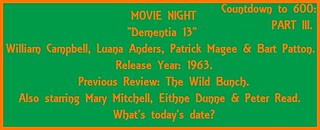
Movie Night: Dementia 13.


Review #592: Dementia 13.

Cast
William Campbell (Richard Haloran), Luana Anders (Louise Haloran), Patrick Magee (Dr. Justin Caleb), Bart Patton (Billy Haloran), Mary Mitchell (Kane), Eithne Dunne (Lady Haloran), and Peter Read (John Haloran) Directed by Francis Ford Coppola.

Review
This was the first mainstream film made by Francis Ford Coppola, and this was made only because Roger Corman had leftover money after making one of his numerous films (The Young Racers, which had some of the cast in this film), and Coppola made the story outline in about a day, with the production in Ireland. Corman did not like how the movie was after Coppola showed him the finished product, and so Corman demanded an additional death scene along with a prologue to be added, though the version I watched lacks the prologue. The movie has an eerie Gothic feel, with the castle being the backdrop. The plot is paper thin at times and sometimes odd, but in the end it all comes together to make a pretty well made movie. Coppola knows what he's doing and the cast does a fine job with the material. There aren't many murders, but at least the movie still enjoyable, even if the identity of the killer could be figured out by the halfway point. Take this for what it's worth, especially on this day, Friday the...13th. Yeah...Countdown to 600: 10, 9, 8...

Overall, I give it 7 out of 10 stars.