Review #1046: Barry Lyndon.
Cast:
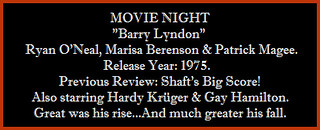
Ryan O'Neal (Redmond Barry), Marisa Berenson (Lady Lyndon), Patrick Magee (Chevalier du Balibari), Hardy Krüger (Captain Potzdorf), Gay Hamilton (Nora Brady), Godfrey Quigley (Captain Grogan), Steven Berkoff (Lord Ludd), Wolf Kahler (Prince of Tubingen), Marie Kean (Belle), Murray Melvin (Reverend Samuel Runt), Frank Middlemass (Sir Charles Reginald Lyndon), Leon Vitali (Lord Bullingdon), and Michael Hordern (Narrator) Directed by Stanley Kubrick (#044 - Full Metal Jacket, #065 - The Shining, #093 - 2001: A Space Odyssey)
Review:
The film was based off the 1844 novel The Luck of Barry Lyndon by William Makepeace Thackeray, with a few significant changes from the novel, such as utilizing a narrator over having Lyndon narrating. Barry Lyndon was Stanley Kubrick's tenth feature film, being released between A Clockwork Orange (1971) and The Shining (1980). It could be argued that this film isn't as well known as other films directed by Kubrick, with the film not being too much of a success on general release, although it has had a rise in reputation in recent years. When asked about his favorite Kubrick film, director Martin Scorsese said this about the film: "I'm not sure if I can have a favorite Kubrick picture, but somehow I keep coming back to Barry Lyndon." I can't say that this is my favorite film of his, but I will admit that this is a fairly neat gem that merits some respect. The best aspects of this film is its technical qualities and its finely constructed narrative, although it likely isn't the film for everyone. I can't say that O'Neal doesn't do a great job in the main role, but I also can't say that his performance isn't one of the weaker ones in the film, and it stems from his arc in the film. I think he does a fine job when it comes to trying (and failing) to fit in to the social ladder, but there are certain moments when he comes off a bit wooden, although he is never awful to watch on screen nor frustrating to see, capturing a nonredeemable man fairly well. Berenson does a fine job in her role, having a stillness and convincing nature to her that works to her advantage. Magee is a fair standout. The rest of the cast do their parts fairly satisfactory, fitting in with the look of the film without being distracting, like portraits in a museum. The narration by Michael Hordern is a key highlight, being quite fitting when he speaks that fits the moment quite well. This was a departure from the novel, which tells the events in first person through Barry. When asked about why he made the change, Kubrick stated that "[it] worked extremely well in the novel but, of course, in a film you have objective reality in front of you all of the time, so the effect of Thackeray's first-person story-teller could not be repeated on the screen." In any case, the narration works well for the mood and pace of the film.
The film won four Academy Awards, winning for Best Art Direction (given to Ken Adam, Roy Walker, Vernon Dixon), Best Cinematography (done by John Alcott), Best Costume Design (Milena Canonero, Ulla-Britt Söderlund) and for Best Original Song Score or Adaptation Score to Leonard Rosenman, for his arrangements of music of Franz Schubert and George Frideric Handel. Of note is that there are sequences in the film that were shot without resorting to simply using electric light, with special lenses being utilized for the film that had been developed for use in the Apollo moon landings, allowing scenes to be lit with actual candles, with other shots using certain lighting to try and mimic natural light. There are also numerous lengthy wide angle long shots that assist in the film having a static but fitting quality. The 187 minute run-time could be a bit of a deal breaker for someone looking for something a bit less slow, but others will find it to be a fine price to pay to appreciate the beauty in the film. On the whole, this is a magnificent film in its scope and its scale, having a certain quality to it that merits a watch.
Overall, I give it 9 out of 10 stars.