Showing posts with label Charles Drake. Show all posts

May 17, 2023

Winchester '73.

Review #2010: Winchester '73.

Cast: 
James Stewart (Lin McAdam), Shelley Winters (Lola Manners), Dan Duryea (Johnnie "Waco Johnnie" Dean), Stephen McNally (Henry "Dutch Henry" Brown), Millard Mitchell (Frankie "High-Spade Frankie" Wilson), Charles Drake (Steve Miller), John McIntire (Joe Lamont), Will Geer (Wyatt Earp), Jay C. Flippen (Sergeant Wilkes), Rock Hudson (Young Bull), John Alexander (Jack Riker), and Steve Brodie (Wesley) Directed by Anthony Mann (#1048 - He Walked by Night and #1408 - El Cid)

Review: 
"The very idea of changing my whole thing from the sort of shy, fumbling fellow to the western was just my work. It's all hard work and dedication, to be able to make a go of it. And those were the things offered to me."

James Stewart believed that the real change added in being more of a presence in Westerns when it came to a new phase in his career was the increase of vulnerability, one that differed him from presences in the same genre such as John Wayne. It probably helps that Stewart was now in his forties and was getting back into the thick of more roles in film since his return from serving in the Army Air Forces during World War II, whether that involved It's a Wonderful Life (1946) or Call Northside 777 (1948). As such, 1950 (just as it was in 1948) saw him in numerous starring roles: this film, Broken Arrow, Harvey and The Jackpot; Stewart got to do the film with Universal in tandem with them making Harvey, by the way. Stewart worked with a wide variety of directors over his career, but he would work with Mann on eight films from 1950 to 1958, five of which were Westerns. The film was written by Borden Chase (brought in by Mann to do a re-write and best known as the co-writer of Red River) and Robert L. Richards with a story by Stuart N. Lake, and it was a script that had been bounced around a bit before it became a film, which evidently had Fritz Lang tapped to direct at one point before that went down the wayside, and it was Stewart who had picked Mann (after seeing scenes from Devil's Doorway) to direct in the first place; Mann had done a share of noirs before breaking in better with Westerns, which he did a handful in the 1950s. For the rest of the decade, Stewart would be involved in a variety of box office hits while having a fair share of time spent in the Western, which would serve him just as well in the next decade. 

It's a pretty good movie, rounding all of the bases that you could see in a routine Western while having a main character with absorbing intensity. The odyssey on just how much one gun can affect the lives of others in the West is a curious one, one told with visual acuity. It is not just some frazzled innocent looking for his gun, this is a trip of bloodshed because of the human quality of wanting something so bad they could kill for it. In a row of gunslingers of familiarity and blood, the one who knows how to adapt to the situation is the one who come out alive with the weapon in their hand, which makes for a film that likes to summarize atmosphere for effect that seems fresh that has been used as an argument for starting its own wave of Westerns. The hero is not just a symbol of something decent in the West or something, now he is just a man looking to stay safe on the frontier, by any means necessary.  You see many types of people here, trying to go with the flow of the wind that get touched by the power of the gun, whether that involves Indian traders or would-be robbers, and it makes a riveting odyssey. 

Stewart clearly prepared for the role to the best of his abilities, right down to practicing handling a weapon (obviously he did not do the trick shots in the film, but you get the idea). He proves brilliant in a role that could've simply been one of blandness with an actor less determined to show vulnerability or interest in playing it straight down the line. His odyssey matters to how we care about the layers that get revealed about why it is more than just an odyssey for a gun, which makes the final confrontation (with a lack of music) that much better. McNally makes a quality presence to counteract him as the adversary, efficient in establishing the threat without missing a beat. Winters was quoted as not particularly understanding the role she played, once being quoted as asking, "What does that tell you about the values of that picture? If I hadn't been in it, would anybody have noticed?" Granted, it is hard being the one prominent woman in a cast, but she does fine with it anyways, a weary presence of battered patience.  Mitchell and Duryea make solid supporting presences to the action on either side of the coin in the odyssey (mostly for the latter, as one always likes the adversary taking a licking). The film is generally involving for its 92 minute runtime in showing what really mattered in the West without falling right away to easy tricks or bland dialogue, instead treating one to a patient story about just what it took to survive with more than just a weapon in stock. It takes a certain impulse and certain timing to differentiate one gunslinger from another, which is captured to lean effectiveness by Mann and company here.

Overall, I give it 9 out of 10 stars.

November 26, 2022

Valley of the Dolls.

Review #1931: Valley of the Dolls.

Cast: 
Barbara Parkins (Anne Welles), Patty Duke (Neely O'Hara), Paul Burke (Lyon Burke), Sharon Tate (Jennifer North), Tony Scotti (Tony Polar), Lee Grant (Miriam Polar), Susan Hayward (Helen Lawson), Martin Milner (Mel Anderson), Charles Drake (Kevin Gillmore), Alexander Davion (Ted Casablanca), Richard Angarola (Claude Chardot), Naomi Stevens (Miss Steinberg), and Robert H. Harris (Henry Bellamy) Directed by Mark Robson (#1797 - Home of the Brave)

Review: 
In 1966, Jacqueline Susann saw her first novel published in Valley of the Dolls. She had aspired to become an actress at a young age in the 1930s, and she got to appear in a handful of stage shows and television, but likely her most known quality was in commercials, which she wrote, produced and starred in for a number of years; she also had a habit of downing amphetamines (calling them "dolls") around this time, which apparently started not long after her son was diagnosed with autism and put into an institution when he was 3. In 1962, at the age of 44, she was diagnosed with breast cancer. She then made a pact with God to say that she would prove herself to be the best-selling writer in the world if she was given ten more years of life. Often called the first "brand-name" novelist, Susann became quite the show-woman in promoting books, and her first published work was Every Night, Josephine! in 1963 (inspired by letter she wrote to her pet dog). Valley of the Dolls, the work she is most famous for, came in 1966. Years after steamy novels like Peyton Place succeeded with readers (not with critics), Valley of the Dolls was a twenty-year odyssey in the lives of three young women who all happen to fall prey to drugs called "dolls" that featured other characters inspired by real-life stars such as Ethel Merman, Carole Landis, Judy Garland and Dean Martin. Fifty years after its release, the book has sold more than 31 million copies, and it inspired a film, a "continuation novel", two TV adaptations and a parody with Beyond the Valley of the Dolls (1970). A book into the process of making Valley of the Dolls called one of the most beloved bad book and movies of its time was written by Stephen Rebello in 2020. Robson was an interesting choice to direct. The Montreal native honed his craft as an editor before he became a director, directing 34 films from The Seventh Victim (1943) to Avalanche Express (1979), with a number of the films seeing him also serve as a producer. Harlan Ellison, Helen Deutsch, and Dorothy Kingsley were brought in to work on the script, although Ellison hated what they did to the book and requested his name taken off - imagine a book that already sees a character kill themselves and another go off the wagon ending on a breezy note. Two further adaptation of the five novels Susann wrote have followed: The Love Machine (1971) and Once Is Not Enough (1975). In 1974, after over a decade of a battle with cancer, Susann died in 1974 at the age of 56.

Just like the film adaptation of Peyton Place (released in 1957 with Robson as director) and Sex and the Single Girl, the book really is steamier than the film it came from, since the book featured elements of homosexuality in both men and women. Of course, the movie takes place in the current day rather than the book timeline from the mid 1940s to the mid 1960s. Jacqueline Susann saw the film on a cruise ship premiere, and she thought it was crap, although she kept that opinion to herself so to not give the movie an early thrashing...which came plenty (probably didn't help that the casting wasn't what she wanted, since she wanted people like Ursula Andress, Bette Davis, Shirley MacLaine and Elvis Presley for the lead roles). The movie and book ended up reflecting each other: audiences dug it while critics trashed it. The movie is an explosion of gloss and grooviness that looks like it was processed in the 1950s that makes a tale of sexual liberation and the entertainment industry seem quite amusing. Adultery, divorce, addiction and deviancy seem like something pulled from the silliest of moral stories.  It's no wonder why she didn't care for it: it's a movie that doesn't know what foot to put in front of the other and looks like a soap opera run amuck. Parkins is just the everyman character, firmly in the middle of weirdo things happening around them with the appeal of a broomstick stuck in a schmaltzy molasses. You might say a normal-ish person is the ideal among all the weirdness, but ordinary isn't always fun. Apparently, Duke wanted to do the film to help transition her into more adult roles, since her role was the most dynamic (she had won an Academy Award for playing Helen Keller in The Miracle Worker and she also had her own TV show). She even gets the opportunity to sing (dubbed by Gail Heideman). The funny thing is that the movie nearly walloped her career, although really, she does pretty well in the art of eating the screen. She eats the screen in all the ways one would hope. Tate is okay, at least because Burke and Scotti are blander. Judy Garland was originally cast in the role later played by Susan Heyward, and promotions were done with that in mind, and she would get to sing a song, which was pre-recorded. After a week, she suffered from her dependence on alcohol and Demerol that saw her get fired from 20th Century Fox. Apparently, on the final day, Robson made her wait until 4pm to film her scenes after making her wait since 8am, in the belief that she would be upset and drunk at the time (so yes, if you believe the account from Duke about Robson, the latter sounds like an asshole). Heyward, an Academy Award winner, is decent in terms of vaunted confidence without particularly having much to really do besides one scene of Duke fighting her over who has the fake appendage on and how to go on. Grant seems to be shuffling through as if the paycheck is just tempting enough to go on. Eh, the movie is as it is: silly but mostly watchable, if one accommodates it being more for the experience rather than a full collection of interesting people. Sure, people think it may be a camp classic with its stylistic kitsch or maybe a revealing look into the struggles of women, but in the end, it all boils down to an absurd and amusing affair that can be thought of as a fantasy for whoever is watching: the gossip-obsessed people desiring a pop event, or people looking for a silly crappy movie to watch (or maybe gay people that look to reclaim the film as a camp classic, but I will let you decide that, since I'm not here for that). In that sense, 55 years has given Valley of the Dolls is overwhelming in the best and worst ways that could only come from a certain time and certain perspective. 

Overall, I give it 6 out of 10 stars.

Well, we have reached the ninth and final film of Turkey Week. I really wanted to scrap the bottom of the barrel in terms of movies fitting for the label of "turkey" for Turkey Week. Since the first two Turkey Weeks had eight reviews, I wanted to try and include at least one more movie than what I did before, and I can say that there were a few candidates that missed the cut that may be considered for next year

The Scarlet Letter (1995), Turks in Space, Sidekicks, Verotika, An American Hippie in Israel, The Legend of the Lone Ranger, and The Conqueror

Any and all suggestions are welcome for next year.

December 6, 2020

Harvey.

Review #1607: Harvey.

Cast: 
James Stewart (Elwood P. Dowd), Josephine Hull (Veta Louise Dowd Simmons), Peggy Dow (Miss Kelly), Charles Drake (Dr. Lyman Sanderson), Victoria Horne (Myrtle Mae Simmons), Jesse White (Marvin Wilson), Cecil Kellaway (Dr. William Chumley), William H. Lynn (Judge Omar Gaffney), Dick Wessel (Bartender Mr. Cracker), Nana Bryant (Mrs. Hazel Chumley), Grayce Mills (Aunt Ethel Chauvenet), and Clem Bevans (Herman Shimmelplatzer) Directed by Henry Koster.

Review: 
"I must say it was a complete, one hundred percent pleasure, the whole picture. I had the most wonderful performers. The spirit of Harvey, that splendid and helpful ghost, was always with us while we did it."

What does one expect from a movie involving an eccentric lead that has a six-foot (and 3 1/2 inches) invisible rabbit for a best friend? Plenty, if you can believe it from a film celebrating its 70th anniversary. I'm sure at least one of my readers has had an imaginary friend that lurked in their lives, and I remember having one to talk my thoughts with out loud (it didn't have a name, however). Harvey first began as a play of the same name, written in 1944 by Mary Chase. She was awarded a Pulitzer Prize for Drama the following year for the play. Its original production ran for five years on Broadway, which originally featured Frank Fay as the lead with Josephine Hull in the secondary role. There were various actors that would take over the role during that run, which included actors such as Joe E. Brown and James Stewart. He managed to snag the role in a deal with Universal-International that meant he would be cast if he agreed to be the star of Winchester '73 (1950), which arguably played a great role in his second phase of stardom. Stewart would play the role again on the stage numerous times, including a revival on Broadway and a run on the West End as well as a TV adaptation in 1972 (done between two other TV adaptations, which had Art Carney and Harry Anderson as leads, respectively). He would note this as one of his favorite roles, reflected as such by him in a special introduction he did for the release of the film onto video in 1990. If you can believe it, Chase wanted the film to show the rabbit at the end, as if to show that the lead was not in fact just a drunk - the studio decided to not do so, instead going with for the final shot of the movie a credit for the title character that shows a door quietly being opened as "as himself" title appears (besides, he technically makes an appearance - in a painting with him and Stewart). This was a film in the middle of the lengthy career of Henry Koster, who grew up interested in cinema from a young age growing up in Berlin, Germany. He grew up to become a screenwriter for German films before moving into directing with Thea Roland (1932) before leaving for Austria and later the United States before World War II started. Koster would direct numerous films in three decades of work (for a variety of studios, most notably with Universal Pictures), directing a variety of genres such as musicals and comedies (including discovering Abbott and Costello that led to them being hired for films) - simply put, it is long overdue to look upon his career.

Chase and Oscar Brodney wrote the screenplay, while Myles Connolly did uncredited contribution as well. So how goes the film with plenty of calm whimsy? Oh, it's a fine one, one that honors its stage roots to make a well-mannered adaptation into film. With Stewart at the helm, he makes the experience all the more useful in quiet endearing charm, which one can expect from a number of his performances in a lengthy career, but this one fits right at home with what is needed here, because he doesn't make it out to seem like one is waiting for a joke to arise, as he is instead a bit stooped over with kindness (since the shots make it look like there really is someone near him to begin with). It may not be a great film, but it is nice to see that no one has tried to remake it into a theatrical effort since this one. While this was only the fourth of five film roles for Hull, don't let that fool you into seeing the talent within, because she was a stage actress for fifty years, going from stock to chorus girl to eventual star. She makes a worthy mild tempered foil to go with Stewart, one that has the interesting act of having to believe and not believe in the title character at the same time. In other words, this is a fine film where either Stewart or Hull can be thought of as easy to go along with. Others do fine in keeping up, such as a fair duo with Dow and Drake in clinical straight folks, alongside quirks such as White and Kellaway in interaction spent with Stewart and/or Harvey.  It balances its main quirk with reasonable pace at 104 minutes and a few interesting performances to go alongside Stewart that delivers some chuckles that keeps its main focus from devolving into farce with simple wisdom in one key thing: normal humans may be stinkers, but that doesn't mean one that happens to believe in a friendly spirit like Harvey is dangerous to you or me. Basically, you could shorten it to "be yourself", but without the eye-roll that comes at times to folks because of the struggle that comes to wrestle with reality in offbeat ways. In any case, one's enjoyment of the film is all up to your imagination, which goes with the amusement of errors that happen throughout its runtime. What we have is a light-hearted winner in bending the usual expectations seen in comedy-dramas, one with no need for an adversary or a romance to carry itself along, instead relying itself on the folksy charm of Stewart and a pooka to carry your imagination anywhere it wants to go. Sometimes, that is more than enough for a fine time, whether for 1950 or 2020.

Overall, I give it 8 out of 10 stars.

October 12, 2013

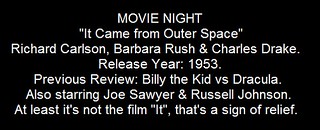
Movie Night: It Came from Outer Space.


Review #464: It Came from Outer Space.

Cast
Richard Carlson (John Putnam), Barbara Rush (Ellen Fields), Charles Drake (Sheriff Matt Warren), Joe Sawyer (Frank Daylon), Russell Johnson (George), Dave Willock (Pete Davis), and Robert Carson (Dugan) Directed by Jack Arnold (#420 - The Incredible Shrinking Man)

Review
With a title like that, expecting a monster/alien is expected, without a doubt, and that certainly is accomplished, but the film manages to be more than just an "alien invades the earth" story, and though it's not a great science fiction film, it certainly is a very passable one. The actors aren't bad, given their characters. The film was originally released in 3-D, which is incredibly obvious even 60 years later, with some shots from the 1st person POV of the aliens, which even without 3-D is actually kind of creative. The film is alright to look at, and the makeup isn't that bad. The story (By Ray Bradbury) and the screenplay (by Harry Essex) are finely written, a film not easy to ignore, and it doesn't run too long, so it's easy to watch without being bored. I'd recommend this for anybody looking for some classic 50's science fiction (or sci-fi, whatever name sounds better to say) to watch.

Overall, I give it 8 out of 10 stars.