Showing posts with label Miloš Forman. Show all posts

August 4, 2023

The Fireman's Ball.

=
Review #2067: The Fireman's Ball.

Cast: 
Jan Vostrčil (Head of Committee), Josef Šebánek (Committee Member #2), Josef Valnoha (Committee Member), František Debelka (Committee Member #1), Josef Kolb (Josef), Jan Stöckl (Retired Fire Chief), Vratislav Čermák (Committee Member), Josef Řehořek (Committee Member #4), Václav Novotný (Committee Member), František Reinstein (Committee Member), František Paska (Committee Member), Stanislav Holubec (Karel), Josef Kutálek (Ludva), and Milada Ježková (Josef's wife) Directed by Miloš Forman (#1164 - One Flew Over The Cuckoo's Nest, #1473 - Amadeus)

Review: 
The story goes that this film was inspired by a friendly trip to a little town for a ball. Miloš Forman had just directed Loves of a Blonde (1965) through the collaboration of writing with Ivan Passer, Jaroslav Papoušek, and Václav Šašek. Apparently, Forman and company were trying to concentrate in trying to do another screenplay that would be the third film involving Forman as director within his native Czechoslovakia. They decided to go to a town called Vrchlabi to write in a hotel but went to a firemen's ball for amusement. What they saw inspired Forman and the others due to how they couldn't stop talking about how it was "such a nightmare". The result was a film of two distinctions: it was Forman's first color film, and it also would be his last film in his homeland, as he would switch over to the United States afterwards for films starting with Taking Off (1971). The film has had pretty favorable reviews in the half-century since release, although at the time, there were objections raised by some, because, well, fire companies apparently don't take nicely to films that seem to make fun of them (to the point where a little tour by Forman was needed to dispel that). The Prague Spring in 1968 curtailed the viewing power of the film for later years, but it was an audience hit for its time, and it also received a bit of distribution abroad. A select group of the actors involved with the film were actually people who were firemen in the small town that the film was shot in.

What we have here is basically a long setup for one big cosmic joke in 73 minutes, if you think about it. The setup in trying to do a ball in a small town with a raffle and a beauty pageant is handled by the volunteer fire department in a way that is squeezed for such wonderful satire. The satire of course isn't spelled out for you here, because Forman actually stated his intentions of being real and true that if achieved right, would "automatically reveal an allegorical sense." As such, it is an allegory that can be looked at in numerous perspectives beyond just poking at its root in a Communist country, particularly since you can always find something amusing within the best-intended plans in authority and bureaucracy. Well, that, and the evident cracks in the morals of a supposed nice small town where just about anything is possible in evanescent values when things basically become a case of one domino falling on top of another. There isn't exactly one big standout among the ensemble of bumblers, but that really just means they fit so well within the structure of the film in a collective showing of amusement for satire. They are locked in the roles that are needed in trying to serve what might be a serious story in a different world (doing a ball for their old boss dying of cancer) that ultimately sees them being about as effective in doing a ball as they would in trying to run a lemonade stand. The film is basically tied to two places: the venue where they host this ball and a sequence involving them trying to volunteer their services for an actual emergency involving a fire. Interpret how you like about how effective the film is with whatever sequence ranks best in effectiveness, although it is entirely possible that the opening sequence may go the best of all, since it involves such best-laid plans of trying to be sweet going right in with subsequent bumbling of a man on a ladder. The attempts at a beauty pageant also prove pretty biting in amusement, but my favorite moment of all involves an attempt to show order by turning off the lights in an attempt to give the crooks a chance to return the stolen goods only to find futility. As a whole, it is a pretty diverting film to spend time within the staging from authority for a certain goal that only goes to show how vision collides with reality in the strangest ways possible. For that, it is a pretty good start to go with in for Czech recommendations.

Overall, I give it 9 out of 10 stars.

Next Stop: a film from....India.

July 15, 2020

Amadeus.

Review #1473: Amadeus.

Cast:
F. Murray Abraham (Antonio Salieri), Tom Hulce (Wolfgang Amadeus Mozart), Elizabeth Berridge (Constanze Mozart), Roy Dotrice (Leopold Mozart), Simon Callow (Emanuel Schikaneder), Christine Ebersole (Caterina Cavalieri), Jeffrey Jones (Emperor Joseph II), Charles Kay (Count Orsini-Rosenberg), Kenneth McMillan (Michael Schlumberg), Kenny Baker (Parody Commendatore), Lisabeth Bartlett (Papagena), and Richard Frank (Father Vogler) Directed by Miloš Forman (#1164 - One Flew Over the Cuckoo's Nest)

Review:
"Director is little bit of everything, little bit of the writer, little bit of an actor, little bit of an editor, little bit of a costume designer. Good director is the director who chooses for this profession people who are better than he is."

Milos Forman directed twelve films (and one documentary segment) in his life, one comprised of life in Czechoslovakia and abroad in the United States, recieving stature in both places through his interesting films, which started with Black Peter (1964) after years spent studying at the Film and TV School of the Academy of Performing Arts in Prague alongside writing work in Czech comedies, which served as his genre for the three films he made in his native country (with The Firemen's Ball (1967), the last before he left the country, being considered a key piece of the Czechoslovak New Wave) before he left in 1968 due to changes in the country. His films in America were a mix of adaptations of numerous media or biographical in nature (with measured success), which resulted in successes such as One Flew Over the Cuckoo's Nest (1975), this film, and Man on the Moon (1999).

The film is adapted from the play of the same name by Peter Shaffer (an English playwright behind works such as Equus that served as writer for the film), which had first been performed in 1979 in London (with a Broadway production in 1980). The play took artistic licence in its depiction of Mozart and Salieri, describing the work as "fantasia on the theme of Mozart and Salieri". This was not the first play to push forward the myth (or to be more blunt, a lie) involving Salieri having a hand in the death of his supposed rival Mozart (with one key point of anger being at Mozart's boorish behavior while being a genius), with famed Russian poet Alexander Pushkin having composed the play Mozart and Salieri in 1830 (with an opera being done by Nikolai Rimsky-Korsakov 67 years later). The idea that the two composers were such rivals to the point that one of them may very well have wanted to kill the other is absurd, full stop (I am not a history buff by any means, but anything that resembles the reek of conspiracy theory is suspicious). This fundamental point is the first and really only hurdle that stops it from being considered a great film for me. It does have a great design to it in terms of costume design, alongside a great appreciation for music (with Neville Marriner serving as music conductor and supervisor for the Academy of St Martin in the Fields orchestra) and a fairly well-rounded cast to go alongside everything (including natural light and location shooting in Prague, most notably in the Count Nositz Theatre, where Mozart had performed in) that is delivered with precision by Forman to make a mostly successful curiousity on the nature of talent and genius. There exists two versions of the film: the original 161 minute film (rated PG) and a three hour (R-rated) version released in 2002 as a Director's Cut that restored scenes cut originally due to not wanting to test the audience's patience too far in run-time (for a project that was hard enough to finance about a period drama).

It proves fitting to have Abraham and Hulce as the leads (as opposed to any of the stars from the play adaptations, which included Ian McKellen and Tim Curry - Forman wanted American leads for the two roles), since they each had experience in the theater just as much as in film. Abraham proves a tremendous presence, one wracked with desire and regret as a self-described "patron saint of mediocrity" that we can all see a little bit in ourselves that makes the most of his time count with gravitas. Hulce (and his occasional dreadful laugh) does just fine with capturing the complciated essence of a troubled genius, eccentric but captivating to see in a pursuit of greatness with tinges of hedonism along the way. Berridge (who won the role after Meg Tilly injured her way out) makes for a quietly driving force to follow along with at times with Hulce with bright spirit. The others in the cast, such as Doctrice and Jones, make for fair impressions in rounding out a period drama with a good deal of importance and distinct pleasure that retains one's attention just as much as when not on Salieri and Mozart alone. On the whole, the film moves at a careful pace within a curious starting point to generate a fairly interesting look upon music and human nature (namely, ambition) that will keep attention for what is needed with music and a game cast and design to make a mix of history and fiction that makes a solid film for its time of over three decades.

Overall, I give it 9 out of 10 stars.

November 28, 2018

One Flew Over the Cuckoo's Nest.


Review #1164: One Flew Over the Cuckoo's Nest.

Cast: 
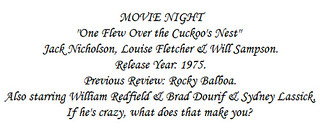
Jack Nicholson (Randle McMurphy), Louise Fletcher (Nurse Ratched), Will Sampson ("Chief" Bromden), William Redfield (Dale Harding), Brad Dourif (Billy Bibbit), Sydney Lassick (Charlie Cheswick), Christopher Lloyd (Max Taber), Danny DeVito (Martini), Dean Brooks (Dr. John Spivey), William Duell (Jim Sefelt), Vincent Schiavelli (Bruce Frederickson), Michael Berryman (Ellis), Nathan George (Attendant Washington), Marya Small (Candy), and Scatman Crothers (Orderly Turkle) Directed by Miloš Forman.

Review: 
One Flew Over the Cuckoo's Nest was originally a novel by Ken Kesey that he had done based off his time working as an orderly in a mental healthy facility, for which he wrote the novel in 1959 before it was published in 1962. In the original novel, the story was narrated through the character named Chief Bromden, who found that society was controlled by some sort of system called "The Combine". A year after the novel was released, the novel was turned into a play, written by Dale Wasserman that had McMurphy played by Kirk Douglas, who had bought the rights to make it for the stage or for film. After a decade of trying to make it into a film, he gave the rights to his son Michael, who helped co-produce the film along with Saul Zaentz, with Lawrence Hauben and Bo Goldman doing the screenplay. The film was primarily filmed at Oregon State Hospital in Salem. Kesey was not happy with how the film adaptation came out, later suing Douglas and Zaentz for a percentage of the gross and damages for “breaking our verbal agreement and ruining the book.” He objected to the fact that the film was from the perspective of McMurphy rather than the Chief, describing it as such: "they took out the morality; they took out the Combine—the conspiracy that is America.”

At any rate, it isn't hard to see why the film is fairly enjoyable, having a certain kind of energy and pull with a fine deal of craftsmanship and interesting people to follow along with. Nicholson and his rebellious presence give a great magnetic pull for the film, bemused at having to deal with the state of the people on both sides of this mental institution that he deals with, while also having a bit of humor and will to him that makes for good entertainment. Fletcher plays her insidious role with a good degree of understated manipulation, having no sense of overblown nature nor being overshadowed by the other members of the cast, having a voice and enough presence to make this battle of wills work without too many hitches. One good scene with Nicholson and Fletcher that I can highlight is the scene where his character tries to get the television to be turned onto the World Series, where he tries to get the necessary amount of votes from the submissive ones in the ward and her attempts to assert her authority, complete with an ensuing (and amusing) act of defiance - imagining the game out loud. Sampson, who had been discovered by the producers due to his 6'7 frame, does a fine job for his acting debut, doing just alright with the small amount of lines he has while playing his part in the climax without any hitches. Dourif and Lloyd (who both had done work on the stage prior to this film) shine in their own ways, with the former's fear and willingness to try and please everyone coming out fairly well and the latter being amusing when picking on Redfield. Lassick does well with conveying panic and nervousness, and DeVito (reprising his role from the 1971 revival of the play) also does fine with brief moments to talk.

The film does take some time to show the conformity and mindless automation of the people in the ward, and for the most part the film keeps itself consistent. The fishing sequence is a bit of a miss when compared to other sequences in part because it just feels a bit too silly that kind of messes with the rest of the film's tone. It should be mentioned that the fishing sequence was present in the novel, although it has a few significant differences - such as the fact that the trip is planned in the book, for example. In any case, it's a bit of a understatement to say that the film turned out to be such a great success, being a hit with audiences while winning numerous awards, winning what is described as the Big Five categories of the Academy Awards: Best Picture (beating films such as Jaws and Nashville), Best Director, Best Actor, Best Actress, and Best Adapted Screenplay. On the whole, the film is pretty entertaining, having an enduring spirit to it that makes it work more often than not in its 133 minute run-time. It still manages to hold up well after over forty years since its release with a game cast and an enduring spirit that makes for at least one watch.

Overall, I give it 9 out of 10 stars.