Showing posts with label 1926. Show all posts

July 9, 2023

The Strong Man.

Review #2036: The Strong Man.

Cast: 
Harry Langdon (Paul Bergot), Priscilla Bonner (Mary Brown), Gertrude Astor (Lily of Broadway), William V. Mong (Holy Joe), Robert McKim (Mike McDevitt), and Arthur Thalasso (Zandow the Great) Directed by Frank Capra (#102 - Mr. Smith Goes to Washington, #319 - It's a Wonderful Life, #456 - It Happened One Night, #1356 - Meet John Doe)

Review: 
"If there is any shortcut to fame and fortune in motion pictures, it is as a gag man. Here you may jump to the top overnight, after the short probationary period, which is long enough to show you whether you have the stuff that makes gag men." - Frank Capra

"Comedy is a satire of Tragedy...deliciously comic moments, on the outside, are full of sad significance for those who realize the sinister characterization of the situation.” - Harry Langdon

In 1926, Frank Capra made his feature film debut as a director. But I'm sure when you think about Capra, you think first of those iconic films he did in the sound era such as It's A Wonderful Life (1944). But the story of Capra is one with plenty of interesting turns beyond just being a television staple every year. The son of Roman Catholics who left Italy for America when he was five, Capra studied chemical engineering at the California Institute of Technology but found himself having to do quick little jobs to get by during and after college, one of which involved selling books. He entered the film industry because when a film studio opened up in San Francisco, he implied he had "film experience" that got him into the door of directing various little films and getting himself other jobs, and one of those was as slapstick comedy director for the famed Mack Sennett, which he did in two separate stints in 1918 and 1924, with other stints in between including Hal Roach's Our Gang. Sennett, who had his own film stage and studio with Keystone, was once known as "King of Hollywood's Fun Factory", and various people appeared in Sennett productions that ranged from Harold Lloyd to Gloria Swanson (of course, the apparent talents of the actor vs. influence of Sennett is an interesting point to raise). Capra would direct his first film (12 minutes) with the independent Fireside Productions in 1922 with Fultah Fisher's Boarding House, which he also wrote, casted and edited based on the poem "The Ballad of Fisher's Boarding-House" by Rudyard Kipling. And then of course there is Harry Langdon. The Strong Man is one of two films that he made as star and producer with Capra, with the other being Long Pants (1927). In 1925, Langdon had signed a deal with First National Pictures that let his corporation (named after him) have full creative control to produce movies.

Admittedly, Harry Langdon was basically forgotten by me for a long time when it comes to mentioning the big names of the silent comedy era. Remember that his first feature was Tramp, Tramp, Tramp (1925), which was a success for the man once referred to as "The Little Elf". But Harry Edwards did not return to direct the next Langdon feature due to going overbudget. Online spelunking reveals several writers, with Arthur Ripley credited for the story while having Hal Conklin and Robert Eddy being labeled as "adaptors" and Reed Heustis for titles to go along with other writers with Tay Garnett, Clarence Hennecke, James Langdon, and Tim Whelan. One thing I can say about Langdon is that breaking into film when one is nearing their forties is quite remarkable. The Iowa native had honed his craft within medicine shows, vaudeville, and stock performances, so he obviously had an in-route to being a film presence that could both differ from the usual expectations that had come from being in league with Mack Sennett for the short films (i.e. Langdon was not a frantic comic) and the comic presences of the time that rivaled him in stature (to put it in perspective, in a film essay for 1949, Langdon was thought to be one of the four kings of silent comedy but the first biography of Langdon did not come out until 1982). All of this makes for saying he was a worthy pantomimist that makes for a useful team with his director in Capra (who knows who came up with a lead character being a Belgian emigrant) that does within careful pacing for a generally sweet feature. It is warmly funny in a way that feels entirely his own within an episodic structure (roughly five of them) with a handful of highlights, whether that involves him asking around just who "Mary Brown" is on every corner to the point where he falls under the situation with a vamp that leads to an amusing chase in a big house. Of course, the sequence involving him trying to help with a cold while on a packed trip that leads to him picking the wrong batch to rub over his chest (cheese!) is likely the most amusing sequence in execution that rewards timing. While Bonner does not have as much screentime as one might think about when it comes to doing a silent comedy with a "love interest", she does fine with the material presented here, with the sequence of the two meeting each other in town and sharing just who they've been since "The War" being a sweet little moment in understanding. By the time the film gets to its climax (for a film that runs at 75 minutes) involving a big coat and a cannon, the movie has shown the talents of its star within clownish rhythm that will please fans of silent comedy in what they see from one of the big names that came across at the right time for it.

Overall, I give it 8 out of 10 stars.

January 7, 2022

Tramp, Tramp, Tramp.

Review #1784: Tramp, Tramp, Tramp.

Cast: 
Harry Langdon (Harry), Joan Crawford (Betty Burton), Edwards Davis (John Burton), Tom Murray (Nick Kargas), Alec B. Francis (Amos Logan), Brooks Benedict (Taxi Driver), and Carlton Griffin (Roger Caldwell) Directed by Harry Edwards.

Review: 
You may be wondering just what is so important about a movie like this, considering its inauspicious title. Well, it really is more about the star more so than the director, although the star and director generally should each have their own share of credit for when a comedy does as well as it should. So here we are with Harry Langdon, a presence in vaudeville and film for nearly four decades. Sure, folks will probably remember Chaplin, Keaton & Lloyd first as the silent comedy icons, but Langdon had his own measure of importance as a silent icon, albeit with less feature films to consider. The Iowa native started work in shows and stock companies as a teenager in the turn of the 20th century. A run in vaudeville was later followed his most famous association: Mack Sennett and his studio, where his pantomime act being quite popular in various short films. It was his work with Harry Edwards and writers Frank Capra and Arthur Ripley that is best known today. He also did a series of features in the latter part of the 1920s, for which three are generally known: this one, The Strong Man (1926), and Long Pants (1927) - the middle film incidentally was the debut of Capra as director. Langdon soon decided after two films with Capra to direct his own films; his three silent efforts (one short) did not fare well (although none are available to see for oneself), and the impending transition to sound in Hollywood likely did not help either; Capra once stated Langdon did not know why his persona was funny, while a producer once described him as "not so funny articulate". While he never became a major star after the end of the silent era, he did keep busy with roles (supporting ones in features and shorts) alongside writing until his death in 1944 at the age of 60. As for Edwards, this was one of only two feature films that he directed, since he was more of a shorts director (doing 150 of them in a three-decade career), although his reputation was not the highest, as his work with the Three Stooges would suggest - they made two shorts together before the group requested that he never work with them again.

Langdon has a persona was certainly interesting for folks to try and pin down about his appeal, one that certainly had a clownish and unique sensibility (one whose attempts at drawing amusement from his little gestures certainly seems different from Keaton). In a sense, it was a persona that was a bit child-like and perhaps just offbeat enough to generate laughs for the time. Of course, one may be wondering just what this film is about. Well, it is about a guy trying to help his dad save his shoe store and woo a woman by winning a cross country foot race across the country with a $25,000 cash prize. Yep, that's about it. The movie, running at an hour in length, is basically composed of a bunch of vignettes involving a child-like pantomime in Langdon going around getting into weird situations, whether involving sheep, prison work, or a cyclone. While one can see pretty easily why his persona may not have been long for the cinema world past the silent era (in terms of the time and as star), one can still find a good deal to appreciate about the efforts of Langdon and Edwards in crafting an energetic and quirky feature with plenty of interesting amusing sequences that he does well with, moving around with confidence and a face ripe for gesture to make useful gags. Strangely enough, it also features Joan Crawford in an early role, one in the midst of her attempts to promote herself as a film star that would merit success soon enough; she doesn't have much to really do, but she at least matches fine with Langdon in those attempts at warm chemistry. The segment with the prison (where he switches tools a few times) is quite amusing, although the cyclone sequence at the end does seem to be the most effective chuckler among the group of vignettes designed to show our quirky hero. The film ends with him playing a baby (because the two leads fell in love, as was pretty much every silent comedy of that time), which is probably just as weird to consider as it is to write that sentence, although it is amusing. At any rate, no matter where one considers Langdon's place in terms of the noted silent comics of Hollywood, one can't deny that Tramp, Tramp, Tramp (1926) is a solid effort worth checking out.

Overall, I give it 8 out of 10 stars.

Next Time: I Was Born, But... (1932)

October 5, 2021

The Magician (1926).

Review #1732: The Magician.

Cast
Alice Terry (Margaret Dauncey), Paul Wegener (Oliver Haddo), Iván Petrovich (Dr. Arthur Burdon), Firmin Gémier (Dr. Porhoet), Gladys Hamer (Susie Boyd), Henry Wilson (Haddo's Servant), and Hubert I. Stowitts (Dancing Faun) Directed by Rex Ingram.

Review: 
Admittedly, certain names fade in and fade out from the annuals of film history, regardless of whatever reputation is meant to precede them, particularly for folks in the silent era. As such, it is always a pleasure to reach another name in that particular era, and it just so happens that this director's path crossed in the lines of horror with an already familiar face. Rex Ingram was borm in Ireland in 1892 and emigrated to America at the age of 19. While he studied sculpture at Yale University, he soon moved to film in the early 1910s, dabbling in acting work before becoming a producer-director that made his debut with The Great Problem (1916). His first notable film came with his shift to Metro Pictures (eventually known as MGM after mergers) with The Four Horsemen of the Apocalypse (1921). In 1924, tired of studio influence, he moved to France and started his own little studio in the region of Nice, and Mare Nostrum (1926) was the first feature he made in this voluntary exile. The slow demise of the silent era led to Ingram shifting his attention away from directing, with his final film being his only sound feature in Baroud (1932) before he shifted to sculpting; Ingram died in 1950 at the age of 58. He was noted by contemporary filmmakers as one of the best, most notably being called the world's greatest by Erich von Stroheim and being called one of the four top creative folks in Hollywood by an MGM chief; this also included his influence with a young Michael Powell, who worked various odd-jobs at the studio (which included a small spot here in comic relief), with Powell later calling him one of his biggest influences. 

Until 2011, one couldn't find the film on DVD, although for several years it had been shown in film festivals and on television after having been thought to have been lost (believed as such by books describing it as lost that were written in the late 1960s), so it is worthy to get to enjoy its 88 minute run-time un-intruded. It is entirely possible to see where Ingram might have lost his interest in filmmaking when the opening credit lists him as "Supervisor" (incidentally, this was his fourth-to-last feature). But hey, making films in your own little studio can't be all bad, and this film does quite well in making little atmospheric moments count, particularly since this is the first and only time with Paul Wegener in an American film. As such, this is an adaptation of W. Somerset Maugham's 1908 novel of the same name (reportedly, occultist/magician/poet/painter Aleister Crowley served as the model for the title character, and Crowley later accused Maugham of plagiarism). Sure, one could say horror films in America became prevalent with the dawn of sound, but that would seem to erase the seeds that were grown with films in the silent era, whether with The Phantom of the Opera (1925) or this one, for example. Think about it: we have a title character that likes to command folks with his piercing eyes while dabbling in kidnapping and body snatching with a director that makes things look nice. Hell, he even has his own laboratory with a hunchback and the ability to help show someone a version of Hell as some sort of orgy of the damned in imagery. Of course, the film is considerably different than the source material, which actually involved the plan to use innocent blood to create life actually being accomplished, albeit with differing results. Undeniably, the spotlight shines mostly on Wegener, who certainly had quite the reputation from the cast and crew (Powell stated later in his memoirs that Wegener had just one idea and expression as if "to open his huge eyes even wider, until he looked about as frightened as a bullfrog."). If he is thought of a outdated ham, then it is the credit of Wegener that it is generally welcomed (at least, here anyway) to play it like that, because who doesnt see that coming here? With stuff about hypnotism and title cards saying how he looks like he came out of a melodrama, he plays the adversary right down to the entertainment bone, and he draws all of the interest (perhaps to the detriment of his stars). Let's be honest: how many old horror movies do you remember besides the guy who played either the hero or the villain? That isn't to say Terry is forgettable, but as long as things seem fair and no one tries to look silly, you generally have the makings of a fine silent film already. The folks in the cast do just fine, although the best sequence with anyone is shared with Wegener, such as the case with a snake scene where he claims to be able to withstand a venomous bite; somehow, they aren't pleased with the result, mostly because some poor soul gets bitten right after and dies. The scenes at the end with the lab are pretty interesting to look at, as if the clichés about a dark and stormy night in a lab all sprang from this (or perhaps needed a few years...). As a whole, it is the bombast of how Wegener draws one in that keeps the movie afloat, and he does a worthy job with what is needed that plays to the curious stage without being broken down by it. While it may have languished in obscurity for a time, there has never been a more perfect occasion to seek this one out, a fair player in the building blocks of American horror in all of its curiosities of star and director. 

Overall, I give it 8 out of 10 stars.

Next Time: Dracula, 90 years later. 

September 24, 2021

The Son of the Sheik.

Review #1726: The Son of the Sheik.

Cast: 
Rudolph Valentino (Ahmed / The Sheik), Vilma Bánky (Yasmin), George Fawcett (Andre), Montagu Love (Ghabah), Karl Dane (Ramadan), Bull Montana (Ali the Mountebank), Bynunsky Hyman (Pincher the Mountebank), and Agnes Ayres (Diana, The Sheik's Wife) Directed by George Fitzmaurice.

Review:  
“Women are not in love with me but with the picture of me on the screen. I am merely the canvas on which women paint their dreams.”

It is interesting to consider the lasting legacy that comes from a film like this, one with numerous aspects to consider. For one thing, it is one of the earliest examples of something that seems quite common now: the sequel. Believe it or not, folks did not exactly yearn for franchises and endless adventures with the same folks back in the silent era. Of course, this isn't to say that sequels were entirely void in that time, since there were quite a few novel sequels to various works (Tarzan, the Oz series, you get the idea); by the time of the mid 1920s, the movie industry had a glut of demand for features from audiences that producers were at a task to re-produce with formulas to keep the folks entertained (one producer once compared turning out films to being like a frozen custard machine). One must consider how this relates to Valentino, of course. All knowledgeable folks of film know Valentino came to prominence from the shadows of menial jobs (like dancing) and bit parts with The Four Horsemen of the Apocalypse (1921), and the release of The Sheik (based on the novel of the same name by E. M. Hull) that same year cemented his lover image into the eyes of many viewers. Fame, as one might expect, does not mean long lasting success, obviously. Valentino soon developed a hatred of the sheik image (one that women loved but men hated, go figure), and he found himself unhappy in his own love life (which included a bigamy charge) that crashed right with having troubles with Famous Players-Lasky that included a strike and lingering debts (which meant that he did not do a film in 1923). At any rate, Valentino may have hated the image that made him the "Latin lover" icon, but he needed to work. What better way to do a comeback for United Artists than to make a film that touched upon his earlier success? After falling out with Lasky, he landed with UA and starred in The Eagle (1925), which was a fair hit. Besides, Hull had already written a second Sheik book (The Sons of the Sheik, written in 1925), so UA had to just task Frances Marion (one of the most prominent female screenwriters of the 20th century) and Frédérique De Grésac (a French librettist, playwright and screenwriter) with adapting it to a film, while George Marion Jr was tasked with titles (Paul Gerard Smith was left un-credited). At the helm as director was Frenchman George Fitzmaurice, who went from being a set designer to director by the time of 1914, and he would direct dozens of features until his death in 1940. 

Of course, the other thing to talk about is the fact that this was the last film to star Valentino. The film was ready for showing in the big cities by July of 1926, and he soon went on a tour across the country to promote the film. On August 15, however, he collapsed in his hotel room; eight days later, having had surgery for a perforated ulcer that led to peritonitis after surgery, he died, at the age of 31). When the film was finally released nationwide, it became a huge hit, riding on the outpouring of grief shown by saddened followers of Valentino (which ranged from riots to hysterics to a fake honor guard for his funeral). Sudden deaths of stars isn't exactly uncommon, but there certainly weren't many that inspired this kind of reaction from folks. It was filmed in Hollywood and Arizona with sweltering heat and production design from William Cameron Menzies. With this, one can at least say that Valentino went out with a film worthy of his lasting image of being the dashing man to dazzle curiosity that was more than the sum of the parts that inhibited his prior Sheik effort. It is no better or worse than what had happened five years prior, mostly because the one difference really is the fact that he plays dual roles. He liked the art of movie-making and he even provided a few costumes to use along with doing his own stunts with this feature, one that certainly doesn't play on as many stereotypes as the original had (namely because the original work was already controversial with its depiction of rape) while being shorter to sit through at 68 minutes. The only other actor to return for this film was Ayres (who by this point had been cutting down on film roles in favor of stock holdings and married life), who has a few brief moments to share with Valentino (looking fairly well with the aged makeup, at least) while he gets to be paired with Banky (whom he had starred with in his previous effort with UA). He might not have liked the role, but he certainly fit well with what was needed for the sensibility of the time with drawing romance without having to do too much (or speak) to get it. He draws one in with plenty of glare and energy required to keep interest for a movie that isn't particularly interested in anything other than a cursory romance/adventure. Sure, him and Banky do seem to have a fair rapport with each other, but this is a case of fair returns of getting what you expect rather than anything more than "diverting" - it may seem goofy, it may seem a bit off-kilter, but it ticks all the boxes of serviceability without fuss or any embarrassment. It is a romp, pure and simple, but it is a likeable one that moves on each plot point with a fair beat and no dull lulls (which includes fair work from Menzies, who made an involving set with desert that doesn't seem entirely phoned in) that works with what Valentino did best in allure. It isn't his greatest feature, but it is certainly one that served as a worthy capstone for a man made for the time and place of the silent era.

Overall, I give it 7 out of 10 stars.

January 21, 2020

3 Bad Men.


Review #1324: 3 Bad Men.

Cast: 
George O'Brien (Dan O'Malley), Olive Borden (Lee Carlton), Lou Tellegen (Sheriff Layne Hunter), Tom Santschi ("Bull" Stanley), J. Farrell MacDonald (Mike Costigan), Frank Campeau ("Spade" Allen), Priscilla Bonner (Millie Stanley), Otis Harlan (Editor Zach Little), Phyllis Haver (Lily), Georgie Harris (Joe Minsk), Alec B. Francis (Rev. Calvin Benson), and Jay Hunt (Nat Lucas) Directed by John Ford (#398 - The Last Hurrah)

Review: 
When it comes to making a classic Western, John Ford as director certainly comes to mind. Ford had a lengthy career that spanned nearly 50 years from his first in The Tornado (1917) to his last with 7 Women (1966). He could direct any sort of genre, whether a Western, drama, war documentary, romance or some sort of drama. In any case, it seems appropriate to pick a film like this from Ford, seeing as a great deal of his silent films are now lost, alongside the fact that it was also his last Western until another classic thirteen years later with Stagecoach. This also ties in to the film's main star in O'Brien, who starred in ten films for Ford (such as The Iron Horse (1924), Ford's first epic) while becoming a popular star for this decade in his own right. It is nice to see a Western that likes to try and play with other genres and succeeds in doing so, having highlights of comedy and romance that gel pretty well with a solid cast. It is a pretty riveting film that comes from Fox Film Corporation (who you might recognize from their subsequent merger with 20th Century Studios in 1935), juggling its plot and numerous characters with careful ambition, where its episodic nature plays out nicely for 92 minutes without overstaying its welcome. It is a film "suggested" by Herman Whitaker's 1916 novel Over the Border, with the scenario and adaptation being done by John Stone while Ralph Spence and Malcolm Stuart Boylan did the titles. There are quite a few Western tropes to spot here, such as bad guys gone good, a last stand for prominent characters, some sort of historical element (in this case, a land rush in the Dakotas), and so on. But it never seems like a cliche waiting to be made fun of because of how interesting Ford can make the landscape seem. Stock characters can still make for great entertainment if one has the right sense of direction to let the actors deliver some effort to them, and Ford does that well. O'Brien and Borden prove to be pretty watchable, having decent chemistry together, compelling to watch when faced with each other or when with the rascally "bad men". Tellegen proves to be a capably ruthless adversary, whose fierce eyes and disposition gel pretty well when needed for a showdown or just being rude to someone who wants to marry him. The highlight proves to be the outlaw group, headlined by a soulful Santschi, who carries this group to redemption with charm and tenderness. MacDonald and Campeau are also pretty good in giving some chuckles (as set up by the title cards). The rest of the cast prove just fine, particularly when it comes to a good ol' bar fight or the land rush. It is a curiosity worth checking out, where one can see a game cast work with equally sturdy foundations for a fun adventure along with seeing an early example of a memorable film by John Ford when it came to delivering capable entertainment that served him well over the course of the next few decades with sound and Westerns.

Next Time: Tribute to the Decades approaches a year of awards and sound first with Underworld.

Overall, I give it 8 out of 10 stars.

January 16, 2020

The Adventures of Prince Achmed.


Review #1323: The Adventures of Prince Achmed.

Cast: 
Directed by Lotte Reiniger and Carl Koch.

Review: 
The Adventures of Prince Achmed (known as Die Abenteuer des Prinzen Achmed in its native country of Germany) is a magnificent achievement. It endures as the oldest surviving feature animated film in existence, surviving where two prior Argentian features (El Apóstol and Sin dejar rastros) from Quirino Cristiani had not. This survived despite the fact the original nitrate print (with color) had been lost. The film was restored by German and British archivists through the Desmet Method to restore the film and its colors from a black-and-white print. The previous years of the 20th century saw an evolution in terms of what animation could do to begin with, starting from 1906 with Humorous Phases of Funny Faces, a three minute film that showed hand-drawn scenes on a chalkboard done by J. Stuart Blackton. In any case, it is still remarkable to make a film like this, done with silhouette marionette being photographed movement by movement, with Reiniger describing them as being "cut out of black cardboard and thin lead, every limb being cut separately and joined with wire hinges." The backgrounds were also cut out with scissors from transparent paper. This film was in production for three years, with roughly 96,000 frame-by frame stills being utilized in the film. One gets the feeling of seeing shadow puppets when first viewing the film, but do not forget that this she is doing all of this one frame at a time, with no live-action manipulating. For a film that is over nine decades old, that is quite the achievement. The film is based of elements from One Thousand and One Nights, combining "Aladdin" and "The Story of Prince Ahmed and the Fairy Perī-Bānū". There were numerous avant-garde animators that helped work on the film, such as Walter Ruttmann (who also directed avant-garde fare such as Berlin: Symphony of a Metropolis), Berthold Bartosch (who went on to do work such as The Idea), and Carl Koch (Reiniger's husband and occasional assistant to Jean Renoir). Each helped with various sequences, such as help with ocean waves and the skies with cutouts from sand and soap, while wax was being used to convey the flying horse and various magic transformations. One is in awe fairly quickly from the craftsmanship displayed in each act, but I think the greatest highlight is the water sequence. In the film, the Princess and the maidens fly with feathered garmets to a stream for a bath. The movements made in that part are already quite nice, but it is the ripples and shimmer of the water surface that seal the deal, since it looks quite realistic with detail. The characters themselves all look fairly distinct, where one can figure out what is going on without needing more detail or even voices for a film that displays usually two colors: the background color and black for the silhouettes. You need films like this to remind oneself of what it means to tell a story in one's own vision, whether with or without actors or even a considerable budget. One is amazed at what one can tell in 65 minutes from cut-outs and occasional title cards (whether in German or another language), such as flying horses, or wizard battles, which proves to be an excellent climax of images (along with a modern recreation of the music) that inspires curiosity just as much as the other images do. On the whole, this is an easy film to recommend, one with plenty of imagination and wonder that rewards its viewer with diverting entertainment that serves its decade with pleasure and amazement.

Next Review - Another film from 1926, with 3 Bad Men.

Overall, I give it 10 out of 10 stars.

March 9, 2018

Battling Butler.


Review #1058: Battling Butler.

Cast: 
Buster Keaton (Alfred Butler), Sally O'Neil (The Mountain Girl), Walter James (Her Father), Budd Fine (Her Brother), Francis McDonald (Alfred "Battling" Butler), Mary O'Brien (His Wife), Tom Wilson (His Trainer), Eddie Borden (His Manager), and Snitz Edwards (Alfred's Valet) Directed by Buster Keaton (#757 - Seven Chances#762 - College#805 - The Navigator#877 - Three Ages#908 - The General#926 - Our Hospitality#941 - Sherlock Jr, and #1037 - Go West)

Review: 
Battling Butler was Keaton's eighth starring role in a feature film, and it was based on a stage play of the same name by Walter L. Rosemont and Ballard MacDonald, which had ran for 313 performances from 1923 to 1924. In any case, while I will give the film credit for having some amusing moments, I can't say that it is one of Keaton's finest pieces of work. Keaton is sharp as ever, particularly in the boxing sequences, which serve for some fine laughs along with showing his willingness to do rough stuff (such as stunts) in order to sell the scene, which works fairly well. O'Neil is fine, having the kind of energy and grace you'd expect. James and Fine prove to be fairly imposing figures, leading to a few laughs. The rest of the cast is okay; Edwards proves to be a fairly amusing character to follow throughout the film, having the kind of expressions and movements you'd expect from him. The movie goes at a fair pace of 71 minutes without any real slog, although the parts with boxing/training fare a bit better than the other parts, which are okay if not anything too special. It is fun to see Keaton play a pampered individual, and he does a decent job with making the character as likable as he can. The sequence at the end with Keaton boxing is pretty decent, serving as a good way to cap the film (that, and him walking off with the girl with a top hat and boxing shorts). The film doesn't stand out too great from Keaton's other films (such as his classics), but it is at the very least acceptable entertainment, compact with decent gags, a flowing story and just enough zip to come out a winner of sorts.

Overall, I give it 7 out of 10 stars.

November 28, 2017

Bardelys the Magnificent.


Review #1015: Bardelys the Magnificent.

Cast: 
John Gilbert (Bardelys), Eleanor Boardman (Roxalanne de Lavedan), Roy D'Arcy (Châtellerault), Lionel Belmore (Vicomte de Lavedan), Emily Fitzroy (Vicomtesse de Lavedan), George K. Arthur (Sainte-Eustache), Arthur Lubin (King Louis XIII), Theodore von Eltz (Lesperon), and Karl Dane (Rodenard) Directed by King Vidor (#987 - Show People)

Review: 
Based on the same novel of the same name by Rafael Sabatini, this is a light-hearted romantic movie that manages to be fairly riveting entertainment. It isn't a great grand classic kind of silent film, but it is at the very least fairly memorable, with some of that credit going to main actor John Gilbert. He comes off as fairly charming along with appealing to watch on screen, having an appeal that keeps the movie on its heels because of how he is, particularly with the climax. Boardman is fairly decent and appealing to watch, with the sequence between the two on a boat ride being particularly noteworthy. D'Arcy is an effective villain, having the smarmy and tricky expressions needed for the role, being a capable villain in his own right. The rest of the cast is also fairly acceptable. For those wanting to know more about the sequence, Vidor stated in his autobiography that the camera was mounted in the bow of the rowboat, with gliding along a corridor of willow branches that passed over the camera lens across the two actors. The inter-titles by Dorothy Farnum are also pretty effective, having some wit along with fitting the movie pretty well.

If you like silent films, this one is a fairly acceptable one to watch, with this one only recently becoming more known. After the movie had been made, the rights to the novel belonged to Metro-Goldwyn-Mayer (MGM) for ten years. After the rights had expired, they destroyed the negative along with any known prints of the film, and it was believed to have been lost, with only the trailer and a brief part that had been shown in Show People (1928) surviving. In 2006, a print of the movie was found in France, with all but one reel surviving. A restoration was done using stills from the production and footage from the trailer as stand-ins for the missing parts, with a release onto the markets following two years later. Ultimately, this is a movie with a fine amount of production value along with a fine pace (with a run-time of 90 minutes) that surely makes it a useful watch for audiences looking for something usefully interesting.

Overall, I give it 8 out of 10 stars.

February 23, 2017

The General (1926).


Review #908: The General.

Cast:
Buster Keaton (Johnnie Gray), Marion Mack (Annabelle Lee), Glen Cavender (Union Captain Anderson), Jim Farley (General Thatcher), Frederick Vroom (Confederate General), Charles Henry Smith (Annabelle's Father), Frank Barnes (Annabelle's Brother), Joe Keaton (Union General), Mike Donlin (Union General), and Tom Nawn (Union General) Directed by Clyde Bruckman and Buster Keaton (#757 - Seven Chances, #762 - College, #805- The Navigator, and #877 - Three Ages)

Review:
The General (distributed by United Artists - released on December 31, 1926 in Tokyo) was the 8th feature length film with Buster Keaton as the star, with the silent action-adventure-comedy inspired by the Great Locomotive Chase, a true story that occurred in the Civil War, involving a military raid of a train. The stuntwork that Keaton did himself at personal risk is played to great effect, with him jumping from engines to other parts of the train along with sitting on the front of the train along with sitting on a coupling rod, which is a particularly good gag to watch. The easiest positive one will notice early is the beautiful photography, which has the look and feel of the time it is supposed to portray, where the atmosphere doesn't look fake because of the technical design, all done to good detail. One could almost get lost in how great it looks, but the film is also filled with its share of gags that manage to keep the eyes on screen. There is a good deal of action and entertainment, with Keaton reacting as only he can, with his typical straight-laced reaction wrapping well with the tone of the film. Mack is a fairly decent romantic lead, doing fine in the scenes with Keaton. The rest of the cast isn't given too much time to standout, but they are fine in their roles. The train collapsing off the bridge is a wonderful way to end the movie, along with the last scene with the two leads, which goes off without much of a hitch (narrative wise anyway). Though the movie was later recognized for its brilliance in later years, it was not a success at the box office, in part due to the budget ($750,000, which was big for the time). Keaton soon had his creative freedom taken away from him for future films (with his deal to join MGM in 1928 being described by him as the worst business decision he ever made), but The General manages to live on as one of his great pieces of work in film due to how adventurous and ambitious it goes, with enough spectacle and charm for everyone.

Overall, I give it 10 out of 10 stars.

September 7, 2015

A Page of Madness.


Review #735: A Page of Madness.

Cast
Masao Inoue (Servent), Ayako Iijima (Servent's daughter), Yoshie Nakagawa (Servent's wife), Hiroshi Nemoto (Young man), Misao Seki (Doctor), Minoru Takase (Crazy man A), Eiko Minami (Dancer), Kyosuke Takamatsu (Crazy man B), Tetsu Tsuboi (Crazy man C), and Shintarô Takiguchi (Boy) Directed by Teinosuke Kinugasa.

Review
World cinema films are interesting to review because they can provide a look into the culture and movie techniques of the time, along with being something different as opposed to the regular state of affairs here. And hey, this is also a silent movie from Japan. But let's go one further: This movie has no inter-titles, making it a rare kind of silent film, one in which its all up to the viewer to try to tell what's going on. The movie (also known as Kurutta Ippēji) had a low budget, comprised of silver painted walls and opening credits that were turned page by page (with a hand sticking out in some shots), but the movie's experimental avant-garde style fits perfectly, particularly with the opening scene, with shots of dim lighting and use of shadows. You can try to figure the movie out, or just step back and watch the images put on screen. The movie is interesting to watch because it doesn't quite follow conventions while also displaying a variety of images, ending with masks. The actors certainly emote well in the offbeat world the movie establishes for itself. One notable fact is that the movie's story had four writers, including the director and Yasunari Kawabata, who later won the Nobel Prize for Literature in 1968. This film was lost for 45 years until Kinugasa found it in his storehouse. For the re-release, Aono Jikken Ensemble did the music to accompany it, which I saw in this version. Speaking of which, the music certainly fits with the haunting quality of the movie, not being distracting and fitting with the eccentric quality of a film such as this, which manages to be a one-of-a-kind movie that can be appreciated for all of its quirks. The run time is just barely under an hour, which is a plus for anyone looking to enjoy some cinema from almost 80 years ago that manages to resonate today.

Overall, I give it 9 out of 10 stars.

July 13, 2015

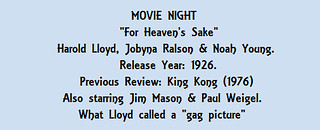
For Heaven's Sake.


Review #727: For Heaven's Sake.

Cast
Harold Lloyd (The Uptown Boy), Jobyna Ralston (The Downtown Girl), Noah Young (The Roughneck), Jim Mason (The Gangster), and Paul Weigel (The Optimist) Directed by Sam Taylor.

Review
It's a quick movie described by Lloyd himself as a "gag picture", which as you can tell means that the movie was more about the comedy bits than his character pictures, like Grandma's Boy or The Freshman. Lloyd was reluctant to release this film due to his disappointment with it, but the movie was a success. As for the film itself, it's enjoyable enough. Is it as good as the previous two Lloyd films I mentioned? Not entirely, but it is nice. The movie sets itself quickly and leaves itself enough time to make gags, right down to the title cards. I especially like the entire sequence with Lloyd being "chased" all throughout the town, which turns from just a small gang into a big group, and it just has gag after gag, succeeding rapidly. The cast is effective enough with the gags in the movie, and Lloyd and Ralston do well together. The movie loads itself up with gags in a near-hour span, and it works well enough to be entertaining without needing too much plot. Comedy is the best medicine, and it can be big or small.

Overall, I give it 8 out of 10 stars.