Showing posts with label Morton Lowry. Show all posts

July 10, 2023

The Verdict (1946).

Review #2037: The Verdict (1946).

Cast: 
Sydney Greenstreet (Superintendent George Grodman), Peter Lorre (Victor Emmric), Joan Lorring (Lottie Rawson), George Coulouris (Superintendent John R. Buckley), Rosalind Ivan (Mrs. Vicky Benson), Paul Cavanagh (Clive Russell), Arthur Shields (Reverend Holbrook), Morton Lowry (Arthur Kendall), and Holmes Herbert (Sir William Dawson) Directed by Don Siegel (#893 - Dirty Harry, #920 - Invasion of the Body Snatchers, #1453 - The Shootist)

Review: 
There is good reason to view as many directors as possible when it comes to distinct presences of filmmaking, and Don Siegel is a clear one. The Chicago native started in the film industry within the library of Warner Bros. before he eventually rose to the head of their montage department, which would see him come up with montages for films such as Casablanca (1942). Siegel's career as a director started on pretty good footing, as his first short films with Star in the Night (1945) and Hitler Lives (1945) each won an Academy Award (the former for what is now referred to as Best Live Action Short Film and the latter for Best Documentary Short Film). The Verdict (1946) would be the first of countless films he would direct, which could involve noirs such as Riot in Cell Block 11 (1954), science fiction with Invasion of the Body Snatchers (1956) or five films spent with Clint Eastwood such as Coogan's Bluff (1968) that would prove influential for the star-turned-director. The movie is loosely based off the 1892 novel The Big Bow Mystery by Israel Zangwill, which had previously served as the basis for two films with The Perfect Crime (1928) and The Crime Doctor (1934). Peter Milne wrote the screenplay. Believe it or not, Greenstreet and Lorre appeared in eight films together. Greenstreet had been born in Eastry, Kent, England in 1879 and had actually tried to make his calling as a tea planter before his financial failures eventually led to acting. By the turn of the 20th century, he was doing his work on the stage, which he did on a regular basis in both Britian and America until he decided, at the age, of 61, to act in films. What better way to start a film career than with a first-time director in John Huston and various others in The Maltese Falcon (1941)? In the next eight years, he would appear in over a dozen feature films, and a number of them happened to feature Lorre, who worked for Warner Bros. in the time from 1941 to 1946. This happened to be the eighth and last film with both in key roles together (technically it is nine, since they were in Hollywood Canteen (1944) together, but that was a cameo bit).

What we have here is a locked room mystery that shuffles the layers around of what you think is a mystery winding down to the climax that finds itself wrapped in paranoia. The 86-minute runtime is the right amount to make a useful first crack for Siegel to hone his talent in something that makes an involving puzzle with seasoned pros (at least for those who are familiar with early 20th century character actor presences). Within its late 19th century atmosphere is a handy feature that wraps things up in the way you might hope to see from a puzzle that isn't so much a puzzle but an inevitability. Greenstreet is effective in the lead role as a man who is seemingly possessed to prove his worth as a man no matter where those decisions may take him in brimming and deductive work. Lorre is the ideal presence to pair him with, observant in the way only he could do in macabre interest in contrast to the looming somber nature of the lead. Coulouris makes a quality contrast to Greenstreet in slimy overconfidence that lingers every step of the way with the right sense of brimming timing. So, here comes the question that arises from the start: how is a man murdered when the door was locked and the windows were closed? Well, the surprise comes from the fact that the seemingly perfect crime is more than just jealousy and blackmail but is instead all about appearances and timing that is told in succinct and convenient fashion that seems about right for a B-level production. As a whole, The Verdict (1946) is a worthy first start for Don Siegel as director with a useful pairing in Greenstreet and Lorre to back up a mostly involving effort fit for curiosity in the now.

Overall, I give it 8 out of 10 stars.

August 22, 2019

Pursuit to Algiers.


Review #1262: Pursuit to Algiers.

Cast: 
Basil Rathbone (Sherlock Holmes), Nigel Bruce (Doctor Watson), Marjorie Riordan (Sheila Woodbury), Rosalind Ivan (Agatha Dunham), Morton Lowry (Steward), Leslie Vincent (Prince Nikolas / Nikolas Watson), Martin Kosleck (Mirko), Rex Evans (Gregor), John Abbott (Jodri), and Gerald Hamer (Kingston) Produced and Directed by Roy William Neill (#846 - Frankenstein Meets the Wolf Man, #873 - Sherlock Holmes and the Secret Weapon, #925 - Sherlock Holmes in Washington, #936 - Sherlock Holmes Faces Death, #1021 - The Spider Woman, #1040 - The Scarlet Claw, #1056 - The Pearl of Death, #1161 - The House of Fear, and #1216 - The Woman in Green)

Review: 
As the Rathbone-Bruce batch of Holmes films gravitates towards its end, one would imagine that this film (the twelfth of the series) would continue on the decent path of the others with its traditional pacing and fair quality alongside offbeat choices involving plotting or characters. After all, this is a movie that starts with Holmes getting a clue to a secret place from a menu with fish and chips and then being recruited to escort a prince back to his country on a plane that is too small for both Holmes and Watson (because one needs a famed detective to escort a prince home). At least one can't say these films have given up on making themselves sticking out (this happened to be released three months after The Woman in Green). Surprisingly (or not), Holmes is presumed to be dead (again) when the plane is shot down, but he shows up on the ship with Watson en route to Algiers because he doesn't like plans set up by others (I can agree with that).  Really, you could make a comedy about these assassination attempts at the prince (disguised as Watson's nephew, because he has quite the resemblance), ranging from trying to poison the tea to knife throwing through a port-hole (ouch) to exploding paper hat packages, but at least one can say they'll have some sort of smile when watching this film, which is mostly set on a ship. It even finds time for a song for Watson to sing, which goes along fine actually. There isn't much of a mystery this time around, since you get to know who the assassins and their plot very early on, so it really seems more of a quiet thriller more than anything, complete with red herrings (with diamonds that don't matter, no less) to boot. At least there are some references to previous Holmes works that will make it seem a bit interesting, such as Watson talking about a giant rat of Sumatra. The highlight of the film proves to be the duo of Rathbone and Bruce, who walk through this conventional kind of vague mystery film just fine, with the latter having his own moments that aren't just there to make fun of the character he plays, such as the aforementioned song or when he believes that Holmes is dead and has to collect himself. The other cast-mates are hit and miss, save for the main trio of villains, who don't even get a showdown scene with Holmes. Imagine watching a movie for 65 minutes and having a twist ending instead of some silly showdown where Holmes and Watson could outsmart three bumbling agents (one of them being wrestler Wee Willie Davis). This is a ridiculous movie, but in the collection of Sherlock movies, it is at least light entertainment that works itself out just fine. You won't find yourself frustrated at what you see, unless you are a strict enthusiast for the Holmes canon or really want something more from the 12th of fourteen movies from seven decades ago. For me, this is just fine. Can one strive for films more (or less) than fine? Sure, but this will work for those curious enough to look further.

Overall, I give it 7 out of 10 stars.

May 18, 2014

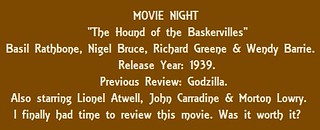
Movie Night: The Hound of the Baskervilles (1939)


Review #583: The Hound of the Baskervilles.

Cast
Basil Rathbone (Sherlock Holmes), Nigel Bruce (Dr. John H. Watson), Richard Greene (Sir Henry Baskerville), Wendy Barrie (Beryl Stapleton), Lionel Atwill (Dr. James Mortimer), John Carradine (Barryman), Morton Lowry (John Stapleton), Eily Malyon (Mrs. Barryman), and Barlowe Borland (Frankland) Directed by Sidney Lanfield.

Review
I had previously reviewed an adaption of the classic novel by Sir Arthur Conan Doyle (#272 - The Hound of the Baskervilles - 1959), which was excellent and such. So how does this film made 20 years beforehand fare? To be honest, I actually have read the novel (big shock, right?), and the movie manages to do a fine job in cramming the story into a small 78 minute window. The story flows well with the novel, not making drastic changes (The fate of the villain is left unknown, but leaving a little ambiguity as opposed to the novel doesn't hurt), and the landscapes look haunting and beautiful. The supporting cast is decent enough, but the main attraction is Basil Rathbone in his first movie as Sherlock Holmes, which he would play for 13 more films for seven more years alongside Nigel Bruce as Watson. Rathbone is certainly fun to watch deduce the crime, though it is debatable on whether if Bruce's somewhat bumbling performance is endearing enough to work or somewhat annoying. Whatever the case, the movie is simply excellent in its portrayal of the novel and manages to work on such a short time scale. Check this one out, then check out the 1959 film to see what all the fuss is about.

Overall, I give it 9 out of 10 stars.