Showing posts with label Mae Marsh. Show all posts

October 2, 2022

The Avenging Conscience.

Review #1895: The Avenging Conscience.

Cast:
Henry B. Walthall (The Nephew), Blanche Sweet (His Sweetheart), Spottiswoode Aitken (The Uncle), George Siegmann (The Italian), Ralph Lewis (The Detective), and Mae Marsh (The Maid) Written, Produced, and Directed by D. W. Griffith (#415 - America, #695 - Broken Blossoms, and #1317 - Way Down East)

Review: 
You have to remember that film is an old medium, one that had to evolve beyond shorts and productions made in humble little studios. This is how it works out for horror, which has been there in some shape and form from the beginning, although we are here to talk about features because of their depth, regardless of the notability that came with early ones such as The House of the Devil (1896) or Frankenstein (1910). One of the people at the forefront of doing films that became more than what they were was D. W. Griffith, who went from failed attempts at script-writing to acting in 1908 only to become a director of shorts in that same year for Biograph Company, and it was he who became one of the first directors of films produced in the States alongside one of the first feature-length movies in Judith of Bethulia (1914). His disputes with the company over wanting to make features along with budgets and cast listing made him leave the company in 1914, taking his troupe of actors with him. Six months after the release of this film (the ninth he did in this year, keep that in mind) came The Birth of a Nation (1915) ...and you get the idea about Griffith being a name not long forgotten among cinema. The movie is based on two works by Edgar Allan Poe: the 1843 short story "The Tell-Tale Heart" and the 1849 poem "Annabel Lee". If one is curious about the film, it is widely available in the public domain for all to check out, and an alternate title is presented in the opening as The Avenging Conscience: or 'Thou Shalt Not Kill'.

You may remember that the Heart story was about a man killing someone and then being tormented by the thumping he hears from somewhere that sees his sanity unravel over where the body is. As for the poem, it was a lament for a departed woman that left someone, and certain lines from the poem are shown as intertitles in the film. So yes, this is how Griffith tries to make a bit of material rise out of loose story elements for 78 minutes of staging, complete with a lead character that is depicted as having a liking for Poe (right down to showing a picture of him). It results in a film that seems a bit corny now but surely must have been quite the interesting one for diverting time in 1914. Walthall makes a quality focus, conveying the spooked desires and regrets required in the role to make tension without overextending himself. He fidgets and makes you think about fidgeting without giggling. Sweet plays the role of affections and all that jazz, while Aitken makes a quality target foil for someone meant to exist as both a grump, alive or dead. The effect to show the ghost of the dead soul isn't anything spectacular, but it gets the basic job done in trying to set some sort of unease in a film that also shows a spider catching a fly and visions of Death and demons (and, perhaps not surprisingly, religious overtones). As hammy it is in actually setting up the story you are here to see, there is something curious in getting to the road of desire and tortured regret that Griffith makes work in enough ways to offset the actual ending. If you think "it was all a dream" seems a bit cliche now, imagine how it must have sounded 108 years ago, one that is both cheap for narrative purposes and the Poe story as a whole (but hey, if you are doing a story "inspired by Poe" where a Poe devotee happens to get in a situation similar to a story, who is the real winner here). As a whole, it might not exactly rank highly as a great horror feature, but as a curiosity for where the steps to get to seeing further chills for the audience in the pre-1930 era, it makes a good start.

Overall, I give it 7 out of 10 stars.

December 26, 2021

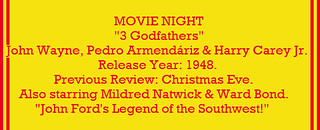
3 Godfathers (1948).

Review #1778: 3 Godfathers.

Cast: 
John Wayne (Robert Marmaduke Hightower), Pedro Armendáriz (Pedro Encarnación Escalante y Rocafuerte), Harry Carey Jr. (William "The Abilene Kid" Kearney), Mildred Natwick (Dying Mother), Ward Bond (Sheriff Buck Sweet), Mae Marsh (Mrs. Sweet), Jane Darwell (Miss Florie), Guy Kibbee (Judge), Hank Worden (Deputy Curly), Dorothy Ford (Ruby Latham), Charles Halton (Oliver Latham), Jack Pennick (Luke), Fred Libby (Deputy), Ben Johnson (Posseman #1), Michael Dugan (Posseman #2), and Francis Ford (Drunken Old-Timer at Bar) Directed by John Ford (#398 - The Last Hurrah, #1324 - 3 Bad Men, #1349 - Stagecoach, #1372 - Fort Apache, #1392 - The Searchers, #1409 - The Man Who Shot Liberty Valance) 

Review: 
Well, if you need a Western with a Christmas bent, here you go? Of course, this also happens to be yet another John Ford and John Wayne collaboration, albeit one that is probably not as well-noted as the others (such as Fort Apache, released around the same time). The film is adapted from the 1913 novel The Three Godfathers, which was written by Peter B. Kyne. That novel had been adapted into a film five times: The Three Godfathers (1916), Marked Men (1919), Action (1921), Hell's Heroes (1930, directed by William Wyler), and Three Godfathers (1936); Ford had directed the 1919 and 1921 films, while Harry Carey Sr had starred in the first two adaptations (I'm sure you are all familiar with the next adaptation of the book in Tokyo Godfathers (2003)). As such, when Ford decided to do another version of this tale, he dedicated it to Carey (who had died in 1947), with the opening title card describing him as the "Bright Star of the early western sky..."). At any rate, this was the fifth starring role for Wayne in a John Ford film, coming off the heels of Fort Apache (1948) that would be followed by She Wore a Yellow Ribbon (1949) and a handful of others, although this might be the lightest of the Westerns they did together. This was the third and final collaboration of Ford and Armendariz (who decided to take on roles besides Mexican cinema in the mid 1940s), while Harry Carey Jr is given an "introduction" despite having done a handful of appearances in film prior to this one, which would be part of a solid run in character roles. The film had three screenwriters in Laurence Stallings, Frank S. Nugent, and Robert Nathan.

You have to understand that the tale is basically a re-telling of the religious tale of the Three Wise Men, so it shouldn't be surprising that there were varying levels of sentimentality in those feature films I just mentioned. The result is a movie that turns out to be just fine, one that will give a fair smile to one's face without turning it into a gloppy mess. For the most part, anyway (106 minutes), since it is sort of a family film that has a bit more chuckles than action (case in point about the adaptation differences, earlier versions featured a bloody gunfight). Well, that and plenty of sand (for Death Valley...doubling as Arizona, anyway), which means that this results in a nice-looking feature that you would expect from Ford. Wayne does fine with what is required from the role in stiff chiseling, one that isn't meant to toe too much into the sentimentality pool that is mostly believable in the long run. Armendariz and Carey Jr make worthy supporting presences in terms of snappy charm that make a useful triangle of pseudo-wise men in a makeshift family feature. Bond is the other key presence, doing exactly what is needed in light casual charm. The sacrifice at the end can only work if one believes it. In two of the previous adaptations (i.e. the 1930/1936 versions), attempts to find suitable water were a key part. Here, it is a bit more tied down, syrupy and curious at the same time. Well, since this is one of the John Wayne features where he isn't engaged in a duel at the end, that shouldn't be too surprising. As long as one stomachs where it goes, all should work out. As a whole, it is a light and charming Western that serves itself well in adapting familiar material with a useful spin and a solid trio that make for a curious Ford selection that follows the holiday tradition well enough without becoming stuck in comparisons. Instead, one takes its message of hope and cheer and runs with it.

Overall, I give it 8 out of 10 stars.