Showing posts with label Paul Lukas. Show all posts

March 26, 2025

Anybody's Woman.

Review #2362: Anybody's Woman.

Cast: 
Ruth Chatterton (Pansy Gray), Clive Brook (Neil Dunlap), Paul Lukas (Gustave Saxon), Huntley Gordon (Grant Crosby), Virginia Hammond (Katherine Malcolm), Tom Patricola (Eddie Calcio), Juliette Compton (Ellen), and Cecil Cunningham (Dot) Directed by Dorothy Arzner (#1648 - Sarah and Son, #1810 - Working Girls, #1992 - The Wild Party, #2187 - Christopher Strong)

Review: 
Well, there are quite a few movies about drunken marriages, so it isn't too surprising to see it here with Dorothy Arzner's 7th credited feature film as a director. The movie is based on the short story "The Better Wife" that had been written by Gouverneur Morris (evidently, the movie was going to be released under that title but went with the other title instead); Zoe Akins and Doris Anderson wrote the screenplay adaptation. Admittedly, Chatterton probably has slipped under the radar as an actress. But hey, she had a busy life beyond the acting life, which apparently began when her friends challenged her to become a stage actress when she criticized the acting when seeing a play in Washington. After a decade-and-a-half of stage work (including Broadway), she scored a contract with Paramount in 1928. Her work in Madame X (1929) and Sarah and Son (1930, as directed by Arzner) got her Academy Award nominations. She stopped acting in films by 1938 at the age of 45, although she would appear from time to time in stage and later in television. She even wrote a handful of novels in the 1950s and did I mention the part where she was an aviator that flew solo across the States a few times? While this movie isn't particularly noted among audiences of the time, one can at least be satisfied with its restoration in recent times by the UCLA Film & Television Archive. This was the third film Arzner had released in 1930, having been involved (alongside ten other directors) in the all-star revue Paramount on Parade (1930), which was released in April of 1930 (the aforementioned Sarah film had come out first in March), with this movie coming out in August; Colbert (who also had been featured in the Parade film) returned to star in the next Arzner movie alongside Fredric March with Honor Among Lovers (1931).

To say that the film is fine is not a particularly hard thing to say. Its 80-minute runtime is pretty routine when it comes to, well a 95-year-old movie that comes and goes in the scenario and executing it. Some of that is more successful than other times, particularly since this is the kind of movie where it wraps up in a "tidy bow" in the last few minutes that you either will accept or just sigh down the road as you wonder what sounds best to watch next.* For Arzner, it is about as competent and involving as one already has seen in her earlier films in trying to depict the general challenge that comes with being a woman where everybody has some sort of opinion of "who they are to somebody". Sure, the outsider view is taken with the eventual realization that one does in fact need someone, particularly someone who at least looks like they understand who they are on the outside beyond just being a clinging post in the dark of night. In that sense, Chatterton does relatively fine in maneuvering the waters of perception and actual action that is snappy enough to elicit enough charm to at least give the movie the fighting chance it needs. Sure, Brook is not given too much to really do besides being the soused up one of the "odd couple", but he plays it with dogged interest to at least seem like he isn't totally on autopilot. Lukas was the dependable supporting presence that you could find for a variety of movies (big or small) in his time, so he plays the "man with foreign-sounding name" with serviceable commitment to at least make a capable triangle seem plausible. As a whole, the movie presents a capable woman trying to make the best of things of a life that has to adjust the upheaval in routines that is more than just being an anybody but instead being a somebody, one who can live within places rather than apart from it all. It might not be a great "Pre-Code" movie, but it might just prove worthwhile enough for those interested in a decent time with Arzner at the helm.

Overall, I give it 7 out of 10 stars.
*Sorry for the delay. On occasion, I find inspiration for a review is split over the course of several days because I somehow get distracted in the most absurd of ways, which either involves rest or searching up old sports stuff. I recently managed to score a free trial of a newspaper archive and on a lark looked up box-scores of the 1968 ABA Playoffs for fun. You would be surprised what gets covered and doesn't find its way into telling a sports story.

May 31, 2023

The Lady Vanishes.

Review #2014: The Lady Vanishes.

Cast: 
Margaret Lockwood (Iris Henderson), Michael Redgrave (Gilbert), Paul Lukas (Dr. Hartz), May Whitty (Miss Froy), Cecil Parker (Mr. Todhunter), Linden Travers ("Mrs." Todhunter), Naunton Wayne (Caldicott), Basil Radford (Charters), and Mary Clare (Baroness) Directed by Alfred Hitchcock (#219 - Rope, #223 - North by Northwest, #446 - Spellbound, #447 - Psycho, #450 - Vertigo, #455 - Rear Window, #553 - Strangers on a Train, #800 - Shadow of a Doubt, #910 - Notorious, #963 - The Lodger: A Story of the London Fog, #964 - The Ring (1927), #965 - Downhill, #970 - Mr. and Mrs. Smith, #977 - Frenzy, #1343 - The 39 Steps, #1739 - The Birds, and #1828 - Rebecca)

Review: 
Admittedly, I haven't covered many British films in the line of Alfred Hitchcock, but the man made a film in six different decades, so clearly there will be time yet to cover more of his films, especially when doing 18 of them isn't even covering half of his filmography. The Lady Vanishes is the penultimate film that Hitchcock made in his native England, as he would move to the States to direct in Hollywood after Jamaica Inn (1939). He had attracted attention with previous British classics such as The Man Who Knew Too Much (1934) and The 39 Steps (1935), and American producer David O. Selznick believed he had talent waiting in America. However, Hitchcock still had a contract to go through with Gainsborough Pictures (with this being the 12th and final film with the studio), and it just so happened that a film idea called "The Lost Lady" fell into his lap, as plans to do the film with Roy William Neill fell through when background filing in the Kingdom of Yugoslavia ended in embarrassment. The film is based on the novel The Wheel Spins by Ethel Lina White, with a screenplay by Sidney Gilliat and Frank Launder. The book has been adapted once more in film in 1979 (a Hammer production with Cybill Shepherd and Elliott Gould as stars) and it has been adapted to television (most recently as 2013 on BBC One) and radio. The nature of the book was shifted by Hitchcock and company, most notably with the climax, since the book did not have a gunfight resolution. There have also been thriller films released with premises that sound a bit similar to the one presented here, such as with So Long at the Fair (1950), about a suddenly missing hotel room and Flightplan (2005), which involved a missing daughter on a plane.

The patience one has with an innocent being thrust into peril will determine just how much of its exhilarating attempts at mystery thrills work for you, with most of it being set on a train filled with a few characters that have evident reasons to maintain the status quo no matter what. With a 97-minute runtime, it does a reasonable job with building the eventual confrontation that comes with trying to confront bold-faced statements without cheating. Lockwood makes a useful lead to follow with when it comes to a archetype familiar in a handful of Hitchcock films: an innocent thrust into a situation with little choice but to dig their way out. Granted, dealing with oddball hotel people that either won't shut up about cricket or music is pretty mundane when compared to missing old ladies, but I'm sure you get the picture of seeing how an ordinary person like her could get swept up in a sea of people being human in "decision-making"; Hitchcock once described her having a gift for both "expressing her beauty in terms of emotion" when it comes to camera shots and also the insight to get the feel of lines, and she became a prominent British star for several years. Redgrave was in his first film role after spending time in the theater, and he does pretty well here in general conviction for wavering belief when spent with Lockwood (whether the belief to mess with her or to be on her side). Lukas and his veteran presence makes a quality adversary in swift conviction that keeps the viewer occupied. Whitty makes a quality presence to serve as the title character, which goes over better when compared to Wayne and Radford, who actually played these "characters" (comedy relief) for a handful of other movies- eh, theyre okay. The funniest thing that happens is probably when one of the characters gets shot the hand when stumbling into a standoff. That, or the attempt at trying to get a "nun" away quietly.

Honestly, I wish I liked it more, but I suppose being a "good" film that just meets expectations is better than being a supposed great film that flounders if one expects way too much. The climax is when the film tries to play neat and tidy with resolving things in clever fashion, which does work out fine. As a whole, it certainly is a movie worth recommending for those quite familiar with the famed director Alfred Hitchcock, especially if one wants to see exactly where the line went from his British roots in directing to taking on Hollywood came with this particular film. You will find plenty to like if you are in the mood for it, and some have even called it one of his best films, so take that for what it is worth.

Overall, I give it 8 out of 10 stars.

March 4, 2022

Working Girls.

Review #1810: Working Girls.

Cast: 
Judith Wood (June Thorpe), Dorothy Hall (Mae Thorpe), Charles "Buddy" Rogers (Boyd Wheeler), Paul Lukas (Dr. Joseph Von Schrader), Stuart Erwin (Pat Kelly), Frances Dee (Louise Adams), Mary Forbes (Mrs. Johnstone), Claire Dodd (Jane), Dorothy Stickney (Loretta), Alberta Vaughn (Violet), and Claude King (Mr. Adams) Directed by Dorothy Arzner (#1648 - Sarah and Son)

Review: 
Working Girls was the ninth feature effort from Dorothy Arzner (with two uncredited contributions), who as we all know deserved better when it comes to appraising one of the most prolific women directors of the first half of the 20th century, if not still one of the most prolific of the now. The film is adapted from the 1930 play Blind Mice, which had been written by Vera Caspary and Winifred Lenihan; Caspary was a novelist who is best known for her novel Laura (that was turned into a hit movie), while Lenihan was an actress mostly involved in the theater and her one defining role as the title role in the 1923-24 American production of Saint Joan. It was a re-working of Caspary's novel Music in the Street, which used undercover work at a rooming house by her. However, the play was actually not much of a success, since she was not experienced in writing plays (to the point where the producers did re-writes) that resulted in two weeks of life on the stage. Zoe Akins served as the screenwriter for the film, as she did for a number of Arzner's early films.

I'm sure you are familiar with the classic structure of two women trying to make it while working in the city. Well, don't forget about the joys of pre-marital relations and making light of marriage. Actually, Arzner described the film as one of her favorites, but Paramount Pictures gave it a limited release - keep in mind, this was the Pre-Code era too. A deal by Universal Pictures to acquire a number of films from Paramount's library from 1929-1948 would also bury the movie in obscurity for years without a home video release. Of course, prints do exist that were screened for occasions such as 2015 for UCLA or for bootlegs. Of course, one might not exactly be quite familiar with the stars besides Lukas (well, him and Erwin were both future Academy Award nominees, though). It was the last starring role for Hall, and Wood had her peak (in terms of roles) in this year, while Rogers had a few years of being known as "America's Boy Friend" who dabbled in music. The reason I am spending a bit of time with history window-dressing is to give a little credit to the actual result generated by Arzner when it comes to making a solid Pre-Code comedy that can be interpreted as a useful feminist work with its ruminations about marriage that make for a fairly interesting 77 minutes. Sure, there were a handful of films that aimed to capture the reality of folks trying to mingle the realities of city life with love life with regard to what expectations are held to them, but this time with a truly feminine perspective. While the structure of the film doesn't exactly yield to too many unpredictable closing marks, it does manage to have a charm and efficiency to make things seem worth it without being absorbed in audience-safe fears (with a little bit of editing charm to go alongside it). Wood and Hall pair fairly decently when it comes to showing the associations that comes with free-spirited young people that will either take advantage of situations presented to them or be swept away by it (or both), which results in a few laughs. Rogers proves adequate in flighty charisma, but Lukas is the more distinct presence in terms of measured interest while Erwin makes a casual foil to seal the puzzle of distinct personalities playing against the leads. While its ending nearly shakes with too much offbeat nature (i.e. a gun-induced marriage proposal), the movie is generally riveting enough with showing perspective in the right places that means it still shows relevance among its peers after nine decades, one that is cheery and earthy enough to recommend.

Overall, I give it 8 out of 10 stars.

Next Time: Not Wanted (1949).

October 16, 2014

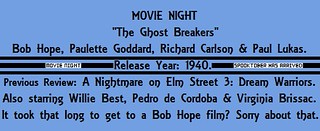
Movie Night: The Ghost Breakers.


Review #650: The Ghost Breakers.

Cast
Bob Hope (Larry Lawrence), Paulette Goddard (Mary Carter), Richard Carlson (Geoff Montgomery), Paul Lukas (Parada), Willie Best (Alex), Pedro de Cordoba (Havez), Virginia Brissac (Mother Zombie), Noble Johnson (The Zombie), and Anthony Quinn (Ramon Mederes/Francisco Mederes) Directed by George Marshall.

Review
The Ghost Breakers isn't exactly a horror film, it's a comedy-horror mix, but it fits into the context of this month, and I get to rectify a long running mistake: Not reviewing a film with Bob Hope in the main cast. It's weird how it took almost four years to do this given Hope had a long running career with over 50 films in a span of 40 years not counting cameo roles. But anyway, this is a movie that even has zombies in it, and guys who play dual roles, this could very well have been a drama, though the movie had been made two times before in the silent era, so who knows? The actors are pretty good conveying spooks and decent enough comedic timing, Hope is probably the best  part of the movie, right next to the cinematography by Charles B. Lang, along with some really fine camera shots that make the movie at least have some chilliness to it. The movie is short at about 83 minutes, but it moves at a good pace and it manages to not overstay or under stay its welcome. Goddard does a pretty good job being the lead next to Hope, she even gets in a few fun lines, and her and Hope share a good rapport in this film, which is a plus. The movie is enjoyable enough and sweet enough to work as a film to watch if it's on or a rental, especially for this month.

Overall, I give it 8 out of 10 stars.

July 1, 2013

Movie Night: Whispering City.


Review #406: Whispering City.

Cast
Helmut Dantine (Michel Lacoste), Mary Anderson (Mary Roberts), Paul Lukas (Albert Frédéric) and John Pratt (Edward Durant) Directed by Fedor Ozep.

Review
Ah Canada, America's neighbors of the North (unless you live in Alaska), the creators of hockey, the second largest country in the world, home of ten provinces and three territories from British Columbia to Quebec. There are Canadians known for film, such as James Cameron, Norman Jewison, Jim Carrey, David Cronenburg, and Mary Pickford (the last two listed I will cover in more detail in reviews in the future), so in light of Canada Day, I decided to review a few Canadian films, and Whispering City...is one of them. Filmed in Quebec City and with a limited cast, A fun fact is that Whispering City was filmed in English and in French. The film itself runs at about 90 minutes and it flows okay, not going on for too long in dialogue, and the actors don't do too bad, doing alright in a noir from the north. It is kind of a curious film to watch as it is easy to find and   the scenery isn't too bad, especially when Montmorency Falls is shown, a crucial part in the film. This is a decent well manner film that tries hard and manages to be a success in its own right, for all that is and all that it is worth, which I suppose makes sense.

Overall, I give it 7 out of 10 stars.