
Showing posts with label Elsa Lanchester. Show all posts

April 12, 2023

Murder by Death.

Review #1996: Murder by Death. 

Cast: 
Eileen Brennan (Tess Skeffington), Truman Capote (Lionel Twain), James Coco (Milo Perrier), Peter Falk (Sam Diamond), Alec Guinness (Bensonmum), David Niven (Dick Charleston), Elsa Lanchester (Jessica Marbles), Peter Sellers (Sidney Wang), Maggie Smith (Dora Charleston), Nancy Walker (Maid), Estelle Winwood (Nurse), James Cromwell (Marcel), and Richard Narita (Willie Wang) Directed by Robert Moore.

Review: 
Admittedly, the appeal is in how much you are invested in mystery characters being spoofed. No, not Sherlock Holmes (that was a deleted scene), but characters such as Sam Spade and Nick & Nora Charles (as created by Dashiell Hammett) to go alongside the works of Agatha Christie in Hercule Poirot and Miss Marple. Oh, and Charlie Chan (as written by Earl Derr Biggers). Neil Simon, playwright and screenwriter of previous ventures such as The Heartbreak Kid (1972) and The Sunshine Boys (1975) wrote the screenplay for this film. This was the first film for director Robert Moore, who had done a handful of productions in the theater such as The Boys in the Band in 1968 and Promises, Promises the following year (Moore did a number of television shows and three total films as a film director before his untimely death). Falk, who is imitating Sam Spade that was notably portrayed on screen by Humphrey Bogart in The Maltese Falcon (1941), returned with Moore and Simon to play a parody of Bogart with The Cheap Detective in 1978 alongside Brennan, Coco, and Cromwell. So yes, here are with a movie that wants to have fun with the "old dark house" genre that was pretty big in the early part of the 20th century, complete with plenty of name actors to go around, which includes two actors making their final appearance in Winwood and Walker and one in Cromwell making his first.

You know, for the most part, it is a pretty good time for 94 minutes. Sure, not every joke is bound to land, and it probably lingers a bit in being too smart and silly for its own good, but it does generally work the points it wants to do when it comes to in the realm of the mystery spoof. It is breezy without laboring hard within its one setting and one eventual punchline to outdo the setups done prior to the climax. It's interesting to watch Falk here in a role that makes light of a hard-boiled detective, mostly because a considerable amount of time has been spent by me (in the past few months) watching him in probably his most famous role as Colombo. But he is a talented actor, playing to the hard-nosed expectations of the spoof role and exceeding it quite well in generating chuckles without playing it as just an easy buffoon, which basically means dry warmth, and Brennan clings with resourceful timing that fits for a genre riff. Guinness seems to be having fun with this role, which mostly has him stumble around for effect with a few offbeat lines and play a blind man. Sellers is in prosthetics to play a character that most famously had been played by Swedish-born actor Warner Oland, much in the same way that Sellers did a decade earlier when playing an Indian in The Party (1968), which is easily the most dated aspect of the film. He does bring a few chuckles, if only because the lines seem so intentionally corny to begin with, one who seems intentionally out of date with the times to make laughs. Of course, Sellers would (in)famously have his last role end up being the title role of The Fiendish Plot of Dr. Fu Manchu in 1980 (one year after that film, Peter Ustinov (another non-Asian actor) played Charlie Chan in Charlie Chan and the Curse of the Dragon Queen (1981), and since that film, neither of the two characters have been portrayed on film). Niven and Smith make a decent pairing in the expense of The Thin Man that namely involves them playing the role to pleasantries. Capote is, well, a writer brought in to play against the other mystery spoofs in his first and only major role in a film. It has been said that Simon and Moore thought about replacing him with an actor but that it never came to pass. Eh, he does what is needed in parts, since it isn't really his movie to steal the scenery as is the case with the others. Coco and Lanchester prove fine in the mildest sense of comic relief. The cliche elements of old are lovingly utilized to chuckles, whether involving an old dark house or hired help with more on the mind than housewares or convivences stacked upon conveniences (which makes for an amusing ending). As a whole, the movie takes a familiar presence with familiar detective types (be it the rough detective or general sleuth) and has a fun time with it, finding a clear balance between ribbing the dynamics that come with trying to play around with an audience and not simply just tearing the dynamic to shreds. It is good fun without being wrapped up in annoyance for its audience, which on the whole makes for a solid recommendation.

Overall, I give it 8 out of 10 stars.

Next: Creed III.

May 15, 2021

The Private Life of Henry VIII.

Review #1678: The Private Life of Henry VIII.

Cast
Charles Laughton (Henry VIII), Merle Oberon (Anne Boleyn), Wendy Barrie (Jane Seymour), Elsa Lanchester (Anne of Cleves), Binnie Barnes (Catherine Howard), Everley Gregg (Catherine Parr), Robert Donat (Thomas Culpeper), Franklin Dyall (Thomas Cromwell), Miles Mander (Wriothesley), Laurence Hanray (Archbishop Thomas Cranmer), William Austin (The Duke of Cleves), John Loder (Thomas Peynell), Lady Tree (The King's Nurse), John Turnbull (Hans Holbein), Frederick Culley (Duke of Norfolk), William Heughan (Kingston), and Judy Kelly (Lady Rochford) Produced and Directed by Alexander Korda.

Review
Alexander Korda was involved in the realm of film for over forty years of his life. In fact, he would get his brothers involved with the industry to work alongside him as well, with Zoltan becoming a director and Vincent serving as an art director (for which he would win an Academy Award, which fittingly came with The Thief of Bagdad in 1940). Born in Austria-Hungary, he had changed his name from Kellner and started work in the film industry during the start of the first World War; his first writing project with Watchhouse in the Carpathians (1914) also became his first time directing a film. Over the next five years, he would eventually turn to producing his films as well as directing, with the presence of Corvin Film behind him that resulted in highlights such as White Nights (1916) and Harrison and Barrison (1917, which Korda called his favorite of the period). Trouble in his native country caused him to leave and never return, and he would spend the next two years in Austria and the next four in Germany, with The Prince and the Pauper (1920) helping to spur Korda on to the idea of making films for an international audience (incidentally, that film also happened to have a portrayal of Henry VIII). In 1926, he moved to Hollywood and would spend the next five years there. Although he had a few highlights such as The Private Life of Helen of Troy (1927, a comic biopic) while doing well with silent and sound, he grew tired of the studio system; a move to Europe meant brief time spent in France before settling in England, where he created his own company with London Films in 1932. In total, Korda would film/produce in six different countries while directing until 1947 and producing until his death in 1956. With this film, Korda made his gamble in trying to make an elegant film that honed British but could still attract attention through international waters while featuring a man of the stage with Laughton, who had made his way into acting on the stage in 1926 before dabbling into acting two years later, and while this was only the second time he would appear in a historical role (he had played Emperor Nero the previous year), this was the movie that turned him into a star in a career that spanned numerous portrayals of historical figures that went from Rembrandt to William Kidd (incidentally, he would play Henry VIII two decades later with Young Bess).

It could be easy to say that there isn't exactly a great central structure to this film. Keep in mind, we have a movie that runs at 97 minutes that can only depict five of the six wives married by the King (the first one is called a "respectable lady" in the opening title-card). After all, the king had married six wives but married five them in a span of ten years (after his marriage to Catherine of Aragon lasted 24 years before being the first of three annulled marriages) that has been characterized as both the most important monarch in English history and also one wracked with ego that could be tender to women but prone to withdrawal once out of love. In other words, if one doesn't really consider all of the historical quibbles, one probably won't also think about it goes with a resourcefully cheap but ultimately curious little gem. If Laughton is the biggest gem of the movie, he certainly deserves the credit for making what could have been a mild affair and turns it into a useful venture full of bombast that never seems like a complete caricature or a rosy portrait. Instead, it is a poignant movie that aims well to international audiences (it was the first non-Hollywood nominee for Best Picture), and eight decades has not quite withered the high-spirited efforts from Korda and his crew, right down to Korda regulars Lajos Bíró and Arthur Wimperis delivering a serviceable script that keeps the tempo relatively sane, at least to what one needs from Vincent Korda and his set design that keeps things fairly level. Laughton has the confidence required of such a big role to go alongside gravitas to make it more than just an offbeat king with a habit for women and eating food whole. If he ended up forming the perception of what folks had of the king in the eyes of an audience member, then so be it, because it does have a flattering edge in playing to the audience that can end with a roar or a curious glance (as one supposes it isn't all fun and games in the life of a king that just wants love to last). Oberon (in one of her first key roles) doesn't have as much time to start the first of numerous stories with the wives of Henry, but she has a striking energy to her that makes what seems like a routine dead person walking roll fairly different. Barrie does fine with garnering the next story with what is needed without being coy. Lanchester would appear in a total of twelve movies with Laughton (the two after all were married until the latter's death in 1962), and she proves quite interesting here, garnering some curious moments that make a fanciful third story, complete with a card game scene with Laughton that is one of the highlight scenes. Donat had just entered film in the year before the release of this film within Korda productions (after entering stage in 1921), and he makes a useful supporting presence for what is needed in the key story between him and Barnes, who garners some worthy ambition into a decent spirited chemistry with Laughton, complete with her watching him wrestle in front of all. Gregg is the last key lady of the movie, and while the portrayal probably won't hone well to the spirit of the person portrayed (namely the idea of a henpecked king), she comes out with at least some sort of dignity (the last line that breaks the fourth wall after she leaves the screen is up to you). In general, it is Laughton that helps to shape a movie that would have likely gone near the deep end without a centralizing performance from a growing star, which means one gets a usefully diverting time that hits the mark in relative entertainment without sacrificing showmanship or dedication, which can be credited to Korda and Laughton, who each can credit this film as a time to shine for the right reasons.

Overall, I give it 8 out of 10 stars.

May 14, 2020

Mary Poppins.


Review #1415: Mary Poppins.
Cast: 
Julie Andrews (Mary Poppins), Dick Van Dyke (Bert / Mr. Dawes Sr), David Tomlinson (George Banks), Glynis Johns (Winifred Banks), Hermione Baddeley (Ellen), Karen Dotrice (Jane Banks), Matthew Garber (Michael Banks), Elsa Lanchester (Katie Nanna), Arthur Treacher (Constable Jones), Reginald Owen (Admiral Boom), Ed Wynn (Uncle Albert), Reta Shaw (Mrs. Brill), and Don Barclay (Mr. Binnacle) Directed by Robert Stevenson.

Review: 
"That’s the real trouble with the world. Too many people grow up."

What is there to say that has not been said about one of Walt Disney's greatest triumphs? Winner of 22 Academy Awards, Disney was a pioneer of animation that created with his brother Roy one of the most powerful film companies of the world that in the span of nearly a century has gone from animation to diversifying in live-action, theme parks and other various ventures. He had an interest in drawing from an early age, doing various exercises such as copying cartoons and working with tools like watercolors. As he grew older, he delivered papers and took courses for drawing and cartooning at the Kansas City Art Institute. By the time he was 18, he had joined the Red Cross (arriving after the armistice that ended World War I) and found work as a commercial illustrator. He soon found interest in cel animation (as opposed to cutouts), and he soon joined forces with others like Ub Iwerks to make their own studio (Iwerks-Disney commercial Artists, which was short-lived, and Laugh-O-Gram Studio, which lasted two years). Although too late to save the studio, their last creation, inspired by Alice in Wonderland, led to eventual interest in creating a series of shorts (which led to the creation of a studio to distribute said films, originally named Disney Brothers Studio). Over the course of a decade, they would create numerous cartoons with Mickey Mouse being created in 1928. Disney yearned to expand the studio's range and money by making a feature of his own. He would soon plan the first feature-length cel animated film in Snow White and the Seven Dwarfs (1937), which would take three years to develop amidst arguments with his own brother and wife to try and talk him out of it that was thought to be a futile idea. Simply put, the film was a tremendous success, and several animated film classics would follow in its wake, and live-action segments and features would later follow, and this ended up being Disney's most successful project of the 1960s, one that appeals to both children and adults to this day, an achievement for everyone from longtime Disney director Robert Stevenson to its star in Julie Andrews.

The film was adapted from the book series of the same name by P. L. Travers, who wrote eight children's books featuring the character over a span of 54 years beginning in 1934. As early as 1938, Disney wanted to buy the film rights to the book (owing to his daughters loving the books), but Travers rebuffed efforts for years and years because of her doubts that a feature could do justice to her work (it did not stop CBS from doing a television play of the book in 1949 for their live telecast Studio One, however). In 1961, Travers allowed the rights to be purchased, although she demanded script approval rights (this however was not final draft approval). Considerable changes were made in settling things to film, such as the timeframe being shifted from the 1930s to 1910, a focus on two Banks children rather than four, and a significant lightening of the title character (characterized as slightly vain and stern in the books). The latter change, along with the decision to use animation in some parts and the music (she wanted period piece) did not ultimately please her; when approached in 1993 about turning it into a musical, her key stipulation was that no one who worked on the film be involved with it, although the subsequent stage show that premiered 21 years ended up utilizing the songs from Richard and Robert Sherman, who do tremendous work here (as they did for decades). When it came to star, one could not ask for a greater debut. Andrews had sang with her parents since she was ten years old and had risen to performing on the stage and Broadway by the time she was 19, noted for her work in My Fair Lady (1956) and Camelot (1960). It was the decision by Warner Brothers to pick Audrey Hepburn over her to star in the film adaptation of the former that led to Disney having the chance to have Andrews for this film. Her charm and grace are immediately present to view after seeing her first few scenes, one with a great singing voice and a warm spirit that always seems ready for an interesting time with the children while seeming authentic and firm no matter who she interacts, whether that means children or something odder. Van Dyke, a radio/Broadway/television star (sporting a "Cockney" accent), proves quite amusing to follow up with Andrews, an inviting presence that never seems out of place, whether that involves him singing "Chim Chim Cher-ee" or being part of a laugh riot on the ceiling with Wynn (who proves just as amusing in his one scene). Tomlinson accompanies the film as a capable stuffy authority that holds his own in inspiring curiosity on the other side of the hill (namely, reality). Johns, although not in the film too much, inspires a few flighty chuckles. Doctrice and Garbert do a fine job for the time needed, having that middle ground for child acting that isn't too knowing or annoying to write home about. The others fill in the details of curiosity quite nicely for quirks.

The songs are quite catchy, with one clear choice being "Supercalifragilisticexpialidocious" in driving a smile to one's face. The animation sequences are interesting, aided by a modification from Petro Vlahos in a Technicolor camera that mixed live-action and animation through what is known as the "Sodium Vapor Process", utilized in films such as The Parent Trap (1961) and The Birds (1963) that served as an alternative for bluescreen in order for more accuracy. There is plenty of imagination and charm to be found here, a film that can sing with the best of them in leaving an impression on its audience with its simple but efficient story of growing up without seeming too sentimental or abrupt through a ravishing 139 minute run-time. Behaving well doesn't mean not having fun, really. Could it have been more accurate to its source material, sure, but does it really matter? Is this not a magical film that accomplishes what it sets out to do for its target audience (i.e. anyone)? There is a magic here that one wishes to experience every now and then that make it an easy pick for its era and Disney's line of work.

Overall, I give it 10 out of 10 stars.

October 23, 2017

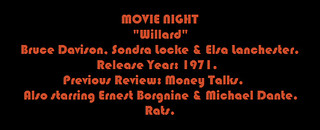
Willard (1971).


Review #1002: Willard.

Cast: 
Bruce Davison (Willard Stiles), Sondra Locke (Joan), Elsa Lanchester (Henrietta Stiles), Ernest Borgnine (Al Martin), Michael Dante (Brandt), and J. Pat O'Malley (Farley) Directed by Daniel Mann (#514 - Our Man Flint)

Review: 
When it comes to horror films, Willard is certainly a interestingly strange one. I've done films with killer animals before, such as #462 - Kingdom of the Spiders (1977), #480 - Jaws (1975), #823 - Zaat (1971), but here's one with killer rats...although they don't exactly do too much killing. Whether that is actually a positive or a negative is up to you, but I found this to be such an average movie (based off a short novel named Ratman's Notebooks (1969) by Stephen Gilbert) that it really didn't matter all too much. The real horror seems to be the human characters and how they act to each other, which actually makes me laugh a bit, mostly because you're supposed to feel for this main character (who just happens to like rats), but I found him to be occasionally annoying (the same could sometimes be said for Lanchester's character, although she is fine). Davison does a decent job with the material he is given with, although I can't really find myself caring too much (this can apply to Locke's character as well). Somehow, Borgnine is my favorite from this film, probably because his maverick demeanor is somewhat amusing. If you are wondering how the special effects are...it's about what you'd expect with rats tearing someone apart. I don't particularly care for rats myself, but I'm not exactly afraid of them. The length of 95 minutes is fairly tolerable, although one has to slog through a first half that sometimes can feel slow, though its second half is at least somewhat serviceable. The climax of the film is likely the best part of the film, for better or for worse, but I can't really convince myself that this movie is anything but just an average b-movie. That's not to say that I am not a fan of what the film was going for (or that I don't like b-movies), but I just can't find myself saying that is really any better than a film like Kingdom of the Spiders. As a whole, this is a mediocre film that inspires a few more laughs than frights/thrills, but it is a somewhat serviceable film for people in the right state of mind.

Overall, I give it 6 out of 10 stars.

December 3, 2016

The Big Clock.


Review #882: The Big Clock.

Cast:
Ray Milland (George Stroud), Charles Laughton (Earl Janoth), Maureen O'Sullivan (Georgette Stroud), George Macready (Steve Hagen), Rita Johnson (Pauline York), Elsa Lanchester (Louise Patterson), Harry Morgan (Bill Womack), Harold Vermilyea (Don Klausmeyer), Dan Tobin (Ray Cordette), Richard Webb (Nat Sperling), Elaine Riley (Lily Gold), Luis Van Rooten (Edwin Orlin), Bobby Watson (Morton Spaulding), and Lloyd Corrigan (McKinley) Directed by John Farrow.

Review:
The Big Clock utilizes its main actors (Milland and Laughton) to great effect, in a movie that manages to work a film noir in part due to its sharp and quick pace. Laughton portrays this villain with a great kind of villainy, in part because how mean he comes off. It's so easy to see parts of this man in other people, but Laughton manages to make him seem so compelling. You know from the gecko that he's a villain, but the way he oozes the lines makes him so watchable. Milland shouldn't be forgotten either, as he makes for a good everyman protagonist. He's a believable character who isn't overplayed from reality. It is a film noir, but it also has some good snappy dialogue along with melodrama. O'Sullivan is okay, though she doesn't really get much screen time. Corrigan is pretty noteworthy, especially around the climax, alongside Macready's effort with a sniveling character. The ending of the movie is swift, after a good deal of buildup and suspense. It's a clever film where the hunter becomes the hunted, but it also is a nifty little look into newspaper editorials of the time, with a serviceable length of 95 minutes and some nice shots (such as the clock) which work well enough for me, and I'm sure it will work well enough for you as well.

Overall, I give it 9 out of 10 stars.

June 7, 2013

Movie Night: Bride of Frankenstein.


Review #394: Bride of Frankenstein.

Cast
Boris Karloff (The Monster), Colin Clive (Henry Frankenstein), Ernest Thesiger (Doctor Pretorius), Valerie Hobson (Elizabeth Lavenza), Elsa Lanchester (The Monster's Bride and Mary Wollstonecraft Shelley), Una O'Connor (Minnie), E.E. Clive (Burgomaster), O.P. Heggie (The Hermit), Douglas Walton (Percy Bysshe Shelley), and Lucien Prival (The Butler), Directed by James Whale (#069 - The Invisible Man, #072 - Frankenstein)

Review
This is a film I've wanted to review ever since I reviewed the first film 567 days ago. I wanted to review this because this sounded really intriguing, with Whale directing once again, and Karloff back in the role that made him famous. After watching this, there's doubt about it, this is a good film. Better than the first? Possibly. Karloff is given more to do with the character, The Monster gets to have a new level of depth to him, which adds to the film. Clive does well, even if his role is considerably downsized, which is understandable. Ernest Thesiger does a memorable job as Doctor Pretorius, having a level of morbid charm, especially when he dines in a cemetery, and he's a good villain. There are too many memorable scenes to count, but one that I find to be brilliant is the scene involving Karloff and O.P. Heggie, which both develops Karloff's character and is a well made and entertaining scene, with a bit of irony included, as the only person who doesn't scream at the sight of the Monster is the only who can't physically see him. The Bride pops up about...10 minutes before the film ends, played by Elsa Lanchester, who also plays Mary Shelley in the opening scene, which is a somewhat ludicrous scene. The Bride looks memorable, thanks to the effects by Jack Pierce, but honestly I think more time was spent on making the character than the time the character has on screen, which is a bit odd given the film is called Bride of Frankenstein. The supporting cast is alright, even if Una O'Connor is a bit annoying. Not as much as in The Invisible Man, but just a bit. But nevertheless, the film has good moments combined with brilliant directing, which work really well to make a film that arguably could be up to the level of the first film. Countdown to 400 Reviews: 10, 9, 8, 7, 6...

Overall, I give it 10 out of 10 stars.